Table of Contents >> Show >> Hide
- The Short Answer: Probably Not Proven, but Understandably Tempting
- Why People Think the Photo Could Be Real
- The Main Candidate Photos in the Titanic Iceberg Debate
- Why It Is So Hard to Prove
- What We Do Know About the Iceberg Itself
- So Why Does the Photo Still Matter?
- What Historians Should Say Instead of “Yes, That’s the Iceberg”
- Conclusion
- Related Experiences: Why This Titanic Iceberg Mystery Feels So Personal
- SEO Tags
Somewhere on the internet, a dramatic black-and-white image is always making the rounds with a breathless caption: This is the actual iceberg that sank the Titanic. It is one of those claims that feels too cinematic to ignore. The jagged white mass. The eerie timing. The irresistible urge to squint at a century-old photograph and whisper, “Well… maybe?”
And that is exactly why this mystery has survived for more than 100 years. The short answer is: maybe, but nobody can prove it. Historians, archivists, auction houses, and Titanic enthusiasts have pointed to several photographs as possible images of the iceberg that doomed the famous liner. Some look convincing. Some have old captions identifying them as the culprit. One even appears in the Library of Congress catalog with wording that links it to the disaster. But the hard historical truth is much less tidy than a viral caption: no known photograph has been verified beyond doubt as the iceberg.
That does not make the story boring. Quite the opposite. It makes the story better. Instead of a neat one-photo answer, we get a fascinating blend of maritime history, eyewitness memory, early 20th-century media hype, ocean science, and a lot of very determined people trying to pin down one floating chunk of ice in a very big Atlantic.
The Short Answer: Probably Not Proven, but Understandably Tempting
If you are asking whether a famous “Titanic iceberg photo” is definitely the one that sank the ship, the honest answer is no. The image may be a candidate. It may be one of several candidates. It may even be the best-known candidate. But “possible” is not the same thing as “proven.”
That distinction matters because the Titanic story attracts bold claims the way a porch light attracts moths. Once a photo gets linked to the disaster, the label sticks. Over time, maybe becomes probably, probably becomes absolutely, and before long the internet is speaking with the confidence of a witness who was somehow on deck, carrying a flashlight, a notebook, and apparently a marine insurance policy.
What historians actually have is a cluster of iceberg photographs and reports from the days surrounding the sinking. Some were taken after the collision by ships entering the area. Some were connected to survivor descriptions. Some included talk of a strange shape or even a reddish mark near the waterline. That sounds dramatic, but it still falls short of courtroom-level proof.
Why People Think the Photo Could Be Real
There are good reasons people keep taking the claim seriously. For one thing, some photos were tied to the Titanic story very early, not just by modern social media sleuths but by contemporary captions, collectors, and publications. If a photograph was labeled near the time of the disaster as the iceberg involved, that naturally gives it historical weight.
One especially intriguing example is a Library of Congress image cataloged as a “View from S.S. Carpathia of iceberg which sank the Titanic.” That wording is enough to make any history lover sit up straight and spill coffee on an innocent notebook. But the same Library of Congress record also warns that the item contains “unverified, old data” from the caption card. In other words, the label is part of the historical record, not final proof of authenticity.
Then there are auctioned photographs that have resurfaced with strong claims attached to them. In recent years, coverage has highlighted images reportedly taken by ships connected to the aftermath of the disaster. A 2024 report described a photograph taken from the recovery vessel Mackay-Bennett, with auctioneers saying it may depict the fatal iceberg. That is a big claim, but even the auction house admitted the key point: nobody can say for sure.
So yes, the excitement is understandable. A period photograph, a plausible timeline, a dramatic caption, and a world-famous tragedy are basically the historical equivalent of catnip. Still, good history asks a tougher question: what can actually be demonstrated?
The Main Candidate Photos in the Titanic Iceberg Debate
1. The Carpathia/Library of Congress Image
This is one of the most famous photographs associated with the mystery. It is often shared as if the case is closed. But the important detail is the archival note attached to it. The old caption links the iceberg to Titanic, yet the archive itself flags that information as unverified. That means the image is historically interesting, but not historically settled.
2. The Etonian Photo
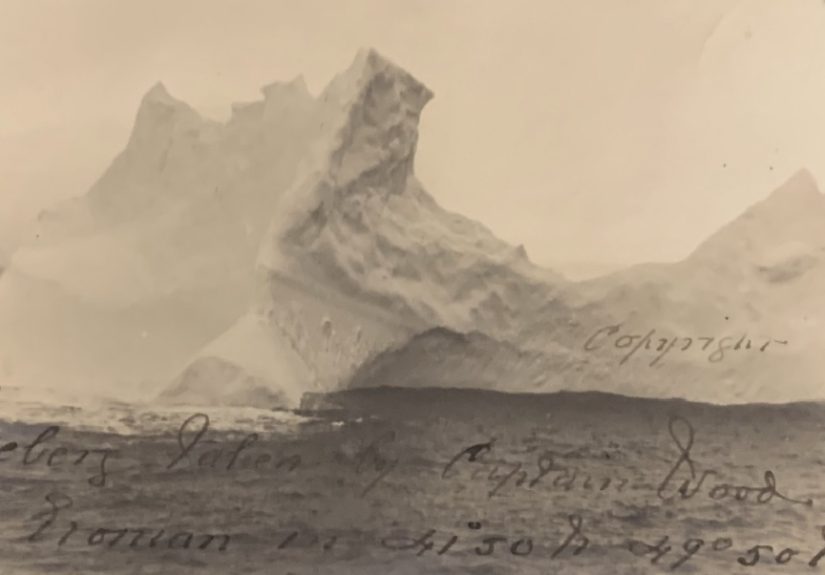
Another widely discussed image was reportedly taken by Captain W. F. Wood of the S.S. Etonian. Advocates have argued that its unusual elliptical shape resembles crew sketches of the iceberg Titanic struck. The coordinates attached to the photograph also helped fuel speculation. It is the kind of evidence that sounds promising until you remember that a lot of North Atlantic icebergs existed at the time, and shape alone is not a fingerprint.
3. The “Red Smear” Iceberg Reports
One of the most haunting details in the entire debate is the claim that some observers noticed a reddish smear or streak near the waterline on an iceberg seen after the disaster. That would, in theory, match paint scraped from the ship during the collision. It is exactly the sort of detail that makes people lean toward certainty. But eyewitness reports are not always consistent, and no physical confirmation survives. It is suggestive, not conclusive.
4. The Mackay-Bennett, Minia, Bremen, and Birma Connections
Several ships entered the area in the days after the sinking to rescue survivors, recover bodies, or pass through the icy zone. Photographs taken from or associated with these ships have all been drawn into the same question: did one of them capture the fatal berg? Some images look impressive. Some were marketed aggressively. Some line up loosely with descriptions. None has crossed the line from compelling possibility to established fact.
Why It Is So Hard to Prove
If this whole mystery feels maddening, welcome to historical research. Pull up a chair. The ocean is cold.
The biggest problem is simple: icebergs move, change shape, and melt. They are not parked monuments with neat address labels. Even when ships recorded positions, the data was limited by the navigation methods of the time. Add current, wind, drift, and changing visibility, and the challenge becomes obvious. Identifying one iceberg among many in a known ice field is difficult enough in the moment. Doing it more than a century later from scattered photographs is another level entirely.
Eyewitness accounts do not completely solve the problem either. Survivors and crew described the iceberg in different ways. Some accounts emphasized a peak. Others suggested a two-peaked formation. Some later candidate photos show a flatter or more tabular profile. That does not mean the witnesses were wrong or the photos were fake. It means memory, angle, distance, darkness, and fear all complicate the picture.
The conditions on the night of the collision matter too. The sea was unusually calm, which may have made the iceberg harder to spot because there was less surf breaking at its base. It was also a dark night. So when we ask whether a surviving photo matches what the crew saw, we are comparing daylight photographs against nighttime impressions formed in a moment of crisis. That is not a perfect match-up. It is more like asking whether a police sketch matches a snowbank you saw at midnight from a moving car. Possible? Maybe. Reliable? Not enough.
What We Do Know About the Iceberg Itself
Even if the photograph remains uncertain, science gives us a strong sense of what kind of iceberg Titanic likely hit. Most North Atlantic icebergs come from Greenland. They calve from glaciers, drift into Baffin Bay, and then travel south through the Labrador Current. Only a small percentage make it as far south as the busy transatlantic shipping lanes. In that sense, the iceberg that crossed Titanic’s path was both a known maritime hazard and an exceptionally unlucky appointment with history.
Researchers have also emphasized that 1912 saw a notable amount of ice in the North Atlantic shipping region. That helps explain why multiple ships encountered or photographed icebergs near the disaster zone. It also explains why proving the identity of one particular berg is so frustrating. Titanic did not strike the only iceberg in the Atlantic that week. It struck one iceberg in a dangerous field of many.
Modern understanding of the sinking also complicates the mental image people often carry. The iceberg did not simply rip one giant cinematic slash down the hull like a villain in a melodrama. Later studies of the wreck and ship structure indicate a more complex failure involving multiple breaches and damage across several compartments. That matters because it reminds us that Titanic’s end was not caused by one photogenic moment alone. It was a chain of decisions, conditions, design limits, and bad luck.
So Why Does the Photo Still Matter?
Because humans are storytellers, and a photograph feels like a shortcut to certainty. We want an object to point at. We want the smoking gun, except colder and much worse for shipping.
The Titanic remains one of the world’s most enduring historical obsessions because it combines scale, tragedy, technology, class, heroism, hubris, and heartbreak in one story. A possible image of the iceberg is like a visual keyhole into that entire event. It lets us imagine the ship’s final hours in a way a map or technical report cannot.
It also keeps the story grounded. Titanic is often wrapped in myth, romance, and movie dialogue. An old photograph of an ordinary-looking iceberg reminds us that the disaster was terrifyingly physical. Not a legend. Not a symbol. Not just a soundtrack swelling in the background. Real steel. Real cold. Real people. Real consequences.
What Historians Should Say Instead of “Yes, That’s the Iceberg”
The most accurate wording is something like this: “This is one of several photographs believed by some to show the iceberg that sank Titanic, but the identification has never been conclusively proved.”
That may not be as catchy as a viral headline, but it is much closer to the truth. It respects the archival evidence. It respects the uncertainty. And it keeps us from turning historical possibility into fake certainty just because certainty is better at getting clicks.
In other words, the best answer is not a dramatic shout. It is a careful shrug with excellent footnotes.
Conclusion
So, is this a photo of the iceberg that sank the Titanic? It could be. It might be one of the strongest candidates. It might even be the image that future researchers still consider the most plausible. But based on the surviving evidence, nobody can honestly claim absolute proof.
And maybe that is part of why the mystery endures. The Titanic story has never been powered only by facts. It is powered by the tension between what we know and what we wish we knew. The ship has been mapped, scanned, filmed, dramatized, debated, and mythologized for generations. Yet one question still floats just out of reach: can we ever identify the exact iceberg?
For now, the answer is no. But the search itself reveals something valuable. Good history is not about pretending uncertainty does not exist. It is about handling uncertainty honestly, carefully, and with enough humility to admit when the Atlantic still has the last word.
Related Experiences: Why This Titanic Iceberg Mystery Feels So Personal
Part of what makes the “Titanic iceberg photo” question so powerful is that it does not feel like a dry museum puzzle. It feels personal, even to people born many decades after the ship sank. Looking at one of these old photographs can create a strangely intimate reaction. You are not just staring at ice. You are staring at a possible witness. That is a rare thing in history. Most disasters leave records, headlines, and official reports. Titanic may also have left a face.
For museum visitors, readers, and history fans, the experience is often emotional before it is analytical. You see the image and immediately imagine the silence of the North Atlantic, the shock on the bridge, the scrape along the starboard side, and the awful delay between impact and full understanding. Even people who know the story well still pause at the thought that a plain photograph of floating ice might connect them directly to that night. It is like history suddenly stops being abstract and becomes visual, cold, and immediate.
There is also the human experience of the aftermath. Survivors on the Carpathia were not thinking about future internet arguments over photographic proof. They were exhausted, frozen, grieving, and stunned. Recovery crews on ships like the Mackay-Bennett faced an even darker reality as they searched the water for bodies. When a photograph from that moment resurfaces, it carries emotional weight because it belongs not only to the sinking, but to the rescue and recovery that followed. That adds a layer of sadness many viral posts completely miss.
Researchers experience the mystery differently. For them, the question is not just “Is this the iceberg?” but “What can we defend with evidence?” That means checking captions, comparing coordinates, reading descriptions, studying publication history, and resisting the temptation to leap to the most dramatic answer. It is slower work. Less glamorous. Fewer gasps. More notes. But that careful process is part of the experience too. Historical truth is rarely found by shouting first.
Then there is the modern online experience, which is a little messier and a lot louder. A Titanic image gets posted, thousands of people share it, and suddenly certainty spreads faster than the Labrador Current. One person says the iceberg has a red mark. Another says the shape matches survivor sketches. Someone else says the Library of Congress labeled it, so case closed. Before long, a complicated archival debate has become a one-line meme. That is why this topic keeps coming back: it sits right at the intersection of real history and internet confidence, which is a very busy intersection indeed.
In the end, the emotional pull of these images may matter more than the final verdict. Even if no photo can ever be proven beyond doubt, the experience of confronting the mystery still teaches something important. It reminds us how people search for closeness to the past. We want details. We want objects. We want images that collapse time. The alleged Titanic iceberg photo does exactly that. It invites us to look, wonder, argue, and imagine. And maybe that is why the question still survives: not because the answer is easy, but because the experience of asking it is unforgettable.