Table of Contents >> Show >> Hide
- Who Are Muller Van Severen?
- What Makes the Muller Van Severen Long Table Special?
- The Story Behind the Design
- Materials, Texture, and Why Polyethylene Works
- How the Long Table Changes a Room
- Is the Muller Van Severen Long Table Worth It?
- How to Style a Muller Van Severen Long Table
- Muller Van Severen Long Table as Functional Art
- Living With the Muller Van Severen Long Table: Experience Notes
- Conclusion
If most dining tables are content to be background actors, the Muller Van Severen Long Table clearly missed that memo. This is not a piece that quietly blends into the room and waits for someone to place a bowl of lemons on it. It has presence. It has posture. It has that rare quality designers love to talk about and homeowners secretly fear: a strong point of view.
And yet, the magic of the Long Table is that it never feels like a diva. It is bold without being loud, sculptural without becoming silly, and playful without turning your dining room into a kindergarten art project. In a design world full of beige rectangles trying very hard to be timeless, the Muller Van Severen Long Table offers something much more interesting: a table that understands function but refuses to be boring about it.
This is one reason the piece continues to attract attention from collectors, stylists, architects, and people who are tired of furniture that looks like it was assembled by a committee. The table sits at the intersection of art, architecture, and everyday life, which sounds lofty until you realize what it really means: you can eat lunch on it, host eight opinionated friends around it, stack books on it, and still admire it as an object when the room is empty.
Who Are Muller Van Severen?
To understand the Long Table, it helps to understand the studio behind it. Muller Van Severen is the Belgian design duo of Fien Muller and Hannes Van Severen, a partnership known for blurring the line between sculpture and furniture. Their work is often described as functional art, but that phrase usually gets tossed around so casually it ends up meaning almost nothing. Here, it actually fits.
The duo’s pieces often look as though someone took a sculptor’s eye, a photographer’s sense of composition, and a child’s fearless love of color, then convinced them to cooperate. The result is furniture that feels distilled rather than decorated. They do not pile on details to prove a point. Instead, they strip things down until material, proportion, line, and color have nowhere to hide.
That design philosophy matters because the Long Table is not just a pretty surface with good PR. It belongs to a larger body of work that consistently treats furniture as something spatial and expressive. In other words, this table is not trying to be an isolated icon. It is part of a visual language.
What Makes the Muller Van Severen Long Table Special?
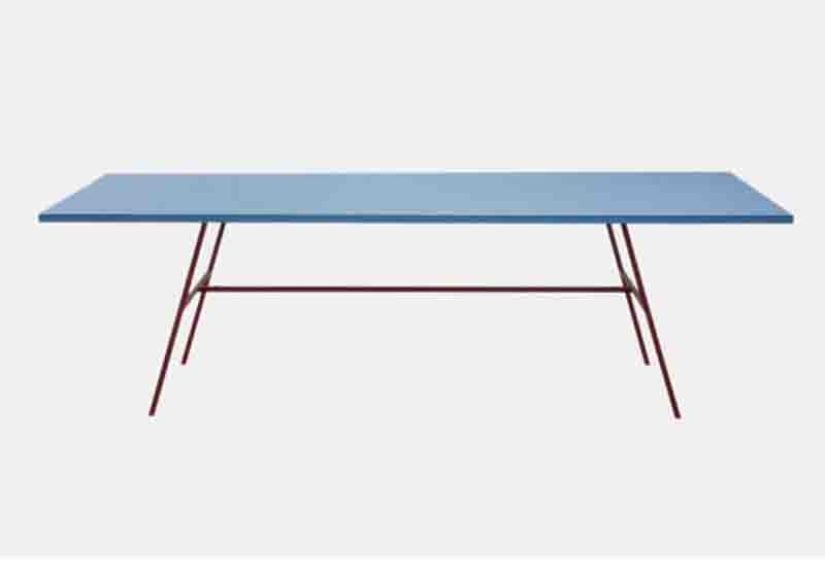
The first thing people notice is the silhouette. The Muller Van Severen Long Table is long and lean, with an elegant visual tension between the tabletop and its support structure. It looks almost drawn into space rather than built in the conventional sense. That matters, because most tables are defined by mass. This one is defined by rhythm.
The second thing people notice is the material choice. Instead of relying on the usual luxury cues, such as thick walnut slabs, fussy joinery, or dramatic stone, the Long Table uses polyethylene paired with lacquered steel. That may sound humble on paper, but in practice it feels unexpectedly rich. Polyethylene has a soft, tactile quality that gives the table a visual warmth, while the steel frame provides crispness, discipline, and contrast.
There is something wonderfully cheeky about making a high-design table from a material that many people associate with industrial applications rather than gallery-worthy furniture. But that is exactly the point. Muller Van Severen has long shown a talent for taking materials that might seem ordinary, technical, or even a little blunt and turning them into something sensual and architectural.
The tabletop’s color is also doing serious work. This is not color for the sake of trendiness. It behaves almost like a building material, shaping how the object reads in a room. Depending on the finish you choose, the table can feel cool and airy, bright and graphic, or subtly surreal. It changes the emotional temperature of a space without needing ornament.
The Story Behind the Design
The Long Table first appeared in connection with the duo’s “New Work” exhibition in 2014, where it was shown alongside other polyethylene table forms. That origin story is revealing. The piece was not born from a generic dining-furniture brief or a mass-market demand for “something modern.” It emerged from an exhibition context, which helps explain why it feels so intentional and self-possessed.
That exhibition background also gives the table a slightly different energy from many showroom-born products. It feels exploratory. It feels like an idea tested in physical space before it was translated into domestic life. In practical terms, that means the table has a gallery-like clarity, but it still knows how to do the boring adult jobs expected of a table, such as supporting dinner, laptops, flowers, and the occasional existential crisis.
Rather than treating the table as a flat object with four obedient legs, Muller Van Severen approaches it more like a three-dimensional composition. The relationship between the colored top and the red lacquered frame creates a visual push-and-pull that keeps the piece active from every angle. Walk around it and it changes. That is a big deal. Good furniture works from the front. Great furniture works in motion.
Materials, Texture, and Why Polyethylene Works
Let’s talk about the elephant in the design studio: polyethylene. To some people, it may not sound glamorous. But glamour is overrated, and good design is smarter than that. Polyethylene offers a tactile, visually dense surface with a matte-to-soft sheen effect that feels contemporary without becoming cold.
Unlike more precious materials that require everyone in the house to behave like museum guards, polyethylene brings a slightly more relaxed attitude. It still looks deliberate and refined, but it does not scream, “Please don’t breathe near me.” That makes it a compelling material for a long dining table, where use is part of the object’s identity.
The steel frame, meanwhile, provides the counterpoint. It is disciplined where the top is soft. It is linear where the top reads as broad and calm. That contrast is central to the appeal of the design. The table is not beautiful because everything matches. It is beautiful because opposites are held in balance.
Why This Material Combination Feels Modern
The Long Table feels modern not because it chases novelty, but because it rethinks familiar expectations. A traditional dining table often tries to signal value through weight, thickness, or historical reference. Muller Van Severen goes the other way. The value comes from proportion, restraint, craft, and the confidence to let materials speak plainly.
That attitude aligns with a broader shift in contemporary interiors, where designers increasingly favor objects that are emotionally expressive yet materially honest. The Long Table fits this moment perfectly. It has personality, but it does not rely on gimmicks. It is bold, but not desperate for attention. In internet terms, it has main-character energy without posting about it every six minutes.
How the Long Table Changes a Room
A table this distinctive does not simply occupy floor space. It organizes the room around itself. In an open-plan interior, the Muller Van Severen Long Table can act almost like a visual spine, drawing together kitchen, dining, and living zones. In a smaller room, it works as a strong central gesture that makes everything else feel more intentional.
What is remarkable is how versatile that impact can be. In a minimalist interior, the table becomes the punctuation mark. In a richly layered room, it cuts through visual noise with clarity. In a more eclectic setting, it acts as a translator between art pieces, vintage finds, and everyday objects.
This is one reason stylists and editors love using Muller Van Severen furniture in photographed interiors. The designs hold their own without swallowing the room whole. They create tension, but also coherence. That is hard to do. Plenty of statement furniture can dominate a space. Far fewer pieces can improve it.
Best Interior Styles for the Muller Van Severen Long Table
The Long Table works especially well in interiors that value line, color, and contrast. Think contemporary apartments with strong natural light, architectural homes with clean geometry, art-filled lofts, or even old spaces that need one sharp modern gesture to wake them up.
It also pairs beautifully with mixed seating. You do not need a perfectly matched dining set to make it sing. In fact, matching chairs can make the room feel too predictable. Try pairing it with a combination of sculptural chairs, simpler wood forms, or even a bench on one side to emphasize the table’s long horizontal sweep.
Is the Muller Van Severen Long Table Worth It?
That depends on what you want from furniture. If your only goal is to own a flat surface that can support a pasta bowl and a candle, then no, you probably do not need a design table with this much identity. A folding table from a utility closet can also hold spaghetti. It just cannot do it with dignity.
But if you care about furniture as part of the architecture of daily life, the Long Table is compelling. It offers utility, yes, but also atmosphere. It turns an ordinary ritual, such as eating, working, reading, gathering, into something staged a little more beautifully. Not in a pretentious way. In a meaningful one.
Collectors appreciate it because it clearly belongs to the Muller Van Severen design vocabulary. Designers appreciate it because it solves both visual and functional problems. Homeowners appreciate it because it feels special every day, not just when guests come over and start asking suspiciously specific questions like, “Wait, where did you get this?”
How to Style a Muller Van Severen Long Table
The best styling advice is surprisingly simple: do less. This table already brings color, shape, and presence to the room. It does not need a parade of decorative objects fighting for relevance on top of it.
A ceramic bowl, a low arrangement of branches, a stack of art books, or a single sculptural lamp nearby is often enough. Let negative space do its job. One of the pleasures of the Long Table is the way its length creates a visual horizon. Cluttering that surface defeats the point.
Lighting matters too. Overhead pendants with clean lines or asymmetrical forms tend to work particularly well. The goal is not to match the table exactly, but to echo its clarity. Rugs can help anchor it, especially if the room is large, but choose one that supports rather than competes. Texture is useful. Chaos is not.
Common Styling Mistakes to Avoid
The biggest mistake is trying to make the room “designerly” by overloading it with other statement pieces. The Long Table already gives you a strong anchor. Use that confidence. Let surrounding pieces be quieter, warmer, or more textural.
The second mistake is being too timid with color elsewhere. The table can absolutely live in a neutral room, but it also plays beautifully with thoughtful color repetition. A lamp, artwork, or textile that quietly picks up one note from the table can make the whole space feel composed rather than accidental.
Muller Van Severen Long Table as Functional Art
This phrase gets used so often it risks sounding hollow, but the Long Table genuinely earns it. It works as furniture, yet still behaves like an artwork in the way it activates space, uses color, and creates visual movement. It invites looking as much as using.
That dual identity explains why Muller Van Severen occupies such an interesting place in contemporary design. Their work is at home in galleries, museums, editorial interiors, and actual houses with actual dishes and actual crumbs. The Long Table is a prime example of that balance.
It does not ask you to choose between practicality and poetry. It insists you can have both. And honestly, more furniture should be that ambitious.
Living With the Muller Van Severen Long Table: Experience Notes
Imagine walking into your dining space early in the morning, before the coffee finishes dripping and before your inbox has started behaving like a villain. The Long Table is already doing something subtle but powerful: it makes the room feel composed. Even when nothing is on it, it does not look empty. It looks ready. That quality is harder to find than many people realize. Some tables only come alive when styled. This one has a natural sense of presence, almost like a line drawing translated into architecture.
As the day unfolds, the table changes roles without fuss. In the morning it is a work surface, with a laptop at one end and a notebook at the other. By noon it becomes a casual lunch spot. By evening it turns into the social center of the home, the place where people lean in, pass plates, argue about movies, and promise to leave in ten minutes before staying another hour. A long table should encourage gathering, and this one absolutely does. Its proportions are generous, but its look remains light enough that the room never feels weighed down.
There is also something satisfying about the tactile contrast of the piece in daily use. The tabletop feels calm and solid, while the steel structure adds a crisp visual edge. You notice it when you pull up a chair, when sunlight hits the surface, when shadows stretch under the red frame in late afternoon. This is not flashy luxury. It is sensory design. The pleasure comes from repeated encounters rather than one dramatic reveal.
Another interesting part of the experience is how the table affects behavior in the room. People tend to notice it immediately, but then they settle around it naturally. That is a rare combination. Some statement pieces are all conversation and no comfort. The Long Table starts as a visual hook and then becomes a genuinely useful part of the routine. It can host a dinner party without feeling formal, and it can support a messy weekday without looking defeated by the realities of life.
Perhaps the most memorable thing about living with a Muller Van Severen Long Table is that it keeps rewarding attention. Weeks later, you may catch the way its color lifts a gray day, or how a simple vase looks sharper on its surface, or how the table turns an otherwise ordinary room into something with real atmosphere. That is when you realize the design is doing more than solving a function. It is quietly shaping mood, movement, and memory. Not bad for a piece of furniture that, at first glance, might have seemed like “just a table.”
Conclusion
The Muller Van Severen Long Table is proof that a dining table can be useful, sculptural, playful, and deeply considered all at once. It brings together color, polyethylene, steel, and disciplined proportions in a way that feels both experimental and livable. Rather than chasing trends or hiding behind safe minimalism, it offers a clearer, braver answer to what contemporary furniture can be.
If you are drawn to interiors that feel thoughtful instead of generic, and if you believe the best furniture should improve a room even before anyone sits down, this table makes a strong case for itself. It is practical, yes. But more importantly, it is memorable. And in a world full of tables that merely exist, that is a very good reason to pay attention.