Table of Contents >> Show >> Hide
- Why This Scandi-Style Cabin Feels So Right
- The Kitchen That Changed Everything
- Scandinavian Style, Canadian Setting
- The Quiet Genius of Light, Texture, and Restraint
- Why This Cabin Still Feels Fresh
- What Homeowners Can Learn From Mjölk’s Renovated Lake Cabin
- The Experience: What It Feels Like to Spend Time in a Place Like This
- Conclusion
Some houses shout for attention. This one does not. Mjölk’s renovated Scandi-style cabin on a Canadian lake wins you over the old-fashioned way: with pale pine, practical beauty, and the kind of calm that makes your shoulders drop two inches without asking permission first. It is the design equivalent of a deep exhale.
The cabin belongs to John and Juli Baker, the couple behind Mjölk, the Toronto design shop known for its restrained mix of Scandinavian and Japanese furniture, objects, and housewares. That background matters, because this lake cabin does not look like a trend board exploded into a cottage. It looks lived in, edited, and loved. The result is a lake house renovation that feels warm rather than precious, minimal rather than empty, and stylish without behaving like it knows it is stylish. Frankly, that is rare.
What makes this home so compelling is not just that it is beautiful. It is that the beauty is inseparable from function. The cabin was originally owned by Juli’s parents, and before the Bakers reworked it, it was described as cramped and musty. Over time, they stripped it back, rethought the layout, and created a place that feels connected to nature, family life, and the daily rituals that actually make a home worth having. In other words: less “weekend showroom,” more “yes, you can put the wet dishes there.”
Why This Scandi-Style Cabin Feels So Right
If you want a textbook example of Scandinavian cabin design adapted for North America, this is it. The ingredients are familiar: light wood, white-painted surfaces, clean-lined furnishings, natural materials, quiet color, and a strong relationship to the landscape. But the Bakers do not use those elements in a generic way. They use them with discipline.
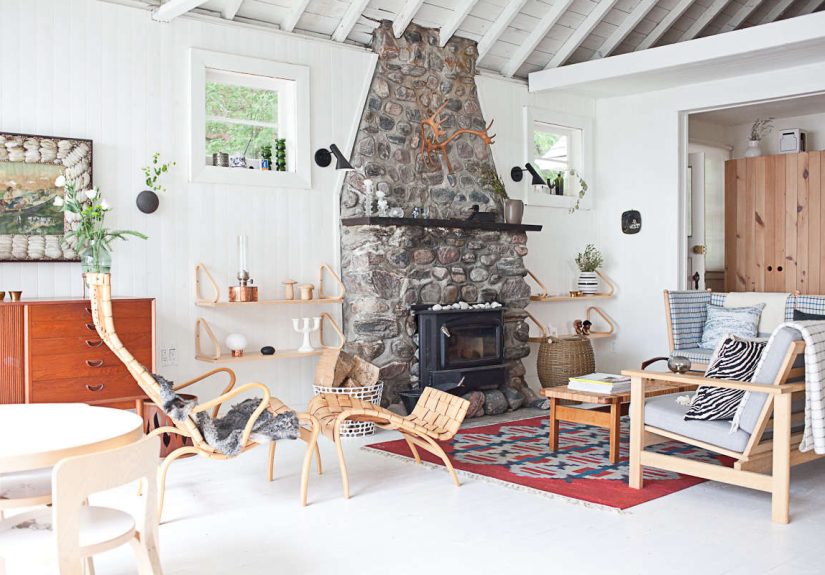
That discipline shows up first in the palette. The white floors and tongue-and-groove pine walls create a bright shell that reflects light and softens the rustic bones of the cabin. Instead of making the space feel sterile, the white backdrop lets texture do the heavy lifting: the grain of pine cabinetry, the matte depth of soapstone, the gentle glow of brass, the worn honesty of vintage wood, leather, and woven textiles. The room is not trying to impress you with color drama. It is trying to make daylight look better. That is a very Scandinavian move, and a smart one in a lakeside retreat where the views deserve top billing.
Then there is the material story. The renovated kitchen uses Carolina pine finished with a lye wash and beeswax coating, a combination that keeps the wood pale but tactile. That finish matters. It preserves warmth while toning down orange or yellow notes that can make cabin interiors feel visually noisy. Paired with soapstone and unlacquered brass, the effect is grounded and quietly luxurious. Nothing is screaming for attention, yet every surface has character. It is the interior design version of speaking softly and still being the most interesting person in the room.
The Kitchen That Changed Everything
A renovation sparked by real life, not fantasy life
The best part of this renovation may be its origin story. The Bakers had long wanted an open kitchen in the unused side of the house, but they initially made do with a more temporary setup near the entry. Then the under-counter refrigerator gave up, refused to be repaired, and effectively staged a small appliance coup. Instead of replacing it with another compromise, the couple used the moment to finally move the kitchen into what had been the dining room.
That decision transformed the cabin. Suddenly, the home could function around the way families really gather: around food, conversation, mess, and the low-grade chaos of everyday togetherness. John Baker has said that after having two kids, the old entryway kitchen quickly revealed its limitations. The new plan made room for a dining table and a more open family zone, which is exactly why the renovation feels so successful. It is not a kitchen designed for photographs. It is a kitchen designed for breakfast, snack o’clock, and the eternal question of who left the jam out.
Studio Junction’s role in the cabin renovation
Studio Junction, the Toronto architecture firm that also designed the couple’s city home, translated that goal into built form. The kitchen keeps the space feeling open through freestanding, table-like counters rather than a heavy bank of conventional cabinetry. That choice is subtle, but powerful. It makes the room feel lighter, more furniture-like, and more in tune with the casual rhythm of a cabin.
The custom soapstone sink is one of the cleverest elements in the entire house. It includes a double drying rack, with a slatted teak shelf inside the sink for smaller items and a slatted shelf above for dishes to drip-dry. This is where the cabin moves from stylish to unforgettable. Scandinavian design has always prized practicality, and this detail captures that principle perfectly. It is beautiful because it works so well. The wet dishes go up. Gravity handles the rest. Design snobs call that elegance. The rest of us call it brilliant.
Layered into the kitchen are details that keep the room from becoming too plain: a brass rod with S-hooks for tools and cookware, a white Smeg refrigerator, a compact electric AGA City60 range, PH pendant lamps reused from the couple’s old dining room, and vintage blue Danish chairs that inject just enough color to keep the room from floating away on a cloud of tasteful restraint. Even the room divider, an Ilse Crawford bench, manages to define space without killing openness.
Scandinavian Style, Canadian Setting
Part of the charm of this home is that it never tries to pretend it was dropped wholesale from Copenhagen or Stockholm. This is a Canadian cabin, and it keeps its sense of place. There is an original fireplace. There are flea-market antlers. There is the mood of the lake outside and the sturdy cottage DNA underneath the refinements. The renovation does not erase the house’s history; it edits it.
That balance is what gives the project its staying power. Plenty of so-called Scandi interiors end up feeling like carefully arranged catalogs: pale oak table, boucle chair, ceramic vase, one branch, done. Here, the Bakers mix vintage Scandinavian pieces with practical storage, personal finds, and the rougher spirit of cabin life. The result has soul. It is closer to Scandinavian philosophy than Scandinavian cosplay.
This is also where the Mjölk connection matters. The shop’s broader design language has long centered on functionality, craftsmanship, timeless simplicity, and a mix of Scandinavian and Japanese influences. You can feel that philosophy throughout the cabin. The peg rails in the bedroom are efficient and handsome. The furniture is spare but not severe. The objects are curated but not fussy. There is a calm respect for materials, patina, and use. If the cabin has a thesis, it is this: good design should make daily life smoother, not more stressful.
The Quiet Genius of Light, Texture, and Restraint
When people talk about Scandinavian interiors, they often reduce the look to “white walls and blonde wood,” which is a little like describing a symphony as “some notes.” The real magic is in balance. Mjölk’s renovated lake cabin gets that balance exactly right.
The white-painted floors and walls brighten the interior, especially important in a region where seasonal light can change dramatically. But the space avoids feeling flat because the textures are doing constant background work: waxed pine, woven seating, painted planks, brass fixtures, wool blankets, birch shelving, and the honed surface of stone. The textures soften the minimalism and keep it welcoming. Scandinavian style works best when it embraces comfort alongside restraint, and this cabin understands that assignment.
It also makes excellent use of visual breathing room. Open shelving, uncluttered counters, and carefully chosen furnishings give the eye somewhere to rest. That matters even more in a smaller home. Clutter shrinks a cabin fast. By contrast, the Bakers use every object as part of the architecture of the room. Tools hang neatly. dishes dry on display. Storage cupboards turn the former kitchen zone into a more gracious entry. Nothing feels accidental, but nothing feels uptight either.
There is a lesson here for anyone planning a lake cabin renovation or trying to bring Nordic cabin decor into a regular house: simplicity is not about owning fewer things for bragging rights. It is about letting the right things do more work. A peg rail becomes storage and wall detail. A bench divides space and offers seating. A dish rack becomes sculpture. A pale room becomes dramatic because light keeps changing across it. That is how you make minimalism feel human.
Why This Cabin Still Feels Fresh
Design trends move fast, but this cabin still looks current because it never depended on trend language in the first place. It leans on principles that age well: natural materials, useful beauty, honest craftsmanship, and a close relationship between indoors and out. Those ideas now overlap with what many people call Japandi, biophilic design, warm minimalism, and modern rustic style. The labels may shift. The core appeal does not.
In fact, the cabin feels even more relevant now because it anticipates several design conversations that have only gotten louder in recent years. People want homes that feel calmer. They want rooms with less visual noise. They want storage that works, kitchens that are deeply functional, and materials that look better with time rather than worse. They want spaces that connect them to the outdoors and support genuine rest. Mjölk’s cabin was already doing all of that.
There is also a deeper reason it resonates: it respects the emotional side of home. The cabin was not conceived as a design stunt. It was reworked so a family could gather more comfortably, move more easily, and enjoy the landscape more fully. The style only works because the life works first. That is the detail too many pretty interiors miss.
What Homeowners Can Learn From Mjölk’s Renovated Lake Cabin
If you are borrowing ideas from this Scandi-style cabin, start with layout before decor. The smartest decision here was moving the kitchen to serve the family better. Paint colors and chairs can come later. Function is the foundation.
Second, be selective with materials. You do not need twenty finishes to make a room interesting. A few thoughtful ones, repeated consistently, will usually look richer. Pale wood, matte stone, painted planks, black accents, and warm metal can carry an entire project without making it feel monotonous.
Third, invest in details that reduce friction. A better drying rack, more useful storage, open space around the table, hooks where you actually need them, lighting that creates warmth after sunset, and furniture that can do double duty will improve daily life more than decorative clutter ever will.
Finally, leave a little room for personality. The Bakers do this beautifully through vintage finds, art, inherited history, and objects that feel collected rather than bulk-ordered. A Scandinavian cabin should feel serene, yes, but it should also feel inhabited by a human being and not a very disciplined robot.
The Experience: What It Feels Like to Spend Time in a Place Like This
What makes a cabin like this linger in your mind is not just the cabinetry or the paint or the perfect restraint of the pendant lights. It is the experience of moving through the space. Morning would likely begin with the kind of soft lake light that sneaks across the white floorboards instead of barging in. The pine walls would catch that light gently, warming up the room before the coffee has even finished brewing. In a darker, heavier cabin, mornings can feel like a negotiation. Here, they probably feel like permission.
You can imagine someone padding into the kitchen in socks, opening the pale cupboards, reaching for a mug that has been left on the drying shelf the night before, and hearing nothing louder than the kettle and maybe a gull outside. The room would not demand anything from you. That is part of its luxury. It is not performative. It does not need styling before use. It is already ready.
By midday, the cabin would likely shift from stillness to movement. Children in and out. A door opening. Damp towels somewhere. Sand or pine needles trying their luck at becoming permanent residents. And yet the design seems made for that. The open layout gives family life room to spread out. The bench quietly defines one zone from another. The hooks, rails, cupboards, and shelves absorb the clutter before it turns into visual panic. The whole place seems to understand that real comfort is not about avoiding mess forever. It is about being able to recover from it gracefully.
Afternoons in a lake cabin always have a slightly dreamlike quality, and this one seems built to amplify that. The white-painted surfaces would bounce light around even on overcast days. The brass would soften. The soapstone would darken slightly near water. A chair by the fireplace would become the kind of seat you swear you are only using for ten minutes and then accidentally occupy for an hour. There is a reason people are drawn to Scandinavian and Japandi interiors in retreats like this: they make silence feel furnished.
Evening is probably when the cabin becomes irresistible. Lamps turn on. The black AJ sconces by the fireplace sharpen the room just enough. The PH pendants create pools of light over dinner. Outside, the lake slips toward dusk, and inside, everything looks a little warmer, a little more intimate, a little more forgiving. This is where the Mjölk approach really shines. It does not treat minimalism as austerity. It treats it as editing, so the comforting parts of life become more noticeable: the grain of the table, the blanket on the bed, the clink of dishes, the hush after a day outdoors.
And maybe that is the real achievement of this renovated Scandi-style cabin on a lake. It is not merely photogenic. It is atmospheric. It creates a rhythm. It invites you to slow down without making a big wellness speech about it. It proves that a house can be pared back and still feel generous, refined and still feel rugged, thoughtful and still feel easy. Which is more than can be said for a lot of vacation properties and at least half the people trying to fold fitted sheets.
Conclusion
Mjölk’s renovated Scandi-style cabin on a lake works because it understands something basic and often forgotten: a retreat should help you live better, not just look better online. By combining Scandinavian clarity, Japanese-influenced restraint, and the practical realities of family cottage life, John and Juli Baker created a home that feels both deeply designed and deeply relaxed.
Its best ideas are not flashy. They are useful. Move the kitchen where life happens. Let natural materials carry the mood. Use white to brighten, not sterilize. Choose objects with purpose. Leave room for patina, history, and the view outside. The final result is not merely a stylish lake cabin renovation. It is a lesson in how to make simplicity feel rich.