Table of Contents >> Show >> Hide
- The unlikely duo: a raccoon named Jasper and a fawn named Hope
- Why would a raccoon “hug” a deer?
- What “hugging” might actually mean in wildlife behavior
- The bigger lesson: “Found a fawn” doesn’t always mean “rescued a fawn”
- Why wildlife rehabilitators handle these cases differently than the internet does
- Keep wildlife wild: the health and legal side nobody puts in the caption
- So… is this friendship “real”? Yes. Is it a blueprint? No.
- How to help wildlife in a way that actually helps
- Experiences that mirror this story (and what they teach us)
Some friendships start with a handshake. Others start with a snack. And then there are the rare, internet-breaking bonds
that begin with a tiny masked “trash panda” sprinting across the yard like, “Hello, stranger, I have decided we are best friends now.”
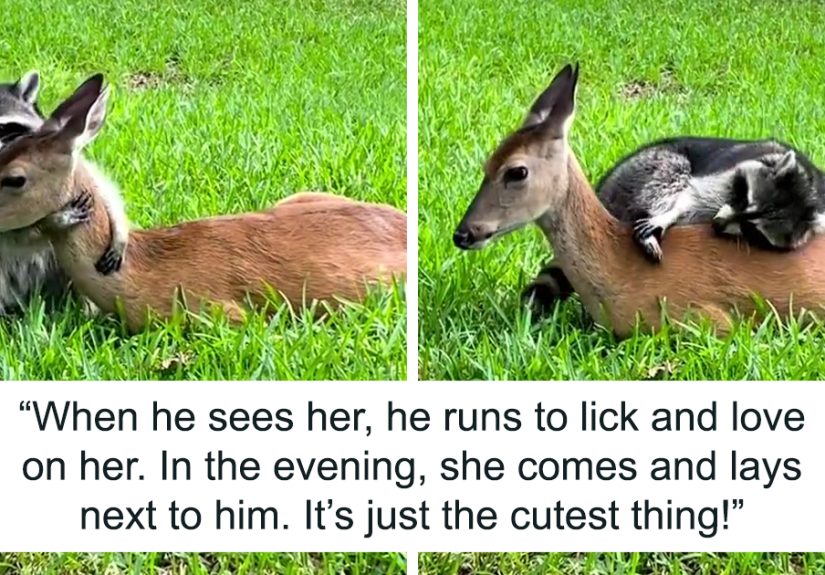
That’s the energy behind the true story of an orphaned raccoon who became utterly devoted to a rescued deer fawnshowing up daily for what looks
suspiciously like hugs, nuzzles, and a whole lot of “I’m here, you’re safe” comfort.
On the surface, it’s a heart-melting animal friendship: raccoon clings, fawn tolerates, everyone watching cries into their coffee.
But underneath the cuteness is a bigger, more useful messageabout wildlife rescue, animal behavior, and why the best compassion sometimes looks like
helping… without turning a wild animal into a roommate.
The unlikely duo: a raccoon named Jasper and a fawn named Hope
The story centers on a licensed wildlife rehabilitator in Texas who took in an orphaned raccoon as a babycold, hungry, and in rough shape after being separated
from his mother in bad weather. With round-the-clock care (the kind that involves sleep deprivation and learning to measure time in “feedings”),
the little raccoon made it through the fragile early weeks and grew into a healthy, curious youngster.
Later, a deer fawn arrivedalso orphaned, also vulnerable, also in need of professional care. The fawn was still at that tender stage where the world is huge,
confusing, and basically designed to startle you every fifteen seconds. In a safe setting, the two animals began interacting, and something clicked:
the raccoon became fascinated with the fawnseeking her out, leaning into her, climbing beside her, and repeatedly initiating what many viewers interpret as
“hugs.”
The fawn, for her part, didn’t exactly sign up for a raccoon’s affection subscription planbut she tolerated it with an impressive level of patience.
Think: exhausted big sister, mildly annoying little brother, and a whole lot of “fine, you can sit here, just don’t chew my ear.”
Why would a raccoon “hug” a deer?
Animal behavior is rarely one-dimensional. What looks like hugging can be a mix of comfort-seeking, social bonding, play, curiosity, and
“I like you and I have no idea what personal space is.”
1) Orphans crave safetyand warmth is a powerful language
Young mammals rely on their mothers not just for food, but also for regulation: warmth, calm, and social learning. When a baby animal loses that anchor,
it may seek comfort from whatever feels stable and non-threatening in its environmentespecially in a rehab setting where stress is minimized and safety is consistent.
2) Raccoons are social opportunists (affection included)
Raccoons are intelligent, curious, and highly motivated by both exploration and relationship-building. In the wild, they can be solitary at times, but they also
interact with other raccoonsespecially during mating season, around abundant resources, or when youngsters are learning the ropes.
A young raccoon raised through rehabilitation may show social behavior toward safe companions, including other species, because the drive to bond doesn’t require
identical stripes (or spots).
3) The fawn may accept contact because “safe” is the new normal
A fawn in a controlled environment isn’t dealing with predators, territorial disputes, or the constant pressure to hide. If the raccoon’s approach is gentle and
predictable, the fawn may tolerate itespecially if the interaction doesn’t interfere with eating, resting, or moving away.
Tolerance isn’t the same thing as “this is my favorite,” but it can still be meaningful.
What “hugging” might actually mean in wildlife behavior
Humans are wired to translate animal behavior into human emotion. Sometimes we’re not wrongmammals do experience stress relief from social contact.
But it’s still helpful to translate the moment into “animal language” too.
- Nuzzling/leaning: often comfort-seeking or affiliative bonding.
- Climbing onto another animal: can be play, curiosity, or attention-seeking.
- Following closely: can signal attachment or social dependence, especially in young animals.
- Relaxed posture from the recipient: suggests the interaction isn’t perceived as a threat.
- Repeated daily contact: points to a learned routineanimals love predictable patterns.
In other words: it may look like a hug, and it may also function like a hugwithout being a human-style emotional monologue.
Either way, it’s an example of how animals can form real bonds across species lines when their environment allows it.
The bigger lesson: “Found a fawn” doesn’t always mean “rescued a fawn”
Here’s the twist: most fawns that look abandoned… aren’t. In many parts of the U.S., does (mother deer) intentionally leave fawns alone for long stretches while they
forage. The fawn’s job is to stay still, stay quiet, and stay hidden. This strategy reduces the chance that predators will follow the mother to the baby.
That’s why wildlife agencies repeatedly urge people: if you find a fawn lying quietly, leave it alone.
Even if you’ve seen it alone for hoursor even a day or twothe mother may be returning to nurse at dawn, dusk, or when humans and pets are gone.
Signs a fawn may truly need help
While “don’t interfere” is the default, there are situations where calling a licensed wildlife rehabilitator is the right move. Watch from a distance and look for:
- Visible injury (bleeding, broken limb, severe limping).
- Dehydration or weakness (listless, head drooping, struggling to stand).
- Constant crying and wandering (a fawn searching rather than bedding down).
- A dead doe nearby (especially roadkill in the area).
- Insect infestation or obvious illness.
If you’re unsure, the safest plan is usually: call your state wildlife agency or a licensed rehabilitator and describe what you’re seeing.
That’s what separates a well-meaning moment from an accidental mistake.
What not to do (even if your heart is doing backflips)
- Don’t feed the fawn. The wrong food can seriously harm it, and feeding increases stress and dependency.
- Don’t “check on it” repeatedly. Your presence can keep the mother away and expose the hiding spot.
- Don’t bring your dog to “sniff it.” That’s not a meet-cute; it’s a crisis.
- Don’t move it unless a professional instructs you to (and only if it’s in immediate danger).
Why wildlife rehabilitators handle these cases differently than the internet does
Online, the story reads like a feel-good rom-com starring a raccoon. In real life, licensed rehabilitation is carefully controlled work with specific goals:
stabilize, minimize stress, prevent imprinting, and prepare animals for appropriate placement or release when possible.
Rehab has rules for a reason: stress, imprinting, and safety
Young deer can imprintmeaning they learn to treat humans (or human spaces) as “normal.” That can lead to dangerous outcomes later, including difficulty surviving
in the wild or approaching people and vehicles. Rehabilitators reduce unnecessary contact, keep routines consistent, and focus on species-appropriate behaviors.
Cross-species friendships can happen in sanctuary settings, but responsible caretakers still watch for:
stress signals, resource guarding, rough play, and hygiene risks. Sometimes “cute” needs supervision.
Keep wildlife wild: the health and legal side nobody puts in the caption
Stories like Jasper-and-Hope are touching partly because they happened in a controlled, knowledgeable environment.
Trying to recreate that at homeby keeping a raccoon or “raising” a fawnis a different story entirely, and it often ends badly for the animal.
Raccoons can carry serious diseases
Raccoons are considered a rabies risk species in the U.S., and public health agencies consistently warn against handling wild raccoons.
They can also carry parasites such as raccoon roundworm (Baylisascaris), which is rare in humans but can be severe if infection occurs.
This is why professionals use protective protocols and why “just a cuddle” is not a harmless choice in the real world.
There are legal restrictions for a reason
Many states restrict private possession of native wildlife. Deer also have transportation and disease-surveillance regulations in various regions.
Licensing exists to protect animals, people, and ecosystemsbecause good intentions don’t replace training, quarantine procedures, or veterinary guidance.
So… is this friendship “real”? Yes. Is it a blueprint? No.
The raccoon-and-fawn bond is real in the sense that it’s a consistent, observable relationshiprepeated contact, comfort-seeking, and a shared sense of safety.
It’s also a reminder that animals are emotionally complex and can create surprising social connections when circumstances allow.
But it’s not a DIY project. The takeaway isn’t “go find an orphan.” The takeaway is:
support wildlife professionals, respect wild behavior, and let compassion be guided by what actually helps.
How to help wildlife in a way that actually helps
- Save the number for your local wildlife rehabilitator or state wildlife office.
- Drive slower in areas with high wildlife crossings, especially in spring and early summer.
- Keep pets supervised outdoorsdogs can unintentionally injure fawns and other young animals.
- Secure trash and pet food to reduce raccoon-human conflict.
- Donate or volunteer with licensed wildlife rescue organizations when possible.
The happiest endings in wildlife stories usually involve a quiet return to “wild,” not a lifetime of being someone’s adorable sidekick.
And if you ever see a raccoon trying to hug a deer again, you can enjoy the moment while still cheering for the professionals behind the scenes.
Experiences that mirror this story (and what they teach us)
Not everyone gets to witness a raccoon-fawn friendship up close, but many people have small, real-life experiences that echo the same themes: surprise, empathy,
and the challenge of doing the right thing when your instincts scream, “Help!”
One common experience starts in a backyard. Someone looks outside and sees a fawn curled up near a shrub, perfectly still. The first reaction is panic:
“Where’s the mom? Is it starving? Should I bring it water?” Then the person does something that feels strangely difficult: they step back. They keep pets
indoors, tell the kids to treat the area like a “no-go zone,” and watch from a window instead of hovering. Hours latersometimes at duskthey finally spot the doe
slipping in quietly to nurse. It’s a lesson in restraint: the most helpful thing was leaving the animal alone.
Another experience happens on a rural road. A driver sees a dead doe and, nearby, a fawn standing uncertainly at the edge of the brush. That moment is heartbreaking,
and it can be tempting to scoop the fawn up immediately. But people who’ve worked with wildlife professionals learn a different reflex:
call first, keep distance, and wait for guidance. When a licensed rehabilitator arrives, they don’t just “take the fawn home.” They assess hydration, check for injuries,
plan quarantine, and decide what placement best supports the animal’s future. Watching that process can change how you see rescuenot as a dramatic act, but as careful,
structured care.
Volunteers at wildlife rehabilitation centers often describe how young animals seek comfort in ways that look almost human. A recovering raccoon might tuck itself
against a warm towel, cling to a stuffed animal used as enrichment, or follow a familiar routine that helps it feel safe. A fawn might relax when the environment is quiet
and predictabledim light, minimal noise, calm handling. The “hug” in these settings isn’t about making animals cuddly; it’s about lowering stress so they can heal.
That’s why professionals work so hard to balance comfort with healthy boundaries. The goal is confidence and survival, not dependence.
People who live near wooded neighborhoods sometimes see unexpected cross-species moments toolike a barn cat lying near a rabbit that doesn’t run, or a dog that gently
watches a fledgling bird from behind a window. These moments can be real, but they’re also fragile. The best “experience-based” lesson is that wildlife doesn’t need us
to interfere to be meaningful. Sometimes the right move is simply to protect the space: keep distance, reduce hazards, and let nature take the lead.
Finally, many families share the experience of teaching kids about “helping without grabbing.” It’s one thing to say, “Don’t touch the fawn.” It’s another thing to explain
why: because the mother might stay away if people linger, because stress can harm the baby, because wildlife belongs outdoors. Turning that into a family ruleno pets near
the bedding spot, no photoshoots, no “just checking”builds respect for animals as wild beings, not props.
The raccoon-and-fawn story goes viral because it’s tender. But the most useful part is what it inspires: a quieter kind of compassionone that protects wildlife by
supporting rehabilitators, following guidance, and knowing when love looks like giving space.