Table of Contents >> Show >> Hide
- Who Was Michael Thonet?
- The Birth of the Bentwood Rocking Chair
- Why Bentwood Was Revolutionary
- Design Features of the Michael Thonet Rocking Chair
- Michael Thonet and the Rise of Modern Furniture
- Why Collectors Still Love Thonet Rocking Chairs
- How to Style a Michael Thonet Rocking Chair at Home
- Care and Maintenance Tips
- Why the Rocking Chair by Michael Thonet Still Feels Fresh
- Experiences Related to the Rocking Chair By Michael Thonet
- Conclusion
Some chairs simply sit there. Michael Thonet’s rocking chair, however, seems to glide into a room with the confidence of a design celebrity who knows it changed furniture history. Curved, airy, surprisingly light, and instantly recognizable, the Thonet rocking chair is more than a pleasant place to read, sip coffee, or pretend to understand modern art. It is a landmark in industrial design.
The phrase “Rocking Chair by Michael Thonet” usually refers to the bentwood rocking chairs developed by the Thonet company in the second half of the nineteenth century, especially the early Model No. 1 rocking chair associated with the 1860s. These pieces combined steam-bent beechwood, woven cane, elegant scrollwork, and a manufacturing system that helped transform furniture from heavy handcrafted luxury into accessible modern design. In other words, Thonet did not merely make a chair that rocked. He made the furniture world wobble beautifully into the future.
Who Was Michael Thonet?
Michael Thonet was a German-Austrian cabinetmaker born in 1796 in Boppard on the Rhine. He began as a traditional craftsman, working in a world where fine furniture was usually carved, joined, polished, and priced for people with generous parlors and even more generous wallets. Thonet’s genius was that he did not accept the idea that beauty had to be heavy, expensive, or painfully slow to produce.
In the 1830s, he experimented with bending wood rather than carving it into shape. This sounds simple today, but at the time it was a radical idea. Instead of cutting away material to create curves, Thonet softened wood with heat and moisture, then bent it into graceful forms. Eventually, the company refined a process for bending solid beechwood with steam and mechanical pressure. The result was furniture that looked delicate but was strong, lightweight, repeatable, and commercially practical.
That one idea turned Thonet into one of the most important names in furniture history. His work helped create the conditions for mass-produced modern seating, long before “flat-pack furniture” became a weekend activity involving tiny Allen keys and emotional endurance.
The Birth of the Bentwood Rocking Chair
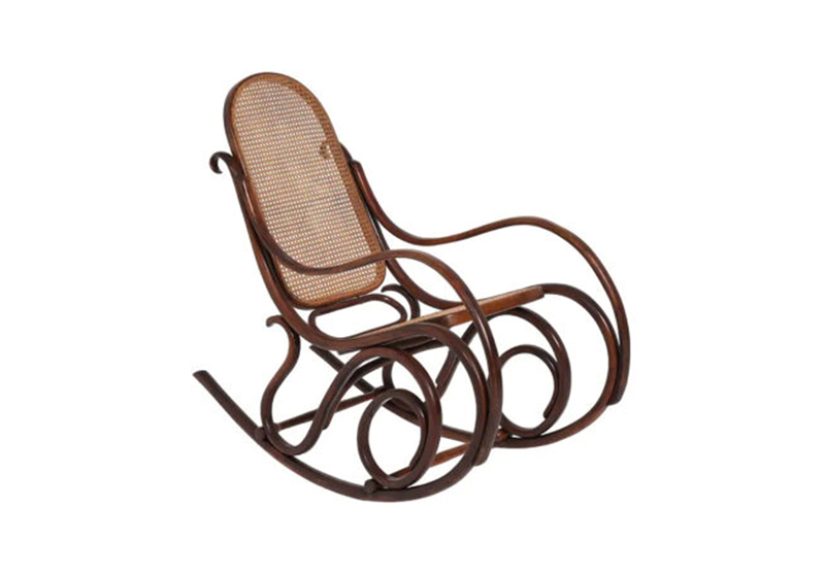
The Thonet bentwood rocking chair appeared around 1860, after the company had already made major progress with café chairs and other lightweight seating. The design was striking because it used continuous curves to solve both structural and visual problems. The runners, arms, legs, and decorative loops seemed to flow into one another, giving the chair a rhythm that felt almost musical.
Before Thonet, rocking chairs were often sturdy wooden objects with a more rustic or domestic character. Many were practical, charming, and comfortable, but they did not usually look like engineering poetry. Thonet’s version was different. It had the romance of Victorian curves, the efficiency of industrial production, and the lightness of a café chair that had decided to take up ballet.
The early Model No. 1 rocking chair became one of the clearest examples of how bentwood could be used not merely as decoration but as structure. The curled supports were not random flourishes. They helped brace the frame, stabilize the seat, and create a smooth rocking motion. The result was a chair that looked ornamental but behaved intelligently.
Why Bentwood Was Revolutionary
To understand why the rocking chair by Michael Thonet matters, you have to understand bentwood. Beechwood was especially important because it could be bent effectively when steamed, yet remained durable after cooling and drying. This allowed Thonet’s factories to produce repeated curved parts with remarkable consistency.
Traditional furniture often depended on thick wood, complex carving, and skilled hand labor. Thonet’s method reduced waste, simplified production, and made furniture easier to ship and assemble. Curved elements could be produced in standardized forms, and chairs could be built from fewer parts. That combination of elegance and efficiency was a quiet revolution.
The famous Thonet No. 14 chair, also known as the Vienna Coffee House Chair, showed this logic perfectly. It used a small number of wooden pieces, screws, and nuts, and it could be shipped disassembled. The same industrial intelligence influenced Thonet’s rocking chairs. They were beautiful, yes, but they were also part of a larger system of design, manufacturing, distribution, and everyday use.
Design Features of the Michael Thonet Rocking Chair
1. Steam-Bent Beechwood Frame
The heart of the chair is its bent beechwood frame. The wood curves in long, elegant lines, creating the chair’s runners, arms, back supports, and decorative spirals. These curves are not merely pretty; they distribute stress and reduce the need for bulky construction.
2. Cane Seat and Back
Many Thonet rocking chairs use woven cane for the seat and back. Cane adds flexibility, ventilation, and lightness. It also creates a visual contrast with the darker or honey-toned wood. A cane seat does not shout for attention. It whispers, “I am comfortable, breathable, and much classier than your plastic patio chair.”
3. Continuous Rocker Form
The rocking motion is supported by curved wooden runners that integrate smoothly with the rest of the frame. Instead of looking like separate rails attached underneath, the runners feel like part of the same flowing gesture. This is one reason the chair remains so visually satisfying.
4. Decorative Scrollwork With a Job to Do
The loops and curls on a Thonet rocking chair can look decorative at first glance, but many of them serve structural purposes. They brace the frame, support the arms, and help balance the chair. This is good design: ornament that earns its rent.
5. Lightweight Elegance
Compared with many nineteenth-century chairs, the Thonet rocking chair feels almost airy. It has presence without bulk. That is why it fits surprisingly well in both traditional interiors and modern homes. Place it near a bookshelf, beside a window, or in a quiet corner, and it looks as if it has been waiting there for 160 years with excellent posture.
Michael Thonet and the Rise of Modern Furniture
Thonet’s rocking chair belongs to a larger story: the birth of modern furniture. Before modernism became associated with steel tubes, plywood, molded plastic, and minimalist apartments with one extremely serious lamp, Thonet had already shown that furniture could be industrial, elegant, affordable, and widely distributed.
His work influenced café culture, domestic interiors, hospitality design, and later modernist architects. Bentwood chairs became common in coffee houses, restaurants, hotels, and homes. Their popularity proved that good design did not need to be rare. A chair could be mass-produced and still have soul.
This is why the Thonet rocking chair feels so modern even today. It is not modern because it looks futuristic. It is modern because it solves problems with economy, clarity, and intelligence. It reduces material without reducing charm. It uses repetition without becoming boring. It proves that manufacturing can support beauty rather than destroy it.
Why Collectors Still Love Thonet Rocking Chairs
Collectors, decorators, and design lovers continue to seek Thonet rocking chairs because they occupy a rare sweet spot. They are historically important, visually distinctive, and genuinely usable. Unlike some collectible furniture that looks amazing until a human body attempts contact, a Thonet rocker still works as a chair.
Original examples can vary in date, model, finish, markings, and condition. Some were made by Gebrüder Thonet, while others were produced later by related firms or competitors inspired by Thonet’s patents and methods. Because bentwood furniture became widely copied, careful attribution matters. A chair “in the manner of Thonet” is not the same as a documented Thonet piece, even if both may be beautiful.
When evaluating a Thonet rocking chair, collectors often look for maker’s labels, stamps, construction details, cane quality, proportions, and signs of restoration. A replaced cane seat is not automatically a problem, since cane wears over time. However, heavy alterations, broken bends, crude repairs, or mismatched parts can affect value and authenticity.
How to Style a Michael Thonet Rocking Chair at Home
The beauty of a Thonet rocking chair is that it does not require a museum room to look good. In a modern living room, it adds warmth and history without feeling dusty. In a bedroom, it creates a quiet reading corner. In a sunroom, it feels natural beside plants, linen curtains, and a small table for coffee. In an office, it softens the atmosphere and gently reminds you that not every task needs to be completed at panic speed.
For a classic look, pair it with warm woods, vintage rugs, and soft lighting. For a contemporary look, place it against a clean white wall with one bold artwork nearby. For a bohemian room, combine it with layered textiles, plants, and natural fibers. The chair’s cane and curved wood make it friendly to many styles: traditional, Scandinavian, minimalist, eclectic, cottage, and even modern farmhouse.
One warning: do not overcrowd it. The chair’s silhouette is the star. Give the curves room to breathe. A Thonet rocker squeezed between a bulky sofa and an oversized storage cabinet is like asking a violinist to perform inside a broom closet.
Care and Maintenance Tips
A Thonet-style bentwood rocking chair should be treated with respect, especially if it is antique or vintage. Keep it away from extreme humidity, direct heat, and harsh sunlight. Wood expands and contracts, and cane can dry out or become brittle. A stable indoor environment is the chair’s best friend.
Dust the frame with a soft cloth. Avoid aggressive cleaners that may damage the finish. For cane seats and backs, use gentle brushing or light vacuuming with a soft attachment. If the cane sags slightly, some owners lightly mist the underside and allow it to dry naturally, but antique pieces should be handled carefully. When in doubt, consult a furniture conservator rather than experimenting like a home-improvement wizard with too much confidence.
Check joints periodically. A rocking chair experiences motion, so loose screws or weakened joints should be addressed before they become major problems. If restoration is needed, sympathetic repair is best. The goal is not to make the chair look factory-new; the goal is to preserve its character, function, and historical integrity.
Why the Rocking Chair by Michael Thonet Still Feels Fresh
The Thonet rocking chair remains relevant because it balances opposites beautifully. It is industrial and romantic. It is decorative and functional. It is antique and modern. It is light but strong, simple but expressive, practical but poetic.
Many furniture designs age into nostalgia. Thonet’s best designs age into relevance. The rocking chair still makes sense in contemporary interiors because it avoids the trap of trendiness. Its curves are not fashionable gimmicks; they come from material logic. Its lightness is not visual trickery; it comes from efficient construction. Its charm is not added afterward; it is built into the way the chair works.
That is the real magic of Michael Thonet. He understood that design is not just about how an object looks. It is about how material, process, comfort, cost, transport, and beauty can work together. The rocking chair is a perfect example. It invites rest, but it also tells a story about invention.
Experiences Related to the Rocking Chair By Michael Thonet
Experiencing a rocking chair by Michael Thonet is different from simply looking at one in a photograph. In pictures, you notice the famous curves first: the looping arms, the circular scrolls, the long runners, and the delicate cane. In person, however, the chair has a special lightness. It does not dominate a room like a throne. It behaves more like a graceful guest who somehow improves the conversation without interrupting anyone.
The first impression is often surprise. Many people expect an antique rocking chair to feel heavy, creaky, and overly formal. A Thonet rocker feels more agile. The frame looks thin, but the geometry gives it strength. The cane seat has a gentle give, and the curved back supports the body without turning the sitter into a stiff portrait from 1880. The rocking motion is smooth when the runners are in good condition, and the rhythm feels calm rather than dramatic.
One of the best ways to appreciate the chair is to place it near natural light. Morning light reveals the grain of the beechwood and the pattern of the cane. Afternoon light emphasizes the shadows inside the curved loops. At night, with a warm lamp nearby, the chair becomes almost sculptural. It looks less like furniture and more like a line drawing made in wood.
In daily use, the chair encourages slower habits. It is excellent for reading, sketching, nursing a cup of tea, or taking a quiet break from screens. Because the design is open and lightweight, it does not visually clutter a room. Even in a small apartment, it can create a dedicated corner for rest. Add a slim side table and a soft throw, and suddenly the room has a destination.
There is also an emotional quality to the Thonet rocking chair. It connects comfort with history. Sitting in one can make you aware that good design is not always loud or luxurious. Sometimes it is a curve that has been refined until it feels inevitable. Sometimes it is a chair that has survived changing tastes, different homes, and generations of owners because it continues to do its job beautifully.
For anyone styling one today, the experience works best when the chair is not treated as a fragile museum relic. It should be respected, of course, but also allowed to participate in the life of the room. A Thonet rocking chair beside a bookshelf, a plant, or a textured rug can feel completely current. That is the wonder of it: a nineteenth-century object that still understands how people want to live.
Conclusion
The rocking chair by Michael Thonet is not just a charming antique. It is a milestone in the history of furniture design. Through steam-bent beechwood, cane seating, standardized production, and elegant engineering, Thonet created a chair that helped redefine what furniture could be. It could be light, strong, affordable, beautiful, and widely available. It could serve ordinary daily life while still earning a place in museums.
More than a century and a half later, the chair still rocks with confidence. Its curves remain graceful, its structure remains smart, and its presence remains quietly magnetic. In a world full of disposable furniture, the Thonet rocking chair offers a better lesson: when design respects material, function, and human comfort, it does not become old. It becomes timeless.