Table of Contents >> Show >> Hide
- The Day a Routine Training Mission Turned Into a Sci-Fi Plot
- The Tic Tac Problem: Why This UFO Encounter Refused to Stay a Joke
- How a Weird Navy Story Became a Serious Government Issue
- So, Was It an Alien Spacecraft?
- Why the Nimitz Encounter Still Matters
- Experiences Reported Around the Navy UFO Encounter
- Conclusion
- SEO Tags
There are blurry UFO stories, there are grainy “my cousin swears he saw it” stories, and then there is the 2004 USS Nimitz incident, which basically kicked the door off the hinges and forced the U.S. military to say, “Okay, fine, something weird happened.” This was not a campfire tale, not a tabloid fever dream, and definitely not a guy in a lawn chair with a disposable camera. It involved Navy pilots, radar operators, advanced sensors, a training exercise off the California coast, and one very rude object that seemed to ignore the basic rules of aviation like they were optional reading.
The encounter became one of the most famous UFO stories in modern American history because it had all the ingredients skeptics usually ask for: trained witnesses, multiple systems tracking the same thing, and a paper trail that eventually pushed the Pentagon, Congress, NASA, and the intelligence community into public discussion. The object was never identified with confidence. It was never officially labeled alien. And yet, nearly two decades later, the story still hangs in the air like a question mark with jet fuel on it.
If you want the short version, here it is: the U.S. Navy met something it could not explain, and the rest of America has been arguing about it ever since.
The Day a Routine Training Mission Turned Into a Sci-Fi Plot
On November 14, 2004, the USS Nimitz Carrier Strike Group was conducting exercises about 100 miles southwest of San Diego. The group included the aircraft carrier USS Nimitz and the guided-missile cruiser USS Princeton, which had sophisticated radar systems. For days, radar operators had reportedly been seeing strange objects appear at very high altitude, drop rapidly, and behave in ways that did not fit neatly into the category of “normal aircraft doing normal aircraft things.” That alone was enough to raise eyebrows. In military aviation, eyebrow-raising is rarely a hobby.
Two F/A-18 Super Hornets were redirected to investigate one of those anomalies. One of the pilots was Cmdr. David Fravor, a highly experienced aviator and former commanding officer of the Black Aces squadron. Another was Lt. Cmdr. Alex Dietrich, who would later become one of the most grounded and persuasive public voices describing the encounter. They were not looking for aliens. They were looking for an answer.
When they arrived at the location, they did not immediately see a craft in the sky. What they noticed first was the water below. It appeared disturbed, churning, as if something large had just been under the surface. Hovering above that area, Fravor and Dietrich saw a white object that looked, in Fravor’s now-famous description, like a giant Tic Tac. It was smooth, oblong, wingless, and showed no visible exhaust plume, rotors, or obvious means of propulsion. In other words, it looked like the kind of thing an aerospace engineer would either love to study or throw a pencil across the room over.
Fravor moved in for a closer look. The object appeared to react. According to the pilots, it mirrored his maneuvering, climbed, turned, and then accelerated away so quickly that it seemed to vanish. That speed, combined with the lack of visible control surfaces, is part of what made the event so memorable. Pilots know what jets, drones, helicopters, balloons, and airborne junk usually look like. This did not behave like the usual suspects.
The Tic Tac Problem: Why This UFO Encounter Refused to Stay a Joke
It was not just one witness
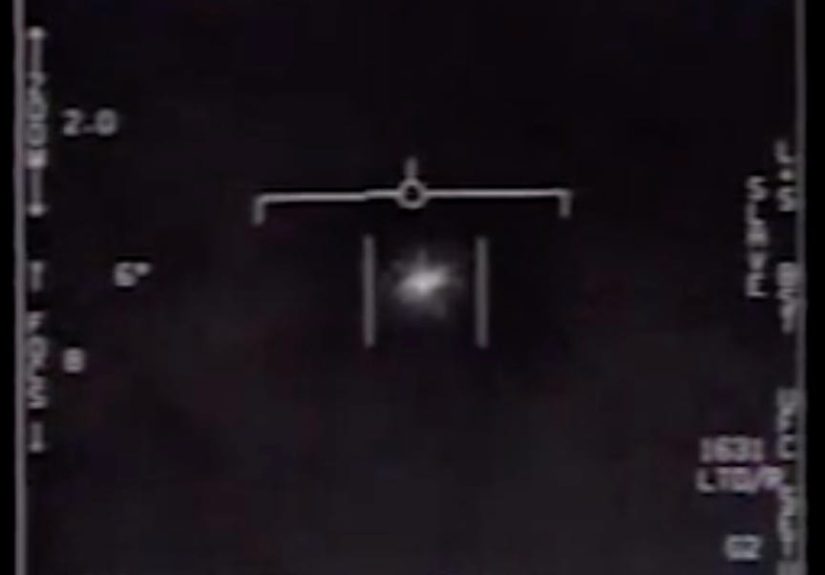
The Nimitz story stuck because it was not built on a lone eyewitness trying to convince everyone at Thanksgiving dinner. Multiple people were involved. Pilots saw the object. Radar personnel tracked unusual activity. Later, infrared footage from another aircraft added another layer of documentation. Whatever the object was, this was not just a case of someone mistaking Venus for a spaceship and calling it a day.
That matters because eyewitness testimony, by itself, is fragile. Human beings are not perfect sensors. We misjudge speed, distance, size, and direction all the time. Even experienced observers can get fooled. But when trained aviators, radar systems, and infrared sensors all point to the same broad conclusion, the story becomes harder to wave away with a bored shrug.
It happened in military airspace
Another reason the incident became such a big deal is where it happened. This was not over a random cornfield. It happened near military training operations. That changes the conversation from “What a mystery” to “What is flying around restricted or sensitive airspace, and should anyone be alarmed?” That is a national security question, not just a paranormal one.
The Pentagon eventually embraced the term UAP, or unidentified aerial phenomena, instead of UFO. The wording may sound less cinematic, but it reflects a more practical mindset. The concern is not whether the thing came from Mars. The concern is whether it threatens pilots, reveals a sensor blind spot, or belongs to an adversary with capabilities the United States does not fully understand.
How a Weird Navy Story Became a Serious Government Issue
For years, the Nimitz encounter mostly circulated in military circles and among the especially dedicated UFO crowd. Then came the public explosion. In 2017, reporting about the Pentagon’s interest in unidentified aerial incidents brought the case into mainstream conversation. In 2020, the Department of Defense formally released three Navy videos that had already circulated publicly, including one tied to the 2004 event, stating that the phenomena in them remained “unidentified.” That was a huge moment. The government was not saying “aliens.” It was saying something almost as provocative: these videos are real, and we still do not have a neat label for what they show.
That public attention led to institutional change. In 2020, the Defense Department established the Unidentified Aerial Phenomena Task Force, led by the Department of the Navy, to improve understanding of these incidents and assess whether they posed a threat. In 2021, the Office of the Director of National Intelligence released its preliminary UAP assessment. It reviewed 144 government reports dating from 2004 to 2021. Of those, 80 involved multiple sensors, and 11 involved near misses reported by pilots. The report did not provide a grand solution. It did something more bureaucratically dramatic: it admitted the data was limited, the problem was real, and more standardized reporting was needed.
That same pattern continued in later official reviews. AARO, the Pentagon’s current office for investigating UAP, has repeatedly emphasized that many reports turn out to be balloons, birds, drones, satellites, or other ordinary objects. At the same time, some cases remain unresolved because the data is incomplete or ambiguous. NASA’s independent study team made a similar point: less stigma, better data, more science, fewer wild leaps. It was basically the federal government’s way of saying, “Everyone please calm down and also keep looking.”
So, Was It an Alien Spacecraft?
Here is where the internet usually kicks down the door wearing tinfoil shoulder pads. The honest answer is no one has publicly proved that the Nimitz object was extraterrestrial, and official government reviews have repeatedly said they have found no verified evidence of alien beings or alien technology. That is the boring answer, which is also the responsible one.
But boring does not mean unimportant. The lack of an alien conclusion does not magically make the incident ordinary. The more grounded interpretation is that the object remains unidentified because the available evidence is not good enough to assign a confident explanation. That leaves room for several possibilities: a misunderstood sensor event, a misperceived object, a classified human-made platform, foreign surveillance technology, or a combination of messy factors that created a deeply confusing encounter.
Skeptics have argued that at least some famous Navy UAP cases may be explainable through camera artifacts, balloon behavior, radar filtering, or parallax effects. Those critiques deserve attention. Good analysis should stress-test dramatic claims, not decorate them. But even when skepticism trims away exaggeration, the Nimitz case still survives as a serious anomaly because so many credible people reported something out of the ordinary.
That is what makes this story endure. It is not proof of visitors from another star. It is proof that the most advanced military on Earth can still run into something that leaves experienced professionals saying, with refreshing technical precision, “What on Earth was that?”
Why the Nimitz Encounter Still Matters
It changed reporting culture
For decades, military personnel had strong incentives to avoid talking about UFOs unless they enjoyed being mocked by coworkers and quietly regretting it. The Nimitz case helped shift that culture. Later reporting and official guidance made clear that the stigma around UAP reporting had undermined data collection. Once that stigma started to weaken, more incidents came forward. That does not necessarily mean the skies suddenly got weirder. It may just mean people finally felt less foolish saying so.
It reframed UFOs as an aviation and defense issue
The biggest legacy of the Nimitz incident is that it dragged the UFO topic out of late-night cable territory and into the much less glamorous but far more important worlds of air safety, sensor reliability, and military readiness. If unidentified objects are showing up around training ranges, pilots need a way to report them without becoming the punchline of the week. If they are drones, balloons, or surveillance platforms, that needs to be known quickly. If they are something else, then the case for careful scientific and technical investigation becomes even stronger.
Put simply, the Nimitz encounter mattered because it forced serious people to take a weird story seriously.
Experiences Reported Around the Navy UFO Encounter
The most fascinating part of the USS Nimitz story is not just the object itself. It is the very human experience wrapped around it. Fravor and Dietrich have both described the event in ways that make it feel less like a Hollywood laser show and more like a deeply unsettling break in reality. They were not thrill-seeking believers hoping to spot a saucer. They were professionals on a training mission, and that is exactly why their reactions carry so much weight. They had a baseline for what “normal weird” looks like in the sky. This was apparently beyond that baseline.
Dietrich has been especially compelling because her tone is so practical. She has not built her public image around cosmic certainty. Instead, she has described the encounter as unidentified, strange, and unsettling. That restraint makes her account stronger, not weaker. She has also spoken openly about the culture around the event. Back on the ship, she and others were teased. Shipmates reportedly put up tinfoil hats, referenced movies like Men in Black and Independence Day, and generally did what military people often do when reality gets too weird: they made jokes. A lot of them.
That humor mattered because it covered a real discomfort. Dietrich later said that if she and Fravor had each been alone, they might never have said much publicly. That detail says a lot. Even highly trained aviators can hesitate to report something extraordinary when they know it sounds ridiculous out loud. The incident became easier to stand behind because there were other witnesses, radio traffic, radar data, and a shared memory. It was not one person risking their reputation on a story that could get them labeled “the UFO pilot” forever.
Fravor’s reported experience reads differently but complements Dietrich’s. His account emphasizes performance, maneuvering, and reaction time. He has described the object as aware of his presence, responsive to his movement, and capable of accelerating beyond anything he had seen in a career full of high-performance aviation. For a combat pilot, that is not just eerie. It is professionally offensive. Pilots spend years mastering machines that are astonishingly complex. Then one day a smooth white capsule shows up, ignores the known rulebook, and exits the scene like physics owed it a favor.
Beyond the cockpit, there were the experiences of radar operators and analysts. Reports from the Princeton crew added another emotional layer: first confusion, then doubt about whether the equipment was malfunctioning, then concern once the anomalies kept appearing. This is important because many great mysteries start with one person saying, “I saw something.” The Nimitz story expanded because other people could say, in effect, “And our systems saw something too.”
The long afterlife of the encounter has also become part of the experience. Witnesses have been pulled into documentaries, interviews, congressional hearings, media cycles, skeptical rebuttals, and internet obsession. Dietrich has spoken about getting attention she never asked for and trying to be useful without becoming consumed by the story. That may be the strangest part of all: a few minutes over the Pacific turned into years of public scrutiny. The object disappeared quickly. The experience did not.
Conclusion
“That time the U.S. Navy had a close encounter with a UFO” has lasted in the culture because it sits in the uncomfortable middle ground between certainty and mystery. The military did not prove an extraterrestrial visit. Skeptics did not erase the event with one tidy debunk. What remains is a deeply credible anomaly: a Navy encounter that triggered radar concern, pilot testimony, infrared footage, government reviews, and a lasting change in how the United States talks about unidentified objects in its airspace.
The lesson is not that aliens are definitely here. The lesson is that serious institutions sometimes run into serious questions before they have serious answers. And when that happens, the smartest move is not panic, mockery, or instant belief. It is disciplined curiosity. The Tic Tac may still be unidentified, but thanks to the Nimitz encounter, the subject itself is no longer untouchable.