Table of Contents >> Show >> Hide
- Marvel Mania: When Universal Went Full Comic Book
- The ’90s Were the Golden Age of “Dinner, But Make It a Theme Park”
- The Pitch: Eat, Watch, Shop, Gawk, Repeat
- The Look: Comic-Panel Carpets and a Video Wall That Wouldn’t Sit Still
- The Menu: Stanwiches, Superhero Burgers, and Names That Tried Their Best
- Character Dining: The Most Delightfully Awkward Photo Opportunity
- So Why Did It Disappear?
- What Replaced It: From Superheroes to Screams
- The Legacy: A Time Capsule of Pre-MCU Marvel Culture
- Could a Marvel-Themed Restaurant Work Today?
- Five Fun Ways to Bring Marvel Mania Energy Into Real Life
- Experiences: What It Felt Like to Eat at the Marvel-Themed Restaurant Time Forgot
Picture this: you’re on a theme-park day high, you’ve walked enough miles to qualify for a tiny marathon medal, and you’re ready to inhale something heroic.
Not a salad. Something with the confidence of a comic-book sound effectWHAM! CRUNCH! “I’ll regret this later!”
Now imagine ordering that meal in a restaurant designed to make you feel like you’d stepped inside a Marvel panel… and a costumed superhero might stroll up to your table
while you’re mid-bite, doing the awkward “I promise I’m enjoying this, please don’t judge my nacho technique” smile.
For a blink-and-you’ll-miss-it stretch in the late ’90s, that place existed. It was called Marvel Mania, and it was a big, loud,
lovingly ridiculous experiment in turning comics into dinner. Today, it’s mostly a pop-culture footnoteremembered through old menus, scattered photos,
and the kind of nostalgia that only happens when something is both short-lived and unapologetically extra.
This is the story of the Marvel-themed restaurant time forgot: what it was, why it looked like a superhero fever dream, what you could actually eat there,
and why it vanished before the world became the perfect audience for it.
Marvel Mania: When Universal Went Full Comic Book
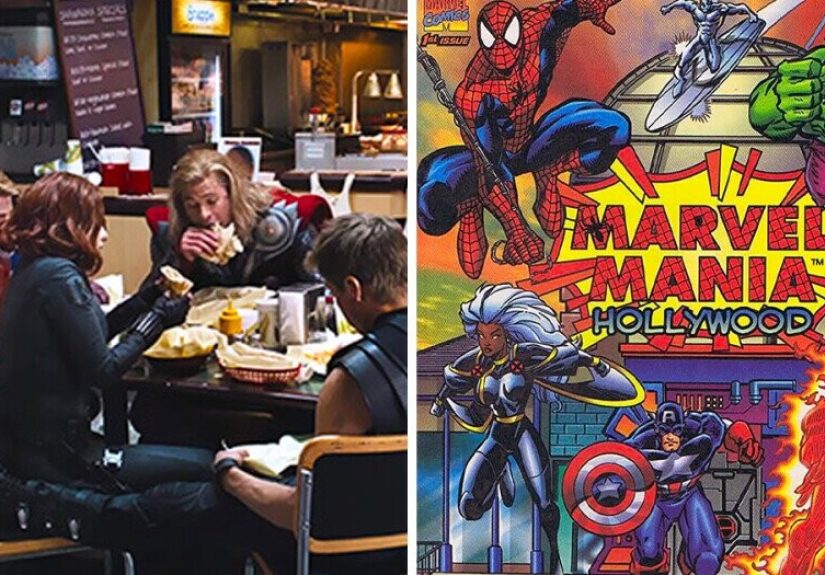
Marvel Mania opened at Universal Studios Hollywood in Universal City, California on February 18, 1998,
and it closed in September 1999. It was positioned as more than a place to refuel; it was pitched as a full-on “experience” restaurantpart
dining room, part mini museum, part gift shop, and part “Wait, is that a wall-sized screen blasting superhero clips while I’m trying to decide between pasta
and pizza?”
The concept was tied to the era’s love affair with themed dining and celebrity-backed restaurant brands. Marvel Mania was connected to the same bigger cultural
wave that helped turn places like movie-memorabilia chains into must-visit tourist stops. In other words: it didn’t just want you to eat there. It wanted you
to remember eating there, buy the T-shirt, and bring your cousin from out of town next time.
The ’90s Were the Golden Age of “Dinner, But Make It a Theme Park”
If you weren’t around for the themed restaurant boom, here’s the simplest way to understand it: the ’90s believed that if you hung enough stuff from the ceiling,
people would forgive you for charging extra for a burger. Movie props! Neon! Fog machines! Retail displays! A soundtrack that never, ever asked whether anyone
wanted to hear it again!
The model was straightforward: lure tourists and locals with novelty, sell them the experience, and hope they return often enough to pay for enormous rent and
labor-heavy operations. The problem is right there in the plan: novelty fades. Once you’ve seen the giant guitar, the rainforest thunderstorm, or the “authentic”
spaceship hallway, you still need a reason to come back besides “I guess we’ll take visiting relatives there.”
By the end of the decade, the market was crowded, the costs were brutal, and several themed chains struggled to convince customers that the food mattered as much
as the decor. The industry started saying the quiet part out loud: repeat visits are hard when your biggest selling point is surprise.
The Pitch: Eat, Watch, Shop, Gawk, Repeat
Marvel Mania was built to keep your attention even if your mozzarella sticks took an extra minute. It wasn’t just “superhero posters on the wall.” It aimed for
immersionbold graphics, interactive screens, and a layout that encouraged you to wander.
A mini-museum and “real” Marvel artifacts
Like other pop-culture restaurants of the era, Marvel Mania leaned into memorabilia and “props,” presenting items as if they belonged to the Marvel universe.
The idea wasn’t subtle: you weren’t simply eating near the Marvel brandyou were dining inside a curated Marvel shrine.
A gift shop that didn’t whisper, it yelled
Merchandise was part of the business plan, not an afterthought. You could browse Marvel-branded items right there: shirts, collectibles, and assorted souvenirs
designed to follow you home and keep the memory alive (and, conveniently, keep revenue flowing after your check was paid).
A game room and screens everywhere
The restaurant leaned hard into video: a towering video wall, scattered monitors, and superhero clips cycling through like your own personal Saturday-morning
cartoon marathonexcept you’re holding a fork, not a cereal spoon.
The Look: Comic-Panel Carpets and a Video Wall That Wouldn’t Sit Still
Descriptions of Marvel Mania’s interior tend to share the same tone: amused admiration. People remember it as “over the top” in the best possible way. The design
language screamed “comic book” from the ground upliterally. There were comic-style patterns underfoot and playful furniture details that turned everyday restaurant
shapes into graphic gags.
One of the most memorable features was the large video walltwo stories of motion and soundplus smaller screens sprinkled across the space. That’s great if you love
energy. It’s less great if you’re the type of person who prefers dinner with a side of “quiet conversation.”
And then there was the sound design: bursts of comic-book drama cueing video segments, like the restaurant itself was narrating your meal.
If you’ve ever eaten somewhere that suddenly gets louder “for the vibe,” you already understand the concept.
The Menu: Stanwiches, Superhero Burgers, and Names That Tried Their Best
The menu was pure themed-restaurant theater: familiar American comfort food dressed up with Marvel-flavored wordplay. Some items were winks; others were full
dad-joke commitment. The goal wasn’t culinary reinventionit was to make ordering feel like participating in the theme.
Signature items people still talk about
- “Stanwiches” sandwiches named as a nod to Marvel legend Stan Lee.
- Captain America burgers because nothing says “patriotism” like committing to a bun the size of a small shield.
- Fantastic Four cheese pizza (and other “Fantastic Four” cheese variations) the pun did the heavy lifting, and honestly, respect.
- Doc Ock’s Wok stir fry proof that a wok pun was always inevitable in ’90s themed dining.
- Archangel Hair pasta a pasta pun so earnest it feels like it should come with a collectible foil card.
- Mutant chicken wings bold naming choice, questionable appetite implications, unforgettable branding.
Adults could also lean into the theme with cocktailsnames that aimed for comic grandeur, as if your drink order needed its own origin story.
And because it was the late ’90s, the menu’s tone was proudly loud: the words wanted to entertain you before the food even arrived.
Character Dining: The Most Delightfully Awkward Photo Opportunity
Here’s where Marvel Mania separated itself from “restaurant with themed wallpaper”: costumed heroes made appearances, moving through the dining area to pose for
photos and interact with guests. That kind of meet-and-greet dining is common now in big entertainment destinations, but at the time it felt like a novelty power move:
your meal came with the chance that a superhero might show up beside your table while you’re trying to chew politely.
It’s easy to laugh at the awkwardnesssuperheroes hovering while you’re deciding if you should dip the fry againbut that’s also why it’s remembered fondly.
It was earnest. It was theatrical. It was trying very hard to turn an ordinary human activity (eating) into a story.
So Why Did It Disappear?
Marvel Mania didn’t fail because the idea was bad. If anything, the concept feels suspiciously like it was built for the futurean era when superhero culture would
become the gravitational center of mainstream entertainment.
The bigger issue was timing and economics. The themed-restaurant model was already under pressure by the late ’90s. Costs were high, competition was fierce, and chains
that relied on novelty had to fight hard for repeat customers. When the broader restaurant and entertainment landscape shifted, many themed brands faced the same
existential question: after the first visit, what brings people back?
Planet Hollywood’s well-publicized financial problems in that period are a useful snapshot of the era’s challengesdebt, underperforming locations, and the struggle to
keep customers returning once the “wow” factor became familiar. In that environment, launching a brand-new theme concept was like debuting a fireworks show during a rainstorm:
you can do everything right and still end up damp and disappointed.
Reports from theme-park history writers describe Marvel Mania’s closure as abruptan “and then it was gone” moment that left employees and fans surprised.
And because it didn’t last long, it never had time to evolve, refine, or find the version of itself that could survive long-term.
What Replaced It: From Superheroes to Screams
One of the strangest twists in the Marvel Mania story is what happened to its physical space. The location didn’t stay a restaurant forever. Over time, the building
became home to different walkthrough attractions and themed experienceseventually including Universal’s horror-focused offerings.
That arc is oddly poetic: a place once designed for bright comic-book energy later became a venue for darker thrills. The same walls that once displayed superhero color
ended up serving an entirely different kind of entertainmentless “kids club souvenir cup,” more “please hold my hand, I hate jump scares.”
The Legacy: A Time Capsule of Pre-MCU Marvel Culture
Marvel Mania is fascinating because it’s a relic from a specific Marvel momentbefore the modern superhero era became the default setting for blockbuster culture.
It was comics-forward: puns, panels, cartoons, characters, and a general attitude that said, “Yes, this is silly, and that’s the point.”
It also foreshadowed how entertainment companies would later treat dining as storytelling. Today, “immersive” restaurants are everywhere, from movie-themed pop-ups to
fully designed dining rooms where every object is part of a narrative. Marvel Mania did that decades agojust with more neon confidence and fewer social-media-ready
minimalist corners.
Could a Marvel-Themed Restaurant Work Today?
Not only could it work todayit does work today, in many forms. The difference is that modern IP dining tends to be engineered around two realities:
(1) people document experiences constantly, and (2) repeat visits are essential.
What Marvel Mania got right
- Instant identity: You knew where you were the second you walked in.
- Multiple revenue streams: Food, drinks, merchandise, and “experience” value bundled together.
- Fan service: Artifacts, characters, and references rewarded people who actually loved the comics.
What likely limited its staying power
- Novelty fatigue: Once you’ve “seen the room,” the food and service have to do the heavy lifting.
- Operational complexity: Characters, screens, retail, and theming cost money every single day.
- Industry headwinds: The late ’90s were rough for several big themed chains, and Marvel Mania was tied to that ecosystem.
If you rebuilt Marvel Mania now, you’d probably see a tighter culinary concept, rotating limited-time menus, reservation-based “events,” and merch drops timed like movie
releasesplus enough photogenic set pieces to keep your phone storage permanently stressed.
Five Fun Ways to Bring Marvel Mania Energy Into Real Life
You don’t need a two-story video wall to capture the vibe. If the charm of Marvel Mania is “comics, but dinner,” here are simple ways to recreate the spiritminus the
theme-park crowds and plus the ability to control the volume.
- Make a pun-forward menu: Rename familiar dishes with comic-style flair. The cornier, the better.
- Set the room like a panel: Use bold primary colors, speech-bubble labels, and cheap pop-art prints.
- Do a “mini museum” corner: Display comics, figurines, or framed covers like artifacts.
- Play cartoons in the background: Keep it light, nostalgic, and joyfully on-theme.
- Add a photo spot: A simple backdrop and a couple props can turn a meal into a memory.
Experiences: What It Felt Like to Eat at the Marvel-Themed Restaurant Time Forgot
Because Marvel Mania didn’t last long, it lives in the mind the way short-lived things often do: sharper, brighter, and a little more magical than everyday reality.
People who talk about it don’t describe a normal lunch. They describe a scene.
The experience started before you even sat down. Walking up to the entrance felt like stepping toward a crossover episode where a theme park decided it wanted to be a
comic shop, a museum, and a restaurant all at once. Instead of the usual “host stand and a smile,” you had an environment designed to pull your eyes in every direction.
Screens, graphics, and saturated color made the space feel alivelike the room itself was humming with the promise that something dramatic might happen at any moment,
even if the only real cliffhanger was whether your table would be ready in ten minutes or twenty.
Once inside, the fun was in the details. A themed restaurant can slap up posters and call it a day; Marvel Mania aimed to make the whole place feel like you’d been
dropped into a comic panel. You’d notice graphic shapes and comic-style patterns underfoot. You’d catch yourself reading the room the way you read a page:
left to right, corner to corner, scanning for the next visual gag. Even the furniture and decor leaned into that “pop art meets superheroes” language, which made it
easy to believe you were in a place built by people who actually loved the source materialpeople who thought a meal should come with a wink.
Then there was the menu momentthe little jolt of joy when you realize the restaurant committed to the bit. Ordering wasn’t just “burger or pasta.” It was choosing
between items with names that sounded like they belonged in a comic narration box. The Stanwiches felt like an affectionate nod, the Captain America burger read like
a dare, and choices like Doc Ock’s Wok made you grin even if you pretended you were above puns. You could almost hear the invisible announcer voice: “Our hero,
faced with a difficult decision… chooses the option with extra cheese!”
The screens and video wall added a constant sense of motionlike the restaurant was always mid-trailer, always mid-intro sequence. For some diners, it was pure energy:
the perfect soundtrack for a theme-park appetite. For others, it was a hilarious overload, the kind that makes you lean over your table and say,
“I love this… but also I can’t hear my own thoughts.” And somehow that was part of the charm. Marvel Mania wasn’t trying to be a quiet bistro. It was trying to be
a memory factory.
The most “only here” moment, thoughthe thing that turned dinner into a story you’d tell laterwas the possibility of a character visit. You’d be halfway through a
bite when a costumed hero appeared nearby, and suddenly the dining room shifted. People straightened up. Parents reached for cameras. Kids lit up. Adults tried to act
casual and failed in the way adults always fail when nostalgia walks right up to the table. It was sweet and slightly awkward and absolutely on brand for the era:
superheroes hovering politely while you tried to chew with dignity.
And when you left, you didn’t just walk out with a full stomach. You walked out with a sense that you’d visited a strange little alternate timelineone where Marvel,
long before superheroes became the most bankable storytelling engine on Earth, took a swing at turning fandom into a meal you could order. That’s why people still
talk about it. Marvel Mania wasn’t perfect, but it was brave in the most endearing way: it tried to make your lunch feel like an adventure.