Table of Contents >> Show >> Hide
- What the Viral Footage Is Actually Showing
- Why EV Battery Fires Freak People Out More Than Gas-Car Fires
- Why “Launch the Battery” Is Not the Future of EV Safety
- What Automakers and Safety Engineers Are Actually Working On
- The Real Lesson in the “Unreal” Footage
- What Real-World Experiences Around Battery Fires Actually Feel Like
- Conclusion
Every so often, the internet gifts us a car video so gloriously unhinged that it makes you pause, squint, and ask, “Is this engineering, performance art, or the trailer for a low-budget action movie?” The latest entry in that hall of fame is a viral clip showing what looks like an electric vehicle battery pack blasting itself out from under a vehicle during a fire event. Not sliding out. Not carefully lowering itself. Launching. As in, goodbye, underbody. Hello, ballistic battery.
And yes, the footage really is unreal. But not just because it looks wild. It is unreal because it captures a very real problem in electric vehicle safetyhow to handle thermal runawayand proposes a solution so dramatic it feels like someone let a stunt coordinator wander into a battery lab. The concept is simple enough: if the battery is becoming the fire, separate the battery from the car before the entire vehicle goes up with it.
That sounds clever for about three seconds. Then your brain catches up and says, “Hold on. Are we solving one hazard by turning a several-hundred-pound battery pack into a flaming projectile?” That, in a nutshell, is why this story has become catnip for car nerds, safety engineers, and anyone who enjoys seeing the words battery pack and yeet accidentally share a sentence.
Still, behind the viral spectacle is a serious conversation about EV battery fires, lithium-ion thermal runaway, first-responder challenges, and where electric vehicle battery safety is actually headed. So let’s separate the sparks from the substance.
What the Viral Footage Is Actually Showing
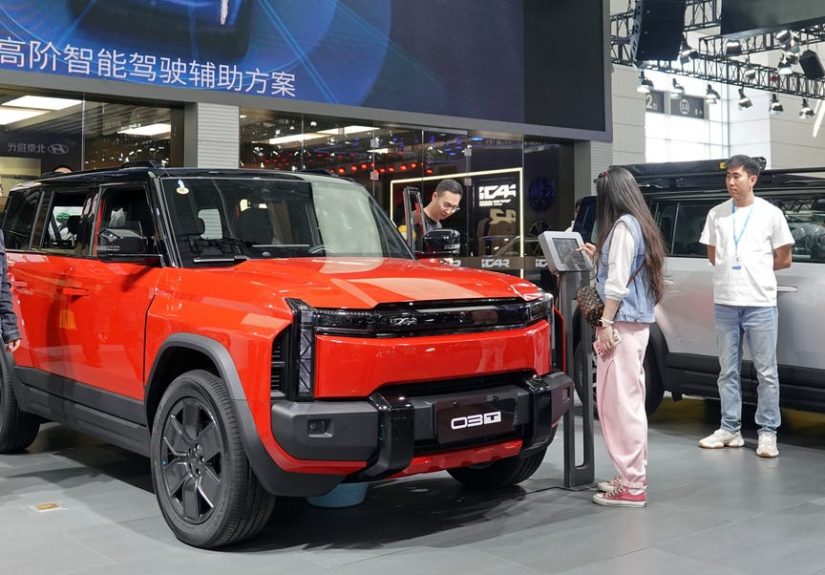
The clip that inspired headlines like “this car battery launches itself during a fire” appears to trace back to a 2025 demonstration in China involving an EV battery ejection concept. Reports tied the demonstration to a safety event and described a system that detects a thermal runaway event, then forcefully ejects the traction battery pack several meters away from the vehicle. In some coverage, the setup was linked to a Chery iCar 03 and a gas-generator-powered mechanism.
That’s an important distinction right away: this was not a normal 12-volt car battery popping loose like a toaster spring. This was the vehicle’s main high-voltage traction batterythe giant slab of lithium-ion cells that powers the carbeing intentionally expelled from the chassis. In other words, this was not “your car battery.” It was the battery pack, the one automakers spend an absurd amount of time trying to bolt down, cool properly, protect from crash intrusion, and keep from becoming tomorrow’s congressional hearing.
The footage went viral because it looked like a loophole in physics. A vehicle is sitting there, danger brewing beneath it, and then the pack erupts out from underneath with all the subtlety of a cartoon cannon. It is mesmerizing. It is also exactly the kind of thing that makes safety experts reach for coffee and a longer meeting.
The biggest issue is not whether the ejection works in a demonstration. It is whether a system like this could ever work safely in the real world, where cars exist near people, curbs, traffic, parked vehicles, storefronts, and the occasional unlucky shopping cart. In a controlled demo, a battery launching away from the cabin may look like problem solved. In a busy street, that same maneuver could create a brand-new emergency several feet away from the original one.
Why EV Battery Fires Freak People Out More Than Gas-Car Fires
Let’s be fair: electric vehicle fires are not scary because they are common. They are scary because they are different. A gasoline fire is dangerous in a way firefighters have understood for generations. A lithium-ion battery fire is dangerous in a way that keeps rewriting the playbook.
The core issue is thermal runaway. That’s the chain reaction in which a battery cell gets hot, fails internally, and begins heating neighboring cells faster than the pack can shed that heat. Once that cascade begins, things can get ugly in a hurry: intense heat, toxic gases, smoke, jetting flame, and sometimes violent venting. This is not a polite little underhood fire. This is chemistry deciding it no longer wants adult supervision.
That is also why footage like this lands so hard online. People already have a mental picture of EV fires as hotter, stranger, and harder to put out. That reputation exists for a reason. Even when EV fires are less frequent overall than fires in gasoline-powered vehicles, the firefighting experience can be more difficult. A damaged battery pack may reignite after the flames seem out. Cooling can take a huge amount of water. Storage after the incident matters. Towing after the incident matters. Even where the water is directed matters.
So when a video appears to show someone solving the issue by simply evicting the problem from the car, it pushes every viral button at once. It is dramatic, visual, easy to understand, and just absurd enough to be memorable. The internet loves that combination almost as much as it loves dashboard warning lights it doesn’t have to fix.
Why “Launch the Battery” Is Not the Future of EV Safety
If you were designing the safest possible electric vehicle, turning the battery pack into an escape pod would probably not top your list. In fact, U.S. safety thinking goes in nearly the opposite direction.
Modern EV safety policy and engineering focus on retaining the battery, isolating electrical hazards, preventing intrusion in a crash, detecting thermal events earlier, limiting propagation from cell to cell, and giving first responders much better information. In plain English: keep the pack protected, keep it attached, keep the danger understandable, and help trained people deal with it.
That makes sense. A battery pack is one of the heaviest and most structurally significant components in an EV. It is integrated into the platform, surrounded by cooling systems, shields, and structural members, and protected by software and battery management systems that monitor temperature, voltage, and other signs of trouble. Launching that whole assembly away from the vehicle may increase distance from the cabin, but it also destroys predictability. Safety engineering loves many things. Chaos is not one of them.
There is also the legal reality. U.S. regulations have been moving toward more detailed requirements for electric powertrain integrity and clearer emergency documentation. That includes standardized rescue sheets and emergency response guides so firefighters, tow operators, and cleanup crews know where high-voltage components are, how to disable systems, how to handle submersion, and how to store a damaged EV afterward. None of that suggests regulators are looking for an “ejecto-pack” button. Quite the opposite: they want managed risk, not airborne drama.
What Automakers and Safety Engineers Are Actually Working On
The truly important battery-safety innovations are less cinematic and far more useful. Sorry to disappoint the action-movie crowd, but the future is probably not “battery trebuchet.” It is better monitoring, smarter pack design, safer chemistry, and stronger containment.
1. Better cell-to-cell isolation
A huge amount of battery engineering is aimed at preventing one bad cell from taking its neighbors down with it. That includes thermal barriers, spacing strategies, vent paths, and module designs that reduce propagation. The dream scenario is not ejecting a burning pack. It is preventing a single-cell failure from becoming a pack-level event in the first place.
2. Smarter battery management systems
The battery management system is the EV’s anxious overachiever. It watches temperatures, charging behavior, voltage balance, and operating conditions. Improvements here can help detect abnormal conditions earlier, reduce charging-related risks, and warn drivers before a situation escalates. It may never become the star of a viral video, but it is doing the grown-up work.
3. Stronger emergency response guidance
This may sound boring until you remember that boring is wonderful during a vehicle fire. Better rescue sheets, towing instructions, post-crash handling guidance, and thermal-event documentation can save lives. Safety boards in the U.S. have repeatedly emphasized that responders need clearer, model-specific information about where to cut, where not to cut, how to cool a battery, and how to prevent reignition.
4. Earlier warning systems
One of the more promising areas of research involves detecting battery failure before open flame erupts. Researchers have been exploring acoustic signatures, gas release, and other warning signals associated with early-stage thermal runaway. That is a much saner direction than waiting for the battery to become a catapult enthusiast.
5. Safer chemistries and pack architectures
Not all batteries behave the same way. Chemistry matters. Pack shape matters. Cooling matters. Structural protection matters. As EV adoption grows, so does pressure on automakers and suppliers to build packs that are not only energy-dense and affordable, but also more tolerant of damage, overheating, and abuse.
The Real Lesson in the “Unreal” Footage
The viral video works because it taps into a broader cultural tension around electric vehicles. People know EVs are advancing quickly. They also know that battery technology can feel mysterious, especially when something goes wrong. A gasoline fire looks familiar, even when it is awful. A battery thermal event looks like the machine has become haunted by industrial chemistry.
That fear is not totally irrational. There are real hazards here, and first responders, regulators, insurers, and automakers all take them seriously. But the footage is also a reminder of how easy it is for public understanding to get distorted by spectacle. A wild clip can make it seem like EVs are out here launching their organs into traffic on a regular basis. They are not.
What the footage does show, however, is that the industry is still actively experimenting with ways to isolate battery hazards. Some ideas will be sensible. Some will be incremental. Some will look like a rejected gadget from a spy car that failed quality control. Innovation is messy like that.
The right takeaway is not “EVs are too dangerous.” It is also not “Look, problem solved.” The right takeaway is that battery safety remains one of the most important engineering challenges in the auto industryand the best solutions are likely to be the ones that drivers barely notice.
What Real-World Experiences Around Battery Fires Actually Feel Like
Here is the part the viral clip cannot capture: the human experience around an EV battery fire is rarely cinematic in the fun way. It is tense, confusing, loud, and deeply inconvenient, which is an elegant way of saying nobody on scene is having a good day.
For firefighters, one of the biggest differences is uncertainty. With a conventional vehicle fire, crews have decades of habit and muscle memory. With a lithium-ion battery event, they often need to think about high-voltage components, hidden heat, toxic gases, and the possibility that a fire that looks controlled is merely pausing to become your problem again in an hour. That changes how they approach the vehicle, where they direct water, how long they monitor the wreck, and what they tell the tow operator afterward.
For tow crews and storage yards, the experience can be just as stressful. A damaged EV is not always a “hook it and forget it” situation. It may need isolation from other vehicles and structures, more observation, and special handling because reignition risk does not politely end when the flames disappear. This is one reason emergency response guides and rescue sheets matter so much. Good information takes some of the guesswork out of a bad scene.
For drivers, the experience is often less about flames and more about confusion. Maybe the car was in a crash. Maybe it was flooded. Maybe there was an impact that did not look catastrophic, but later triggered a chain of failures. What many owners remember is not a Hollywood fireball but a sequence of strange moments: warning messages, unusual smells, hissing, smoke, a decision to get away from the vehicle fast, and then the surreal realization that a machine designed for silent commuting has suddenly become the loudest thing in their life.
Even in testing labs, where conditions are controlled and professionals are prepared, battery failure is not treated casually. Engineers monitor temperature, venting, ignition timing, and propagation because once a cell enters thermal runaway, the event can accelerate fast. Researchers studying early warning signslike gas release or distinct sounds before ignitionare trying to buy precious time before a failure becomes visible to the naked eye. In safety work, a few minutes of warning can matter far more than a flashy last-second trick.
And for bystanders watching these incidents online, the experience is usually emotional rather than technical. A dramatic EV fire clip spreads because it is shocking and unfamiliar. That is understandable. But viral attention can flatten the story into something simpler than reality. The truth is less meme-ready: EV fires appear less common than gasoline-vehicle fires, yet they pose unique response challenges when they do happen. That is not a contradiction. It is the whole point.
So yes, the footage of a battery launching itself during a fire is wild. It looks like engineering by plot twist. But the lived experience around battery safety is usually not about spectacle. It is about preparation, training, containment, better design, and the uncomfortable fact that advanced technology still has to survive the oldest test in transportation: what happens when things go wrong in the real world.
Conclusion
“This car battery launches itself during a fire” is the kind of headline that practically writes its own internet comments. And to be fair, the video earns the reaction. It is bizarre, memorable, and just plausible enough to make you wonder whether someone in a conference room really said, “What if the safest battery is the one we fire out of the vehicle?”
But the deeper story is more useful than the clip itself. EV battery fires remain a real safety challenge, not because electric vehicles are secretly rolling fireworks, but because lithium-ion failures behave differently from the fires people are used to understanding. That difference is driving serious work in crash protection, battery architecture, emergency response, thermal-event detection, and safer system design.
So no, the future of electric vehicle battery safety probably is not a launch sequence worthy of a Bond villain. It is smarter engineering, better rules, more responder training, and fewer reasons for any battery to audition for a stunt reel in the first place. Which is less exciting on video, admittedly. But it is a lot better for literally everyone standing nearby.