Table of Contents >> Show >> Hide
- The Moment That Turned a Routine Service Call Into a Human One
- Why This Hit So Hard: The Hidden Weight Parents Carry
- A Quick, Respectful Primer on What “Blind Baby” Can Mean Medically
- What Technicians Actually Doand Why “Just Give Him a Raise” Isn’t a Silly Ask
- Customer Service vs. Humanity: The Difference Is Often 30 Seconds
- How to Ask for an Employee to Be Rewarded (Without Sounding Like You’re Starting a Customer Service War)
- What Employers Should Learn From Robert’s 45 Minutes
- Yes, Kindness Has Boundariesand That’s Part of the Conversation
- Conclusion: The Raise Is the Point… and It Isn’t
- : Experiences That Echo This Story (And Why People Keep Sharing It)
Some stories go viral because they’re outrageous. This one went viral because it was ordinaryuntil it wasn’t. A mom was having one of those mornings where the coffee goes cold, the laundry multiplies like gremlins, and a toddler’s tears can feel louder than a fire alarm. Then an internet technician showed up to do a routine job… and ended up doing something that made the whole house exhale.
The mom later wrote a message to the company that basically said: Yes, he fixed the internet. But more importantly, he fixed my ability to keep going today. She didn’t just leave a five-star review. She asked for a raise. A promotion. Something. And if you’ve ever had a day where you felt like you were juggling flaming torches while riding a unicycle on a treadmillthis story probably hit you right in the feelings.
The Moment That Turned a Routine Service Call Into a Human One
In the original story, the mom explained that her son is blind and has complex medical needs. That morning, he was inconsolable. She was trying to soothe him while also taking care of her other child and keeping the household moving. When the technician arrived, the toddler reached for himone of those pure, instinctive “I need comfort” moments that doesn’t wait for an invitation.
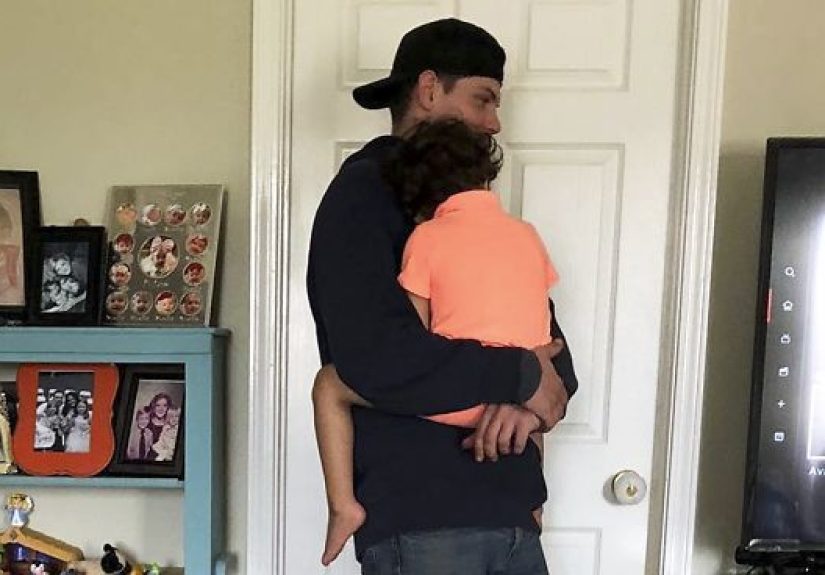
Instead of freezing, awkwardly backing away, or “staying strictly professional” in the most robotic sense, the technician simply… helped. He held the child on and off while completing the installation. He kept working. He kept the household calm. He didn’t make the mom feel embarrassed. He didn’t act like compassion was a separate appointment that needed scheduling.
The mom later praised him publicly and directly to the company, calling it “humanity at its best” and insisting he deserved a raise. The reason the story spread wasn’t because people thought technicians should become babysitters. It spread because the world feels loud, and this was quiet goodnesscaptured in one small, practical act.
Why This Hit So Hard: The Hidden Weight Parents Carry
Parenting is demanding even on “easy” days. Add special needs, and you’re often parenting with a second job layered on top: coordinating appointments, tracking symptoms, managing therapies, advocating at school, troubleshooting sleep, and constantly translating your child’s needs for a world that doesn’t automatically understand them.
Now add one more ingredient: a child who can’t easily communicate what hurts, what scares them, or what they need. That’s not a minor inconvenience. It’s a full-body stress response for the parent, because you’re always running a mental checklist: Is it pain? Hunger? Overstimulation? A seizure? A headache? A sensory meltdown? Exhaustion?
When someone steps in with calm energywithout judgment, without making it weirdit’s not “extra.” It’s a pressure valve releasing. And for a parent who has been holding it together with duct tape and determination, that relief is unforgettable.
A Quick, Respectful Primer on What “Blind Baby” Can Mean Medically
The story referenced diagnoses that many people have never heard of. Understanding them helps explain why that morning was so overwhelmingand why sleep, sensory issues, and developmental delays often show up in the same conversation.
Optic Nerve Hypoplasia (ONH)
Optic nerve hypoplasia is a condition present at birth where the optic nerve doesn’t fully develop, which can lead to vision loss ranging from mild impairment to complete blindness. It can affect one eye or both. Kids with ONH may also experience involuntary eye movements (nystagmus) or misalignment (strabismus).
ONH is also important because it can be associated with brain and hormone-related issues. In some cases, doctors recommend brain imaging and endocrine evaluation, since hormone problems and seizures can occureven when imaging looks normal. In plain English: the eyes may be the headline, but the body can be part of the story, too.
Chiari Malformation
Chiari malformations involve structural issues at the base of the skull and brain, where brain tissue can extend into the spinal canal. Symptoms vary widely. Some people have no symptoms; others experience headaches (often worsened by coughing or straining), balance issues, neck pain, dizziness, or other neurologic symptoms. In certain cases, surgery may be used to relieve pressure and improve cerebrospinal fluid flow.
The key takeaway for non-medical readers: Chiari can be a “silent” condition or a very loud oneand in kids, it can show up alongside other neurologic challenges. It’s another reason parents may be constantly monitoring behavior changes and discomfort clues.
Seizures, Developmental Delays, and the “He Can’t Tell Me What’s Wrong” Problem
When a child has seizures or developmental delays, parents often learn to become expert observers. A small shift in behaviorextra fussiness, a different cry, unusual drowsiness, a change in appetitecan signal something that deserves attention. This kind of vigilance is exhausting, especially when paired with typical toddler chaos (which is already basically a tiny tornado with snacks).
It also explains why a seemingly small kindnessholding a child for a few minutescan feel enormous. It gives the caregiver time to breathe, reset, and function again.
Sleep and Sensory Overwhelm: When the Body Clock Won’t Cooperate
Sleep can be particularly complicated for people who are totally blind because light is a major cue for circadian rhythm. Without normal light signals, some individuals develop circadian rhythm disorders where sleep timing drifts later and later. For families, that can translate into fragmented nights, unpredictable exhaustion, and a child who is overwhelmed faster because they’re running on fumes.
If you’re thinking, “So… the household is exhausted and overstimulated before breakfast,” yes. That’s the vibe. And that’s why the technician’s calm, steady presence mattered.
What Technicians Actually Doand Why “Just Give Him a Raise” Isn’t a Silly Ask
Internet and telecom technicians aren’t just plugging in a magic Wi-Fi box and whispering, “Be free, little router.” They install, maintain, and repair telecommunications infrastructure, test lines and devices, troubleshoot problems, and explain equipment use to customers. They also travel frequently, sometimes work nights or weekends, and often enter homes during stressful momentsbecause people usually call when something isn’t working.
From a labor perspective, it’s a skilled job with real training. And according to U.S. labor data, telecom technician roles have a meaningful wage range, with pay varying by specialty and industry. When a customer says, “This worker delivered excellence and made our day better,” that’s not fluff. That’s performance feedback.
Customer Service vs. Humanity: The Difference Is Often 30 Seconds
There’s a myth that professionalism requires emotional distance. In reality, great service often comes from emotional intelligence: reading the room, recognizing stress, staying calm, communicating clearly, and being respectful.
In this case, the technician didn’t abandon his job to do something unrelated. He did his job better. He reduced chaos in the environment, which likely made it easier to complete the work efficiently and safely. He built trust. He strengthened the company’s reputation in a way no billboard can buy.
That’s why the mom’s request for a raise didn’t land as “dramatic internet content.” It landed as a pretty logical conclusion: If companies want great service, reward the people who deliver it.
How to Ask for an Employee to Be Rewarded (Without Sounding Like You’re Starting a Customer Service War)
If you ever want to do what this mom didadvocate for a worker who showed real kindnesshere’s a practical playbook. The goal is to make it easy for a manager to say “yes” and act quickly.
1) Give specifics that can be verified
- Employee name (or description if you don’t know it)
- Date and time of visit
- Location (city/state is usually enough)
- Work order number (if you have it)
- What happened, in 5–10 clear sentences
2) Describe impact, not just behavior
- “He held my child while finishing the installation” is behavior.
- “That support helped me calm my child and function again” is impact.
- Companies measure impact. Tell them what changed because of the employee’s actions.
3) Make an explicit request
Be direct, but not demanding. You can say something like:
“Please share this with his supervisor. I hope the company will recognize him formallythrough a commendation, performance award, or raisebecause he represents your brand exceptionally well.”
4) Copy the right channels
- Customer support (so it’s logged)
- Local office manager (if available)
- Corporate customer relations
- Social media (optional, and only if you’re comfortable)
One more tip: if the worker is a contractor or subcontractor, ask the company to share the feedback with the contracting employer as well. Praise should land where payroll decisions actually happen.
What Employers Should Learn From Robert’s 45 Minutes
Research and workplace reporting consistently point in the same direction: recognition matters. When employees feel valued, they’re more likely to be engaged, stay longer, and perform better. But recognition can’t be vague. “Good job, team!” is fine. “We see the way you handled that customer with empathy and professionalism” is better.
Companies often say they want “customer obsession” or “white-glove service.” Then they measure only speed and volumehow fast a technician closes tickets, how many jobs get done in a day. Stories like this expose the gap: if you only reward speed, you train people to rush. If you reward quality, you get quality.
A smart organization doesn’t need every technician to become a therapist. It simply needs to protect and encourage basic humanityespecially in roles that put workers inside people’s homes, where life is messy by default.
Yes, Kindness Has Boundariesand That’s Part of the Conversation
There’s also a fair question here: should workers be expected to do emotional labor on top of technical labor? The answer is: not as an obligation, and not at the cost of their well-being.
Compassion fatigue is real, especially in caregiving and high-stress helping professions. Even outside healthcare, repeatedly absorbing other people’s stress can wear a person down. That’s why a “kindness culture” has to include support from the organization: reasonable schedules, safety policies, clear boundaries, and recognition that doesn’t punish employees for being human.
The technician in this story chose compassion in a moment where it fit naturally and safely. That’s the sweet spot: not performative, not forcedjust a person helping another person while still doing the job.
Conclusion: The Raise Is the Point… and It Isn’t
On the surface, this is a feel-good story about a mom who wanted a raise for a technician. Underneath, it’s about something bigger: how much families carry, how invisible that load can be, and how powerful it is when a stranger responds with steadiness instead of indifference.
The mom wasn’t asking for a miracle. She wasn’t asking the company to rewrite the laws of physics. She was asking them to notice excellenceand reward it. Because when a worker represents a brand with skill and humanity, that’s not “extra.” That’s exactly the kind of service every company claims to want.
: Experiences That Echo This Story (And Why People Keep Sharing It)
In homes with medically complex kids, “a regular appointment” is rarely regular. It might be the day you slept two hours because your child’s sleep schedule doesn’t line up with the sun. It might be the day your toddler’s sensory system is so overloaded that a doorbell feels like an air horn. It might be the day you’re trying to remember whether the new medication is supposed to be taken with foodwhile simultaneously negotiating peace talks over a toy truck.
That’s why so many parents have stories about kindness from unexpected places. A grocery cashier who quietly opens another lane when they see a meltdown starting. A delivery driver who waits an extra minute so a parent can transfer a child safely to a stroller. A call-center representative who doesn’t rush the script when a caregiver’s voice cracks. None of these people were hired to solve the family’s whole situation. But for that moment, they made the world less sharp.
On the technician side, there’s a parallel experience: walking into strangers’ lives all day. Sometimes you enter a spotless living room where everything looks like a catalog photo. Other times you step into a house that clearly had a rough morninglaundry baskets overflowing, a tired adult apologizing too much, a child crying in the background. You can choose to treat the house like a problem to escape quickly, or you can choose to treat it like a real place where real people live. That choice shows up in tone, patience, and the small pauses that signal respect.
Managers have their own version of this, too. Many leaders say they want employees who “take initiative” and “show ownership.” But when initiative looks like compassionlike taking 30 seconds to calm a customer, or staying an extra minute to explain how the equipment workssome systems accidentally punish it. The schedule is too tight. The metrics are too blunt. The recognition is inconsistent. Then companies wonder why service feels cold. You get what you measure, and you keep what you reward.
The most relatable part of this story isn’t the internet upgrade. It’s the moment of relief: someone competent arrived, did the work, and didn’t add stress. That’s the “dream scenario” for families who are already stretched thin. And for anyone watching from the outside, it’s a reminder that you don’t need a cape to be helpful. Sometimes being a hero looks like holding a toddler with one arm, checking signal levels with the other, and acting like kindness is normal.
If this story makes you want to do something, here’s the simplest version: notice people doing good work, say it out loud, and say it to someone who can reward it. A thoughtful message can travel further than you thinksometimes all the way to a supervisor’s desk, a performance review, or the kind of recognition that keeps a great worker from quitting on a hard week.