Table of Contents >> Show >> Hide
- What Is the Vitra Prouvé Standard Chair?
- The Genius of Jean Prouvé
- Why the Standard Chair Still Matters Today
- Materials and Construction
- Comfort: Is the Vitra Prouvé Standard Chair Actually Comfortable?
- How to Style the Vitra Prouvé Standard Chair
- Vitra Standard Chair vs. Standard SP
- Authenticity and Buying Considerations
- Who Should Buy the Vitra Prouvé Standard Chair?
- Care and Maintenance Tips
- Design Analysis: Why the Chair Looks So Good
- Experience Notes: Living With the Vitra Prouvé Standard Chair
- Conclusion
The Vitra Prouvé Standard Chair is one of those pieces of furniture that quietly walks into a room, says almost nothing, and somehow becomes the most interesting person at the dinner party. Designed by French architect, engineer, and designer Jean Prouvé, the chair looks simple at first glance: a wood seat, a wood back, a steel frame, and a profile sharp enough to make ordinary dining chairs feel like they forgot to do their homework.
But the Standard Chair is not famous because it is decorative. It is famous because it is honest. Every angle, screw, curve, and leg has a job. The chair was originally developed in 1934, later refined, and is now produced by Vitra, the Swiss furniture company known for preserving and manufacturing modern design classics. The result is a chair that feels industrial, elegant, practical, and slightly intimidatingin the best possible way.
For homeowners, collectors, architects, and design lovers, the Vitra Prouvé Standard Chair represents more than a place to sit. It represents a way of thinking: design should not simply look good; it should make sense. And this chair makes so much sense that it almost feels rude to question it.
What Is the Vitra Prouvé Standard Chair?
The Vitra Prouvé Standard Chair is a modern production version of Jean Prouvé’s iconic Standard Chair, a steel-and-wood seating design that became one of the most recognizable examples of 20th-century French modernism. It is typically used as a dining chair, desk chair, side chair, or statement chair in residential and commercial interiors.
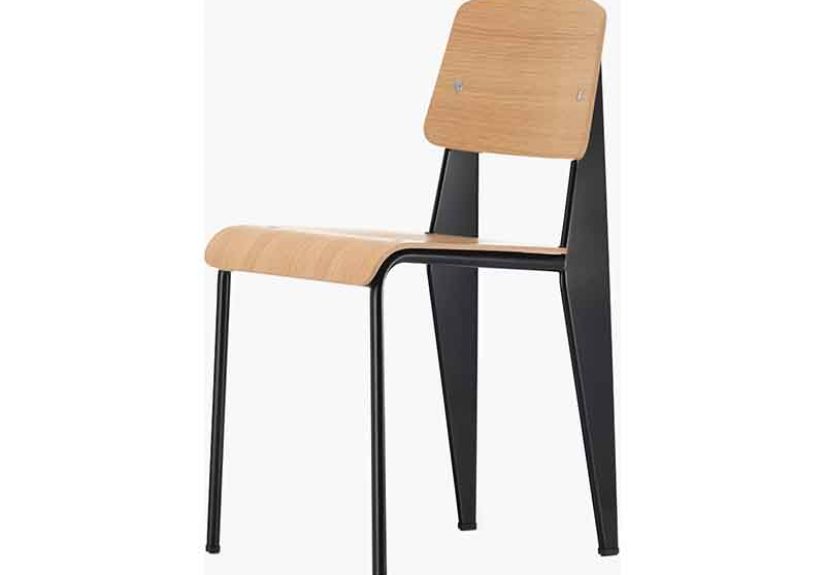
Its most distinctive feature is the dramatic difference between the front and rear legs. The front legs are slim tubular steel because they carry less weight. The rear legs, however, are wider, hollow, and made from bent sheet steel because they carry the greater load from the sitter’s upper body. In other words, the chair is basically a tiny engineering lecture disguised as furniture.
The seat and backrest are usually made from wood, such as oak or walnut, while the frame is powder-coated steel. Vitra also offers related versions, including the Standard SP, which uses plastic for the seat and backrest, and the Chaise Tout Bois, an all-wood design that reflects wartime material shortages when metal was harder to obtain.
The Genius of Jean Prouvé
Jean Prouvé was not the type of designer who began with a pretty sketch and then asked, “Now, how do we make this stand up?” He worked more like an engineer, a builder, and a practical inventor. His famous design philosophy can be summarized simply: never design anything that cannot be made.
That attitude is visible in the Standard Chair. Prouvé understood that a chair does not receive weight evenly. Most of the stress falls on the back legs, where the sitter leans and where the chair is most likely to fail. Instead of hiding that structural reality, he highlighted it. The rear legs became larger, stronger, and visually dominant. The chair’s appearance comes directly from the way it works.
A Chair That Shows Its Homework
Many chairs try to appear effortless. The Standard Chair proudly shows the math. Its rear legs resemble aircraft wings, not because Prouvé was trying to make a chair look fast, but because that shape efficiently channels force toward the floor. The widest point is where the greatest stress occurs: near the seat connection. From there, the form narrows upward and helps determine the angle of the backrest.
This is why the Vitra Prouvé Standard Chair still feels fresh. It does not rely on trend, ornament, or upholstery drama. It relies on structural intelligence. That is a much better long-term strategy than hoping people stay excited about yet another chair with “cloud-like comfort” and legs the thickness of breadsticks.
Why the Standard Chair Still Matters Today
In a market overflowing with chairs that look stylish for about six months and then quietly migrate to the garage, the Standard Chair has unusual staying power. It was designed in the 1930s, yet it works beautifully in modern apartments, restaurants, creative studios, dining rooms, libraries, and offices.
Its lasting appeal comes from a combination of proportion, honesty, material contrast, and versatility. The chair has enough character to stand out but not so much ego that it dominates the room. It can sit next to a marble dining table, a rustic farmhouse table, a compact writing desk, or a minimalist conference setup without looking lost.
Industrial, But Not Cold
The steel frame gives the chair an industrial edge, while the wood seat and backrest add warmth. This balance is one of the reasons interior designers love it. It can soften a modern room without making it cozy in a cupcake way. It can also sharpen a traditional room without turning it into a design showroom where everyone whispers and nobody knows where to put their coffee.
The chair’s silhouette is especially strong from the side. The angled rear legs create a sculptural profile that makes the Standard Chair instantly recognizable. Even people who do not know its name often pause and say, “That chair looks important.” They are correct.
Materials and Construction
The standard Vitra production model typically combines a molded sheet steel and tubular steel frame with a powder-coated finish. The seat and backrest are available in fine wood options such as natural oak, dark oak, or black walnut, depending on the retailer and current configuration.
The materials are not decorative afterthoughts. Steel provides strength and precision, while wood gives the body a warmer contact surface. The chair arrives fully assembled through many retailers, which is excellent news for anyone who has ever lost a tiny hex key and briefly considered moving to a cabin in the woods.
Dimensions and Everyday Fit
The Vitra Prouvé Standard Chair is compact enough for dining rooms and small apartments, yet substantial enough to feel serious. Retail dimensions commonly list it at about 16.5 inches wide, 19.25 inches deep, with a seat height around 18.25 inches. That makes it suitable for standard dining tables and many desks.
Because the chair is visually strong, it can be used as a full set around a dining table or as a single accent piece. Four to six chairs around a table create a refined, gallery-like atmosphere. One chair at a writing desk gives a workspace instant credibility, as if your grocery list might suddenly become an architectural manifesto.
Comfort: Is the Vitra Prouvé Standard Chair Actually Comfortable?
Yes, but with a useful clarification: the Standard Chair is comfortable in the disciplined, supportive way of a well-designed wood chair. It is not a cushioned lounge chair, and it is not pretending to be one. The shaped seat and backrest provide ergonomic support, but the experience is upright and purposeful.
For dining, working, reading, or conversation, the chair performs very well. It encourages good posture without feeling punitive. You will not sink into it. You will not disappear into foam. You will sit like a person with plans, perhaps even a person who owns matching napkins.
Best Uses for Comfort
The Standard Chair works especially well for meals, meetings, creative work, and short-to-medium sitting sessions. If you plan to sit for eight hours straight, you may want an ergonomic office chair with adjustable features. But if you want a chair that supports daily dining, occasional desk work, and beautiful interior composition, the Vitra Prouvé Standard Chair is an excellent candidate.
How to Style the Vitra Prouvé Standard Chair
The beauty of the Vitra Prouvé Standard Chair is that it can move between styles without losing its identity. It belongs to modern design history, but it does not feel trapped in a museum case. Here are several ways to style it naturally.
1. Around a Modern Dining Table
Pair the chair with a clean-lined wood, stone, or metal dining table. The Standard Chair’s steel frame creates visual rhythm around the table, while the wood seat and back keep the arrangement inviting. A set of six can make even Tuesday night leftovers look like they have been curated.
2. As a Desk Chair
Use a single Vitra Prouvé Standard Chair at a writing desk, especially in a home office where aesthetics matter. It pairs well with simple desks, vintage tables, and modern workstations. Add a good task lamp and suddenly your workspace has the energy of a design editor who drinks espresso responsibly.
3. In a Mixed Chair Dining Setup
The Standard Chair also works beautifully in a mixed-chair arrangement. Place two at the ends of a table or combine them with simpler side chairs. Because its silhouette is bold, even one or two can anchor the room visually.
4. With Warm Textures
To prevent the industrial frame from feeling too severe, pair the chair with wool rugs, linen curtains, ceramic tableware, books, plants, or warm lighting. The goal is contrast: steel and softness, precision and personality.
Vitra Standard Chair vs. Standard SP
One common question is whether to choose the classic Vitra Standard Chair or the Standard SP. The original-style Standard Chair uses wood for the seat and backrest, giving it a warmer and more traditional material presence. The Standard SP uses plastic for those surfaces, making it more colorful, often more accessible in price, and slightly more casual in personality.
If you want the richest connection to Prouvé’s steel-and-wood legacy, choose the wood version. If you want the same form with a contemporary twist and practical color options, the Standard SP may be the better fit. Both versions preserve the chair’s structural idea: the slender front legs and strong rear legs remain the star of the show.
Authenticity and Buying Considerations
Because the Standard Chair is famous, replicas exist. Some are inexpensive lookalikes; others imitate the form closely but do not match the quality, proportions, finishes, or production integrity of a genuine Vitra piece. When buying, look for authorized retailers, clear product documentation, authentic branding, and accurate materials.
Retailers such as Design Within Reach and museum design stores often emphasize authenticity and manufacturer-backed production. Buying from a trusted source matters because the Standard Chair is not just a shape. Its value comes from the combination of design rights, correct engineering, quality materials, and careful production.
Price and Value
The Vitra Prouvé Standard Chair is a premium design object, not a budget dining chair. That said, its value is tied to longevity. A well-made design classic can survive changing trends, multiple homes, and countless dinner conversations. Cheap chairs may cost less today, but they often need replacing once their legs wobble, finishes chip, or their style begins to resemble a regrettable haircut from 2014.
For buyers who care about design history, resale potential, and build quality, the Standard Chair can be a thoughtful long-term purchase. It is not simply bought; it is adopted.
Who Should Buy the Vitra Prouvé Standard Chair?
The Vitra Prouvé Standard Chair is ideal for people who appreciate modern furniture with meaning. It suits design collectors, architects, creative professionals, minimalists, and homeowners who want furniture that feels timeless rather than trendy.
It is also a strong choice for anyone who likes furniture with a story. This is not a generic chair with a vague “European-inspired” description. It has a clear origin, a famous designer, a structural concept, and a recognizable silhouette. It gives a room design credibility without shouting for attention.
Who Might Skip It?
If you want a soft upholstered chair for long lounging, this may not be your first choice. If you prefer furniture that disappears visually, the Standard Chair may feel too distinctive. And if your dining room is mainly used by toddlers with markers, spaghetti sauce, and mysterious sticky fingers, you may want to think carefully about finish choices and daily maintenance.
Care and Maintenance Tips
Maintaining the Vitra Prouvé Standard Chair is straightforward. Dust the wood and steel regularly with a soft cloth. Clean spills quickly, especially on wood surfaces. Avoid harsh chemicals, abrasive pads, and aggressive cleaners that can damage the finish. Use felt pads or floor glides as needed to protect flooring.
Because the chair combines wood and metal, it is best kept indoors in stable conditions. Extreme humidity, direct sun, and rough handling can affect the finish over time. Treat it like a design classic, not a folding chair at a backyard barbecue.
Design Analysis: Why the Chair Looks So Good
The Vitra Prouvé Standard Chair succeeds because it transforms structural logic into visual beauty. The rear legs are not decorative fins. They are necessary. The front legs are not thin because thin looks elegant. They are thin because they can be. That distinction matters.
Good design often feels inevitable. Once you understand the Standard Chair, it is hard to imagine it any other way. The heavy rear structure balances the lighter front legs. The wood surfaces soften the steel. The angled back provides posture and rhythm. The chair seems to say, “I am exactly this shape because this is the shape I need to be.” Very few chairs speak with that level of confidence.
The Standard Chair also avoids a common problem in iconic furniture: it does not feel like a fragile trophy. It was born from practical concerns, public use, offices, schools, and institutional settings. That utilitarian DNA keeps it grounded. It is sophisticated, yes, but not precious. It can handle real life, which is fortunate because chairs are occasionally expected to do chair things.
Experience Notes: Living With the Vitra Prouvé Standard Chair
Living with the Vitra Prouvé Standard Chair is different from simply admiring it in a photo. In images, the chair can look severe, almost architectural. In a real room, it becomes warmer and more approachable, especially when paired with wood floors, books, textiles, or natural light. The steel frame adds definition, while the wood seat and backrest keep it from feeling cold.
One of the first things you notice is how compact it feels. It does not take over a room, yet its silhouette is unmistakable. Slide it under a dining table, and it behaves politely. Pull it out, and suddenly the side profile becomes a small sculpture. That is the magic trick: useful when tucked away, dramatic when seen clearly.
The sitting experience is upright and alert. This is not the chair for melting into after a long day while watching three episodes of something you claim is “research.” It is the chair for meals, focused work, coffee, sketching, reading, and conversation. The shaped wood surfaces offer support, but the chair keeps you aware of your posture. In a world of furniture that increasingly resembles marshmallows, that can feel refreshing.
At a dining table, the Standard Chair brings order. A set of four or six creates a strong rhythm, especially when the frame color contrasts with the tabletop. Around a simple oak table, it feels classic and grounded. Around a black or stone table, it becomes sharper and more architectural. In a small apartment, one chair can serve double duty at a desk and then move to the dining table when guests arrive. It is flexible without looking temporary.
The chair is also surprisingly easy to decorate around. It works with modern lighting, vintage art, neutral walls, colorful rugs, and even imperfect everyday spaces. In fact, it often looks better when the room is not too perfect. A Prouvé chair next to a stack of books, a ceramic mug, and a slightly chaotic desk feels natural. It reminds you that great design was made for use, not just admiration.
There is also a quiet emotional benefit to owning a chair with such clear logic. Every time you see the strong rear legs, you are reminded that beauty can come from solving a problem well. The chair does not beg for compliments. It earns them. Guests may not immediately know its history, but they usually notice its presence. Someone will eventually ask, “What chair is that?” and then, congratulations, you are now the person explaining French modernism over dinner.
Maintenance in daily life is manageable. The wood should be treated with care, and the steel frame should be kept clean, but the chair does not feel fragile. It has the personality of furniture designed by someone who understood workshops, factories, public buildings, and real use. That durability is part of its charm.
Overall, the Vitra Prouvé Standard Chair feels like a rare combination: practical enough for everyday living, beautiful enough for design lovers, and historically important enough to make a room feel more considered. It is not the cheapest chair, nor the softest, nor the loudest. It is something better: a chair with a reason for being.
Conclusion
The Vitra Prouvé Standard Chair remains one of the most intelligent and enduring furniture designs of the modern era. Its appeal is not built on decoration, trend, or nostalgia alone. It is built on a brilliant structural idea: reinforce the parts of the chair that carry the most stress and let that engineering become the visual language.
Jean Prouvé created a chair that is practical, elegant, and deeply logical. Vitra’s modern production keeps that legacy alive for contemporary homes, offices, dining rooms, and design collections. Whether used as a full dining set or a single statement chair, the Standard Chair brings clarity, character, and quiet authority to a space.
If you want a chair that merely fills a corner, there are many options. If you want a chair that explains why good design still matters, the Vitra Prouvé Standard Chair is hard to beat.