Table of Contents >> Show >> Hide
- What Actually Happens When a Tank Shoots Down a Rocket?
- Why Tanks Need This Kind of Protection
- The Technology Behind the “Rocket Knockdown” Moment
- Examples of Active Protection Systems
- Does This Mean Tanks Are Safe From Rockets?
- Why the Video Feels So Surprising
- What This Means for the Future of Armored Warfare
- Common Misunderstandings About Tank Active Protection
- Why “Watch This Tank Shoot Down a Rocket” Is More Than Clickbait
- Experience-Based Reflections: What Watching This Kind of Tank Defense Teaches Us
- Conclusion
Note: This article is written for educational and editorial purposes, based on publicly available information about armored vehicle survivability, active protection systems, and modern tank defense. It avoids operational instructions and focuses on safe, high-level analysis.
There are military videos that make you blink twice, rewind, and ask, “Wait… did that tank just swat a rocket out of the air?” Yes. That is exactly the kind of moment behind the phrase “Watch This Tank Shoot Down a Rocket”a scene where a main battle tank does not simply rely on thick armor, good luck, or a very confident crew. Instead, it uses an active protection system, often called APS, to detect an incoming anti-tank rocket and intercept it before impact.
For decades, tanks have been described as rolling fortresses. They are heavy, loud, armored, and generally not the sort of thing you want to argue with. But modern battlefields have become crowded with anti-tank guided missiles, rocket-propelled grenades, drones, loitering munitions, precision weapons, and sensors that can spot vehicles from far away. In other words, the tank is still powerfulbut the neighborhood has gotten a lot less friendly.
That is why a tank shooting down a rocket is more than a viral “military tech goes boom” clip. It represents a major shift in armored warfare: tanks are no longer protected only by passive armor. They are increasingly protected by layered defense systems that act more like a goalkeeper, bodyguard, and overcaffeinated math teacher all rolled into one.
What Actually Happens When a Tank Shoots Down a Rocket?
At a high level, an active protection system works by watching the space around a vehicle, identifying a dangerous incoming threat, and launching a defensive countermeasure to stop it. Think of it like a car’s emergency braking system, except the “car” weighs tens of tons and the “obstacle” is an anti-tank rocket moving at very unpleasant speeds.
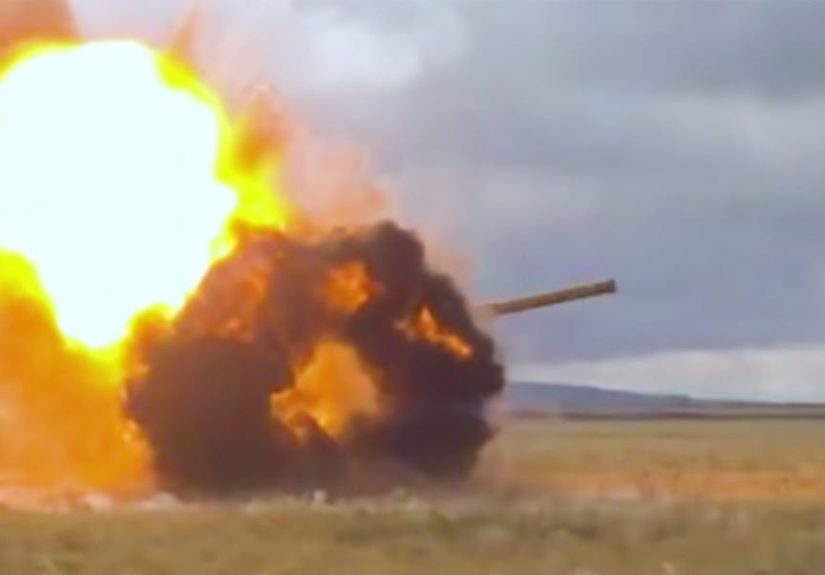
In the widely discussed video that inspired this topic, a tank appears to detect an incoming anti-tank rocket and destroy or deflect it before it reaches the vehicle. The key point is not that the tank’s main cannon shot the rocket down. This is not a cowboy duel between a tank shell and a rocket in midair. Instead, the vehicle’s defensive system reacts automatically, using sensors and a countermeasure designed for close-range protection.
Active Protection System: The Tank’s Invisible Shield
An active protection system is different from traditional armor. Armor waits to be hit. APS tries to prevent the hit from happening in the first place. That distinction matters. Traditional tank protection often involves adding thicker armor, reactive armor blocks, or external protective structures. Those can help, but they also add weight. And tanks, like people after Thanksgiving dinner, can only carry so much extra mass before movement becomes a problem.
APS technology gives designers another option: use sensors, computing, and defensive countermeasures to defeat certain threats before impact. Instead of endlessly stacking steel, engineers build a system that can notice danger and respond in a fraction of a second. It is not magic. It is engineering under pressure, which is basically magic wearing a hard hat.
Why Tanks Need This Kind of Protection
The modern tank faces a very different threat environment from the one it was originally designed for. A tank used to worry mostly about other tanks, artillery, mines, aircraft, and infantry anti-tank weapons. Those threats still matter, but now crews also have to think about drones, top-attack weapons, guided missiles, and cheap systems that can be used in large numbers.
Conflicts in Ukraine and the Middle East have shown that armored vehicles remain important, but they are vulnerable when used without support, protection, concealment, and coordination. The lesson is not “the tank is dead.” Military history has announced the death of the tank so many times that the tank should probably start charging rent for the phrase. The better lesson is that tanks must evolve.
The Armor Weight Problem
One reason active protection systems matter is weight. Modern main battle tanks are already massive. Add more armor, electronics, sensors, cooling systems, and protection kits, and eventually the vehicle becomes harder to transport, harder to maintain, and harder to operate in certain terrain.
That is why military planners increasingly talk about integrated protection instead of simply bolting on more armor. The goal is to combine passive armor, active defenses, sensors, mobility, electronic systems, and battlefield awareness into one survivability package. In plain English: do not just make the turtle shell thicker; give the turtle radar, reflexes, and a smarter escape plan.
The Technology Behind the “Rocket Knockdown” Moment
While different countries and companies build different active protection systems, most hard-kill APS concepts share a similar basic idea. The system monitors the area around the vehicle. When it detects a threat that appears to be on a collision path, it calculates whether the object is dangerous. If the system decides the threat is real, it launches a defensive response intended to neutralize the incoming round before it hits.
This all happens extremely quickly. The crew may not have time to manually react, which is why automation is central to the concept. A human being is excellent at many thingsstrategy, judgment, complaining about coffee qualitybut reacting to a close-range anti-tank rocket in milliseconds is not usually one of them.
Hard-Kill vs. Soft-Kill Protection
Active protection systems are often grouped into two broad categories: hard-kill and soft-kill. A hard-kill system physically attacks or disrupts the incoming threat. A soft-kill system tries to confuse, obscure, or misdirect the threat, especially if the weapon relies on guidance or targeting. Both approaches can be valuable, and future armored vehicles may combine several layers of defense.
The tank-shoots-down-a-rocket moment is usually associated with hard-kill APS. That is the dramatic versionthe one where something launches from the vehicle and the incoming projectile suddenly has a very bad day.
Examples of Active Protection Systems
Several active protection systems have become well known in defense discussions. Israel’s Trophy system is one of the most famous, partly because it has been fielded on vehicles such as the Merkava tank and has also been integrated onto U.S. Abrams tanks. Another system, Iron Fist, has been developed for armored vehicles and has drawn attention as militaries look for protection against a wider range of threats.
Russia has also developed systems such as Arena, which has often been discussed in connection with demonstrations of tanks intercepting anti-tank rockets. These systems differ in design and performance, but the larger trend is clear: militaries want armored vehicles that can detect and defeat incoming threats rather than merely absorb them.
Why the U.S. Army Cares About APS
The U.S. Army has invested in active protection for Abrams tanks because anti-armor threats have become more common and more capable. Modernization is not just about adding a better gun or a fancier display screen. Survivability is central. A tank that cannot survive long enough to fight is just an expensive metal rectangle with scheduling issues.
The Army’s newer Abrams modernization efforts also point toward reduced weight, better protection, open architecture, digital systems, and adaptability. That matters because future tanks must be upgraded faster than older designs. The battlefield is changing too quickly for vehicles to remain frozen in one technology generation.
Does This Mean Tanks Are Safe From Rockets?
No. And this is where the hype train needs to slow down before it drives through a wall. A tank shooting down a rocket is impressive, but it does not make tanks invincible. Active protection systems are one layer of defense, not a force field from a superhero movie.
APS can improve survivability against certain threats, especially anti-tank rockets and guided missiles. However, tanks still face mines, artillery, drones, air attacks, precision weapons, mechanical failures, bad terrain, and the oldest enemy in military history: poor planning. A tank with active protection is safer than a tank without it in many scenarios, but it still needs infantry support, reconnaissance, electronic warfare support, air defense, logistics, maintenance, and competent leadership.
The Myth of the Indestructible Tank
Every major conflict reminds observers that tanks are both powerful and vulnerable. They can deliver heavy firepower, protect crews, break through defenses, and dominate ground when used properly. But they are not solo superheroes. A tank operating alone in a hostile environment is not “bold”; it is a very loud invitation to trouble.
The best way to understand active protection systems is not as a replacement for tactics, training, or combined arms warfare. APS is an upgrade to the survivability toolbox. It helps crews survive threats that may otherwise destroy or disable the vehicle. But the tank still has to be used intelligently.
Why the Video Feels So Surprising
The reason people react so strongly to a tank shooting down a rocket is that it reverses the usual mental picture. Most people imagine a tank being hit by something. The rocket flies in, the armor takes the impact, and everyone waits to see what happens. But APS changes the sequence. The tank sees the threat coming and acts first.
That is visually shocking. It makes a huge armored vehicle seem strangely quick, almost alert. The tank is not just sitting there like a steel refrigerator with a cannon. It is actively defending itself.
It Is a Sensor Story, Not Just an Armor Story
The real star of the moment is not only the countermeasure. It is the sensor network and decision-making process behind it. Modern armored warfare increasingly depends on who can see first, understand first, and respond first. A tank with better sensors and defensive systems has a better chance of surviving long enough to complete its mission.
This is why future armored vehicles are being designed with more cameras, radars, electronic systems, networking, and automated support. The tank is becoming less like a simple armored gun platform and more like a moving combat node in a larger battlefield network. That phrase sounds like it escaped from a PowerPoint briefing, but it is accurate.
What This Means for the Future of Armored Warfare
The future tank will likely be lighter, better connected, more sensor-rich, and protected by multiple defensive layers. It may work more closely with drones, robotic vehicles, electronic warfare systems, and long-range fires. The classic tank rolemobility, protection, and firepowerwill remain, but the way those qualities are achieved will keep changing.
Active protection systems are part of that evolution. They help address a painful battlefield reality: anti-tank weapons are widely available, increasingly accurate, and often cheaper than the vehicles they threaten. That cost imbalance matters. If a relatively low-cost weapon can disable a high-value armored vehicle, the vehicle needs smarter defenses.
Layered Defense Is the New Normal
The best protected armored vehicles will not rely on one solution. They will combine armor, APS, camouflage, mobility, electronic systems, battlefield awareness, and supporting units. Think of it like home security. A lock is good. A camera is better. A dog helps. A neighbor who notices suspicious activity is useful. A moat with alligators may be excessive, but you get the idea.
For tanks, layered protection means surviving long enough to move, fight, and support other forces. APS helps, but it is only one part of a larger defensive ecosystem.
Common Misunderstandings About Tank Active Protection
Misunderstanding 1: The Tank’s Main Gun Shot the Rocket
In most active protection examples, the main gun is not involved. The defensive system uses dedicated sensors and countermeasures. The main gun is for offensive firepower; APS is for close-in defense.
Misunderstanding 2: APS Works Against Everything
No single system protects against every threat. Different weapons approach from different angles, speeds, and profiles. Active protection is valuable, but it is not universal protection.
Misunderstanding 3: Armor No Longer Matters
Armor still matters enormously. APS is designed to complement armor, not replace it. If an incoming threat is not intercepted, the vehicle still needs passive protection and internal survivability features.
Misunderstanding 4: Tanks Are Obsolete
Tanks are under pressure, but pressure is not the same as extinction. The tank remains useful when paired with infantry, drones, artillery, engineers, air defense, and logistics. What is obsolete is the idea that tanks can roll around without support and expect the battlefield to politely cooperate.
Why “Watch This Tank Shoot Down a Rocket” Is More Than Clickbait
The title sounds like a viral video headline, and yes, it has a certain “grab the popcorn” energy. But underneath the spectacle is a serious story about military adaptation. Armored vehicles are being forced to respond to threats that are faster, smarter, cheaper, and more numerous than before.
When a tank shoots down a rocket, it is not just a cool clip. It is a preview of where vehicle protection is headed. The future of armored warfare will be decided not only by thicker armor or bigger guns, but by sensors, software, automation, and the ability to survive in a sky full of eyes and a battlefield full of precision threats.
Experience-Based Reflections: What Watching This Kind of Tank Defense Teaches Us
Watching a tank shoot down a rocket creates a strange mix of emotions. First, there is amazement. The reaction is immediate: that should not look possible. A rocket is fast, a tank is huge, and yet the vehicle reacts like it has been waiting for the moment. Then comes curiosity. How did it detect the threat? How did it know the rocket was dangerous? How did it respond so quickly?
The biggest lesson from watching this kind of event is that modern defense technology is rarely about one dramatic object. It is about systems working together. The tank is not impressive only because it has armor. It is impressive because sensors, processors, launchers, software, crew training, and vehicle design all connect into one defensive chain. Break one link, and the result may be very different.
Another experience from studying these systems is that the most exciting footage often hides the least glamorous work. The video shows a split-second intercept. It does not show years of testing, calibration, maintenance, integration, safety analysis, crew training, procurement debates, budget approvals, and engineering headaches. Military technology is rarely born in one glorious “aha!” moment. It usually arrives after a long parade of spreadsheets, test ranges, prototypes, and people saying, “Well, that didn’t work. Try again.”
There is also a practical lesson for anyone interested in defense analysis: never judge a weapon system from one clip alone. A successful intercept is meaningful, but context matters. Was the test controlled? What type of threat was used? What were the conditions? Was the vehicle stationary or moving? How many attempts were made? A video can show what is possible, but it does not always show how reliable, scalable, or battlefield-ready a system may be.
That is why serious analysis should stay balanced. It is fair to say that active protection systems are impressive. It is also fair to say they are not miracle shields. The best defense writing avoids both extremes: it should not dismiss new technology as hype, and it should not treat every shiny demonstration as the final answer to warfare.
From a viewer’s perspective, the most memorable part is how quickly the tank changes from target to participant. Without APS, the incoming rocket defines the moment. With APS, the tank gets a vote. That is a powerful idea. Survivability is no longer just about enduring impact. It is about interrupting the attack before impact happens.
For readers, the larger takeaway is that the tank’s future is not simply a debate between “obsolete” and “unstoppable.” The truth is more interesting. Tanks are becoming more complex, more connected, and more dependent on protective ecosystems. They still need crews. They still need support. They still need logistics. They still need smart commanders. But they are also gaining defensive reflexes that older generations of armored vehicles did not have.
So when you watch a tank shoot down a rocket, enjoy the spectaclebut do not stop there. The real story is not just the explosion in the air. The real story is the changing relationship between offense and defense, between armor and sensors, between battlefield threats and battlefield adaptation. And yes, it is perfectly acceptable to say “whoa” while thinking about all of that. Serious analysis and nerdy excitement can ride in the same armored vehicle.
Conclusion
A tank shooting down a rocket is one of those rare military technology moments that feels cinematic but points to something very real. Active protection systems are changing how armored vehicles survive. They do not make tanks invulnerable, and they do not erase the need for smart tactics, support units, and careful planning. But they do give crews an additional layer of defense against some of the most dangerous anti-armor threats on the battlefield.
The future of tanks will not be decided by armor alone. It will be shaped by integrated protection, sensors, software, mobility, electronic warfare, drones, and the ability to adapt faster than the threats evolve. The headline may be “Watch This Tank Shoot Down a Rocket,” but the deeper story is this: the tank is learning to fight back before it gets hit.