Table of Contents >> Show >> Hide
- Titan Is a Strange World That Feels Uncomfortably Familiar
- NASA Is Not Just Sending a Spacecraft. It Is Sending a Flying Field Scientist
- Why Titan Needs a Rotorcraft Instead of Another Rover
- The Real Scientific Prize Is Bigger Than "Is There Life?"
- Dragonfly's Tool Kit Is Built for Chemical Detective Work
- Titan Is Also an Engineering Challenge Disguised as a Science Destination
- Why NASA Chose Titan Instead of a Simpler Destination
- Conclusion
- What It Feels Like to Follow a Mission Like Dragonfly
If Mars is the solar system’s celebrity neighbor, Titan is the mysterious genius in the back row wearing an orange haze and refusing to explain itself. Saturn’s largest moon has lakes, rivers, rain, dunes, seasons, and weather. That sounds pleasantly familiar until you remember the lakes are liquid methane, the “rocks” are often water ice as hard as stone, and the average forecast is less “bring a jacket” and more “your eyelashes would quit immediately.”
So why is NASA sending one of its boldest missions there? Because Titan is one of the most compelling places in the solar system to study the chemistry that may lead to life. NASA’s Dragonfly mission is not simply a sightseeing tour with rotors. It is a flying laboratory built to explore whether Titan preserves clues to the same kinds of chemical steps that may have happened on early Earth before biology showed up and changed the neighborhood forever.
In other words, Dragonfly is heading to Titan because Titan is weird, rich in chemistry, surprisingly Earthlike in some ways, and wildly alien in others. For scientists, that is not a problem. That is the invitation.
Titan Is a Strange World That Feels Uncomfortably Familiar
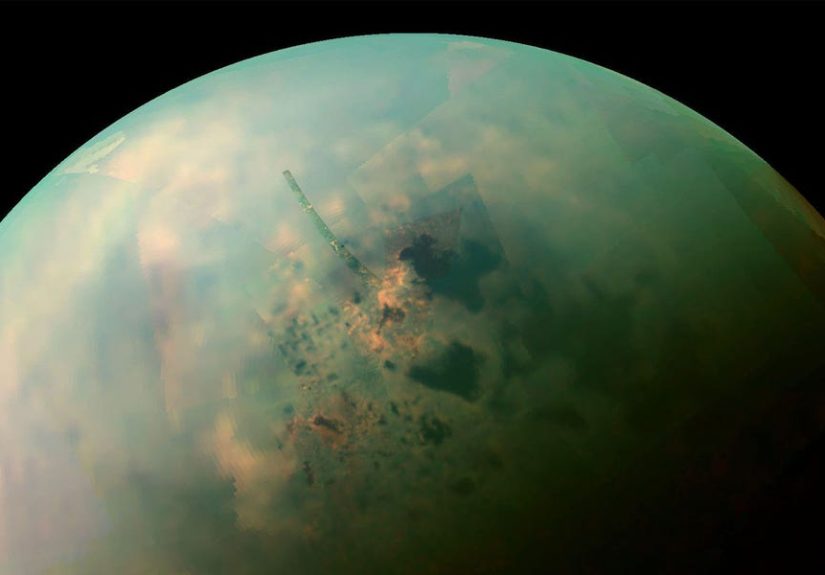
Plenty of moons are interesting. Titan is the one that keeps making planetary scientists lean closer to the screen. It is the only moon in the solar system with a truly thick atmosphere, and that atmosphere is mostly nitrogen, like Earth’s. It has clouds, rainfall, river channels, lakes, and seas. It even has seasonal cycles. If you squint at the broad shapes, Titan can look like Earth wearing a Halloween costume designed by an astrobiologist with a very dark sense of humor.
But Titan is not Earth 2.0. It is colder than a freezer that holds grudges. Its seas are not water but methane and ethane. Its surface chemistry is loaded with organic molecules, the carbon-containing compounds that matter deeply when scientists talk about the ingredients for life. That makes Titan far more than a scenic oddball. It is a natural laboratory for studying complex chemistry on a planetary scale.
This is the core reason NASA is going. Titan gives researchers a place where carbon chemistry has been unfolding for a very long time in a setting that echoes some broad themes from the young Earth, while still being different enough to test ideas rather than flatter them. If scientists want to understand how nonliving chemistry can become more organized, more complex, and maybe someday biological, Titan is one of the best addresses in the solar system.
NASA Is Not Just Sending a Spacecraft. It Is Sending a Flying Field Scientist
Dragonfly is ambitious because it is not built to sit in one spot and politely take notes. It is a rotorcraft, essentially a car-sized robotic flyer with eight rotors, designed to hop from site to site across Titan’s surface. That mobility is the mission’s secret weapon. A stationary lander can reveal a lot. A rover can reveal more. But a flying explorer can compare entirely different environments, follow clues, and sample a broader story.
And Titan is almost absurdly well suited for that approach. Its dense atmosphere and low gravity make flight easier there than you might expect on another world. A rover on Titan could struggle with rough terrain and sand-like deposits. Dragonfly can simply lift off, move, and land somewhere more interesting. That is the sort of sentence engineers dream about and mission planners put in bold.
NASA expects Dragonfly to spend more than three years investigating multiple sites on Titan after arriving in the 2030s. Over the course of its primary mission, it is planned to travel across many locations, turning Titan from a single landing site into a connected field area. Instead of asking, “What is this one patch of ground like?” Dragonfly gets to ask, “How does this world work across landscapes, chemistry, weather, and time?”
Why Titan Needs a Rotorcraft Instead of Another Rover
Because Titan rewards mobility
Titan is packed with scientific variety. There are organic dunes near the equator, channels carved by flowing liquids, and impact sites where heat may once have allowed liquid water to mix with complex organics. That last detail matters a lot. On Earth, water and organic chemistry are a powerful combination. When scientists look at Titan, they see a world where the raw materials for interesting chemistry are everywhere, and where specific locations may have briefly offered the right conditions for even richer reactions.
A rover would be limited by terrain and speed. Dragonfly can leapfrog across it. NASA has described a mission path that begins in Titan’s equatorial Shangri-La dune fields and eventually reaches Selk crater, an impact site that could preserve evidence of chemistry involving water and organics. That journey is not a gimmick. It is a strategy. Titan’s story is written across multiple environments, and Dragonfly is built to read more than one page.
Because Titan is too important for one sample
Imagine trying to understand Earth by landing in one desert parking lot and never moving. You would learn something, sure, but not enough to explain forests, oceans, volcanoes, weather, or life. Titan deserves better than a single snapshot. Dragonfly’s design reflects that. NASA wants a mission that can compare materials, contexts, and landscapes directly rather than guessing how representative one spot might be.
That is especially important because Titan’s chemistry appears to be diverse. Organic particles form in the atmosphere, settle onto the surface, and interact with local conditions. Some places may preserve relatively unaltered atmospheric products. Others may show signs of geologic processing. Some may hint at past interactions with liquid water. A mobile craft can tell those possibilities apart. A static one mostly shrugs and does its best.
The Real Scientific Prize Is Bigger Than “Is There Life?”
Space headlines love a dramatic question, so Titan often gets packaged as a “could there be life?” destination. Fair enough. It is a fascinating astrobiology target. But Dragonfly’s main scientific ambition is more subtle and arguably more profound. NASA has been clear that this is not a mission designed simply to detect life directly. It is designed to investigate the chemistry that may come before life, the stage where nature is still experimenting with ingredients, structures, and reactions.
That matters because life did not begin with cells already assembled and waving hello. At some point, chemistry had to get weirdly productive. Molecules had to combine, persist, and move toward greater complexity. Earth’s early record of those steps is frustratingly incomplete because our planet is geologically active and has been remixing itself for billions of years. Titan, by contrast, may preserve chemical pathways in a different setting that still reveal the kinds of processes that matter for life’s origins.
This is why Titan keeps showing up in serious scientific conversations. It is not merely exotic. It is relevant. Dragonfly may help researchers understand which compounds are present, how they are distributed, how surface and atmospheric processes interact, and whether locations that once hosted liquid water plus organics pushed chemistry farther along than scientists can currently prove.
That is a huge deal. If Mars helps answer whether life ever emerged elsewhere, Titan may help answer how the universe makes the kinds of chemistry that life can eventually use. Those are different questions, and both are worth the airfare.
Dragonfly’s Tool Kit Is Built for Chemical Detective Work
NASA did not send a flying machine to Titan just because it looks cool in artist renderings, although, to be fair, it absolutely does. Dragonfly carries instruments meant to do serious chemical and environmental analysis. Its mass spectrometer will examine the molecular makeup of samples. A drill and sampling system will gather material from Titan’s surface and feed it into the onboard lab. A gamma-ray and neutron spectrometer will help determine elemental composition. Cameras will study terrain and support navigation. Meteorological and geophysical sensors will monitor conditions and even listen for seismic activity.
That combination is smart because Titan is not only a chemistry story. It is also a geology story, an atmosphere story, and possibly an interior story. Recent research has even complicated older ideas about Titan’s subsurface ocean, suggesting the moon’s interior may be slushier and more complex than the classic simple ocean-world picture. Dragonfly’s measurements will not solve every mystery in one dramatic science-movie montage, but they can sharpen the questions and ground future models in real surface data.
Think of the mission as part flying geologist, part weather station, part organic chemistry lab, and part patient detective. Not a bad resume for a robot headed nearly a billion miles from the Sun.
Titan Is Also an Engineering Challenge Disguised as a Science Destination
Getting to Titan is not a casual weekend errand. Dragonfly is scheduled for a no-earlier-than July 2028 launch and is expected to arrive in late 2034 after a long cruise through the solar system. Sunlight out there is weak, so the mission uses a nuclear power source rather than solar arrays. Temperatures are brutally low. Communication delays mean the craft cannot be flown like a remote-controlled toy. Titan’s atmosphere is helpful for flight, but first the spacecraft has to survive entry, descent, and landing on a world humans have never explored this way before.
NASA has spent the past several years advancing the mission through design reviews, testing rotor performance in Titan-like conditions, and confirming the updated schedule and budget needed to get the project to the launch pad. Dragonfly was confirmed in 2024 for continued development and passed critical design review in 2025, which means it moved beyond the stage of being a wonderful idea with great slides and into the far more serious stage of becoming actual hardware.
That progress matters because Dragonfly sits at the intersection of science ambition and engineering maturity. It builds on what NASA learned from Cassini-Huygens at Titan and from autonomous flight technologies demonstrated closer to home and on Mars. This mission would have been a much tougher sell twenty years ago. Today, it looks bold but achievable, which is exactly where great exploration missions like to live.
Why NASA Chose Titan Instead of a Simpler Destination
Because simpler is not always smarter. Titan offers an unusually rich scientific payoff per mission. It has atmospheric chemistry, surface liquids, active weather, organic-rich materials, and sites where water may have interacted with those materials in the past. That is a remarkable stack of clues in one destination.
There is also a bigger philosophical reason. Titan lets scientists study a world that feels eerily familiar without being comfortable. It is a reminder that the ingredients and processes we associate with Earth can appear in startlingly different forms elsewhere. Clouds are not uniquely ours. Rivers are not uniquely ours. Even chemistry that hints at life’s building blocks may not be uniquely ours. Titan asks whether Earth is special in the ways we assume, or whether some of our story is a broader cosmic habit.
NASA is heading there because Titan is one of those rare places that can test ideas across planetary science, chemistry, geology, atmospheric science, and astrobiology all at once. Missions like that do not come along every day. If they did, NASA would need a much larger notebook and a much larger budget.
Conclusion
NASA’s ambitious new mission is heading to Titan because Titan may be one of the best places in the solar system to study the chemistry that leads toward life without assuming life itself has to be waving from the shoreline. It is a world with a thick atmosphere, active weather, organic-rich materials, Earthlike landscapes, and crucially, a record of chemical processes that may echo some of the most important chapters in our own planet’s history.
Dragonfly is the right mission for that destination because Titan rewards movement, comparison, and curiosity. A flying laboratory can travel where a rover would crawl, sample where a lander would wait, and connect environments that together tell a deeper story. The mission is ambitious because Titan is ambitious. It is not content to be just another moon. It wants to be a chemistry experiment the size of a world.
And if Dragonfly succeeds, Titan may stop being merely the solar system’s most intriguing oddball and become one of the places that most clearly explains how the universe takes simple ingredients and starts doing something extraordinary with them.
What It Feels Like to Follow a Mission Like Dragonfly
There is also a human side to all of this, and it deserves space in the conversation. Following Dragonfly is not like following a routine satellite launch or a mission to a destination people already understand. Titan feels different. It activates the imagination in a way few places do because it looks half familiar and half impossible. When you read about rivers, dunes, clouds, and rain, your brain starts building an Earthlike landscape automatically. Then Titan casually reminds you that the rain is methane, the air is hazy orange, the ground may crunch with hydrocarbon grains, and the temperature would end your travel vlog in about half a second. It is science by way of beautiful mental whiplash.
For space fans, that creates a peculiar experience: Titan feels knowable and unknowable at the same time. You can picture standing there, but only until the details arrive and politely wreck the fantasy. That tension is part of the appeal. Dragonfly is not just going to a remote moon. It is going to a place that constantly forces us to update our assumptions about what a “world” can be.
For scientists and engineers, the emotional experience is different but just as intense. Missions like Dragonfly require years of patience before they deliver even a single data point from the destination. There are design reviews, budget revisions, test campaigns, autonomy planning, environmental constraints, launch windows, and endless discussions about risk. Space exploration often looks glamorous from the outside, but inside the mission it can feel like a long marriage between optimism and spreadsheets. Dragonfly embodies that perfectly. It is wildly imaginative in concept and deeply disciplined in execution.
There is also something moving about the timeline. A mission launched in 2028 and arriving in 2034 asks people to care across years, administrations, hardware milestones, and life changes. Students reading about Dragonfly today may be professionals by the time it lands. Engineers working on it now will likely remember tiny design decisions when the first real Titan images arrive. That long arc gives the mission a different emotional texture. It is less like a quick headline and more like planting a tree whose shade you are determined to enjoy later.
And then there is the specific thrill of Titan itself. Mars has become vivid to the public because we have seen so much of it. Titan remains more dreamlike. Its haze hides details. Its chemistry sounds like science fiction but is very real. Its landscapes are recognizable enough to tempt the imagination and strange enough to keep it humble. That combination makes Dragonfly feel like a mission not just of measurement, but of revelation. It promises the pleasure of seeing a place become more real, one dataset at a time.
That is why this mission resonates beyond the usual circle of planetary scientists. It speaks to a broader human instinct: the desire to go somewhere difficult, learn something fundamental, and come back with a better understanding of where we fit. Dragonfly will not bring people to Titan. But it will bring Titan closer to people, and that may be one of the most exciting experiences in modern space exploration.