Table of Contents >> Show >> Hide
- What Is a Cusp in Astrology?
- Why Cusp Dates Feel Fuzzy (And Why Your Friend’s App Disagrees With Yours)
- Zodiac Sign Dates vs. Cusp Dates
- Zodiac Cusp Signs and Dates
- Are Cusp Signs “Real”? The Helpful Answer (Not the Snarky One)
- How to Tell If You’re Actually “On the Cusp”
- Quick Personality Notes for Each Cusp Pair
- Common Myths About Zodiac Cusps (And What’s More Useful Instead)
- A Quick Note on Astrology vs. Astronomy
- of Real-Life “Cusp Experiences” People Commonly Describe
- Conclusion
If you’ve ever told someone, “I’m a Leo-Virgo cusp,” you’ve probably gotten one of two reactions:
(1) an enthusiastic “Omg SAME,” or (2) the astrology equivalent of a polite cough.
Either way, cusp talk has survived group chats, dating apps, and that one aunt who forwards horoscopes like it’s a civic duty.
This guide clears up what a zodiac cusp is, why cusp dates can be confusing, and how to tell whether you’re
actually “on the cusp” (and what that even means). We’ll keep it grounded, practical, and just cheeky enough to feel like a conversation
not a lecture delivered by a crystal that somehow has Wi-Fi.
What Is a Cusp in Astrology?
In everyday astrology, a cusp is the “border period” when your birthday lands near the end of one zodiac sign’s season
or the beginning of the next. People often use cusp language to explain why they relate to traits from two signslike a Capricorn who is
secretly a little too social for comfort, or a Gemini who cries during commercials.
In chart-based astrology (the kind that uses your exact birth time and place), “cusp” has a more precise meaning:
planets aren’t in two signs at once. The Sun (your “sun sign”) is in one sign at a specific degree0° through 29°.
If your Sun is very close to 0° (just entered a sign) or 29° (about to leave), you may feel “in-between” because you’re near a transition,
but technically, the Sun is still in one sign.
Why Cusp Dates Feel Fuzzy (And Why Your Friend’s App Disagrees With Yours)
Here’s the core reason cusp debates never die: the Sun doesn’t change signs at the same clock time every year.
“Aries season starts March 21” is a handy shorthand, but the exact moment the Sun enters a sign (called an ingress) shifts a bit
year to year. That shift is why someone born on the same calendar date might be Pisces one year and Aries the nextdepending on the year,
time, and time zone.
Translation: if you were born near a sign change, you’re not “half-and-half.” You’re “please provide the receipt,” and the receipt is your
birth time and location.
Three common reasons cusp results vary
- Exact ingress time changes yearly: the Sun’s sign change time drifts, and leap years nudge things too.
- Time zone and birth time matter: “April 20” at 11:50 p.m. is not the same as “April 20” at 2:00 a.m.
- Different sources define “cusp windows” differently: some use 1–2 days, some use 4 days, some use a full week.
Zodiac Sign Dates vs. Cusp Dates
First, let’s set the stage with the standard “season” date ranges most mainstream U.S. references publish (used for quick sun-sign lookup).
Then we’ll talk about cusp windowsbecause cusp windows are more like “popular convention” than a universal rule.
Commonly published zodiac sign date ranges (quick reference)
These ranges are widely used for simple sun-sign identification. If you’re not near the edges, you can usually stop here and go live your life.
If you are near the edges, keep reading (and maybe find your birth certificate while you’re at it).
| Sign | Typical Date Range | Vibe in One Line |
|---|---|---|
| Aries | Mar 21 – Apr 19 | “Let’s do it now.” |
| Taurus | Apr 20 – May 20 | “Let’s do it comfortably.” |
| Gemini | May 21 – Jun 20/21 | “Let’s do it… and also talk about it.” |
| Cancer | Jun 21/22 – Jul 22 | “Let’s do it if everyone feels safe.” |
| Leo | Jul 23 – Aug 22 | “Let’s do it and make it iconic.” |
| Virgo | Aug 23 – Sep 22 | “Let’s do it correctly.” |
| Libra | Sep 23 – Oct 22/23 | “Let’s do it nicely.” |
| Scorpio | Oct 23/24 – Nov 21 | “Let’s do it deeply.” |
| Sagittarius | Nov 22 – Dec 21 | “Let’s do it somewhere else.” |
| Capricorn | Dec 22 – Jan 19 | “Let’s do it with a plan.” |
| Aquarius | Jan 20 – Feb 18/19 | “Let’s do it differently.” |
| Pisces | Feb 19 – Mar 20 | “Let’s do it… spiritually.” |
So what are “cusp dates” exactly?
Cusp dates are not one official set of dates across all astrology traditions. They’re a popular way to describe
birthdays that fall close to the transition between two signs. Some websites define cusps as about 2 days on either side; others use 4 days;
some use roughly a week. None of that overrides the actual chart calculation, but it can be a fun shorthandlike calling a messy closet
“eclectic.”
Zodiac Cusp Signs and Dates
Below is a commonly used “wider window” approach (roughly a week) that many modern astrology sites share in some form.
Treat these as approximate cusp windows, not a legal document. If your birthday falls in these ranges, you’re in “cusp territory”
and should use your birth time to confirm your Sun sign.
| Cusp Pair | Common Nickname | Approx. Cusp Window | Blend Theme (Plain English) |
|---|---|---|---|
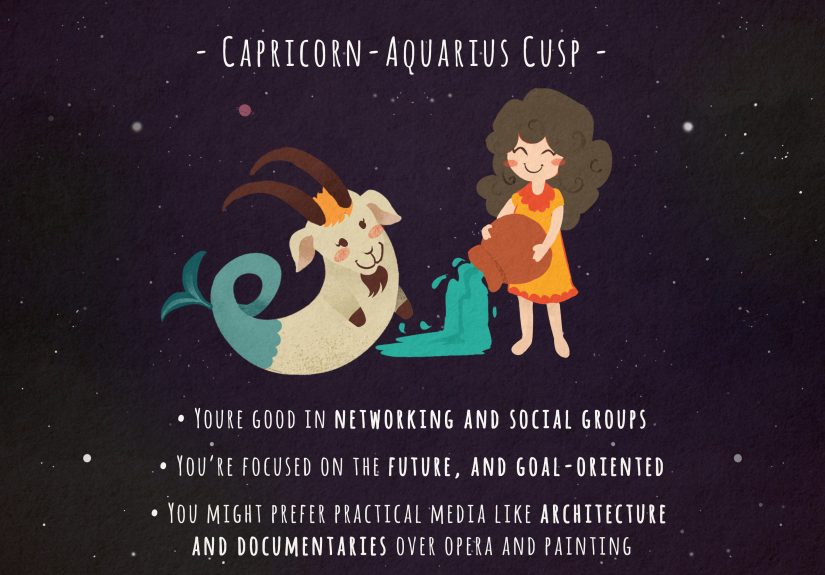
| Capricorn–Aquarius | Cusp of Mystery | Jan 16–23 | Ambition meets originality |
| Aquarius–Pisces | Cusp of Sensitivity | Feb 15–21 | Ideas meet empathy |
| Pisces–Aries | Cusp of Rebirth | Mar 17–23 | Imagination meets action |
| Aries–Taurus | Cusp of Power | Apr 16–22 | Boldness meets staying power |
| Taurus–Gemini | Cusp of Energy | May 17–23 | Stability meets curiosity |
| Gemini–Cancer | Cusp of Magic | Jun 17–23 | Wit meets emotional intelligence |
| Cancer–Leo | Cusp of Oscillation | Jul 19–25 | Nurturing meets confidence |
| Leo–Virgo | Cusp of Exposure | Aug 19–25 | Spotlight meets precision |
| Virgo–Libra | Cusp of Beauty | Sep 19–25 | Function meets aesthetics |
| Libra–Scorpio | Cusp of Drama | Oct 19–25 | Charm meets intensity |
| Scorpio–Sagittarius | Cusp of Revolution | Nov 18–24 | Depth meets blunt honesty |
| Sagittarius–Capricorn | Cusp of Prophecy | Dec 18–24 | Big dreams meet big discipline |
Notice how these windows are clustered around the typical sign-change dates (around the 19th–23rd of many months).
That’s why cusp conversations are so commonlots of birthdays sit right near the “handoff.”
Are Cusp Signs “Real”? The Helpful Answer (Not the Snarky One)
The internet loves a dramatic yes/no. Astrology, however, thrives in the “it depends.”
Here’s a balanced way to think about it:
Technically…
Your Sun is in one sign at a specific degree. So in a strict, chart-calculated sense, you are not “two sun signs.”
If your Sun is at 29° Taurus, it’s still Taurus. If it’s 0° Gemini, it’s Gemini.
Experientially…
People born near transitions often relate to both signs because they may have:
- Fast-moving planets (like Mercury or Venus) in the neighboring sign, shaping communication and relationship style.
- A Moon sign that sounds “more like” the other sign emotionally.
- A rising sign (Ascendant) that changes how they come across socially.
- Strong aspects (planet-to-planet angles) that create “blended” behavior.
So the cusp label can be a useful doorway into deeper chart understandingif you treat it like a hint, not a whole identity.
Think of it as the trailer, not the full movie.
How to Tell If You’re Actually “On the Cusp”
If you’re within a day or two of a sign change (and sometimes even three), the only reliable method is to calculate your natal chart.
Here’s how to do it without turning it into a weeklong quest:
Step 1: Get your birth details
- Date of birth
- Exact time of birth (as close as possible)
- Location (city and state)
Step 2: Check your Sun’s sign and degree
Look for something like “Sun: 29°59′ Taurus” or “Sun: 0°12′ Gemini.”
Those tiny numbers explain why a “Taurus” might feel suspiciously Gemini-ishor vice versa.
Step 3: Look at the supporting cast (aka, the rest of your chart)
If cusp energy resonates, these placements are often the reason:
- Moon sign: emotional instincts
- Rising sign: first impression + personal style
- Mercury: communication and thinking patterns
- Venus: love language and aesthetics
- Mars: motivation and conflict style
- Sun house placement: where your “shine” shows up most
A real-world example (because charts shouldn’t feel like algebra)
Imagine two people born on April 20:
- Person A is born at 2:10 a.m. and the Sun is still in Aries (late degrees). They may show classic Aries traits: direct, fast-moving, competitive.
- Person B is born at 11:55 p.m. after the Sun entered Taurus (early degrees). They may feel more Taurus: steady, sensual, grounded.
Same birthday. Different Sun sign. Cusp drama avoided. Group chat saved.
Quick Personality Notes for Each Cusp Pair
These are “blend themes,” not a personality diagnosis. Use them as a mirror: keep what resonates, leave what doesn’t.
Capricorn–Aquarius cusp
Often shows up as: “I’m responsible… but only if the rules make sense.” Practical visionary energy. Can build systems, then redesign them.
Aquarius–Pisces cusp
Often shows up as: inventive empathy. Big ideas plus big feelings. Tends to understand people’s vibes before they understand their own.
Pisces–Aries cusp
Dreamer-to-doer energy. Can be gentle one minute and aggressively motivated the next. Great for creative projects that need a launch button.
Aries–Taurus cusp
Fire meets earth. The spark and the stamina. Can start fast and finish strongassuming they don’t get distracted by snacks midway.
Taurus–Gemini cusp
Comfort meets curiosity. Can be steady but socially agile. Loves a reliable routine… with optional plot twists.
Gemini–Cancer cusp
Witty but soft. A “funny friend” who also remembers your childhood trauma story and checks in when you go quiet.
Cancer–Leo cusp
Protective confidence. Loves their people loudly. Can be nurturing and dramaticsometimes in the same sentence.
Leo–Virgo cusp
Star power plus quality control. Wants attention, but also wants it done right. Can be both performer and editor-in-chief.
Virgo–Libra cusp
Practical elegance. Notices details and vibes. Can organize your pantry and style your living room in one afternoon.
Libra–Scorpio cusp
Charm with intensity behind the eyes. Reads the room, then reads your soul. Strong relationship instincts, high standards for honesty.
Scorpio–Sagittarius cusp
Truth seeker with a megaphone. Deep feelings, blunt delivery. Can be transformative and hilarioussometimes accidentally.
Sagittarius–Capricorn cusp
Big vision, grounded execution. The “let’s travel” person who also has a spreadsheet. Can turn inspiration into a real plan.
Common Myths About Zodiac Cusps (And What’s More Useful Instead)
Myth 1: “If you’re on a cusp, you’re both signs.”
Useful reframe: your Sun is one sign, but other placements can echo the neighboring sign.
That’s why a cusp label feels true to many peoplebecause the chart is layered.
Myth 2: “Cusp = extra special powers.”
Useful reframe: everyone has a complex chart. Cusps don’t grant VIP access to the universe.
(But if you want to feel special, start learning your Moon and rising sign. That’s where the plot thickens.)
Myth 3: “The dates are fixed forever.”
Useful reframe: published sign date ranges are a convenience; exact sign entry times vary.
If you’re near the border, calculate your chart rather than arguing with a meme.
A Quick Note on Astrology vs. Astronomy
Western astrology uses a symbolic zodiac system (often tropical), while astronomy tracks physical constellations in the sky.
That difference is why “NASA changed the zodiac” rumors pop up now and then. If you enjoy astrology, it helps to know it’s a belief-based,
symbolic systemnot a scientific method of personality prediction.
of Real-Life “Cusp Experiences” People Commonly Describe
If cusp signs had a theme song, it would be: “I contain multitudes… and also confusion.”
People who identify as “born on the cusp” often describe a handful of very specific experiences that feel almost universal
like a secret club where the membership card is printed on a birth certificate.
One classic cusp experience: reading two horoscopes and claiming both. You open a site, your birthday is on April 20,
and the Aries horoscope says, “Be bold,” while Taurus says, “Be patient.” Naturally, your brain goes, “I am bold and patient,”
which is a comforting thought until you remember you’ve been avoiding one email for six days. Still, the dual reading feels validating,
especially when your personality doesn’t match the one-note stereotypes people quote at parties.
Another common one: feeling “in-between” in social roles. Many cusp-identifying folks say they can switch gears depending on the room.
Around outgoing friends, they lean into the louder sign. Around quieter people, the softer sign takes the wheel. This can look like “two different people”
from the outside, but from the inside it’s often described as being adaptableor, in less flattering moments, “why am I like this?”
(Answer: you’re human, and humans are complicated. Astrology just gives the complication a cute label.)
Cusp talk also shows up during identity checks: those moments when someone says, “You don’t seem like a Virgo,” or “You’re not intense enough
to be a Scorpio.” People born near sign transitions often use cusp language as a shorthand defense: “Well, I’m Virgo-Libra, so I’m organized,
but I also want everyone to like me.” Whether or not cusp theory is technically accurate, that sentence can open a more honest conversation about
how personality has multiple layersfamily upbringing, culture, life experiences, and yes, your chart placements beyond the Sun.
Finally, cusp experiences tend to be social glue. “I’m on the cusp” is an easy, low-stakes way to connect. It invites follow-up questions:
“Which cusp?” “Do you relate to both?” “What’s your Moon sign?” Suddenly you’re trading birth times like Pokémon cards and learning that your friend who
seems chaotic is actually a Capricorn rising with a very serious inner accountant. In that sense, cusp culture is less about proving a rule and more about
telling storieshow we make meaning, how we describe ourselves, and how we laugh when the universe (or at least the calendar) refuses to fit us into a tidy box.
Conclusion
A zodiac cusp is basically astrology’s way of saying, “This part of the calendar has wiggle room.”
If your birthday falls near a sign change, the most accurate move is to use your birth time and location to calculate your Sun’s exact sign and degree
then look at your Moon, rising sign, and personal planets for the “blend” you feel. Use cusp labels as a fun doorway into deeper chart work,
not as a strict rule. And remember: if your personality is complicated, congratulationsyou’re doing human correctly.