Table of Contents >> Show >> Hide
- Why These Facts Still Catch People Off Guard
- 30 Wild Facts About the Female Body
- 1. The vulva and the vagina are not the same thing.
- 2. There is no one “correct” way for a vulva to look.
- 3. A regular menstrual cycle does not have to be exactly 28 days.
- 4. Ovulation does not magically happen on day 14 for everyone.
- 5. Sperm can hang around longer than most people realize.
- 6. Premenstrual symptoms can start well before the period itself.
- 7. A period that lasts more than seven days deserves attention.
- 8. Missing periods for months is not something to casually ignore.
- 9. Estrogen does far more than regulate reproduction.
- 10. Ovaries make more than one important hormone.
- 11. Dense breasts do not necessarily feel dense.
- 12. Breast density can affect screening decisions.
- 13. The pelvic floor is a major player in everyday life.
- 14. Pelvic floor problems are not always about weakness.
- 15. Kegels are not a cure-all.
- 16. Women are more likely to get UTIs partly because of anatomy.
- 17. Severe period pain is not always “just bad cramps.”
- 18. Endometriosis affects more than the uterus area.
- 19. Endometriosis is often diagnosed late.
- 20. Pregnancy can change sex drive in either direction.
- 21. Postpartum recovery involves more than caring for a newborn.
- 22. Serious heart problems can happen during or after pregnancy, even though they are rare.
- 23. Pregnancy warning signs are not always dramatic movie scenes.
- 24. Menopause is officially diagnosed only after 12 straight months without a period.
- 25. Perimenopause can begin before menopause officially arrives.
- 26. Hot flashes are common, but they are not the only menopause symptom.
- 27. Mood changes during perimenopause are real.
- 28. Falling estrogen can affect bones, skin, hair, and joints.
- 29. Menopause raises the stakes for heart and bone health.
- 30. Women’s heart attack symptoms can be easy to miss.
- What These Facts Really Mean
- Experiences People Often Share After Learning These Facts
- Conclusion
The female body is one of nature’s greatest overachievers. It manages hormones, cycles, temperature shifts, muscle support, fertility, metabolism, sleep, mood, skin changes, and sometimes the kind of pelvic drama that deserves its own limited series. And yet, a shocking number of people grow up knowing very little about how it actually works.
That’s partly because women’s health has long been wrapped in euphemisms, myths, embarrassment, and that old classic, “Nobody really explained it, so I just assumed this was normal.” The result? People discover basic facts about periods, anatomy, pregnancy, menopause, pelvic health, and heart disease way later than they shouldand then immediately feel the need to text a friend, call a sister, or post, “Wait… why did no one tell us this?”
This article rounds up 30 real, evidence-based facts about the female body that often surprise people. Some are fascinating, some are useful, some are wildly overdue, and a few may inspire a dramatic pause followed by, “Excuse me, what?”
Why These Facts Still Catch People Off Guard
A lot of women are taught the basics of reproduction, but not the full picture of health. They may learn that periods happen, pregnancy is possible, and menopause arrives someday like an uninvited calendar notification. What often gets left out is the nuance: the difference between the vulva and vagina, what counts as heavy bleeding, why UTIs are so common, how hormones affect the whole body, and why heart attack symptoms in women can be easy to miss.
So let’s fix that. Here are 30 wild facts people learned about the female body and absolutely needed to share.
30 Wild Facts About the Female Body
1. The vulva and the vagina are not the same thing.
This is one of the most common anatomy mix-ups. The vulva is the external genital area, while the vagina is the internal canal. In other words, calling everything “the vagina” is like calling your entire house “the hallway.” Close enough for chaos, not close enough for anatomy.
2. There is no one “correct” way for a vulva to look.
Labia vary in size, shape, symmetry, and color, and that variation is normal. Some labia minora extend beyond the labia majora, some do not, and uneven labia are common. Human bodies are not stamped out of a cookie cutter, despite what the internet sometimes suggests.
3. A regular menstrual cycle does not have to be exactly 28 days.
That 28-day number gets treated like gospel, but real life is messier. Many healthy adult cycles fall within a wider range, and some month-to-month variation can still be normal. Bodies like rhythm, not rigid choreography.
4. Ovulation does not magically happen on day 14 for everyone.
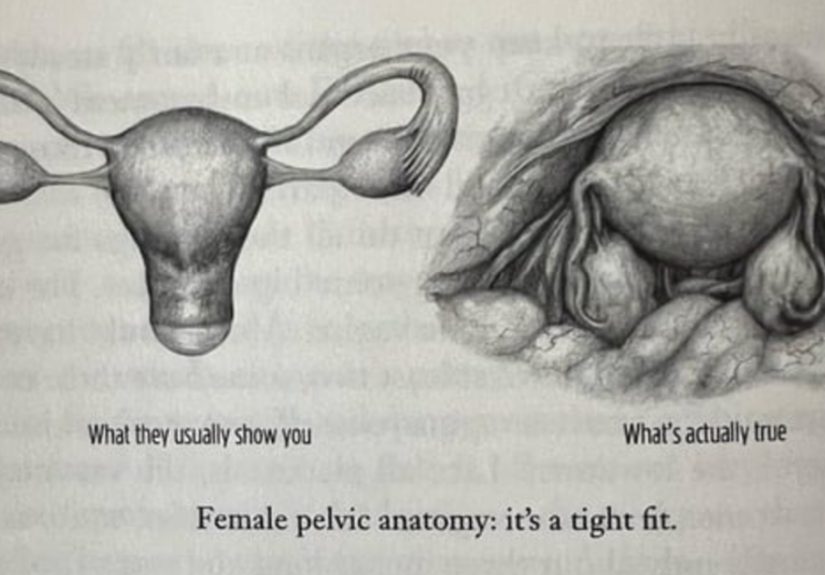
Cycle length matters, and so does individual variation. If someone has a longer cycle, ovulation may happen later. That means fertility timing is more personalized than the old textbook diagram made it seem.
5. Sperm can hang around longer than most people realize.
Sperm can live in the reproductive tract for several days, while the egg has a much shorter window after ovulation. Translation: pregnancy timing is not as simple as “one exact day.” Biology enjoys suspense.
6. Premenstrual symptoms can start well before the period itself.
Bloating, breast tenderness, mood changes, sleep shifts, cravings, and irritability may start one to two weeks before bleeding begins. So if someone feels “off” before their period arrives, that is not imaginary. It may just be hormones warming up backstage.
7. A period that lasts more than seven days deserves attention.
Many people normalize very long, very heavy periods because they have always had them. But bleeding that goes on and on is not something to shrug off. Heavy or prolonged bleeding can point to underlying issues worth discussing with a clinician.
8. Missing periods for months is not something to casually ignore.
If someone who usually menstruates stops getting periods for three months or more, that is a medical conversation, not a personality trait. Stress, hormone conditions, pregnancy, weight changes, medications, and other health issues can all play a role.
9. Estrogen does far more than regulate reproduction.
Estrogen helps influence much more than periods and fertility. It affects the heart, bones, skin, blood vessels, and more. So when estrogen changes, the ripple effects can show up all over the body, not just in the reproductive system.
10. Ovaries make more than one important hormone.
People often hear about estrogen and progesterone, but the ovaries also produce testosterone. Yes, testosterone. The female body contains a whole hormonal ensemble, not a one-hormone solo act.
11. Dense breasts do not necessarily feel dense.
Breast density refers to how breast tissue looks on a mammogram, not whether breasts feel lumpy on an exam. That means someone can have dense breasts without realizing it. Mammograms reveal what fingers cannot.
12. Breast density can affect screening decisions.
Dense breast tissue can make abnormalities harder to see on mammograms, which is one reason screening conversations matter. It is not about panic; it is about understanding the information your body gives and the tools doctors use to read it.
13. The pelvic floor is a major player in everyday life.
These muscles support the bladder, bowel, and reproductive organs. They also help with urination, bowel movements, and sexual function. In short, the pelvic floor is doing way more behind the scenes than it gets credit for.
14. Pelvic floor problems are not always about weakness.
Many people assume pelvic floor issues mean the muscles are “loose” or weak. Not always. Sometimes those muscles are too tight and do not relax properly, which can contribute to pain, constipation, urinary issues, or painful sex.
15. Kegels are not a cure-all.
Kegels can help strengthen the pelvic floor in some cases, but more squeezing is not the answer for every symptom. If the muscles are already too tense, piling on more contractions may be about as helpful as trying to solve a traffic jam with extra cars.
16. Women are more likely to get UTIs partly because of anatomy.
The female urethra is shorter, and its opening is closer to the anus and vagina, making it easier for bacteria to reach the bladder. That does not mean someone is doing anything wrong. It means anatomy can be annoyingly efficient in all the wrong ways.
17. Severe period pain is not always “just bad cramps.”
If pain is intense, disruptive, or accompanied by heavy bleeding, pain during sex, bowel trouble, or fertility concerns, it may be worth evaluating for conditions such as endometriosis or adenomyosis. Too many women are told to tough it out when what they really need is an answer.
18. Endometriosis affects more than the uterus area.
Endometriosis involves tissue similar to the uterine lining growing outside the uterus, and it is increasingly understood as a systemic condition. That means its effects can go beyond pelvic pain and influence fatigue, mood, and overall quality of life.
19. Endometriosis is often diagnosed late.
One of the more frustrating facts in women’s health is how long diagnosis can take. Symptoms may be dismissed, mistaken for something else, or normalized. By the time many people learn what is happening, they have already spent years thinking their suffering was ordinary.
20. Pregnancy can change sex drive in either direction.
Hormonal changes during pregnancy may increase libido for some people and lower it for others. There is no universal pregnancy script. One body may say, “Romance sounds great,” while another says, “Please hand me crackers and let me nap.”
21. Postpartum recovery involves more than caring for a newborn.
After birth, many women experience bleeding, cramping, soreness, back pain, neck pain, joint pain, and perineal discomfort. Yet postpartum recovery is often treated like a quick afterthought. The body, meanwhile, is busy rebuilding itself after a major event.
22. Serious heart problems can happen during or after pregnancy, even though they are rare.
Peripartum cardiomyopathy is a rare form of heart failure that can appear near the end of pregnancy or in the months after delivery. Because symptoms can overlap with normal pregnancy discomfort, recognition may be delayed. That is why unusual shortness of breath, swelling, or extreme fatigue should not be brushed off.
23. Pregnancy warning signs are not always dramatic movie scenes.
Urgent symptoms can include severe headache, vision changes, chest pain, trouble breathing, fainting, or swelling that suddenly gets worse. Real-life complications often look less like a television emergency and more like symptoms someone is tempted to dismiss.
24. Menopause is officially diagnosed only after 12 straight months without a period.
One skipped month does not equal menopause. Menopause is diagnosed after a full year without menstruation, and the average age in the United States is 51. Biology likes paperwork, apparently.
25. Perimenopause can begin before menopause officially arrives.
For many women, the transition starts in the mid-40s, though timing varies. Often the first clue is a change in the menstrual cycle. That means the body may start changing long before anyone uses the word “menopause” out loud.
26. Hot flashes are common, but they are not the only menopause symptom.
Night sweats get a lot of attention, and yes, they deserve it. But menopause can also affect sleep, mood, vaginal dryness, sexual comfort, and concentration. It is less a single symptom than a whole-body remix.
27. Mood changes during perimenopause are real.
Many women experience PMS-like mood symptoms during perimenopause. That can include irritability, sadness, anxiety, or emotional unpredictability. It is not “being dramatic.” It is a real physiological shift that deserves real support.
28. Falling estrogen can affect bones, skin, hair, and joints.
When estrogen levels drop, changes may show up in surprising places: drier skin, thinner hair, achier joints, and faster bone loss. This is one reason midlife health conversations should go well beyond “Are you having hot flashes?”
29. Menopause raises the stakes for heart and bone health.
Lower estrogen and age-related changes can increase the risk of osteoporosis and heart disease. This is a major reminder that women’s health is whole-body health, not a niche category tucked away in a gynecology brochure.
30. Women’s heart attack symptoms can be easy to miss.
Chest pain is still common, but women may also have nausea, unusual fatigue, shortness of breath, jaw pain, back pain, or stomach discomfort. That is one reason heart disease in women can be overlooked. When symptoms do not match the Hollywood version, people may delay getting help.
What These Facts Really Mean
The biggest takeaway is not that the female body is mysterious. It is that it has been underexplained. When women learn that long periods are not always normal, pelvic pain deserves evaluation, mood changes can be hormonal, and heart symptoms may look different, they are not discovering bizarre trivia. They are discovering health information they should have had all along.
And that matters. Good information changes behavior. It helps someone stop apologizing for symptoms, ask better questions, seek care sooner, and stop treating suffering like a personality quirk. Knowledge may not fix everything overnight, but it does make it harder for misinformation and self-doubt to keep running the show.
Experiences People Often Share After Learning These Facts
One of the most common reactions is disbelief. A woman learns that her soaking-through-a-pad period should have been evaluated years ago, and suddenly a decade of “I thought I was just unlucky” gets reclassified as “Wait, that was a medical issue?” Another finds out that the burning, urgency, and repeat UTIs she blamed on bad luck were partly tied to basic anatomy, not some personal failure at being a hygienic adult. It is often less of an “aha” moment and more of a “You have got to be kidding me” moment.
Then there are the people who discover pelvic floor therapy and feel like they have been let in on an excellent secret. Many expected pelvic issues to mean weak muscles and endless Kegels, only to learn that some pelvic floors are actually too tight. For women with pelvic pain, constipation, bladder leaks, or painful sex, that fact can be life-changing. It reframes the problem from “my body is broken” to “my body is asking for a different kind of support.”
Others talk about the first time they learned the difference between the vulva and vagina and felt personally betrayed by every vague health class diagram they had ever seen. It sounds funny, but it has real consequences. If people do not know what body part is what, it becomes harder to describe symptoms, understand diagnoses, or advocate for themselves in medical settings. Good anatomy language is not awkward; it is useful.
Pregnancy and postpartum stories often carry the same theme: surprise. New mothers are stunned to learn how many body systems are involved in recovery. Bleeding, cramping, soreness, back pain, and emotional whiplash can all coexist while everyone around them is focused on the baby. Many women later say they wish someone had been more honest about postpartum healingnot in a scary way, but in a respectful, realistic one.
Perimenopause brings its own genre of delayed revelations. A woman in her 40s suddenly has erratic periods, poor sleep, mood swings, brain fog, and dryness and wonders whether she is stressed, aging, overworked, under-rested, or secretly turning into a gremlin. Then she learns that hormonal shifts can affect all of those things. What often follows is relief. Not because the symptoms vanish, but because the confusion does.
And perhaps the most serious stories involve heart symptoms. Women frequently report that they did not realize nausea, jaw pain, back pain, or overwhelming fatigue could signal a heart attack. That gap in awareness can be dangerous. The lesson people share afterward is simple and urgent: women’s symptoms do not have to look dramatic to matter.
Taken together, these experiences point to one truth: women do not need more shame, silence, or “that’s just part of being a woman” speeches. They need clear information, earlier conversations, and healthcare that takes their symptoms seriously the first time.
Conclusion
The female body is not fragile, confusing, or “too complicated.” It is sophisticated. The real problem is that too many important facts about it are treated like niche trivia instead of everyday health knowledge. Once women learn how much is actually normal, what is not, and which symptoms deserve attention, the whole picture changes.
So yes, these facts are wild. But they are also practical. They can help someone understand their cycle, recognize a warning sign, seek treatment sooner, or finally realize that the thing they have been quietly enduring for years is worth talking about. And honestly, that is the kind of information absolutely worth sharing.
Note: This article is for educational purposes only and is not a substitute for personal medical advice, diagnosis, or emergency care.