Table of Contents >> Show >> Hide
- What Is the Area of a Square?
- Can You Find the Area of a Square from the Diagonal?
- Why the Formula Works
- The Main Formula You Need
- How to Solve It Step by Step
- How to Find the Area of a Square Using the Diagonal and Side Length Relationship
- Exact Answers vs. Decimal Answers
- Common Mistakes to Avoid
- Real-World Uses of This Formula
- Practice Problems
- Quick Mental Math Trick
- When to Use This Formula Instead of the Standard Square Area Formula
- A Helpful Summary Formula Box
- Experience and Practical Lessons From Using This Formula
- Conclusion
Some math formulas walk into your life like a drill sergeant. This one strolls in like a helpful friend carrying coffee and graph paper. If you know the length of a square’s diagonal, you can find its area fast, cleanly, and without turning your notebook into a crime scene of crossed-out numbers. Better yet, the formula is elegant enough to make geometry feel less like punishment and more like a neat little magic trick.
In this guide, you’ll learn exactly how to find the area of a square using the length of its diagonal, why the formula works, how to solve common examples, and what mistakes to avoid. We’ll also look at real-life situations where this comes in handy, because math tends to behave better when it has a job to do.
What Is the Area of a Square?
The area of a square is the amount of space inside it. Since all four sides of a square are equal, the basic formula is simple:
Area = side × side = side2
That works perfectly when you know the side length. But sometimes you do not know the side. Sometimes all you have is the diagonal, which is the line segment stretching from one corner of the square to the opposite corner. Luckily, geometry has excellent backup plans.
Can You Find the Area of a Square from the Diagonal?
Yes, absolutely. In fact, if you know the diagonal of a square, you can find the area in one move:
Area = d2 ÷ 2
Here, d represents the diagonal length.
That means the area of a square using the diagonal is just half of the diagonal squared. It is one of those formulas that feels suspiciously convenient, but it is completely legitimate.
Why the Formula Works
Step 1: Split the Square into Two Right Triangles
Draw the diagonal across a square. That diagonal divides the square into two identical right triangles. If each side of the square is s, then the triangle’s legs are both s, and the hypotenuse is the diagonal d.
Step 2: Use the Pythagorean Theorem
For a right triangle, the Pythagorean Theorem says:
a2 + b2 = c2
In this case:
s2 + s2 = d2
So:
2s2 = d2
Divide both sides by 2:
s2 = d2 ÷ 2
But remember, s2 is the area of the square. Therefore:
Area = d2 ÷ 2
And there it is. Geometry did the heavy lifting so you would not have to.
The Main Formula You Need
If the diagonal of a square is known, use:
A = d2 / 2
Where:
- A = area of the square
- d = length of the diagonal
This is the key formula for how to find the area of a square using the length of its diagonal.
How to Solve It Step by Step
Method 1: Use the Formula Directly
- Write down the diagonal length.
- Square the diagonal.
- Divide by 2.
- Attach the correct square unit, such as square inches, square feet, or square centimeters.
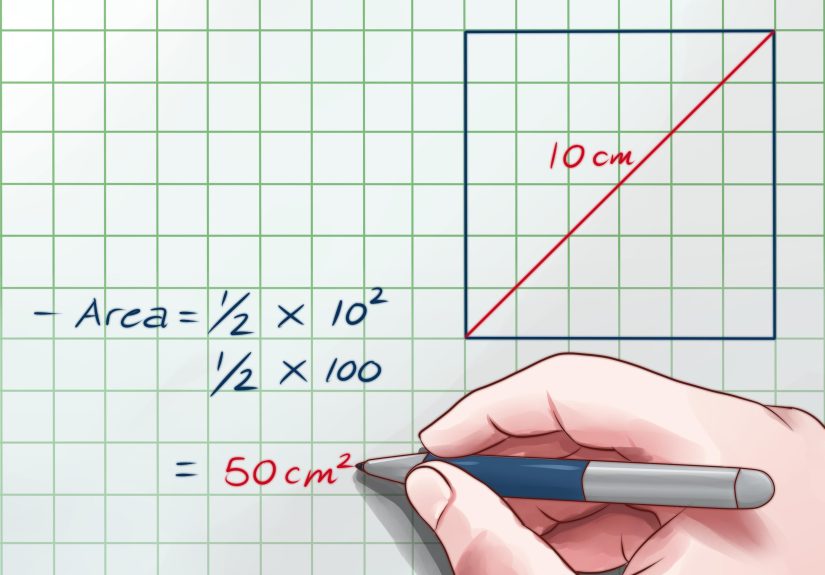
Example 1: Diagonal = 10 inches
Use the formula:
A = d2 / 2
Substitute d = 10:
A = 102 / 2 = 100 / 2 = 50
Answer: 50 square inches
Example 2: Diagonal = 12 cm
A = 122 / 2 = 144 / 2 = 72
Answer: 72 cm2
Example 3: Diagonal = 7 feet
A = 72 / 2 = 49 / 2 = 24.5
Answer: 24.5 square feet
This example is a good reminder that the answer will not always be a whole number. Math does not owe us pretty endings.
How to Find the Area of a Square Using the Diagonal and Side Length Relationship
Some people prefer understanding the diagonal formula through the side length first. That is also a solid approach.
For a square:
d = s√2
To solve for the side length:
s = d / √2
Then plug that into the standard area formula:
A = s2 = (d / √2)2
Simplify:
A = d2 / 2
So whether you go directly or take the scenic route through side length, you end up at the same destination.
Exact Answers vs. Decimal Answers
When working with square roots and diagonals, you may see two styles of final answer:
Exact Form
Example: 49/2 square units
Decimal Form
Example: 24.5 square units
Both are correct unless your teacher, textbook, test, or client asks for a specific format. In classroom settings, exact form is often preferred. In real-world measurements, decimals are often more practical.
Common Mistakes to Avoid
1. Forgetting to Square the Diagonal
If the diagonal is 8, the formula is not 8 ÷ 2. It is 82 ÷ 2. That is a very different party.
2. Mixing Up Area and Perimeter
Area measures the space inside the square. Perimeter measures the distance around it. If your answer is in plain inches instead of square inches, something has gone sideways.
3. Forgetting Units
If the diagonal is measured in feet, the area must be in square feet. Area always uses square units.
4. Using the Wrong Formula
Do not use the rectangle formula or the rhombus formula unless the problem actually involves those shapes. Yes, a square is a special kind of rhombus, but when the diagonal formula for a square is this clean, there is no reason to make life harder.
Real-World Uses of This Formula
The formula may look like a textbook favorite, but it has practical uses too. Here are a few examples:
- Flooring and tile design: If a square tile is measured corner to corner, you can still find the surface area.
- Architecture and drafting: Designers sometimes work from diagonal measurements in plans and layouts.
- Carpentry: Square frames and panels may be checked by diagonal measurements.
- DIY projects: If you are building a square tabletop, planter, or sign, diagonal dimensions can help estimate coverage and materials.
- Classroom geometry: It is a classic example of how the Pythagorean Theorem connects shapes and measurement.
Practice Problems
Problem 1
A square has a diagonal of 6 inches. What is its area?
A = 62 / 2 = 36 / 2 = 18 square inches
Problem 2
A square has a diagonal of 14 meters. What is its area?
A = 142 / 2 = 196 / 2 = 98 square meters
Problem 3
A square garden has a diagonal of 9 feet. What is its area?
A = 92 / 2 = 81 / 2 = 40.5 square feet
Problem 4
A square window has a diagonal of 20 cm. What is its area?
A = 202 / 2 = 400 / 2 = 200 cm2
Quick Mental Math Trick
If the diagonal is an even number, this formula often becomes especially friendly.
For example:
- Diagonal 4 → Area 8
- Diagonal 8 → Area 32
- Diagonal 12 → Area 72
- Diagonal 16 → Area 128
Why? Because you square the diagonal and cut it in half. Once you do it a few times, your brain starts spotting the pattern before your calculator even wakes up.
When to Use This Formula Instead of the Standard Square Area Formula
Use A = d2 / 2 when:
- The problem gives you the diagonal instead of the side
- You measured corner-to-corner
- You want a faster route without first solving for the side length
Use A = s2 when the side length is already known.
Both formulas are correct. One just saves you a step when the diagonal is what you have.
A Helpful Summary Formula Box
Standard formula: Area = side2
Diagonal formula: Area = diagonal2 ÷ 2
Diagonal-side relationship: diagonal = side√2
If you remember only one thing from this article, make it this:
To find the area of a square from its diagonal, square the diagonal and divide by 2.
Experience and Practical Lessons From Using This Formula
One of the most interesting things about learning how to find the area of a square using the length of its diagonal is that people usually do not trust the formula at first. Students see A = d2 / 2 and immediately give it the same suspicious look they reserve for group projects and printers that claim they are “offline” for emotional reasons. The formula feels too simple. Then they test it with a square whose side length is easy to verify, and suddenly geometry earns a little respect.
In classroom practice, this topic often becomes the moment when abstract math starts feeling connected. A student may begin with a plain square drawn on paper, add a diagonal, and realize that one line has secretly created two right triangles. That small visual shift changes everything. Instead of memorizing disconnected formulas, they start seeing relationships. The square is no longer just a box. It becomes a shape with structure, symmetry, and a hidden shortcut built inside it.
Outside the classroom, the same idea shows up in surprisingly practical ways. Someone measuring a square tile from corner to corner can estimate coverage without first calculating the side. A DIY builder checking a square wooden panel may already have the diagonal measurement on hand. A designer looking at a plan or template may need area quickly from a corner-to-corner dimension. In these situations, the formula is not just a math exercise. It saves time and reduces extra steps.
Another common experience is that learners remember this formula better when they compare it with the side formula. They notice that if the diagonal gets larger, the area grows fast because the diagonal is squared. That leads to better number sense. For example, doubling the diagonal does not merely double the area. It makes the area four times as large after squaring, then dividing by two. That kind of pattern recognition helps students become more confident with geometry, algebra, and measurement in general.
There is also a confidence boost that comes from solving the same problem two ways. You can use the direct formula A = d2 / 2, or you can find the side first using s = d / √2 and then square it. When both methods match, people stop feeling like they are guessing and start feeling like they actually understand the math. That is a big deal. Understanding sticks longer than memorizing, and it is much more useful when test day or real life shows up.
Perhaps the best experience tied to this topic is the moment the formula stops looking random. Once learners see the Pythagorean Theorem create the connection, the result feels logical instead of magical. That is when math becomes less about surviving formulas and more about recognizing patterns. And honestly, that is a pretty satisfying upgrade for one humble square and its very hardworking diagonal.
Conclusion
Finding the area of a square from its diagonal is one of the cleanest moves in geometry. Instead of hunting for the side length first, you can go straight to the answer with A = d2 / 2. The formula comes directly from the Pythagorean Theorem, which means it is not just easy to use; it also makes mathematical sense.
Whether you are solving homework problems, checking measurements for a DIY project, or just trying to keep geometry from getting dramatic, this method is fast, reliable, and surprisingly elegant. Square the diagonal, divide by two, add the correct square units, and move on with the confidence of someone who has outsmarted a word problem before lunch.