Table of Contents >> Show >> Hide
- Meet the AI Time Traveller: The Artist Behind the Selfies
- How the AI Historical Selfies Are Created
- Iconic People From the Past, Reimagined as Selfie-Takers
- Why These AI Selfies Feel So Real (and So Uncanny)
- Fun, But Also Serious: The Ethics of AI-Generated History
- How to Enjoy AI Time Traveller Art Responsibly
- What Makes This Bored Panda Style So Addictive?
- Looking Ahead: The Future of AI, Art, and Historical Imagination
- Experiences and Reflections on the AI Time Traveller Phenomenon
- Conclusion: A Playful Passport Between Past and Present
Imagine opening your favorite photo app and seeing Martin Luther King Jr. grinning at the camera, Cleopatra casually posing with eyeliner on point, or Albert Einstein trying to figure out which filter makes his hair look the most chaotic. That’s the wonderfully weird universe of the “AI Time Traveller” series, where iconic people from the past appear as if they’ve just discovered front-facing cameras and Wi-Fi.
The project, popularized on Bored Panda, reimagines historic personalities as selfie-takers using a mix of artificial intelligence and digital artistry. It’s part history lesson, part social-media parody, and part “wait… why does this feel so real?” fever dream. Let’s time travel through this series, explore how it’s made, and talk about why these AI selfies are both entertaining and thought-provoking.
Meet the AI Time Traveller: The Artist Behind the Selfies
The mastermind behind many of these AI-powered historical selfies is digital artist Jyo John Mulloor, a Dubai-based creative known for turning imaginative “what if” scenarios into photorealistic art. With years of experience in graphic design, retouching, and concept-driven campaigns, he brings professional-level polish to images that could easily pass as real photographs at first glance.
Mulloor’s “Historical Selfie Series” leans into a simple but powerful idea: what if our most iconic figures had smartphones and the same urge to document everything that modern people do? Instead of oil paintings and dusty black-and-white photos, we get crisp, colorful portraits that feel like they were shot on a brand-new flagship phone.
The result is not just a set of fun images for social media. It’s also a playful bridge between past and present, reminding us that behind every famous name was a person who laughed, posed, had good angles, and probably had bad hair days too.
How the AI Historical Selfies Are Created
These portraits don’t appear out of thin air just because someone typed “Napoleon selfie at Waterloo” into a magical box. The process usually blends several tools and skills:
- Prompting AI image models: The artist starts with prompts that describe the person, their era, their clothing, and the mood of the “photo.” Think: “Martin Luther King Jr., mid-speech energy, close-up selfie, 1960s suit, realistic lighting.”
- Reference images: Historic portraits, photos, and sculptures help the AI generate a face that feels recognizable and grounded in reality.
- Digital retouching: After AI does its first pass, traditional tools like Photoshop come in. The artist refines facial details, adjusts lighting, cleans up AI glitches (extra fingers, strange ears, ghost jewelryAI can be weird), and adds final touches.
- Smartphone-style framing: The final images mimic real selfies: slightly extended arm angles, tight framing, blurred backgrounds, and that “I just opened the front camera and committed to the moment” vibe.
It’s part machine, part human, and 100% crafted. That’s what makes the series more than just a collection of random AI outputsit’s digital storytelling.
Iconic People From the Past, Reimagined as Selfie-Takers
A big part of the charm is the casting. The “AI Time Traveller” concept pulls from different eras, cultures, and fields, letting us see how a wide range of historic legends might show up in our social feeds today.
Civil Rights Leaders and Visionaries
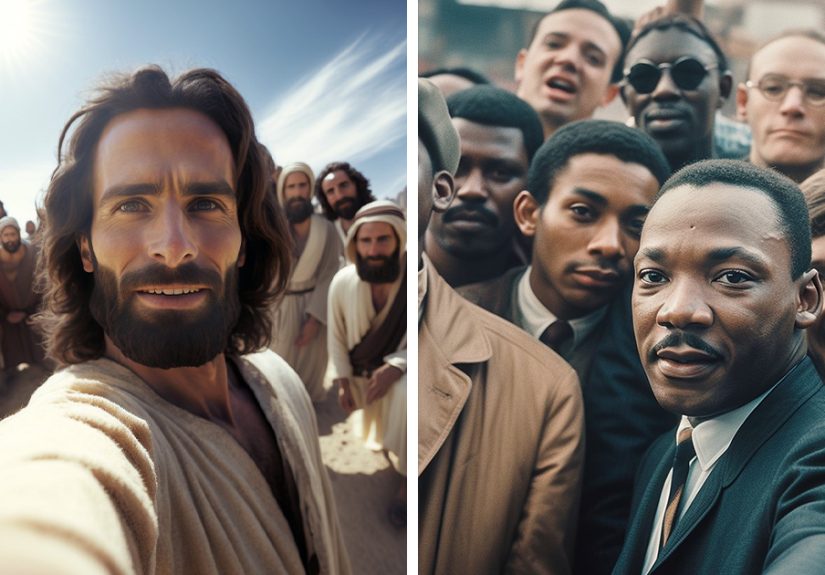
A selfie of someone like Martin Luther King Jr. is instantly striking. Instead of a documentary-style archive photo, you see him looking straight into the “phone,” eyes warm, slightly smiling, as if he’s about to post, “Headed to the march. Keep dreaming big.”
These portraits don’t replace historical records, of course, but they humanize leaders who are often frozen in very formal, serious images. The selfie pose feels casual and intimate, reminding viewers that their courage came from real people with everyday emotionsnot untouchable statues come to life.
Musical Legends in the Age of Filters
Then there are the music icons. Imagine Bob Marley, relaxed and radiant, framed by the greens and golds of a tropical backdrop, or a young Elvis Presley smirking into the camera like he just discovered Instagram Stories. These AI selfies lean into each artist’s aesthetic while giving them a modern, almost influencer-like presentation.
You can practically hear the playlist: reggae, rock and roll, classic soulall packed into a digital photo that would probably rack up millions of likes within minutes.
Scientists, Explorers, and Space Pioneers
One of the most delightful twists is seeing scientists and explorers in selfie mode. A recreated Neil Armstrong selfie, for example, might show him in a space suit with Earth glowing behind him, like the ultimate “greetings from the moon” postcard.
Albert Einstein’s wild hair fits perfectly into the selfie age. Instead of the iconic tongue-out photo taken by a press photographer, you get the sense that he’d be the kind of guy to post experimental selfies while joking about bending space-timeand probably complaining about the algorithm.
Queens, Pharaohs, and Old-World Royalty
Royal portraits also get a glow-up. Cleopatra might appear with dramatic eyeliner and golden accessories, posing like a modern beauty influencer; a young Queen Elizabeth I could be lit with renaissance-meets-ring-light energy. These images mash up classical regal styling with the casual intimacy of a smartphone portrait.
The combination is strange and mesmerizing: people who were historically distant and heavily mythologized suddenly feel like they might DM you back.
Why These AI Selfies Feel So Real (and So Uncanny)
Part of the series’ viral power is how eerily convincing some of the images are. AI models and skilled digital artists can now simulate:
- Natural skin textures and pores
- Realistic lighting and shadows
- Fabric, jewelry, and historical clothing details
- Camera lens distortions, like subtle wide-angle stretching at arm’s length
Our brains are used to seeing “vintage” people only through paintings or grainy photographs. When the same figures appear in 4K selfie quality, our sense of time gets scrambled. It feels like we’re looking at an alternate timeline where Cleopatra posts in Stories and Shakespeare runs an “Ask Me Anything” about writer’s block.
That mix of familiar and unfamiliar is what makes the series both entertaining and slightly uncanny. It asks, without saying a word: if these people lived today, how would they present themselves online?
Fun, But Also Serious: The Ethics of AI-Generated History
As fun as it is to imagine Napoleon arguing about filters, AI-generated historical selfies also raise serious questions. When we create new “photos” of long-gone people, we’re inventing images that never existedyet can look more convincing than many original sources.
A few key ethical points to keep in mind:
- Historical accuracy vs. artistic freedom: AI can make people look younger, older, prettier, or more glamorous than they were. That’s art, but it shouldn’t be mistaken for fact.
- Respect for legacy: Some figures, especially civil rights leaders or people who died tragically, carry emotional weight. Using their image should be done with care and respect, not just for quick clicks.
- Clear labeling: Viewers should know that these are AI-based interpretations, not newly discovered photographs from a secret archive under a museum staircase.
When artists and platforms clearly frame these works as creative reinterpretations, AI historical selfies can spark curiosity instead of confusion. They become conversation starters, not counterfeit evidence.
How to Enjoy AI Time Traveller Art Responsibly
If you’re scrolling through Bored Panda, Pinterest, or Instagram and stumble on these AI time-travel selfies, here are a few ways to appreciate them without losing your grip on reality:
- Read the captions: Good creators usually mention that AI tools are involved and describe their process.
- Treat them as “what if” stories: Think of them like fan art of historya playful remix, not a replacement for actual archives.
- Use them as a learning gateway: See a selfie of a historical person you barely know? Use that as a nudge to look up their real life, achievements, and actual portraits.
- Discuss the ethics: Talk with friends, students, or kids about how AI can both enrich and complicate our understanding of the past.
Instead of fearing the technology, you can use these images to sharpen digital literacy: “This is cool. Also, this is not real. Let’s learn what is.”
What Makes This Bored Panda Style So Addictive?
If you’ve spent any time on Bored Panda, you know the formula: eye-catching visuals, a fun premise, and a scrollable gallery that keeps you hooked. The “AI Time Traveller” series fits that template perfectly.
The mix of humor, nostalgia, and tech novelty gives the piece long “scroll life.” You don’t just glance and move onyou stop, zoom in, compare, share, and send to that friend who always says they were born in the wrong era.
It’s also extremely shareable content for platforms like Pinterest and Facebook, where people love visually driven, conversation-sparking posts. A single image of a historical selfie can start threads about fashion, politics, religion, music, and technology, all in one place.
Looking Ahead: The Future of AI, Art, and Historical Imagination
The “AI Time Traveller” concept is probably just the beginning. As AI and creative tools improve, we’ll see more:
- Animated versions of historical selfiesshort clips where figures laugh, blink, or look around
- Immersive “time travel” experiences where you can stand “next to” iconic people in virtual or augmented reality
- Educational projects that blend AI visuals with expert historical commentary to explain context, clothing, and culture
Used thoughtfully, these tools can make history feel less like a dusty chapter and more like a vivid, emotionally resonant story. The key is to balance playfulness with responsibility.
Experiences and Reflections on the AI Time Traveller Phenomenon
So what is it actually like to live with this kind of content everywhereon your feed, in group chats, and in late-night scrolling sessions you promised yourself you wouldn’t have? Let’s walk through some common experiences people have with the “AI Time Traveller” style of art.
First, there’s the shock of recognition. You’re scrolling casually when a face pops up that you absolutely know shouldn’t exist in modern camera quality. Maybe it’s a pharaoh, a philosopher, or a revolutionary leader. For a split second, your brain goes, “Wait, who took this?” That cognitive glitch is powerfuland it’s exactly what makes these images so shareable.
Then comes the curiosity phase. People often zoom in, inspect details, and start playing detective: Is this AI? Is it a movie still? Is it some kind of deepfake? You might notice tiny giveawaysslightly off hands, too-perfect skin, or jewelry that doesn’t quite obey gravity. The longer you look, the more you become aware that you’re seeing a blend of imagination and computation, not an actual time-travel snapshot.
There’s also a big dose of personal projection. Viewers imagine how these figures would behave online today. Would Einstein run a chaotic but brilliant Twitter account? Would Cleopatra dominate luxury Instagram and beauty TikTok? Would civil rights leaders be using livestreams and hashtags to mobilize support? These mental “what if” scenarios can actually deepen your connection to the historical people themselves.
For some, the experience becomes educational by accident. You recognize a couple of famous faces in the gallery, but then stumble on someone you’ve never seen before. Curious, you Google them, fall into a short biography, then a documentary, then a thread about their impact. All because an AI-generated selfie made you wonder, “Who is this, and why are they important enough to be in this lineup?”
There’s also a very modern, very human layer: comparing our own selfies to theirs. People joke in the comments that their front-camera photos could never compete with Cleopatra’s AI glow or a knight’s perfect armor. It highlights how much of our identity we now filter through photos and how natural it feels to evaluate ourselves and others through imagesreal or generated.
At the same time, some viewers feel a twinge of discomfort. It can be unsettling to see victims of injustice, revolutionaries, or people who lived through violence turned into glossy portraits that could be mistaken for fashion photography. That discomfort is not a bugit’s a signal. It reminds us that while AI can make beautiful imagery, we have a responsibility to think about the stories and histories behind the faces.
Many educators, content creators, and parents use this discomfort as a teaching moment. They’ll show the AI selfies alongside real historical portraits, asking questions like: “Which one feels more real? Why?” and “How can you tell the difference?” This turns an entertaining image gallery into a mini masterclass in media literacy.
Ultimately, the experience of the “AI Time Traveller” style content is a blend of awe, amusement, reflection, and caution. You can enjoy the creativity, laugh at the idea of time-traveling selfies, and still hold onto a clear understanding that these images are interpretations, not evidence. When approached with that mindset, the series becomes more than just 28 fun picturesit becomes a playful mirror reflecting how we, in the selfie era, relate to the people who shaped our world long before smartphones existed.
Conclusion: A Playful Passport Between Past and Present
“AI Time Traveller: Artist Shows How Iconic People From The Past Would Take Their Selfies (28 Pics)” is more than a catchy headline. It’s a snapshot of our moment in time, where technology lets us remix history, social media shapes how we present ourselves, and AI tools blur the line between documentation and imagination.
These images won’t replace textbooks or museums, and they shouldn’t. But they can spark curiosity, inspire conversations, and remind us that history is made of people who were just as complex, funny, insecure, and expressive as we are. If seeing a legendary figure in selfie form nudges someone to learn more about their real life, that’s a pretty good use of pixels.
And if you ever catch yourself thinking, “What would my selfie look like if I lived in another era?”congratulations. You’ve officially joined the AI time-travel club.