Table of Contents >> Show >> Hide
Some museums are quiet. Some are educational. Some are so impressive that your brain briefly forgets how to form complete sentences and settles for, “Whoa.” Space Shuttle Atlantis belongs in that third category. An evening with Atlantis is not just a museum visit. It is part engineering lesson, part national memory, part emotional ambush, and part reminder that humans once built a winged spacecraft, launched it like a rocket, flew it in orbit, and landed it like an airplane. That sentence alone still sounds like science fiction wearing a government badge.
Yet Atlantis is very real, and that is the magic. At Kennedy Space Center Visitor Complex in Florida, the orbiter is displayed in a way that makes it feel less like a retired artifact and more like it just slipped home from orbit, stretched a robotic arm, and paused long enough for the rest of us to catch up. For visitors, especially in the evening when the lighting turns theatrical and the crowds feel a little softer around the edges, Atlantis becomes more than a spacecraft. It becomes a story you can walk into.
This is what makes an evening with Space Shuttle Atlantis unforgettable: the shuttle’s astonishing record, the exhibit’s clever design, the human triumphs and tragedies wrapped around the program, and the strange, powerful feeling of standing beneath a machine that once outran dawn.
Why Atlantis Still Owns the Room
Before you even get to the shuttle itself, the experience works hard to build suspense. That is not accidental. Atlantis is too big, too storied, and too iconic to just plop in front of visitors like an oversized coffee maker at a warehouse store. The reveal matters. And when it happens, it lands.
A Spacecraft Displayed Like a Spacecraft
Atlantis is not parked flat on the floor. It is suspended at an angle, payload bay doors open, Canadarm extended, as if it has just undocked from the International Space Station and drifted into a freeze-frame. That choice changes everything. Instead of looking like retired hardware, the orbiter looks alive with purpose. You do not merely see Atlantis; you encounter it in its native pose.
The visual effect is startling because the shuttle is enormous. In photos, orbiters can seem sleek and almost toy-like, the way big machines often do when the camera steals their scale. In person, the illusion collapses. Atlantis is 122 feet long, broad-shouldered, scarred with thermal tiles, and somehow both elegant and rugged at once. It looks less like a vehicle designed by committee and more like a machine designed by very smart dreamers who occasionally ignored the phrase “that seems difficult.”
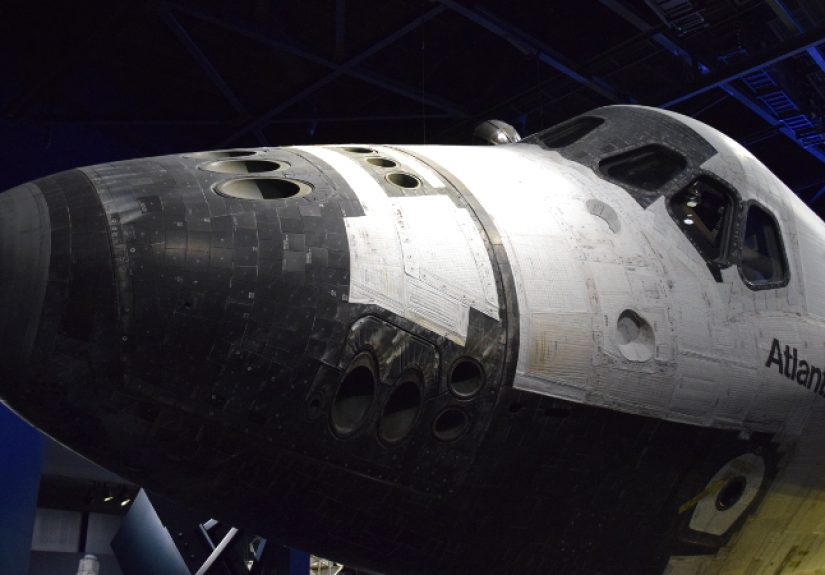
That contrast is part of the appeal. Atlantis is graceful from a distance, but close up it is all business: black tiles, weathered surfaces, mechanical lines, and the unmistakable evidence that this was not a movie prop. It went to space 33 times. It came back. It did the job. Then it came back again.
The Power of the First Glimpse
One reason the exhibit lingers in memory is that it understands showmanship without slipping into gimmickry. Atlantis is treated with a little drama and a lot of respect. That balance matters. A shuttle orbiter does not need fireworks. It already was the fireworks.
Once the shuttle appears, the mood in the room changes. People start talking more quietly. Phones come out, of course, because modern civilization has decided that awe must always be documented. But even behind the screens, most visitors are doing the same thing: trying to reconcile the legendary object in their imagination with the actual machine hovering a short distance away. The result is one of those rare public experiences that still feels personal.
The Real History Behind Atlantis
Atlantis deserves the reverence because its résumé is absurdly impressive. Delivered to Kennedy Space Center in 1985, Atlantis flew its first mission in October of that year and went on to become one of the defining orbiters of the shuttle era. By the time NASA retired it, Atlantis had orbited Earth 4,848 times and traveled about 126 million miles. That is not just a lot of frequent flyer points. That is a career.
From Defense Missions to Deep-Space Ambition
Atlantis began with a classified Department of Defense mission, which is a very intense way to introduce yourself. But its career quickly expanded into the wide-ranging, sometimes contradictory genius of the shuttle program. Atlantis helped deploy major spacecraft, supported scientific research, carried international crews, and handled some of the most visible missions of the late twentieth and early twenty-first centuries.
Two of the most famous science missions associated with Atlantis were the launches of Magellan to Venus and Galileo to Jupiter. That alone would be enough to secure a solid place in space history. Very few vehicles can brag that they helped send humanity’s robotic scouts toward two different planets. Atlantis can do that without even loosening a tile.
Atlantis and Hubble: A Great Save
If there is one chapter that gives Atlantis a heroic glow, it is Hubble. In 2009, Atlantis flew the final shuttle servicing mission to the Hubble Space Telescope. During that mission, astronauts carried out five spacewalks to repair and upgrade the observatory, replacing key hardware, installing new instruments, and extending Hubble’s scientific life.
That mission matters because Hubble is one of the most beloved scientific instruments ever built. It has shown humanity star birth, galactic collisions, black hole neighborhoods, and the deep-field images that make the universe feel both larger and stranger than common sense allows. Atlantis helped make those years of discovery possible. In other words, if you have ever stared at a Hubble image and felt gloriously tiny, Atlantis had a hand in that.
Mir, the ISS, and the Work of Building Orbit
Atlantis also played a major role in international cooperation. In 1995, it docked with the Russian space station Mir, a milestone that helped turn former Cold War rivalry into practical partnership. The Shuttle-Mir missions were more than symbolic. They taught NASA and its partners how to operate together in orbit, how to transfer crews and cargo, and how to build trust in the kind of complicated environment where “close enough” is not a comforting phrase.
That experience helped pave the way for the International Space Station, and Atlantis became one of the orbiters that helped assemble and maintain that orbital outpost. It delivered major components and supplies, including the Destiny laboratory and the Quest airlock, along with truss elements and logistics cargo essential to station operations. For all the attention the shuttle received as a spectacle, missions like these showed its practical genius. Atlantis did not just visit the future. It helped bolt the future together.
The Final Flight of an Era
Atlantis made the last shuttle flight in history. STS-135 launched on July 8, 2011, and landed on July 21, closing the 30-year shuttle era. That final mission carried supplies and equipment to the International Space Station and marked the end of a program that had shaped generations of scientists, engineers, astronauts, teachers, and kids who once looked at the sky and thought, “That. I want to understand that.”
So when you stand before Atlantis now, you are not just looking at a retired orbiter. You are looking at the vehicle that closed one of the most ambitious chapters in American spaceflight.
What Makes the Exhibit More Than a Victory Lap
Plenty of institutions can display an important object. Fewer can build an experience that explains why the object mattered. The Space Shuttle Atlantis exhibit succeeds because it is not content to say, “Here is a famous machine.” It asks a better question: “What did it feel like to build this, fly this, depend on this, and lose people in pursuit of this?”
Interactive, But Not Empty Calories
The building around Atlantis includes more than 60 interactive and immersive exhibits, and thankfully they are not the kind of digital filler that makes adults mutter about screen time while children press every glowing button within reach. The surrounding galleries help visitors understand life and work in orbit. There are mission displays, simulators, interactive kiosks, and opportunities to explore the broader shuttle program across all 135 missions.
A full-scale Hubble replica reinforces Atlantis’s role in servicing that telescope. Shuttle simulators let visitors appreciate the complexity of docking and landing. The famous Shuttle Launch Experience adds a dose of bodily empathy by giving people at least a tiny, sanitized hint of the violence and excitement of launch. Sanitized is important here. Real launch is considerably louder, more intense, and less interested in your snack schedule.
The Objects Around the Orbiter Matter Too
One of the exhibit’s smartest moves is that it does not let Atlantis float in isolation. Nearby artifacts and displays widen the story. The Astrovan, for example, links the shuttle era to the ritual of crew transport, those pre-launch moments when astronauts were still technically on Earth but already halfway into history. Touchscreens mapping every shuttle mission help visitors see Atlantis not as a lone celebrity, but as part of a larger fleet and a larger national effort.
This matters because the shuttle program was never just about a single orbiter or a single astronaut. It was about thousands of workers, decades of refinement, constant risk management, and a deeply complicated promise: that reusable spaceflight could become a durable part of modern life. The exhibit honors that workforce as much as the famous names.
The Quietest Room Is One of the Most Important
Then there is Forever Remembered, the memorial space connected to the Atlantis exhibit. It honors the 14 astronauts lost in the Challenger and Columbia disasters and includes personal items from the crews as well as recovered hardware from both orbiters. This is where the exhibit deliberately stops being triumphant and becomes reflective.
That choice is essential. Any honest story about the shuttle program must make room for grief as well as glory. The triumphs were real. So were the losses. By placing remembrance inside the broader Atlantis experience, the exhibit makes a mature argument: exploration is not only about success. It is also about cost, accountability, memory, and the obligation to learn.
Why an Evening Visit Feels Different
There is something especially fitting about seeing Atlantis in the evening. Daytime visits are wonderful, but evening gives the orbiter a different personality. The lighting is more dramatic. The spaces feel more contemplative. The exhibit takes on the mood of a theater, a cathedral, and a machine shop all at once.
Evening also suits the shuttle emotionally. Night launches were some of the most unforgettable sights of the program, turning the Florida coast into a brief artificial sunrise. Atlantis itself completed the final shuttle mission with a pre-dawn landing at Kennedy Space Center. So there is a strange poetic rightness in visiting the orbiter after daylight begins to soften. Atlantis belongs to the age of spotlights, countdown clocks, floodlit pads, glowing tiles, and black sky.
At that hour, the exhibit can feel less like a crowded attraction and more like a long conversation with history. Children still run ahead. Adults still stare upward. But the pace slows just enough for details to land: the texture of the thermal protection system, the open payload bay, the sense of how complicated the orbiter really was, and the dawning realization that every mission represented an enormous act of trust between crew, hardware, and ground teams.
An Extended Experience: Spending an Evening Under Atlantis
Picture the evening beginning not with the shuttle itself, but with anticipation. You move through the exhibit with the vague confidence of someone who has seen plenty of spacecraft in photos and documentaries and therefore assumes they know what is coming. Then the path narrows, the presentation builds, the lighting shifts, and suddenly you are aware that the designers are setting a trap for your emotions. It is a very effective trap.
When Atlantis finally appears, the reaction is immediate and physical. Your posture changes. Your pace changes. Conversation breaks into half-sentences. There it is, hanging at that improbable angle, payload doors open, the robotic arm stretched overhead like a gesture frozen mid-thought. For a second, the mind does a weird little stutter. Museum object. No, spacecraft. No, national icon. No, giant machine that actually survived reentry dozens of times. Atlantis resists being reduced to a single category, which is why people keep circling it, trying to understand it from another angle, and then another.
Stand beneath it long enough and the details start to do their work. The black tiles on the belly are not decorative. The seams and edges are not polished for beauty. The shuttle carries the visual grammar of effort. It looks used, because it was used. It looks tough, because it had to be. And somehow that used, weathered quality makes it more moving, not less. Perfection would have made Atlantis feel distant. Evidence of labor makes it feel earned.
An evening visit also sharpens the sense that Atlantis belongs to a particular era of American optimism, one in which the country routinely built machines so ambitious they seemed to dare physics to object. The shuttle program was flawed, expensive, brilliant, risky, transformative, and at times heartbreaking. All of that seems to hover around the orbiter with the same quiet presence as the lighting. You do not need a lecture to feel it. The machine communicates it on its own.
Then come the surrounding exhibits, and the evening deepens. You look at mission displays and realize Atlantis was not just famous for being the last shuttle to fly. It was busy for decades. It launched planetary probes. It helped service Hubble. It docked with Mir. It carried pieces of the International Space Station. The shuttle stops being a symbol and becomes a worker again, a vehicle with a long career of specific assignments, real crews, and concrete accomplishments. That shift is powerful because it rescues Atlantis from nostalgia and returns it to history.
The interactive elements help in a surprisingly human way. They break up the grandeur with texture. One moment you are staring upward in awe; the next, you are learning how docking worked, tracing mission timelines, or watching children realize that living in orbit involves a lot more engineering than cartoon gravity jokes suggested. The exhibit is good at this balance. It respects experts, welcomes beginners, and gives both groups something meaningful to do.
But the emotional center of the evening may arrive when the tone changes and you enter the memorial space. There, the noise inside your head gets quieter. The lost crews of Challenger and Columbia are not treated as footnotes to the program or as symbols flattened by familiarity. They are presented as people. That matters. It reminds visitors that exploration is built from human beings first and hardware second. The memorial does not interrupt the Atlantis story; it completes it.
By the time you return to the main hall, Atlantis may look different than it did at first. Not smaller, certainly. If anything, bigger. But also heavier with meaning. It is still beautiful. It is still dramatic. Yet now it carries the full weight of its context: triumph, routine labor, scientific payoff, international cooperation, public excitement, institutional memory, and sacrifice. Few exhibits manage to broaden a visitor’s emotional range like that without becoming preachy. Atlantis does.
And then there is the final, lingering sensation of an evening under the orbiter: inspiration without childishness. That is harder to achieve than it sounds. Plenty of attractions aim to inspire by oversimplifying. Atlantis does almost the opposite. The more you learn, the more impressive the shuttle becomes. It launched like a rocket, worked like an orbital construction platform, and landed like a glider. It demanded precision from thousands of people. It succeeded spectacularly, failed tragically, and left behind lessons that still shape human spaceflight.
Walking away, you understand why Atlantis remains so compelling. It is not just because the shuttle looks cool, though it absolutely does. It is because it represents a very specific kind of human ambition: practical enough to build hardware, bold enough to attempt the improbable, and honest enough to remember the cost. An evening with Space Shuttle Atlantis leaves you with the rare feeling that history is not finished talking. It is still right there in the room, hanging above your head, waiting for the next person to look up.
Conclusion
Space Shuttle Atlantis is one of those places where engineering, memory, and imagination share the same floor. The orbiter’s record is extraordinary on its own, but the real achievement of the exhibit is that it turns facts into feeling. You come for the shuttle and leave thinking about the people who designed it, flew it, repaired telescopes with it, docked it to stations, mourned losses around it, and passed its story forward.
An evening with Atlantis is not merely a look back at the shuttle era. It is a reminder that big, difficult, borderline outrageous projects can still matter. And standing beneath Atlantis, that idea feels less like nostalgia and more like a challenge.