Table of Contents >> Show >> Hide
- Why Trust Matters With a Parakeet
- Step 1: Give Your Parakeet Time to Settle In
- Step 2: Make the Cage Feel Like a Safe Home
- Step 3: Learn Your Parakeet’s Body Language
- Step 4: Use Your Voice Before Your Hands
- Step 5: Move Slowly and Predictably
- Step 6: Offer Treats Through the Cage Bars
- Step 7: Introduce Your Hand Inside the Cage Carefully
- Step 8: Teach the “Step Up” Cue
- Step 9: Use Positive Reinforcement, Not Punishment
- Step 10: Create Safe Out-of-Cage Time
- Step 11: Build a Daily Bonding Routine
- Common Mistakes That Slow Down Trust
- How Long Does It Take to Gain a Parakeet’s Trust?
- What If Your Parakeet Bites?
- Experience-Based Tips for Gaining Your Parakeet’s Trust
- Conclusion
Winning a parakeet’s trust is not about “showing who’s boss.” It is about proving, day after day, that your hand is not a hawk, your voice is not thunder, and your presence usually means snacks, safety, and interesting conversation.
Why Trust Matters With a Parakeet
Parakeets, also known as budgies or budgerigars, are tiny birds with huge personalities packed into bodies that look like flying highlighters. They are social, intelligent, curious, and surprisingly good at reading the room. If your parakeet does not trust you yet, it is not being “mean.” It is being careful.
In the wild, small birds survive by noticing everything: sudden movement, loud sounds, shadows, unfamiliar objects, and large mammals who open cage doors with suspicious confidence. So when a new parakeet freezes, backs away, nips, or refuses to step onto your finger, it is not plotting against you. It is asking one very reasonable bird question: “Are you safe?”
The goal of parakeet training is to answer that question with consistency. Trust grows when your bird learns that you move slowly, speak gently, respect its body language, and reward brave choices. This guide explains how to gain your parakeet’s trust in 11 practical steps, from the first quiet days at home to hand-taming, step-up training, and building a long-term bond.
Step 1: Give Your Parakeet Time to Settle In
The first step is wonderfully simple: do less. When your parakeet arrives home, resist the urge to immediately pet, hold, train, photograph, introduce it to every cousin, or perform your best “please love me” speech through the cage bars.
A new home is a lot for a small bird. There are new sounds, new smells, new lighting, new people, and perhaps a dog staring from across the room like a furry security camera. Place the cage in a calm area where your parakeet can observe the household without being trapped in nonstop chaos. Avoid high-traffic doorways, loud speakers, smoky kitchens, and windows with direct drafts.
For the first few days, focus on routine. Change food and water gently. Speak softly. Sit nearby without demanding interaction. Your bird is learning your schedule, your voice, and your general vibe. Think of yourself as applying for the position of “trusted flock member.” The interview may take a while, and yes, the interviewer has feathers.
Step 2: Make the Cage Feel Like a Safe Home
A parakeet that feels unsafe in its cage will struggle to trust anyone outside it. The cage should be more than a container; it should be a secure, enriching home base. Provide properly sized perches, fresh water, a balanced diet, and safe toys for chewing, climbing, and exploring.
Parakeets need mental stimulation. A bored bird can become fearful, frustrated, noisy, or nippy. Rotate toys regularly so the environment stays interesting, but introduce new items gradually. A toy that looks cute to you may look like an alien octopus to your bird on day one.
Place food and water where your parakeet can reach them easily. Keep the cage clean, but avoid dramatic rearranging every day. Predictability helps your bird relax. When the cage feels safe, your parakeet has the confidence to become curious about you.
Step 3: Learn Your Parakeet’s Body Language
Before you ask your parakeet to trust your hands, learn what your bird is saying without words. Birds communicate constantly through posture, feathers, eyes, movement, vocalizations, and personal space. The tricky part is that one signal can mean different things depending on context.
Signs your parakeet may be relaxed
A comfortable parakeet may chirp, preen, stretch one wing and one leg, grind its beak softly, fluff lightly while resting, or move around the cage with curiosity. It may lean toward you, take treats, or stay calm when you sit nearby.
Signs your parakeet may be nervous
A fearful parakeet may freeze, lean away, slick its feathers tight, pant, flutter around the cage, open its beak defensively, or move to the farthest perch. If your bird backs away, do not chase. Chasing teaches one lesson very quickly: humans are terrifying with fingers.
Good trust-building starts with listening. If your parakeet says “too close,” believe it. Respecting boundaries makes future progress much easier.
Step 4: Use Your Voice Before Your Hands
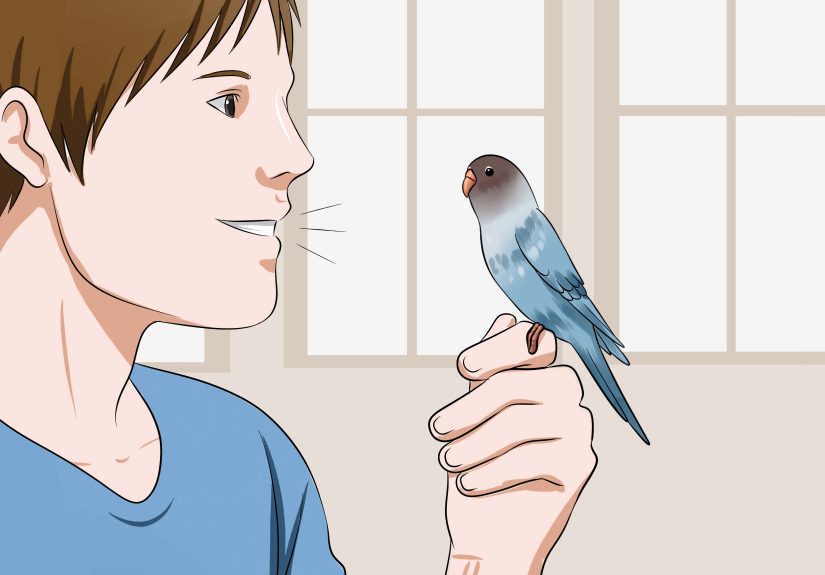
Your voice is one of your best trust-building tools. Parakeets are social birds, and many enjoy soft talking, whistling, and familiar sounds. Start by sitting near the cage for short sessions. Read a book aloud, talk about your day, or narrate simple activities in a calm tone.
You do not need to deliver a dramatic speech. “Good morning, little buddy. Fresh water is coming. Please hold all applause until the end,” is perfectly acceptable. What matters is that your bird hears you without being pressured.
Use a consistent phrase when you approach, such as “Hi, Kiwi” or “Hello, buddy.” Over time, your parakeet learns that your arrival is predictable. Predictability builds safety, and safety builds trust.
Step 5: Move Slowly and Predictably
Fast movement can scare parakeets. A hand swooping toward the cage may feel like a predator attack, even if your intention is only to adjust a millet spray. Move slowly, especially near the cage. Announce what you are doing with your voice before you do it.
When cleaning or feeding, avoid reaching over your bird from above. Many birds are more comfortable when hands approach from the front or side. Keep your gestures smooth. If your parakeet panics, pause and give it time to settle before continuing.
Trust is often built in boring moments. The quiet food change. The calm water refill. The person who does not lunge, grab, or squeal every time the bird looks cute. In parakeet language, boring can be beautiful.
Step 6: Offer Treats Through the Cage Bars
Once your parakeet seems calmer around you, introduce high-value treats. Many parakeets enjoy millet, though treats should be used in moderation. The goal is to create a positive association: when you appear, good things happen.
Hold a small piece of millet near the cage bars without pushing it toward your bird. Let the parakeet decide whether to approach. If it comes closer, stay still. If it takes a nibble, congratulationsyou have just signed a tiny snack-based friendship contract.
If your bird does not take the treat, do not force it. Place the treat nearby and try again later. Some parakeets take treats on the first day. Others require many sessions. Patience is not a decorative virtue here; it is the main ingredient.
Step 7: Introduce Your Hand Inside the Cage Carefully
After your parakeet comfortably takes treats through the bars, you can begin hand-taming inside the cage. Open the door slowly and place your hand just inside, holding a treat. Do not chase the bird around the cage. Do not corner it. Do not perform the classic beginner mistake known as “The Claw of Friendship.”
Keep sessions short, around five to ten minutes. End on a calm note. If your parakeet stays relaxed while your hand is present, that is progress. If it leans toward the treat, that is more progress. If it steps closer, you may silently celebrate, but please do not startle the bird with a victory dance.
The aim is not to grab your parakeet. The aim is to teach your bird that your hand is safe, predictable, and connected to rewards.
Step 8: Teach the “Step Up” Cue
Step-up training is one of the most useful skills for a parakeet. It helps with daily handling, safe movement, cage cleaning, and bonding. Start only when your bird is comfortable near your hand.
How to begin step-up training
Hold your finger or a small perch near your parakeet’s lower chest, just above the feet. Use a calm cue such as “step up.” Offer a treat so the bird has a reason to move forward. The moment your parakeet places one foot, then both feet, on your finger or perch, reward it with praise and a small treat.
Some birds prefer stepping onto a perch before stepping onto a finger. That is fine. A perch can be less intimidating, especially for birds that are nervous around hands. Training should feel like an invitation, not a tiny hostage negotiation.
Practice in short sessions. Repetition matters, but so does stopping before your bird gets tired or frustrated. A few successful minutes are better than a long session that ends with flapping, biting, and both of you questioning your life choices.
Step 9: Use Positive Reinforcement, Not Punishment
Positive reinforcement means rewarding the behavior you want so your parakeet is more likely to repeat it. Rewards can include millet, seeds used only for training, verbal praise, access to a favorite perch, or a break from interaction. For some birds, “I get to go back to my cage calmly” is a powerful reward.
Punishment, yelling, cage-hitting, forced grabbing, or scolding can damage trust. Parakeets do not understand lectures like humans do. If your bird bites and you respond with drama, it may learn that biting creates big interesting reactionsor that you are unpredictable and scary.
Instead, look for the reason behind the behavior. Was your hand too close? Was the session too long? Was your bird tired, hormonal, startled, or guarding its cage? Training improves when you stop labeling the bird as “bad” and start asking what the behavior is communicating.
Step 10: Create Safe Out-of-Cage Time
Once your parakeet steps up reliably and seems comfortable, supervised out-of-cage time can strengthen your bond. Before opening the cage, bird-proof the room. Close windows and doors, turn off ceiling fans, cover mirrors if needed, remove toxic plants, keep other pets away, and block access to unsafe spaces behind furniture.
Let your parakeet explore at its own pace. Some birds fly out immediately like they have been waiting to inspect the property. Others sit at the cage door for several sessions, considering their options like tiny real-estate investors.
Use treats and step-up practice to encourage calm interaction. Avoid chasing your bird to return it to the cage. Instead, make the cage rewarding by placing food inside and keeping the routine predictable. A bird that trusts you outside the cage is a bird that has learned you are not just safe when bars are between you.
Step 11: Build a Daily Bonding Routine
Trust is not a one-time achievement. It is a routine. Spend time with your parakeet every day, even if some days are simple. Talk softly. Offer training games. Rotate toys. Practice step-up. Let your bird choose interaction when possible.
Short daily sessions are usually better than one long weekly session. A parakeet learns through patterns. If you are calm and kind every day, your bird begins to expect calmness and kindness. That expectation is the foundation of trust.
Remember that each parakeet is an individual. Some become finger-loving comedians. Some enjoy sitting nearby but dislike being touched. Some learn words. Some prefer whistles. Some are brave explorers; others are cautious observers. The best bond respects the bird in front of you, not the fantasy bird in your head.
Common Mistakes That Slow Down Trust
Trying to rush the process
Many owners lose progress by pushing too hard too soon. If your parakeet takes millet from your hand today, that does not automatically mean it is ready to be carried around the house tomorrow. Trust has layers. Build them in order.
Grabbing the bird unnecessarily
Sometimes handling is necessary for safety or veterinary care, but grabbing should never be your normal bonding method. Forced handling can make a parakeet fear hands, cages, towels, or people. Use gentle training and voluntary step-up practice whenever possible.
Ignoring body language
If your bird is leaning away, breathing fast, lunging, or fleeing, it is already communicating. Continuing anyway teaches the bird that subtle signals do not work. Then it may escalate to biting. Respect the whisper so you do not get the beak-shaped exclamation point.
Using treats without a plan
Treats are helpful, but they work best when paired with clear behavior. Reward calm approaches, stepping closer, touching a target, or stepping up. Do not simply stuff your bird with snacks and hope friendship happens by magic. Even parakeets appreciate structure.
How Long Does It Take to Gain a Parakeet’s Trust?
The honest answer is: it depends. Some parakeets begin taking treats within days. Others need weeks or months. Age, previous handling, personality, environment, health, and whether the bird is housed alone or with other birds can all affect progress.
A young, hand-raised parakeet may warm up quickly. A parent-raised or poorly socialized bird may need more time. A bird bonded strongly to another parakeet may be less motivated to interact with humans, though it can still learn to trust you with patient, consistent work.
Measure success in small signs: your bird no longer panics when you enter the room, accepts treats, chirps while you talk, stays relaxed during feeding, steps toward your hand, or chooses to remain near you. These moments may look small from the outside, but in bird trust-building, they are confetti-worthy.
What If Your Parakeet Bites?
A bite is communication. It may mean fear, overstimulation, territorial behavior, discomfort, or confusion. Instead of taking it personally, calmly pause and review what happened right before the bite.
Were you reaching into the cage too quickly? Was your bird trapped in a corner? Did you miss earlier warning signs? Was the session longer than usual? Did someone make a loud noise? Once you identify the trigger, adjust your approach.
Do not punish the bite. Calmly remove pressure, give your bird space, and return later with an easier step. For example, go back to offering treats through the bars or simply sitting nearby. Trust can recover when you respond with patience instead of panic.
Experience-Based Tips for Gaining Your Parakeet’s Trust
Real-life parakeet trust-building is rarely as smooth as a checklist. Some days your bird acts like you are best friends. The next day, it looks at your finger as if your hand has committed tax fraud. This is normal. Progress with birds often moves in loops rather than straight lines.
One helpful experience is to choose a “trust chair” near the cage. Sit there at the same time each day with a calm activity, such as reading, doing homework, or answering messages quietly. At first, do not stare directly at your parakeet for long periods. Predators stare. Friendly flock members casually hang out. Over time, your bird may start moving closer to your side of the cage, chirping, preening, or eating while you are nearby. Those are excellent signs.
Another practical trick is to save the best treat only for training. If millet is always available, it loses some magic. If millet appears only when your hand appears, your hand becomes much more interesting. This does not mean withholding a proper diet; it means using special treats wisely during short sessions.
Many owners also discover that morning or early evening sessions work better than random training attempts. A tired or overstimulated bird may not want to learn. A calm bird in a predictable routine is more likely to cooperate. Watch when your parakeet seems alert, curious, and relaxed. Train during those windows.
Voice consistency helps more than people expect. Use the same phrases for the same actions: “fresh water,” “step up,” “good bird,” and “all done.” Your parakeet may not understand every word at first, but it can learn patterns. Predictable words make your behavior easier to read.
If your parakeet is afraid of fingers, try a small handheld perch. Some birds see fingers as suspicious wiggly worms but accept a perch with dignity. Once the bird learns the step-up concept, you can gradually transition to a finger if appropriate. There is no shame in using tools that make your bird feel safer.
It is also wise to keep training sessions slightly too short rather than slightly too long. Stop while your bird is still successful. Ending with a calm treat, a soft “good bird,” and space to relax teaches your parakeet that interaction has a pleasant ending. That makes the next session easier.
Finally, do not compare your parakeet with social media birds. Online, you may see budgies skateboarding, talking, cuddling, or solving puzzles while looking like feathered geniuses. What you do not see is the patient training behind those clips. Your bird does not need to become a viral celebrity. It needs to feel safe with you. A parakeet that calmly steps onto your finger after weeks of patient work is every bit as impressive as a bird that says “pretty bird” on command.
The deepest trust often shows up quietly. Your parakeet eats while you sit nearby. It fluffs comfortably when you speak. It chooses to step closer. It returns to you after flying. It relaxes because you have become part of its safe world. That is the real rewardand it is better than any viral video.
Conclusion
Learning how to gain your parakeet’s trust is really learning how to become understandable to a small, intelligent prey animal. Move slowly. Speak gently. Respect body language. Use positive reinforcement. Keep training short, safe, and consistent. Most importantly, let trust be a choice your parakeet makes, not something you force.
When you build trust the right way, your bird does more than tolerate you. It begins to see you as part of the flock. That bond is worth every quiet session, every patient pause, and every tiny millet crumb that somehow ends up in places millet should never be.