Table of Contents >> Show >> Hide
If you have a flat, fast-spreading weed turning your lawn into a green-and-red doormat, there is a good chance you are dealing with spurge weed. It is one of those weeds that seems to appear out of nowhere, settle into every bare spot you forgot existed, and then act like it pays property taxes. The frustrating part is that spurge is built for survival. It loves heat, tolerates poor soil, and can set seed quickly, which means a tiny problem can become a full-blown yard headache in a hurry.
The good news is that spurge is beatable. You just have to identify it correctly, move early, and combine removal with better lawn or garden care. A single spray or one heroic afternoon of weeding usually will not solve the whole problem. Think of spurge control as equal parts detective work, cleanup crew, and prevention plan. Once you know what to look for and why it keeps coming back, the weed becomes much easier to manage.
What Is Spurge Weed?
“Spurge weed” is a common name used for several low-growing weeds in the Euphorbia family. In lawns and landscapes, the usual troublemakers are spotted spurge and prostrate spurge. These are summer annual broadleaf weeds, which means they sprout when temperatures warm up, grow aggressively through summer, produce lots of seed, and then die when cold weather arrives. Unfortunately, before they go, they often leave behind enough seed to stage a comeback tour next year.
Spurge thrives in hot, sunny, stressed areas. It is especially common in thin lawns, compacted soil, dry patches, sidewalk cracks, gravel edges, mulched beds, and anywhere desirable plants are not growing densely enough to shade the soil. In other words, spurge is basically a specialist in finding weak spots and making itself comfortable.
How to Identify Spurge Weed
Correct identification matters because spurge is often confused with other low-growing weeds, especially knotweed and purslane. If you know the signature features, though, spurge is not too hard to spot.
1. It grows flat and forms a mat
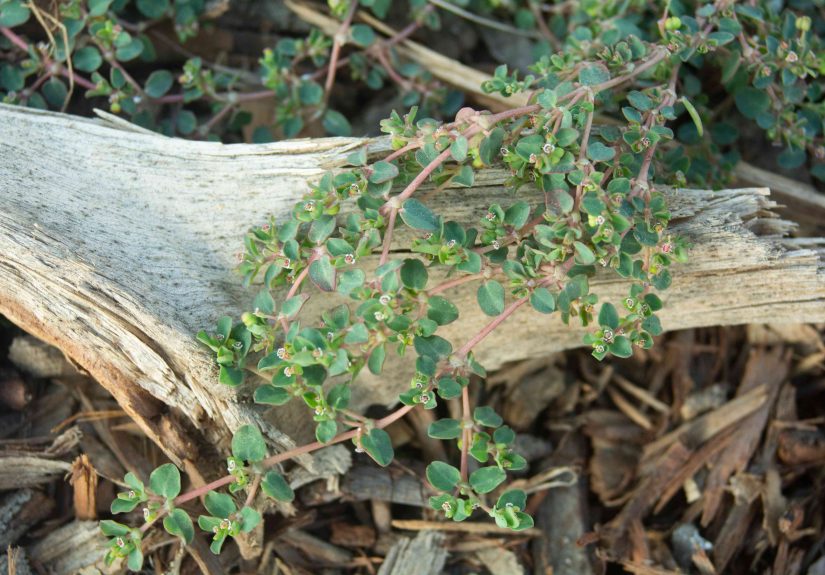
Spurge usually spreads outward from a central point, hugging the soil and forming a dense, circular mat. It stays so low that mowing often misses the problem entirely. That is one reason people are surprised by how fast it spreads. The mower glides over it, while the weed keeps plotting.
2. The leaves are small and opposite
The leaves grow in pairs directly across from each other on the stem. They are usually oval, oblong, or slightly egg-shaped. Many plants have a reddish, purple, or maroon spot in the center of the leaf, especially spotted spurge, though not every leaf shows it clearly.
3. The stems may look reddish or pink
Many spurges have reddish, pinkish, or maroon stems. They often branch heavily and create a spider-like pattern across the soil surface. Spotted spurge typically does not root at the nodes, while prostrate spurge can root as it creeps along the ground.
4. It oozes milky white sap
This is one of the biggest giveaways. Snap a stem and spurge releases a milky sap. That sap can irritate skin and eyes, so gloves are smart. It also helps separate spurge from lookalikes like knotweed, which does not produce that milky latex.
5. The flowers are tiny and easy to miss
Spurge flowers are small, pale, and not exactly the showstoppers of the garden world. They appear close to the leaves and stems and are easy to overlook unless you are examining the plant up close.
6. It shows up in heat-stressed, bare, or compacted spots
If the weed is popping up where turf is thin, soil is hard, or the area dries out quickly, that is another clue. Spurge is often less a random invader and more a symptom of an underlying site problem.
Why Spurge Weed Keeps Coming Back
Spurge is successful because it is fast, opportunistic, and annoyingly good at reproduction. It germinates in warm conditions, grows low enough to avoid mower blades, and produces seed quickly. Some spurge species can begin setting viable seed only weeks after emergence. That means if you wait until the plant looks “big enough to deal with later,” later may already be too late.
It also loves open sunlight at the soil surface. Bare spots in turf, thin mulch, compacted paths, and drought-stressed lawn areas are all invitations for spurge to move in. In many yards, the weed is not the main problem. The main problem is weak turf, compacted soil, poor watering habits, or neglected garden beds. Spurge just takes advantage of the opportunity.
How to Get Rid of Spurge Weed
The most effective approach is integrated weed control. That simply means using more than one tactic so the weed does not get comfortable. Here is how to tackle it.
Hand-pull young plants early
If the infestation is small, hand-pulling works well, especially when the soil is slightly moist. Pull young plants before they flower and set seed. Try to remove the central root or crown, not just the top growth. If you break off the stems and leave the base behind, the plant may recover.
Always wear gloves. The milky sap can irritate skin, and it is sticky enough to make you question your life choices. A narrow weeding tool can help loosen the soil beneath mat-forming plants so you can lift the whole plant more cleanly.
Use mulch in beds and around ornamentals
In garden beds, one of the best nonchemical defenses is mulch. A solid layer of organic mulch helps block the light spurge seeds need for germination. Keep mulch deep enough to do the job, and refresh it when it thins out. Thin, patchy mulch is basically a welcome mat for weeds.
Improve lawn density
In lawns, the real long-term fix is to strengthen the turf. A thick lawn shades the soil surface and makes it harder for spurge seeds to sprout. Focus on:
- mowing at the proper height for your turf type,
- watering deeply instead of lightly and constantly,
- fertilizing according to soil and grass needs,
- overseeding bare spots, and
- core aerating compacted soil.
Spurge often points to compaction or drought stress. If you kill the weed but ignore those conditions, something else will likely take its place, and it may not be more charming.
Remove it from cracks, borders, and hardscape edges
Spurge loves sidewalk seams, driveway edges, paver joints, and the scruffy strip between the lawn and the curb. In those spaces, hand removal, hoeing, and repeated cleanup are often the best choices. Because seeds can spread on shoes, mower tires, and tools, it helps to clean equipment after working in heavily infested areas.
Use post-emergent herbicides when needed
For larger lawn infestations, a selective post-emergent broadleaf herbicide can be useful. Products containing active ingredients such as 2,4-D, MCPP (mecoprop), dicamba, triclopyr, or combinations of these are often used for spurge control in established lawns. Spot treatment is usually better than blanket spraying when the problem is limited to patches.
Apply post-emergent herbicides when the plants are young and actively growing. Mature spurge is harder to control, and repeat applications may be necessary because new seedlings can keep emerging through summer. Follow label directions carefully, and make sure the product is safe for your specific grass type. Also be cautious with products containing dicamba around trees and shrubs, since roots can absorb it in some situations.
Consider pre-emergent herbicides for prevention
If spurge shows up every year like an unwanted seasonal subscription, a pre-emergent herbicide may help prevent germination. These products are applied before seeds sprout, usually in late winter or early spring depending on climate. Timing matters. If you apply too late, the weed may already be on its way.
Common pre-emergent options used for spurge control include active ingredients such as isoxaben, pendimethalin, dithiopyr, oryzalin, and trifluralin. Many pre-emergents need to be watered in after application to activate them. Do not use these products in food-growing areas unless the label specifically allows it.
The Best Time to Control Spurge Weed
Timing can make the difference between a manageable weed problem and a full summer standoff.
Early spring: prevent germination
If you plan to use a pre-emergent, apply it before soil temperatures rise into the range where spurge germinates. In many regions, that means late winter to early spring. This is the “close the gate before the goats escape” stage of weed control.
Late spring to early summer: attack new seedlings
This is often the best window for hand-pulling and post-emergent control in lawns. Plants are usually still small enough to manage, and the surrounding turf has a better chance to recover and fill in.
Summer: stay consistent
Spurge can continue germinating through warm weather, so one treatment may not be enough. Scout regularly, pull seedlings early, and spot-treat new patches before they seed.
Fall: fix the conditions that invited it
Once summer weeds decline, use fall to repair the site. Overseed thin turf, aerate compacted soil, improve irrigation habits, refresh mulch, and address drainage or traffic problems. This is how you stop next year’s sequel from getting greenlit.
Mistakes That Make Spurge Worse
- Waiting too long: Small plants are far easier to remove or kill than mature mats.
- Mowing and hoping: Spurge grows low, so mowing alone is usually ineffective.
- Ignoring bare spots: Open soil gives spurge exactly what it wants: light and room.
- Watering too often and too shallowly: Weak turf and surface moisture encourage weed problems.
- Skipping aeration in compacted lawns: Hard soil weakens grass and favors opportunistic weeds.
- Using the wrong herbicide: Always confirm the product is labeled for spurge and safe for your lawn or landscape plants.
- Pulling after seed set: You may remove the plant but still leave the next generation behind.
How to Prevent Spurge Weed From Returning
The secret to long-term spurge control is making your yard less welcoming to it. That means fewer bare areas, healthier turf, deeper mulch, and less compaction. Prevention is not glamorous, but it works.
- Maintain dense grass with proper mowing, watering, and feeding.
- Core aerate compacted soil where foot traffic is heavy.
- Overseed or repair thin lawn areas before weeds move in.
- Refresh mulch in ornamental beds.
- Scout often and remove the first few plants immediately.
- Use pre-emergent control if your yard has a strong history of spurge outbreaks.
Once you shift from “How do I kill this weed today?” to “Why does this spot keep growing weeds?” you usually start winning.
Common Homeowner Experiences With Spurge Weed
Many homeowners first notice spurge in the exact same way: they are out admiring the lawn from ten feet away, feeling mildly victorious, and then they spot a flat green patch that was definitely not there last week. Up close, it looks harmless at first. It is low. It is small. It is almost decorative in a very sneaky, uninvited way. Then two weeks later, it has spread into a mat and started popping up in three other places. That is a classic spurge story.
One common experience happens in newly stressed lawns. A family has a stretch of summer heat, misses a few waterings, and heavy foot traffic wears down the grass near the driveway or patio. The turf thins just enough to expose the soil. Spurge arrives like it had the address saved in its phone. In these situations, people often assume the weed is the main issue, but after removal they realize the real problem was compacted, droughty soil and weak turf coverage. Once they aerate, reseed, and change watering habits, the spurge pressure usually drops the following year.
Another common experience happens in garden beds that were mulched beautifully in spring and then mostly ignored through summer. By midsummer, the mulch layer has thinned, the edges have shifted, and sunlight is reaching the soil again. Spurge seedlings slip in under shrubs, around annuals, and along borders. Homeowners often say the weed seemed to appear overnight, but what really happened is that conditions became just right. A quick refresh of mulch plus early hand-pulling usually makes a dramatic difference.
People also talk about how frustrating it is to mow over spurge and see it survive like nothing happened. That is because the plant grows so close to the ground that mower blades often miss most of it. This leads many homeowners to think they are dealing with an indestructible weed, when in reality they are using the wrong tactic. Once they switch to hand-pulling young plants, spot-treating patches, and correcting the turf conditions that favor invasion, the weed becomes much more manageable.
There is also the herbicide learning curve. A lot of people spray spurge once, expect a dramatic movie ending, and then feel betrayed when new plants appear later. In truth, spurge often germinates over an extended period, so repeat scouting is part of the process. Experienced homeowners usually figure out that successful control comes from timing. Young plants respond better. Pre-emergent products work best before germination. Mature mats are harder to control. Once that timing clicks, the whole project starts feeling less like yard warfare and more like strategy.
Probably the most useful shared lesson is this: homeowners who get ahead of spurge early spend far less time fighting it later. The ones who walk the yard every week, pull a few young plants, keep mulch topped up, mow correctly, and repair bare spots usually avoid the giant midsummer infestation. The ones who wait until the weed is everywhere end up with a much bigger job. Spurge is not unbeatable, but it absolutely rewards procrastination in the worst possible way.
Final Thoughts
If you want to identify and get rid of spurge weed, focus on the clues that matter: flat mat-like growth, small opposite leaves, reddish stems, and that telltale milky sap. Then act early. Pull it while it is young, mulch beds well, strengthen your lawn, and use herbicides only when needed and at the right time. The best long-term fix is not just killing the weed. It is removing the conditions that make your yard attractive to it in the first place.
Spurge may be persistent, but it is not magical. It just happens to be excellent at exploiting stress, heat, and neglect. Fix those three things, and the weed loses most of its swagger.