Table of Contents >> Show >> Hide
- Why Roast Beef Dries Out in the Oven
- Choose the Right Cut of Beef First
- How to Prep Roast Beef So It Stays Moist
- The Best Oven Method for Roast Beef Without Drying It Out
- Internal Temperature Matters More Than Time
- Should You Sear Roast Beef Before or After Roasting?
- Resting Is Not Optional
- How to Slice Roast Beef So It Stays Tender
- Common Mistakes That Dry Out Roast Beef
- A Simple Roast Beef Formula You Can Use
- What to Serve with Roast Beef
- Final Thoughts
- Real-World Experience: What Repeated Roast Beef Experiments Teach You
Roast beef has a funny way of making people feel incredibly confident right up until the moment they slice into it and discover something between “Sunday dinner masterpiece” and “expensive chew toy.” The good news is that making roast beef in the oven without drying it out is not wizardry. It is mostly a matter of choosing the right cut, seasoning it properly, cooking it gently, and trusting a thermometer more than your inner optimist.
If you have ever wondered why one roast comes out juicy, rosy, and glorious while another turns into a beef-flavored life lesson, this guide is for you. We are going deep on oven-roasted beef, including the best cuts, ideal temperatures, timing, common mistakes, and the simple habits that keep the meat tender and flavorful. In other words, no drama, no guesswork, and no pretending that “well done” and “still moist” are always best friends.
Why Roast Beef Dries Out in the Oven
Before fixing the problem, it helps to know the suspects. Roast beef usually dries out for one or more of these reasons: the cut is too lean, the oven temperature is too high, the roast is cooked too long, the meat is sliced too soon, or it is carved the wrong way. Sometimes it is all five at once, which is the culinary version of stepping on a rake and then walking into a screen door.
The biggest culprit is overcooking. Beef loses moisture as its internal temperature climbs, so every extra degree matters. That is why the secret to juicy roast beef is less about magic marinades and more about controlled heat, patience, and pulling the roast before it goes too far.
Choose the Right Cut of Beef First
The best oven roast beef starts at the butcher counter, not with a sauce later meant to hide your sorrow. Different cuts behave differently in the oven, and picking the wrong one for your goal makes everything harder.
Best cuts for juicy roast beef
- Rib roast or prime rib: Rich, well-marbled, and naturally forgiving. This is the luxury sedan of roast beef.
- Top sirloin roast: Beefy flavor, good tenderness, and a solid balance of cost and moisture.
- Tenderloin: Very tender, leaner than rib roast, elegant, and fast-cooking. Great for special occasions.
- Top round roast: Leaner and more affordable. Delicious when cooked carefully and sliced thin.
- Eye of round: Very lean and easy to dry out, but still workable if you roast gently and stop early.
- Tri-tip: Deep beef flavor and great texture, especially when roasted to medium-rare and sliced correctly.
If your main goal is moist roast beef in the oven, marbling matters. Intramuscular fat helps protect texture and flavor during cooking. A beautifully marbled roast gives you a wider margin for error, while a very lean roast behaves like it is waiting for one excuse to become dry.
How to Prep Roast Beef So It Stays Moist
1. Dry-brine it ahead of time
One of the smartest things you can do is salt the roast in advance. Season it generously with kosher salt 12 to 24 hours before cooking, then leave it uncovered in the refrigerator. This “dry brine” helps the salt move deeper into the meat, improves flavor throughout, and helps the surface dry for better browning.
You can keep the seasoning simple with salt, pepper, garlic, and rosemary. Roast beef does not need a costume change. It already knows who it is.
2. Pat it dry before it goes into the oven
Surface moisture slows browning. A roast that goes into the oven damp is more likely to steam than brown, which is not the look we are chasing. Pat the outside dry with paper towels before roasting.
3. Tie it if needed
If the roast is uneven or floppy, tie it with kitchen twine. A more uniform shape cooks more evenly, which means fewer overdone edges and a better chance of juicy slices from end to center.
4. Let it lose some of its refrigerator chill
You do not need to leave beef out for ages, but taking the roast out 30 to 60 minutes before cooking can help it roast more evenly. Keep food safety in mind and do not let it lounge around on the counter like it pays rent.
The Best Oven Method for Roast Beef Without Drying It Out
If you want consistent results, a lower-temperature roast is the safest path. A gentle oven gives the meat more time to cook evenly from edge to center, which reduces the thick gray band of overcooked beef around the outside.
Low-and-slow oven roast method
- Preheat the oven to 250°F to 275°F.
- Place the beef on a rack in a roasting pan or on a wire rack set over a rimmed baking sheet.
- Position it fat side up if the cut has a fat cap. As the fat renders, it helps protect the surface and adds flavor.
- Insert a thermometer into the thickest part, avoiding bone and large pockets of fat.
- Roast until the meat is about 5°F to 15°F below your desired final temperature, depending on the size of the roast.
- Rest it loosely tented with foil before slicing.
- For a stronger crust, finish with a short blast in a very hot oven at the end, or sear briefly before serving.
This method is often called a reverse-sear style roast. It is especially useful for larger roasts because it gives you more even doneness and a juicier interior. High heat can still be part of the plan, but it should be the closing act, not the entire concert.
Internal Temperature Matters More Than Time
If you want to know how to make roast beef in the oven without drying it out, here is the headline: stop cooking by the clock alone. Time is a rough estimate. A thermometer is the truth serum.
Oven performance, roast shape, bone structure, and starting temperature all affect cooking time. Two roasts of the same weight can finish differently. Your meat thermometer does not care about your recipe card, and that is exactly why it is the best friend in the room.
Target temperatures for roast beef
- Pull at 125°F to 130°F: Very rosy center after resting
- Pull at 130°F to 135°F: Medium-rare zone for many larger roasts after carryover cooking
- Pull at 135°F to 140°F: Medium
- 145°F final temperature with a rest: Common food-safety benchmark for whole cuts of beef
Large roasts continue to cook after they leave the oven. This is called carryover cooking, and it can raise the internal temperature by several degrees. That is why pulling the roast early is not undercooking; it is planning ahead like a person who has already made peace with physics.
General timing estimates
At 250°F to 275°F, many roasts take roughly 20 to 30 minutes per pound, but treat that as a parking sign, not a promise. Start checking early. A thick, round roast usually takes longer than a flatter one.
Should You Sear Roast Beef Before or After Roasting?
Either can work, but for the juiciest, most evenly cooked roast, finishing with high heat at the end often wins. A final blast in a 475°F to 500°F oven for a few minutes can build a handsome crust without overcooking the center.
Searing first is still a valid method and adds great flavor, but if your main concern is avoiding dryness, a low roast followed by a brief final sear is easier to control. Think of it as giving your roast a tan without sending it on a desert survival show.
Resting Is Not Optional
The roast is not ready the second it leaves the oven. Resting allows the temperature to even out and the juices to redistribute. Slice too soon, and the cutting board will get dinner while your guests get disappointment.
How long should roast beef rest?
- Small roast: 10 to 15 minutes
- Medium roast: 15 to 20 minutes
- Large roast: 20 to 30 minutes
Tent the roast loosely with foil rather than wrapping it tightly. Tight wrapping traps steam and can soften the crust you worked so hard to build.
How to Slice Roast Beef So It Stays Tender
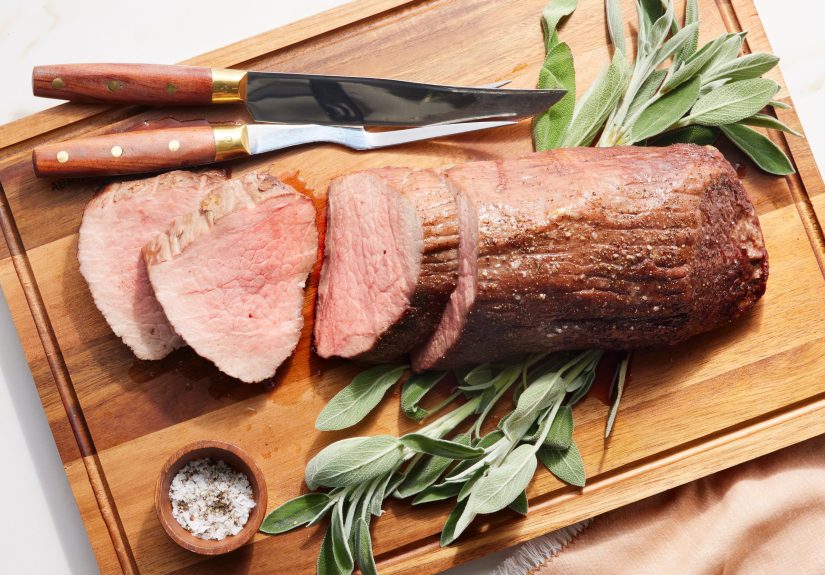
You can roast beef perfectly and still ruin the eating experience with bad slicing. Always slice against the grain. That shortens the muscle fibers and makes every bite more tender.
This matters especially with lean cuts like top round and eye of round. Thin slices can make a modest roast feel luxurious, while thick slices cut with the grain can feel like a polite argument with your jaw.
Common Mistakes That Dry Out Roast Beef
Using a roast that is too lean for aggressive cooking
Eye of round can be delicious, but it is not a forgiving cut. If you roast it like a rib roast, it will retaliate.
Cooking at high heat the whole time
A hot oven cooks the outer layers much faster than the center. That creates a wide band of dry, gray beef around the outside.
Skipping the thermometer
This is the fastest way to turn dinner into a guessing game. Roast beef is too expensive for vibes-only cooking.
Not salting ahead
Advance seasoning improves flavor and helps the meat cook up better. Last-minute seasoning mostly sits on the surface and looks busy.
Slicing immediately
Resting is part of the cooking process, not a decorative pause.
Slicing with the grain
Even juicy roast beef can seem tough if the slices are cut the wrong way.
A Simple Roast Beef Formula You Can Use
Here is an easy blueprint for a classic oven roast beef:
- Buy a 3- to 5-pound top sirloin, rib roast, or top round.
- Season with kosher salt and black pepper 12 to 24 hours ahead.
- Add garlic, rosemary, thyme, or onion powder before roasting.
- Roast on a rack at 250°F to 275°F.
- Check early and remove when it is 5°F to 10°F below your desired final temperature.
- Rest 15 to 25 minutes.
- Slice thinly against the grain.
- Serve with pan juices, horseradish sauce, or a simple au jus.
This formula works because it prioritizes even cooking, moisture retention, and texture. It is not flashy, but neither is a seatbelt, and both save the day more often than they get credit for.
What to Serve with Roast Beef
Juicy roast beef loves simple company. Try it with roasted potatoes, Yorkshire pudding, mashed potatoes, green beans, carrots, creamed spinach, or a sharp horseradish sauce. Leftovers are excellent in sandwiches, hash, grain bowls, and reheated gently in broth.
How to reheat without drying it out
Warm slices in a little beef broth or jus over low heat, covered. Microwaving at full power is a bold move if your goal is “tender.” Less bold is better here.
Final Thoughts
If you remember only one thing, remember this: the path to juicy roast beef in the oven is gentle heat and accurate temperature control. Pick a good cut, salt it ahead, roast it low, rest it properly, and slice it against the grain. Do that, and your roast will be tender, flavorful, and dramatically less likely to resemble a piece of leather luggage.
Making roast beef in the oven without drying it out is not about complicated tricks. It is about a few smart decisions repeated consistently. Once you get the rhythm, roast beef becomes one of those meals that feels fancy, smells amazing, and makes people assume you know far more than you actually do. Which, in cooking, is a perfectly respectable outcome.
Real-World Experience: What Repeated Roast Beef Experiments Teach You
After making roast beef enough times to learn that ovens have personalities and thermometers have saved more dinners than hero music ever could, a few practical lessons stand out. The first is that the roast itself decides the pace. You may have a recipe that says a 4-pound roast should be done in 90 minutes, but if your particular cut is thicker, colder, or leaner, that timetable can wander off and betray you. The roast does not care that guests are arriving in 20 minutes. It cares about internal temperature and nothing else. Accepting that fact makes you a better cook almost immediately.
The second lesson is that expensive cuts are not automatically easier; they are just more forgiving in certain ways. A rib roast gives you luxurious marbling and an excellent buffer against dryness, but it can still be overcooked if you get distracted and decide to “just leave it in five more minutes.” Meanwhile, a cheaper cut like top round can be surprisingly delicious if you treat it gently, slice it thinly, and do not expect it to behave like prime rib in a tuxedo. Matching expectations to the cut is one of the quiet secrets of good roast beef.
Another big lesson is that resting feels longer than it actually is. When the roast comes out smelling incredible, everyone suddenly becomes an amateur timekeeper. People hover. People ask questions. People offer terrible advice with great confidence. And yet the roast really is better after a proper rest. The juices settle, the internal temperature finishes climbing, and slicing becomes cleaner. Every single time I have rested a roast properly, I have been glad I did. Every time I have rushed, I have watched the cutting board turn into a puddle of regret.
I have also learned that crust and juiciness are not enemies, but they do need boundaries. A fierce sear is wonderful, but when high heat lasts too long, the outer layers dry out before the center catches up. That is why the low-oven method is so useful in real kitchens. It gives you time to think, adjust, and pull the roast at the right moment. Then you can add a final blast of heat if you want more color. It is a calmer, smarter process, especially when you are juggling side dishes and trying to appear relaxed.
Perhaps the most humbling lesson is that slicing technique can change everything. I have made perfectly seasoned, beautifully roasted beef that seemed merely okay because I carved it too thick or with the grain. Then I have made a leaner, cheaper roast taste far better simply by slicing it thinly across the grain and serving it with warm juices. That moment really drives home an important truth: cooking does not end when the oven timer beeps. Serving is part of the craft.
In the end, the best roast beef is rarely the one made with the fanciest ingredient list. It is usually the one made by someone who paid attention. Someone who salted ahead, used a thermometer, respected resting time, and did not panic at the finish line. That is what makes roast beef feel special. Not perfection in some glossy magazine sense, but a well-cooked piece of beef that is juicy in the center, browned on the outside, and sliced like you meant it. Once you experience that a few times, the fear disappears. Then roast beef stops being intimidating and starts becoming a reliable, deeply satisfying meal you actually look forward to making.