Table of Contents >> Show >> Hide
- Serrations 101: Why They’re Different (and Why That Matters)
- Do You Really Need Sharpeningor Just a Smarter Test?
- The Quick Decision Guide: DIY vs. Professional Sharpening
- Professional & Brand Services: The “No Drama” Route
- Tools That Actually Work for Serrations (and Why)
- Safety First: Sharpening Rules That Prevent ER Stories
- The Biggest Serrated Sharpening Mistakes (So You Can Avoid Them)
- How to Keep a Serrated Pocket Knife Sharp Longer
- When It’s Time to Replace (Yes, Sometimes That’s the Smart Move)
- Real-World Experiences: What Knife Owners Learn the Hard Way (500+ Words)
- Conclusion: Sharp Serrations, Smarter Choices
A serrated pocket knife is the “tiny saw that could.” It chomps through rope, zip ties, cardboard, and
stubborn clamshell packaging like it’s auditioning for a superhero movie. Then one day… it starts tearing
instead of slicing. Suddenly you’re sawing through a shipping label like you’re trying to start a campfire.
This guide explains how serrations actually get dull, the safest ways to restore sharpness,
how to choose the right approach (DIY vs. service), and how to keep your serrated edge biting longer.
Because a serrated blade is fantasticuntil it becomes a tiny, angry butter knife.
Safety note: Sharpening any knife can cause serious injury if done carelessly. If you’re new to knives,
ask a responsible adult or a professional sharpener to handle the sharpening. This article focuses on
smart decision-making, tool selection, and safe maintenanceso you don’t turn “knife care” into “bandage collection.”
Serrations 101: Why They’re Different (and Why That Matters)
A straight edge is basically one continuous line you can re-shape and refine. A serrated edge is a row of
small scallops (often called gullets) and points that work together like a zipper made of tiny teeth.
Those teeth grab and tear into fibrous materialsrope, webbing, crusty bread, heavy cardboardwhere a plain edge
might slide around first.
The catch: serrations don’t “dull evenly.” Usually the points get rounded, the gullets get polished smooth,
or the edge geometry changes from repeated contact with hard surfaces. Many serrated blades are also ground so the
working bevel is on one sidewhich is convenient for performance, but easy to mess up if someone sharpens the wrong side.
Translation: serrated sharpening is less about “make it razor sharp” and more about
preserving the original tooth pattern so it keeps biting the way it was designed to.
Do You Really Need Sharpeningor Just a Smarter Test?
Before you do anything, figure out what’s actually wrong. Serrations can feel dull even when they’re still functional,
especially if the blade is dirty, sticky with residue, or has light corrosion. Try these low-risk checks:
- Visual inspection: Under bright light, look for shiny, flattened spots along the teeththose are common “dull zones.”
- Material test (safe): Try cutting a piece of scrap cardboard or a short length of soft rope on a stable surface. If it tears wildly or slips, sharpness is likely reduced.
- Clean-first rule: If the knife is gunked up with tape adhesive or grime, clean it before judging performance.
If the blade still struggles after a thorough cleaning, it’s time to choose a sharpening route.
The Quick Decision Guide: DIY vs. Professional Sharpening
| Option | Best For | Pros | Cons |
|---|---|---|---|
| Brand or mail-in service | Expensive knives, sentimental knives, or badly worn serrations | Factory geometry preserved; low risk; often includes cleaning/tune-up | Shipping time/cost; some services may not cover serrationscheck first |
| Local professional sharpener | Quick turnaround; you want expert eyes on the edge | Personal guidance; can assess damage; often affordable | Quality varies by shop; ask how they handle serrations |
| DIY with serration-specific tools | Light touch-ups; you have proper tools and supervision | Convenient; good for maintenance; lower cost long-term | Higher injury risk; easy to ruin serrations if done incorrectly |
If you’re not 100% confident, choose a service. A serrated edge is forgiving in use, but surprisingly unforgiving
when sharpened the wrong way.
Professional & Brand Services: The “No Drama” Route
If your serrations are significantly worn, uneven, or you simply want the safest option,
professional sharpening is often the best move. Many knife owners underestimate how affordable this can beespecially
compared to replacing a favorite pocket knife.
Manufacturer services (read the fine print)
Several major knife and tool brands offer sharpening or maintenance programs. These often include cleaning,
oiling, and adjustmenthelpful for pocket knives that have seen real-world grit. The important detail:
some programs treat serrations differently (or may limit what they’ll do for serrated sections),
so check the program details before shipping your knife.
Local sharpeners (what to ask)
Not all sharpening shops treat serrations the same. When you call or walk in, ask:
- “Do you sharpen serrated edges by preserving the existing pattern?”
- “Do you sharpen the beveled/edged side only, and how do you handle the back side?”
- “Will this change the look or aggressiveness of the serrations?”
- “Can you show me a similar serrated knife you’ve done?”
A good sharpener won’t get offended by questions. If they do, that’s your cue to moonwalk out of the shop.
Tools That Actually Work for Serrations (and Why)
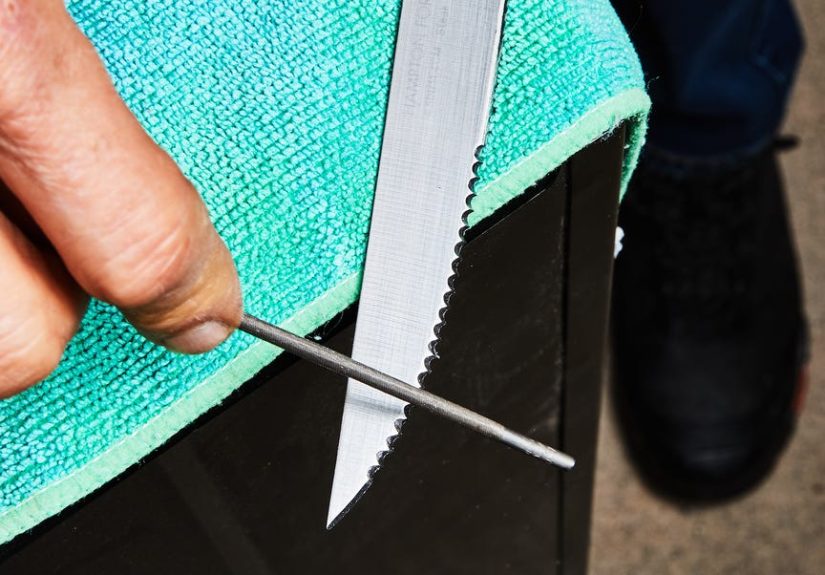
Serrations typically require a tool that can match the shape of the scallops. That’s why you’ll see
tapered rods (often ceramic or diamond-coated) recommended for serrated edges. The taper helps the rod fit
different-sized gullets on the same blade.
Common serration-friendly tool types
- Tapered sharpening rods: Designed to contact the inside curve of serrations without flattening them.
- Guided systems with serration accessories: Helpful when you want more control and consistency.
- Compact field sharpeners: Some include rod features intended for serrations, but results vary by design.
Material matters (ceramic vs. diamond)
In general, diamond abrasives remove material faster and can be useful when a serrated edge is very dull.
Ceramic tends to be gentler for touch-ups. If you’re maintaining an edge rather than rebuilding it, “gentle and consistent”
is usually the winning combo.
Whatever you choose, the key principle is simple: use a serration-appropriate tool.
Pull-through sharpeners and many electric sharpeners are designed for straight edges and can damage serrations or
change their cutting character.
Safety First: Sharpening Rules That Prevent ER Stories
Knife care should be boring. Boring is good. Boring means you still have the same number of fingers you started with.
Whether you’re cleaning, maintaining, or having someone sharpen your knife, these safety habits matter:
- Stabilize everything: Work on a firm surface with good lighting and no distractions.
- Move away from your body: Keep hands out of the path of the edge.
- Don’t “test sharpness” with your finger: Use paper/cardboard tests on a stable surface instead.
- Go slow: Rushing is how mistakes happen.
- If you’re inexperienced: Have a responsible adult or a professional do the sharpening.
One more underrated tip: if your pocket knife is a folding knife, make sure it’s locked open properly (if it has a lock)
before any maintenance. If you’re not confident in the lock or mechanism, don’t proceeduse a professional.
The Biggest Serrated Sharpening Mistakes (So You Can Avoid Them)
1) Sharpening the wrong side
Many serrated blades are designed so the working bevel is on one side. Removing material from the wrong side can
reduce the definition of the teeth and make the serrations less effective. When in doubt, stop and confirm how
the knife is builtespecially on multitools and combo blades.
2) Overdoing it
Serrations can keep cutting long after a straight edge would feel “done.” That can trick people into over-sharpening,
which may reshape the teeth and reduce that grippy bite serrations are famous for. For most users, the goal is a
touch-up, not a full redesign.
3) Using the wrong sharpener
Tools built for straight edges can flatten points, miss the gullets, or leave a serrated edge feeling weirdly slick.
If a tool doesn’t fit the serration pattern, it’s not “close enough.” It’s just wrong.
4) Ignoring cleaning and storage
A serrated pocket knife that lives in a linty pocket, gets wet, and never gets dried is basically speed-running
dullness and corrosion. Maintenance isn’t just sharpeningit’s the boring daily stuff that keeps the knife working.
How to Keep a Serrated Pocket Knife Sharp Longer
The easiest sharpening job is the one you don’t have to do. Good habits dramatically extend the life of serrations:
Clean it like you respect it (because you do)
- Remove tape residue promptly: Adhesive builds up fast in serrations and makes the edge feel dull.
- Dry thoroughly: Moisture trapped near pivots or inside serrations invites corrosion.
- Light lubrication: For folding knives, a tiny amount of appropriate lubricant can keep action smooth and reduce wear.
Use the right cutting surfaces and tasks
- Avoid hard surfaces: Cutting on stone, metal, or glass surfaces can accelerate edge wear.
- Don’t pry or twist: Knives are cutters, not mini crowbars. Prying can chip edges and damage tips.
- Be mindful with gritty materials: Dirty rope, sandy webbing, and abrasive cardboard will dull any edge faster.
Know “honing” vs. “sharpening”
Honing generally realigns an edge, while sharpening removes material to recreate the cutting bevel. Serrations
don’t “hone” the same way a straight edge does, but the concept matters for combo blades (part straight, part serrated)
and for understanding maintenance intervals. Keeping a knife clean, used properly, and stored safely reduces how often
it needs true sharpening.
When It’s Time to Replace (Yes, Sometimes That’s the Smart Move)
Not every serrated blade is worth rebuilding. Consider replacement if:
- The serrations are visibly flattened across most of the edge.
- There’s major chipping, bends, or damage that affects safety.
- The knife is low-cost and the sharpening cost exceeds its value.
- The blade steel is heavily corroded or pitted near the edge.
This isn’t defeatit’s maintenance maturity. Sometimes the best tool decision is “new knife day.”
Real-World Experiences: What Knife Owners Learn the Hard Way (500+ Words)
People often buy a serrated pocket knife for one reason: it works when everything else slips. The first time you slice
cleanly through tough rope or a stubborn package, it feels like magic. But the “magic” has a habit of fadingusually
right when you’re in a hurry and your hands are full. Over time, many owners notice a predictable pattern:
the knife still kind of cuts, but it takes more force, and the cut looks messy. That’s the moment serrations
start behaving like a tiny saw that forgot its job description.
One common experience is the “cardboard confidence crash.” Fresh serrations rip through shipping boxes like they’re
made of warm butter. After weeks of daily box dutyespecially if the cardboard is dusty or grittythe edge begins to
skate. Owners describe the blade catching at first, then slipping, then tearing the cardboard instead of slicing it.
That tearing isn’t just annoying; it can be a safety issue because it tempts people to use extra pressure. Extra pressure
is how blades slip and bad days happen. When people switch to better techniquesteady surface, controlled cuts, less force
they often realize the knife wasn’t just dull; the whole setup was working against them.
Another frequent “aha” moment: residue is sneaky. Tape adhesive, sap, food oils, and pocket lint can collect in serrations,
and the knife starts feeling dull even if the teeth still have bite. Owners who clean their blades regularly report that
the knife “comes back to life” without any sharpening at all. It’s not glamorous, but it’s real: a clean edge performs better,
and you can actually see what needs attention. A dirty serrated edge is like trying to judge a car’s paint job while it’s covered
in mud. You’re not seeing the truth.
People also learn that serrations are “high mileage.” Because they excel at tough materials, they get used on tough materials.
Rope, zip ties, and heavy packaging are all abrasive in their own way. That’s why many experienced users treat serrations like a
specialty edge: they save it for the jobs that need it, and use a straight edge (or scissors) for everything else. This simple habit
can stretch the time between sharpenings dramatically.
The most expensive lesson, though, is sharpening the wrong way. Owners who attempt a one-size-fits-all sharpener sometimes end up
with serrations that look the same but feel “slick.” The knife loses that aggressive grab. The takeaway many people share is:
serrations are not the place to freestyle. Either use a serration-specific solution under proper supervision or hand it to a professional.
Preserving the original tooth pattern is what keeps the knife cutting like it’s supposed toespecially on pocket knives where serrations
are often a key feature, not an afterthought.
Finally, there’s the satisfaction factor. A well-maintained serrated pocket knife becomes a reliable everyday toolone you trust for quick,
controlled cuts without fighting the material. Owners who build a simple routine (clean, dry, store safely, sharpen only when needed) often
say the knife feels “new” far longer than expected. And that’s the real goal: not chasing perfection, but keeping your tool dependable.
Conclusion: Sharp Serrations, Smarter Choices
Learning how to sharpen a serrated pocket knife isn’t just about abrasives and anglesit’s about
choosing the right method for your knife and your skill level. For many people, the safest move is a
professional or brand service that preserves factory geometry. If you do maintain serrations at home,
use serration-specific tools, prioritize safety, and avoid “quick fix” sharpeners that can flatten the teeth.
Keep your knife cleaner than your search history, store it properly, and use it for cutting (not prying, twisting,
or playing lumberjack on a glass tabletop). Do that, and your serrated pocket knife will keep doing what it does best:
biting into tough materials and making you look ridiculously competent in front of a cardboard box.