Table of Contents >> Show >> Hide
- Why Bodie Is So Hard to Photograph Well
- What Makes Bodie So Worth the Trouble
- The History in the Frame Matters
- How I Finally Started Making Better Photos There
- Practical Tips for Photographing Bodie Ghost Town in California
- Why I Kept Going Back
- Extra Reflections From Years of Chasing Bodie Through a Lens
Some places are easy to photograph. They show up on time, wear flattering light, and practically pose for the camera like they know they are famous. Bodie Ghost Town in California is not one of those places. Bodie is stubborn. It is windy when you want calm, bright when you want drama, crowded when you want silence, and hauntingly perfect only when you have already packed the tripod back into the car. In other words, it is a photographer’s dream and a photographer’s headache, which is really just another way of saying it is unforgettable.
I spent years trying to photograph Bodie State Historic Park the way it felt in my head: lonely, weathered, dignified, eerie, and full of stories that never quite stay still. Every visit taught me the same lesson in a new disguise. Bodie is not a place you conquer in one afternoon. It is a place you return to, argue with, respect, and slowly understand. The light changes. The weather changes. Your eye changes. And the town, somehow, seems to change too, even though its entire identity is built around preservation.
That is part of the magic. Bodie is preserved in what California State Parks famously calls a state of “arrested decay.” This is not a polished Old West set dressed up for tourists with shiny signs and cowboy cosplay. It is the real thing: a former boomtown that rose fast, burned, emptied out, and was saved before it vanished completely. Gold was discovered here in 1859 on the native homelands of the Kootzaduka’a people. By 1879, Bodie had roughly 8,500 residents, more than 2,000 buildings, and the kind of lawless reputation that sounds like it was workshopped by a dime novelist on too much coffee. More than 60 saloons and dance halls once lined the streets. Today, only a fraction of that boom remains, with about 110 buildings still standing in and around town.
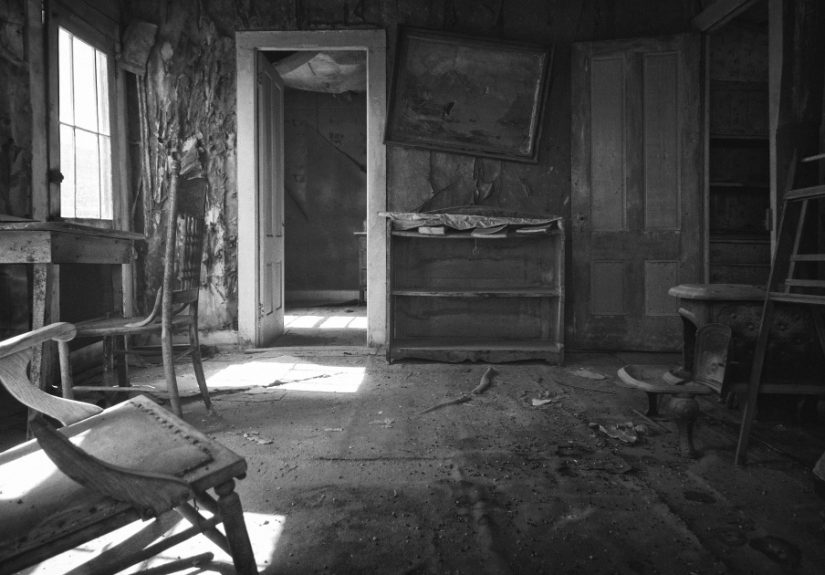
And yet what remains is astonishing. You can peer through dusty windows and see furniture, dishes, bottles, shelves, machinery, and the ordinary clutter of interrupted lives. That is what makes Bodie different from other abandoned places. It does not feel empty. It feels paused.
Why Bodie Is So Hard to Photograph Well
The first challenge is access. Bodie sits at about 8,375 feet in the Eastern Sierra, reached from Highway 395 by a road that gets increasingly serious about your suspension. The final stretch is rough dirt, and even before you arrive, the place is already testing your commitment. Once you get there, you learn the second challenge: the best light and the official access window do not always get along.
That matters because Bodie is all mood. It wants early light grazing the clapboard walls. It wants long shadows across sagebrush. It wants clouds gathering over the hills like an old Western soundtrack. Midday can flatten the town into a history lesson when what you really want is atmosphere. Many photographers, myself included, discover that Bodie does not reveal its most cinematic face on demand. You have to work for it, and sometimes that means coming back in another season, another month, or another year.
The weather is the third challenge, and honestly, it deserves its own co-author credit. At Bodie, the wind is not background noise. It is a personality. The altitude makes temperatures swing hard, even when the day begins politely. Conditions can turn fast in this high desert landscape, and winter is its own entirely different animal. In colder months, the town is still open, but access may require skis, snowshoes, or snowmobiles. That is less “casual photo stop” and more “earn your masterpiece.”
Then there is the fourth challenge: restraint. Most of the structures are protected, many interiors are visible only through windows, and the rules are strict for a reason. You are not there to rearrange history for a better shot. You are there to notice it. That sounds noble, and it is, but it also means you have to photograph around glare, dust, reflections, fences, worn paths, and the occasional human being wandering into frame dressed like they accidentally took a wrong turn on the way to a ski resort.
What Makes Bodie So Worth the Trouble
Because when Bodie works, it really works.
Visually, the town is a masterpiece of texture. Sun-bleached wood, cracked paint, rusted metal, warped porches, broken glass, faded signage, and huge open skies create the kind of layered scene photographers spend years chasing. You do not need smoke machines or dramatic editing tricks when the town already looks like time itself has been sanding every surface by hand.
Bodie also rewards every kind of photographer. Landscape photographers get the sweeping valley, rolling hills, and raw weather. Architecture photographers get geometry, repetition, and deterioration. Documentary photographers get evidence of real lives: a stove, a curtain, a schoolhouse, a church, a general store that still looks like someone stepped out for five minutes and never came back. Even street photographers can have a field day if they shift their thinking a little. In Bodie, the “street” is history, and the subjects are absence, memory, and the traces people leave behind.
What I love most is that Bodie does not rely on spooky gimmicks. Yes, it is a ghost town. Yes, it has an eerie reputation. But the deeper feeling is not horror. It is intimacy. The town still carries evidence of community: businesses, homes, Chinese settlement life, work sites, and public spaces that once pulsed with noise and ambition. Photographs made here can be dramatic, but the best ones usually feel human.
The History in the Frame Matters
A lot of people photograph Bodie as if it were simply an abandoned backdrop. That is the quickest way to make boring pictures. Bodie gets more interesting the moment you remember what it actually was.
This was one of the West’s great mining boomtowns. A rich strike in the late 1870s transformed Bodie from a rough prospecting settlement into a place of serious money, serious labor, and serious trouble. By the height of the boom, thousands of people lived here. The town had hotels, shops, a railroad connection, mills, boarding houses, and the kind of nightlife that made its reputation louder than its church bells. It was also a multicultural place. Immigrants arrived from Cornwall, Wales, Ireland, Canada, Mexico, Germany, and China. Bodie’s Chinese community created a town within the town, with businesses, lodging, social spaces, and a Taoist temple along King Street. That history matters because it shifts the photographs away from generic “ruin porn” and toward something more honest: a portrait of labor, migration, risk, exclusion, survival, and ambition.
The town’s decline came quickly by historical standards. Rich mines played out, money moved elsewhere, and fires did terrible damage. By the twentieth century, Bodie was fading into silence. Later, state preservation efforts kept the surviving town from being stripped clean by time, theft, and development. That decision is why photographers today can still look through windows and find tables, shelves, tools, and rooms that feel like they exhaled one last time and then held the breath for a century.
Knowing this changes the way you shoot. The church is not just photogenic. The schoolhouse is not just quaint. The mill is not just industrial eye candy. Each building is part of a system that once held a real community together. When you understand that, you stop hunting only for “spooky” and start looking for evidence of life. The work gets better immediately.
How I Finally Started Making Better Photos There
1. I stopped chasing only the postcard shot.
For a long time, I wanted the obvious winner: a dramatic wide view of Bodie with perfect light, perfect clouds, and not a single person in sight. That image exists, and it is wonderful, but it is also not the whole town. The turning point came when I started photographing smaller things: door handles, peeling notices, shadows on warped floors, bottles in windows, a chair sitting with all the confidence of a movie star. Bodie is not one picture. It is a collection of clues.
2. I learned that midday is not useless.
Photographers love to complain about midday light as if the sun personally offended us. In Bodie, harsh light can actually help. It exaggerates texture, makes wood grain pop, and brings out the dry, high-desert severity of the place. If you cannot get sunrise or sunset, lean into the honesty of the conditions. Bright light can make the town feel brutally exposed, which is its own kind of truth.
3. I started using windows as frames, not obstacles.
Bodie’s interiors are often viewed from outside, which means reflections can drive you slightly insane. Instead of fighting that every single time, I learned to use the glass creatively. Reflections can layer sky, landscape, and interior objects together in a way that makes the pictures feel like memory instead of documentation. When I wanted a cleaner view, I worked angles patiently, used a lens hood, and sometimes just waited for the light to shift a little.
4. I packed for the mountain, not for my ego.
At elevation, with limited services and fast-changing weather, Bodie is not a place to pretend you are invincible because you own a nice camera. Water, layers, sun protection, snacks, and a full tank of gas matter. So does accepting that you may not need every lens you own. One body, a wide lens, a normal zoom, and maybe a short telephoto are often enough. Your back will thank you, and so will your concentration.
5. I respected the rules instead of treating them like suggestions.
This should not be controversial, but somehow it still is. Everything in the park is protected. You do not pocket artifacts. You do not hop barriers. You do not fly a drone. You do not stage scenes with found objects. And if you are planning commercial filming or photography, permits matter. Bodie has survived because people took preservation seriously. The least a photographer can do is not become the reason a ranger gets a headache before lunch.
Practical Tips for Photographing Bodie Ghost Town in California
If you are planning your own visit, here is the practical version of what took me far too long to learn.
Choose your season carefully.
Summer and fall are generally the easiest for access, longer exploring time, and more predictable conditions. Fall often gives you fewer people and a little more breathing room. Winter can be visually spectacular, but it is a commitment, not a spontaneous detour.
Arrive with a shot list, but keep it loose.
Bodie will absolutely hand you surprises. Maybe the church catches the light. Maybe the mill suddenly becomes the story. Maybe a plain side street ends up saying more than the famous buildings. Give yourself structure, but leave room for the town to interrupt your plan.
Photograph the big picture and the tiny evidence.
Wide shots establish place. Details create emotion. You need both. A weathered storefront tells you where you are; a dusty shelf tells you why you care.
Prepare for limited services.
There is no full convenience cushion out here. Bring what you need. Cell service can be limited, the weather can turn, and the rough road is not interested in your schedule.
Look into official programs if photography is your main goal.
Serious photographers sometimes use official workshops and programs through the Bodie Foundation, which can provide expanded opportunities beyond ordinary park-hour shooting. That can make a huge difference if your whole mission is light, atmosphere, and deeper access.
Why I Kept Going Back
I kept going back because Bodie never looked finished. Not to the eye, and definitely not to the camera. Every return visit showed me a different town. One year I noticed scale. Another year I noticed silence. Another year I became obsessed with the strange tenderness of ordinary objects left behind. That is the thing about photographing historic places: the subject is not just what is there. The subject is also what you are finally able to notice.
Bodie taught me patience more than technique. It taught me to let weather participate. It taught me to stop chasing theatrical clichés and start paying attention to evidence. It taught me that a ghost town is not compelling because it is empty. It is compelling because it was once full.
If you go to Bodie hoping for one perfect image, you might leave a little frustrated. If you go ready to listen with your camera, you will probably come home with something better: photographs that feel earned.
Extra Reflections From Years of Chasing Bodie Through a Lens
The strangest part of spending years photographing Bodie was realizing that the town kept becoming a mirror. The first time I went, I was in full photographer mode, which is a polite way of saying I was annoyingly sure I knew what I was doing. I wanted drama. I wanted moody skies. I wanted an image so cinematic that even my hard drive would stand up and applaud. Instead, I got wind, glare, a couple of mediocre frames, and the deeply humbling discovery that an old ghost town does not care about my artistic ambitions.
So I came back. And then I came back again. On one trip, I obsessed over the scale of the place. Bodie is not just a cluster of photogenic ruins; it spreads out in a way that makes you understand how real the town once was. On another visit, I focused on windows and started seeing how much emotion can live in reflected light. A chair behind dirty glass can feel lonelier than an entire street. A shelf of canned goods can say more about time than a grand scenic overlook. Bodie kept training my eye by refusing to be simple.
I also learned that the drive in is part of the experience. By the time you reach the rough final miles, the modern world begins to loosen its grip a little. Then you park, step out, feel that sharp high-desert air, and suddenly the silence has weight. Even when there are other visitors around, the place still carries a strange hush beneath the footsteps and camera shutters. It is not empty silence. It is layered silence, the kind that feels like it has absorbed decades of weather and memory and has no particular interest in explaining itself to you.
Some of my favorite moments never produced my favorite photographs. Once, a cloud bank rolled in just enough to turn the whole town cool and silver for maybe three minutes. I remember fumbling with settings, trying to be efficient, then finally giving up and just looking. Another time, I watched late light hit one plain wooden wall until the grain glowed like it had heat trapped inside it. It was not a famous building. No one around me seemed especially impressed. But that is the kind of moment Bodie gives you when you stop demanding spectacle and start noticing character.
Over time, the place changed my definition of success. I used to think a successful visit meant coming home with one portfolio image. Now I think success can mean understanding the town a little better than I did before. Maybe that understanding comes in the form of a wide shot from a hill. Maybe it comes from a photograph of a doorknob. Maybe it comes from realizing that the best picture that day was the one I did not take because I was too busy standing there, feeling grateful that a place this fragile and this honest still exists.
That is why I kept returning to Bodie, and why I probably always will. Not because I ever fully nailed it, but because I did not. The town remains just out of reach in the best possible way. Every visit offers another angle, another mood, another lesson in patience and restraint. For a photographer, that kind of unfinished conversation is irresistible.