Table of Contents >> Show >> Hide
- The Numbers (and Why They Make Your Eyebrows Levitate)
- Market Cap Isn’t a Trophy. It’s a Spreadsheet About Tomorrow.
- Why Palantir Gets Valued Like a Rocket Ship
- Why Salesforce Can Look “Cheap” (Even While It’s Printing Billions)
- Does the Palantir-vs-Salesforce Valuation Gap “Make Sense”?
- What Could Break the “It Might” Part?
- So, Does It Make Sense? YesIf You Accept What the Market Is Actually Buying.
- Experiences From the Real World: What This Kind of Valuation Moment Feels Like (And What People Learn the Hard Way)
- Experience #1: “Am I late… or am I early?”
- Experience #2: The “multiple shock” after an earnings call
- Experience #3: Inside companies, tool choice is rarely “Palantir vs Salesforce”
- Experience #4: The whiplash of “AI changes everything” budgeting
- Experience #5: The most common lessongreat company ≠ great stock at any price
Somewhere in the markets, a calculator is quietly begging for mercy.
On one side, you’ve got Salesforcethe grandparent of modern CRM, the company that convinced the business world that “cloud” wasn’t just weather. It just closed a record fiscal year with $41.5 billion in revenue. On the other side, you’ve got Palantirthe data-and-AI specialist with deep roots in government and regulated industriesposting full-year revenue of about $4.5 billion.
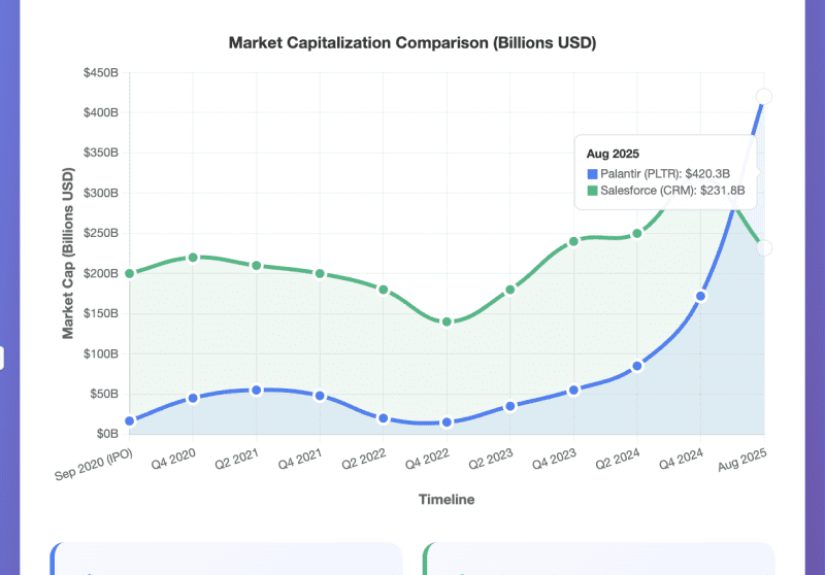
And yet, in late February 2026, market data has shown Palantir around the $420B neighborhood while Salesforce is far lower (often cited around ~$185B; some trackers show a higher figure depending on timing, methodology, and currency conversions). In other words: the smaller revenue business is wearing the bigger market-cap crown. That looks upside-down… unless you remember what a market cap actually is.
Market cap is not a prize for having the most revenue. It’s a crowd-sourced forecast of future cash flows, filtered through optimism, fear, interest rates, and the occasional bout of “I saw it on FinTok.” If investors believe Palantir’s future is exponentially larger than its present, the math can start to look less like a typo and more like a very aggressive bet.
The Numbers (and Why They Make Your Eyebrows Levitate)
Let’s anchor the conversation with the basics (late February 2026 snapshots):
| Company | Market Cap (approx.) | Latest Full-Year Revenue | Implied Price-to-Sales (rough) |
|---|---|---|---|
| Palantir (PLTR) | $420B-ish | $4.475B (FY 2025) | ~90x+ |
| Salesforce (CRM) | $185B–$230B-ish | $41.5B (FY 2026) | ~4x–6x |
Palantir’s FY 2025 revenue and growth highlights came through recent earnings disclosures, including a Q4 revenue print of about $1.407B and FY revenue around $4.475B. Salesforce reported $41.5B for its fiscal 2026 year. Those aren’t “close enough” numbers; that’s a different solar system.
So if you’re asking, “How can 10x less revenue be worth more?” you’re asking the right question. The answer is: the market isn’t paying for the pastit’s paying for the story of the future.
Market Cap Isn’t a Trophy. It’s a Spreadsheet About Tomorrow.
There are two big ideas that explain most valuation weirdness:
- Growth expectations: If investors think Company A will grow much faster than Company B for much longer, Company A can trade at a wildly higher multiple.
- Profitability expectations: Revenue is nice. Cash flow is the point. If investors believe Palantir can eventually generate far higher margins (and do it at scale), they’ll value each dollar of revenue more.
This is why a startup with $50M in revenue can be valued more (on paper) than a mature company with $500M. The market is basically saying: “That $50M is the first chapter of a big book. The $500M might be chapter twenty-five, and the plot has slowed down.”
When that logic gets turned up to 11and sprinkled with “AI platform” languageyou can get a scenario where revenue size becomes less important than revenue trajectory.
Why Palantir Gets Valued Like a Rocket Ship
Palantir’s bull case in 2026 isn’t “nice steady enterprise software.” It’s closer to: “an AI operating system for high-stakes decisions”in government, defense, manufacturing, energy, healthcare, and other places where bad data literally costs lives or billions.
1) Growth acceleration investors can point to (not just vibe to)
Palantir’s recent results have been the kind that makes analysts start using words like “durable” and “inflecting.” In the Q4 2025 period, Palantir reported revenue growth of about 70% year-over-year to $1.407B, with especially strong U.S. commercial growth. The company also issued FY 2026 guidance pointing to another year of rapid expansion (guidance cited around 61% year-over-year in some disclosures). That’s the kind of growth rate that can justify a premiumat least mathematicallybecause it implies the revenue base could be dramatically larger in a few years.
Importantly, this isn’t being framed as “one lucky quarter.” Recent coverage has tied performance to increased U.S. defense spending and expanding demand for AI-driven analytics tools in both government and commercial markets.
2) Operating leverage: the dream that software margins come back from the dead
Enterprise software investors love a specific kind of magic trick: the one where revenue grows, and costs don’t grow as fast. Palantir has leaned into the narrative that its platform approachdeploying core products across customerscreates compounding economics as it scales.
When markets smell operating leverage, they start pricing a future where “today’s revenue” turns into “tomorrow’s cash machine.” That’s why you’ll see valuation conversations drift from price-to-sales to things like free cash flow multiples and long-range margin assumptions.
3) The “AI + data + defense” premium is real (and emotionally potent)
Palantir sits in a rare intersection: AI, data integration, and national-security-adjacent work. In a world where governments are modernizing logistics and intelligence systemsand enterprises are trying to operationalize AI without turning their data into a flaming trash canPalantir’s positioning stands out.
Recent analyst commentary has highlighted customer validation and expanding demand, while also acknowledging competition. The “premium” isn’t just for AI; it’s for being perceived as mission-critical AI.
4) Investors are paying for a future revenue scale that dwarfs the present
Here’s the mental model that can make the valuation feel less insane (still spicy, but less insane):
- If Palantir eventually becomes a $30B–$50B revenue business, and
- it produces very high margins (say 30%+ operating margins, or hefty free cash flow), and
- the market still values that cash flow at a healthy multiple,
…then a $420B market cap becomes possible. Not guaranteed. Not “safe.” But possible in a spreadsheet that assumes Palantir becomes a category-defining platform.
In other words, investors aren’t valuing Palantir as “$4.5B revenue Palantir.” They’re valuing it as “future platform Palantir.” The multiple is the price of that belief.
Why Salesforce Can Look “Cheap” (Even While It’s Printing Billions)
Salesforce is not a tiny company being misunderstood. It’s a giant. And giants have a different valuation problem: gravity.
1) Growth is harder at $41.5B than at $4.5B
Salesforce delivered $41.5B in fiscal 2026 revenue and highlighted large remaining performance obligations (RPO) around the $72B level. That’s a lot of contracted future revenue sitting on the books, which is usually a comforting thing for investors.
But the market also knows the rule: the bigger you are, the harder it is to grow fast. Even strong double-digit growth can be framed as “maturing” when investors are intoxicated by faster growers elsewhere.
2) Salesforce is being priced like a mature cash-flow business (because it is one)
Salesforce has leaned into shareholder returnsbuybacks and dividendsalong with margin improvement. It’s a classic “quality large-cap software” playbook. But when the market is chasing the next platform shift, maturity can get punished, even if the underlying business is healthy.
3) AI changes the SaaS pricing storyand the market is nervous
Salesforce is pushing hard into agentic AI (including messaging around Agentforce), and recent reporting has discussed both the promise and investor anxiety around AI disrupting traditional SaaS models. If AI agents can do work that used to require more human seats, does “per user” pricing hold forever?
Salesforce’s leadership is arguing the opposite: AI makes the platform more valuable, not less. Still, when a market is anxious, it discounts the future until proven otherwise.
Does the Palantir-vs-Salesforce Valuation Gap “Make Sense”?
It canbut only under a specific set of assumptions. Think of it like buying a concert ticket:
- Salesforce is the legendary band that already has 20 platinum albums. You know what you’re getting.
- Palantir is the new act that might become the next stadium phenomenon. The ticket is expensive because everyone wants to say they were there early.
Here’s a simple way to sanity-check the market’s logic.
A “what must be true” checklist for $420B to feel reasonable
- Revenue scaling: Palantir needs to keep growing fast for years, not quarters.
- Commercial expansion: Government business can anchor credibility, but commercial scale must carry the long-term size.
- Margin expansion: The business needs to convert growth into substantial cash generation.
- Platform durability: Customers must stick, expand spend, and build workflows that are painful to rip out.
- Competition management: It must win against heavyweight ecosystems and fast-moving AI/data competitors.
If those things happen, Palantir’s current valuation becomes a prepayment on a much larger future. If they don’t, the multiple can compress brutallyeven if revenue keeps growing.
What Could Break the “It Might” Part?
High-multiple stocks have one recurring vulnerability: they’re priced for a near-flawless story. Here are the biggest ways the story gets messy:
1) Valuation compression (a.k.a. “the market sobers up”)
Even if Palantir executes well, the market can decide it no longer wants to pay triple-digit price-to-sales multiples. That’s not personal. That’s just interest rates, risk appetite, and a crowd rotating to the next shiny object.
2) Growth slows earlier than hoped
When a company guides to rapid growth, expectations get locked in. A couple of quarters of deceleration can feel like a betrayal, even if the business is still doing fine by normal-human standards.
3) Competition gets underestimated
Analyst coverage has noted competition from major players in data platforms and AI tooling. If customers can assemble “good enough” solutions with existing cloud stacks, Palantir’s premium pitch gets harder.
4) Narrative risk: government ties cut both ways
Defense and intelligence relevance can be a valuation tailwind. It can also increase scrutiny and reputational riskespecially when contracts touch politically sensitive areas. Markets don’t like uncertainty, even when revenue is real.
So, Does It Make Sense? YesIf You Accept What the Market Is Actually Buying.
If you treat market cap like a reward for current revenue, then no: it doesn’t make sense. Salesforce should be “worth more” because it sells more.
But the market isn’t awarding medals for last year’s sales. It’s buying a probability-weighted future. In that framing:
- Salesforce is valued like a massive, durable, cash-generating enterprise platform that will grow steadily and return capital.
- Palantir is valued like a potential category-defining AI platform whose revenue and margins could scale dramaticallyfast enough to justify paying a premium today.
That’s why the valuation gap can “make sense.” Not because it’s guaranteed. Because it reflects a very specific bet: Palantir’s future business could be so much larger than its present that today’s multiple is the entry fee.
One last note: this isn’t investment advicejust an explanation of why the market can look irrational while still following its own internal logic.
Experiences From the Real World: What This Kind of Valuation Moment Feels Like (And What People Learn the Hard Way)
When a company with a fraction of the revenue passes a household-name giant in market cap, it tends to create a predictable set of human reactionsbecause investors are people first, and spreadsheets second.
Experience #1: “Am I late… or am I early?”
This is the emotional seesaw that defines high-multiple, high-narrative stocks. People watch a chart climb, then wonder whether the move is just starting or already finished. With Palantir, the reaction often comes in two flavors:
- The believer: “This is the platform moment. If it becomes infrastructure, $420B will look cheap later.”
- The skeptic: “This is the classic ‘great company, wild price’ setup. The business can win and the stock can still lose.”
Both perspectives can be rationalbecause they’re arguing about different things. One is arguing about business quality. The other is arguing about price paid.
Experience #2: The “multiple shock” after an earnings call
In mature software, a good quarter often leads to a modest reaction. In a stock priced like Palantir, a “good” quarter can be treated like “meeting the minimum requirements for staying on the ride.” The surprise comes when the company posts strong numbers and the stock still drops. That’s usually the moment investors learn a key lesson: expectations are part of the financial statements, just not officially.
A high multiple can make performance feel binary: either you’re beating aggressive expectations, or the market re-prices you. Even analyst notes about valuationlike discussions of free cash flow multiplescan become as influential as the company’s operational progress.
Experience #3: Inside companies, tool choice is rarely “Palantir vs Salesforce”
From an operator’s perspective, these two companies often solve different problems. Salesforce is frequently part of the “system of record” for customer relationshipssales pipelines, service workflows, customer data structures. Palantir tends to enter the room when an organization has complex data integration needs and wants analytics, decision support, and AI-enabled operations across messy systems.
In practice, teams may say: “Salesforce runs the front office; Palantir helps us connect and reason over the whole business.” That’s why the markets can compare them financially even when customers don’t treat them as direct substitutes.
Experience #4: The whiplash of “AI changes everything” budgeting
Across enterprises, AI budgets have been moving from experimentation to operational deployment. The experience many leaders report is that AI projects fail not because the models are bad, but because data is fragmented and governance is unclear. That environment can make Palantir’s pitch resonateespecially with executives who are tired of “pilot purgatory.”
Meanwhile, Salesforce’s experience has been about embedding AI into the workflows where work already happenssales, support, marketing, and collaboration tools. The tension is that AI might reduce the number of human actions needed to get results, which is why investors debate SaaS pricing models. Internally, teams feel this as a practical question: “Do we pay per seat, per outcome, per agent, or per usage?” That uncertainty can affect how markets value even dominant incumbents.
Experience #5: The most common lessongreat company ≠ great stock at any price
When a business is excellent, people start to treat the stock like a lifetime pass. But valuation still matters. High-multiple stocks tend to teach investors (sometimes gently, sometimes violently) that returns depend on the gap between expectations and reality. If the future turns out even slightly smaller or slower than the market implied, a premium multiple can compress quickly.
On the flip side, investors who study these moments also learn why the market pays up for rare platform candidates: if a company truly becomes foundational infrastructure, revenue growth and margins can compound in ways that look unbelievable in the early innings. That’s the bet embedded in Palantir’s valuation todayand it’s why the comparison to Salesforce can be simultaneously shocking and explainable.