Table of Contents >> Show >> Hide
- The crater nobody expected to still be there
- Why this discovery matters more than the headline
- How scientists knew this was an impact crater
- Hidden in plain sight means exactly what it sounds like
- China’s crater story is suddenly getting a lot more interesting
- From Arizona’s Meteor Crater to Jinlin
- This is not an apocalypse story
- What scientists still need to prove
- The bigger picture: Earth is probably missing pages
- What It Feels Like to Chase a Crater Story
Earth is not great at keeping cosmic receipts. The Moon hangs onto its impact scars like a proud scrapbooker. Mars preserves ancient dents by the thousands. Earth, meanwhile, has weather, oceans, forests, plate tectonics, and a bad habit of recycling its surface like a neat freak with no sentimental attachment. So when scientists identify a large impact crater that has been sitting out in the open for ages, the discovery is not just cool. It is a reminder that our planet may still be hiding major chapters of its own collision history in places no one thought to look.
That is exactly why the recently confirmed Jinlin crater in southern China has drawn so much attention. The bowl-shaped structure, located in Guangdong Province near Zhaoqing, measures about 900 meters across and appears remarkably well preserved despite sitting in a region known for heavy rain, humidity, and monsoon weather. In plain English, it survived in the kind of landscape where geology usually gets softened, blurred, buried, or turned into a gardening problem. And that makes it one of the more surprising impact-crater finds in recent memory.
The crater nobody expected to still be there
At first glance, the Jinlin crater does not fit the stereotype of a dramatic asteroid scar in a dry desert. It sits on a hillside covered by weathered granite, in a lush and erosion-friendly environment that should have spent thousands of years smoothing away the evidence. Yet the crater still shows a clear rim, a distinct depression, and the kind of structure that made researchers take a second look and ask the geological version of a very good question: “Wait a second… why is that so round?”
The answer was not based on shape alone. Circular landforms can come from many processes, and geology loves a fake-out. But the research team found something much more persuasive inside quartz grains collected from rock fragments at the site: planar deformation features. These microscopic shock signatures form under immense pressures generated by impact events. They are essentially geology’s version of a fingerprint left at the scene. Once those features showed up, the case for an impact origin became much harder to argue with.
That confirmation matters because the crater may be very young in geological terms. Researchers inferred that the impact likely happened during the early to mid-Holocene, which would place it sometime within roughly the last 11,700 years. If that timeline holds up under future work, Jinlin would be the largest known impact crater from the Holocene. That is a big deal. It would not be the biggest young crater of all recent Earth history, but it would reset expectations for how large a relatively recent asteroid impact could be while still slipping past the historical and geological spotlight.
Why this discovery matters more than the headline
Earth is terrible at preserving impact craters
There are only about 200 confirmed impact sites on Earth, depending on which database update you check. That number sounds tiny because, frankly, it is. Earth has been getting smacked by space debris for billions of years, but most of the evidence is erased by erosion, buried under sediment, swallowed by oceans, disguised by vegetation, or dragged into deeper geological oblivion by tectonic activity. Our planet is active, which is wonderful for life and deeply annoying for anyone trying to reconstruct ancient impact history.
That is why craters on Earth are often harder to recognize than those on the Moon or Mars. Other rocky worlds preserve impact scars like old bruises. Earth heals. Fast. A crater can fade into hills, fill with lake sediment, hide beneath forest, or vanish beneath younger rock. The result is a patchy record that almost certainly undercounts how many sizable impacts happened here, especially in wetter or more tectonically active regions.
Jinlin rewrites what “recent” can look like
Before Jinlin entered the chat, the biggest known Holocene impact structure was the Macha crater in Russia, at roughly 300 meters across. Jinlin is about three times wider. That is not a small update. That is a “somebody please adjust the chart” update. It suggests that recent asteroid impacts by relatively modest space rocks may have been more consequential, or at least more geologically visible, than the known record implied.
Some reporting based on the new research estimates the impactor may have been around 30 meters wide and moving at roughly 20 kilometers per second. That is the kind of object that sounds manageable until you remember that space turns speed into violence very efficiently. A rock that size does not need to be dinosaur-ending to ruin a very large area’s day.
How scientists knew this was an impact crater
The strongest evidence lies in those quartz microfeatures. Planar deformation features are diagnostic shock markers, meaning they are not the sort of thing ordinary earthly processes casually whip up on a Tuesday afternoon. The intense pressure needed to create them is associated with celestial impacts. In other words, the crater is not just shaped like an impact site. It bears the microscopic scars of one.
The setting also helped researchers reconstruct what happened. Jinlin formed in granite and appears slightly elliptical because the impact hit a hillside rather than a perfectly flat surface. That detail matters because real impacts do not always produce textbook symmetry. Nature likes chaos, and asteroid strikes are not known for their tidy manners. The crater’s rim and floor contain weathered granite soil and fragments that fit the story of a high-speed strike excavating the hillside and tossing debris outward.
Researchers also argue the object was almost certainly a meteorite rather than a comet. A cometary impact would likely have produced a far larger crater, on the order of many kilometers across. The team has not yet pinned down whether the incoming body was iron-rich or stony, which remains one of the more interesting open questions. That future detective work could help refine the size, energy, and exact behavior of the impactor.
Hidden in plain sight means exactly what it sounds like
The phrase “hidden in plain sight” works here because the crater was not tucked beneath ice, buried under the seafloor, or covered by a lava plateau. It was sitting in the landscape. People could see the depression. The problem was interpretation. Earth is full of circular and semi-circular features, and unless someone investigates them with the right tools, a crater can look like just another basin, ridge, or oddly symmetrical landform.
That is a theme in crater science. Researchers have found clues to lost impacts in museum collections, in buried geophysical data, in satellite imagery, and in places locals knew well but never identified as extraterrestrial scars. Sometimes the “discovery” is not the landform itself. It is the moment a scientist recognizes what the landform actually is. Geology has a way of making the obvious look ordinary until someone asks the right question.
And yes, that is a little funny. Imagine an asteroid slamming into Earth hard enough to reshape a hillside, only for the planet to respond with, “Eh, probably just a weird hill.”
China’s crater story is suddenly getting a lot more interesting
Jinlin is not the only Chinese impact structure to shake up recent crater science. The Yilan crater in Heilongjiang Province, identified in the early 2020s, spans about 1.85 kilometers and is thought to have formed between roughly 46,000 and 53,000 years ago. It is heavily associated with forest cover and was long overlooked as just another circular mountain feature. That crater helped show how much might be missed in vegetated terrain. Jinlin adds a second lesson: humid, weathered landscapes may preserve more than researchers expected too.
Together, Yilan and Jinlin hint that China may hold more impact structures than older inventories suggested. Given the country’s enormous land area, that possibility is not shocking. What is surprising is how recently these findings have accelerated. For a long time, the sparse number of confirmed Chinese craters looked like a geological mystery. Now it looks more like a search problem.
From Arizona’s Meteor Crater to Jinlin
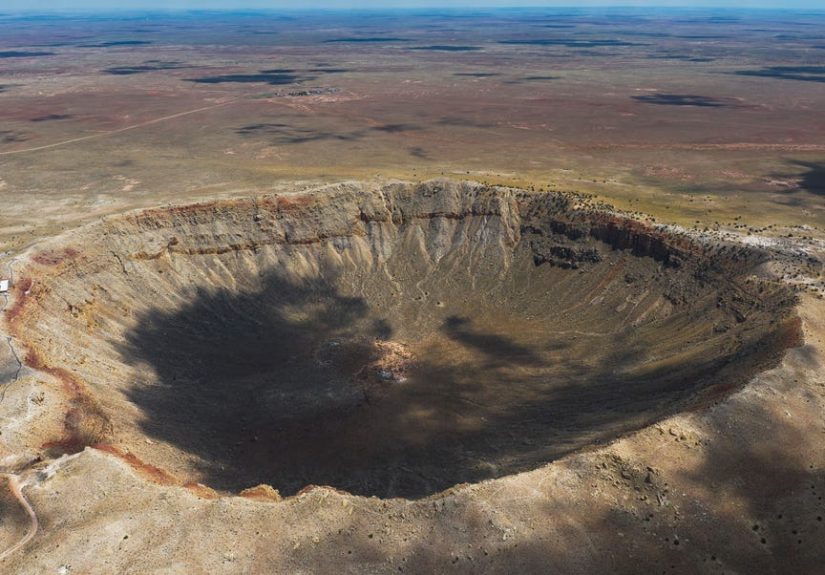
For context, it helps to compare Jinlin with Arizona’s famous Meteor Crater, also known as Barringer Crater. Meteor Crater is about 1.2 kilometers wide and roughly 50,000 years old. It remains one of the best-preserved impact craters on Earth largely because it formed in an arid environment where erosion has been relatively slow. That site has become a natural laboratory for understanding how medium-size impacts excavate rock, throw ejecta, and shape the landscape.
Jinlin is smaller than Meteor Crater, but its preservation in a much wetter climate is what makes scientists sit up straighter in their chairs. If an impact structure that size can survive on a monsoon-prone granite hillside, then the old assumption that young, readable craters mostly belong to deserts and dry plateaus may need some updating. The Earth may not be as forgetful as we thought. It may just be selective.
This is not an apocalypse story
Whenever an asteroid-crater headline lands online, the internet tends to react in two speeds: “wow” and “we are all doomed.” The calmer truth is that discoveries like Jinlin are mostly about improving the geological record, not sounding a cosmic fire alarm. Large impacts are rare, and Earth’s atmosphere destroys many small objects before they ever reach the ground intact.
Still, the crater does matter for hazard awareness. Scientists study preserved impact sites partly because they help estimate what certain size classes of incoming objects can do. Meteor Crater has long served that role. Jinlin now adds another useful example, especially for understanding impacts into weathered granite in a humid setting. Better records of past strikes improve our sense of what Earth has faced before and what kinds of events belong in planetary-defense planning.
What scientists still need to prove
This is where responsible science writing has to keep both feet on the ground. The impact origin of Jinlin is well supported. The age estimate is the shakier part. Researchers inferred a Holocene age by comparing local weathering and erosion rates with the condition of rock fragments at the site. That is clever, but it is not the same as directly dating impact material. Some outside experts have already noted that the timeline should be treated as provisional until additional tests confirm it.
That does not weaken the importance of the discovery. It simply means the story is still being written. Future work could narrow down the date, identify the meteorite type, refine the impact energy, and map the crater’s structure in greater detail. If the Holocene estimate holds, Jinlin becomes a genuine record-breaker. If the date shifts older, it is still a major and fascinating crater that survived in a place where it probably should have been erased.
The bigger picture: Earth is probably missing pages
One of the most interesting things about Jinlin is what it implies about all the impact structures we have not found yet. Scientists keep uncovering evidence of ancient strikes from tektites, buried anomalies, and subtle topographic patterns. In some cases, they can prove a major impact happened without locating the crater itself. In others, they find the crater only after decades of looking at the same region through the wrong lens.
So the real story is bigger than one bowl-shaped depression in southern China. Jinlin is a reminder that Earth’s impact history is incomplete, not because the impacts were rare, but because the planet is constantly editing the record. Forests grow. Rain falls. Mountains erode. Sediment accumulates. Human eyes get used to familiar landscapes and stop asking questions. Then one day, a geologist notices that a “normal” hillside looks suspiciously like a wound from space.
That is the magic of this discovery. Not just that scientists found a massive asteroid crater, but that the crater had apparently been sitting there all along, like the universe’s least subtle secret.
What It Feels Like to Chase a Crater Story
There is something uniquely strange about standing near an impact crater, even if you are only seeing one through photographs, satellite images, or the careful language of a research paper. Most landscapes feel slow. Rivers carve valleys over ages. Wind shaves down stone grain by grain. Forests expand, die back, and return. A crater is different. A crater is an interruption. It is the geological equivalent of a sentence ending with an exclamation point written in fire.
That may be why crater stories grab people who do not normally care about rock textures or quartz microfeatures. You do not need a geology degree to feel the drama. One moment, there is an ordinary piece of Earth. The next, a space rock moving at absurd speed punches into it and changes the place forever. Then time takes over again. Rain softens the rim. Sediment settles. Plants move in. Eventually the scar becomes scenery. A hill. A basin. A weird circle on a map. Something locals pass by without realizing they are looking at a record of sudden violence from the sky.
There is also a human thrill in the detective work. Crater science is not just about giant explosions. It is about humility. Researchers often begin with incomplete clues: a suspicious ring, an odd gravity anomaly, glassy fragments, shocked minerals, an overlooked museum specimen, a piece of satellite imagery that refuses to stop looking circular. The fun comes from turning those clues into a story the rocks can defend. That process has a kind of romance to it. Not the roses-and-violin kind. More the dusty-boots, “we may be onto something,” map-spread-across-the-table kind.
And for readers, there is a quieter experience too: perspective. Crater stories make everyday scale feel flimsy. A 900-meter-wide hole is huge to us, but tiny compared with the planet. A 30-meter asteroid sounds modest until it hits at cosmic speed. Ten thousand years feels ancient until geology shrugs and calls it recent. Reading about a crater hidden in plain sight has a way of rearranging the mind. It reminds us that Earth is not just a home. It is a target, a survivor, and a very messy archive.
Maybe that is why discoveries like Jinlin linger in the imagination. They carry wonder, danger, mystery, and a little comedy all at once. The comedy is that the evidence can sit in front of us for ages while everyone misses it. The danger is obvious. The wonder comes from realizing that our familiar world still contains features dramatic enough to sound fictional. And the mystery is the best part, because every new crater raises the same irresistible question: how many more are out there, quietly waiting for someone to notice that the landscape has been telling a space story this whole time?
In that sense, the experience tied to a crater story is not just awe. It is recognition. We look at Earth and think we know it because we live on it. Then science points to a hillside, a forest ring, a buried anomaly, or a bowl in the desert and says, actually, that is where the sky hit the ground. Suddenly the planet feels wilder, older, and more surprising than it did five minutes earlier. And honestly, that is a pretty great reason to keep reading about rocks.