Table of Contents >> Show >> Hide
- Step 1: Decide what “coverage” actually means for your event
- Step 2: Find the story hook (the thing a journalist can defend in a newsroom meeting)
- Step 3: Build a small, accurate media list (not a massive one)
- Step 4: Choose the right tool: media advisory vs. press release vs. pitch
- Step 5: Create a one-page media advisory that’s fast to scan
- Step 6: Write a pitch email that sounds like a human wrote it
- Step 7: Time your outreach like a pro (without being annoying)
- Step 8: Make a tiny media kit that removes friction
- Step 9: Be ridiculously clear about access, logistics, and rules
- Step 10: Follow up politely, once or twice, then move on like an adult
- Step 11: If they don’t come, create “coverage-ready” assets anyway
- Common mistakes that quietly kill coverage
- Conclusion
- Additional : Real-World Experiences and Lessons Learned
You planned the event. You booked the venue. You begged someone’s cousin to bring “a real camera.”
Now you want the one thing money can’t always buy: earned media coveragethe kind that makes your event feel
official, amplifies your mission, and convinces your boss (or your mom) that this was absolutely worth it.
Here’s the good news: requesting media coverage doesn’t require a PR agency, a fancy Rolodex, or a magical
“journalist summoning circle.” It does require clarity, preparation, and a pitch that respects one basic truth:
journalists aren’t looking for eventsthey’re looking for stories.
Below are 11 simple, practical steps to help you pitch the right outlets, write a media advisory that doesn’t get ignored,
and make coverage easy for editors and assignment desks to say “yes” to.
Step 1: Decide what “coverage” actually means for your event
Before you email a single reporter, define the outcome you want. “Media coverage” can mean wildly different things:
a calendar listing, a short community mention, a feature story, a photographer showing up, a TV segment, or even a
newsletter blurb that drives RSVPs.
Pick a primary goal
- Awareness: “We want people to learn this is happening.”
- Attendance: “We need RSVPs and walk-ins.”
- Credibility: “We want a story that explains why this matters.”
- Documentation: “We want photos/video we can republish (with permission).”
Your goal will determine whether you prioritize local TV assignment desks, community calendars, niche reporters,
or trade publications. Otherwise, you’re throwing spaghetti at an inbox and hoping it becomes lasagna.
Step 2: Find the story hook (the thing a journalist can defend in a newsroom meeting)
Newsrooms don’t cover “events.” They cover angles: impact, timeliness, conflict, novelty, community benefit,
strong visuals, notable findings, and people with something real on the line.
Try these hook prompts
- Impact: Who benefits, and what changes because of this event?
- Timeliness: Why now? Is it tied to a season, policy change, or awareness month?
- Local relevance: What does this mean for your city/county/state?
- Human story: Who’s at the center, and what’s their “why”?
- Visuals: What will look good on camera or in photos?
Example hook (nonprofit fundraiser): “Local teen-led team raises funds for pediatric cancerfamilies share why this matters.”
Example hook (business event): “New workforce program aims to fill 200 skilled jobsemployers and trainees speak.”
Step 3: Build a small, accurate media list (not a massive one)
A common mistake: emailing 200 people you found on a random list and calling it “outreach.” A better move:
create a lean list of outlets and contacts who are actually likely to care.
Start with three buckets
- Local daily news: metro paper, local TV, local radio, city magazine
- Community and niche: neighborhood outlets, faith/community publications, ethnic media, event calendars
- Industry/trade: if your event matches a beat (health, tech, education, real estate, hospitality)
Quick checklist for each contact
- Do they cover your topic (their beat)?
- Are they local enough to care?
- Do they publish event listings or community briefs?
- Do they include an “events” email or assignment desk contact?
Keep it clean: name, role, outlet, email, phone (if public), beat, notes, and links to 2–3 recent stories (for your own reference).
This step isn’t glamorous, but it’s where most “why did nobody cover us?” problems begin.
Step 4: Choose the right tool: media advisory vs. press release vs. pitch
You don’t always need a full press release. For events, you typically use:
- Media advisory: an invitation with the key detailsdesigned to get media to attend.
- Pitch email: a short, tailored note offering a specific angle or interview opportunity.
- Press release: a fuller “ready-to-report” summary, often best for announcements or post-event results.
Think of it like this: the advisory gets them in the door, the pitch gets them interested, and the release gives them
clean copy if they’re on deadline.
Step 5: Create a one-page media advisory that’s fast to scan
A media advisory should feel like a helpful cheat sheet, not a novel. Your job is to make it effortless for an assignment editor
to understand what’s happening in under 15 seconds.
Media advisory must-haves
- Headline: clear and specific (avoid hype words like “exciting”)
- What/When/Where: bolded and easy to grab
- Who: notable attendees, speakers, partners
- Why it matters: 1–2 lines on public impact
- Visuals: what cameras/photos can capture
- Interviews: who is available, and when
- Logistics: parking, check-in, credentials, safety notes
- Media contact: name + cell number (day-of matters)
Mini advisory example (short)
MEDIA ADVISORY: Community Food Drive Packs 25,000 Meals for Local Families
WHAT: Volunteer meal-packing event benefiting regional food banks
WHEN: Saturday, March 14, 10:00 a.m.–12:00 p.m. (media window: 10:30–11:15)
WHERE: Eastview Community Center, 123 Main St., Springfield
WHO: 300 volunteers, partner food bank leaders, local small businesses
WHY: Hunger relief effort as food insecurity risesfamilies and organizers available for interviews
VISUALS: Assembly lines packing meals, pallets of finished boxes, group photo at 11:00 a.m.
MEDIA CONTACT: Jordan Lee, (555) 123-4567, [email protected]
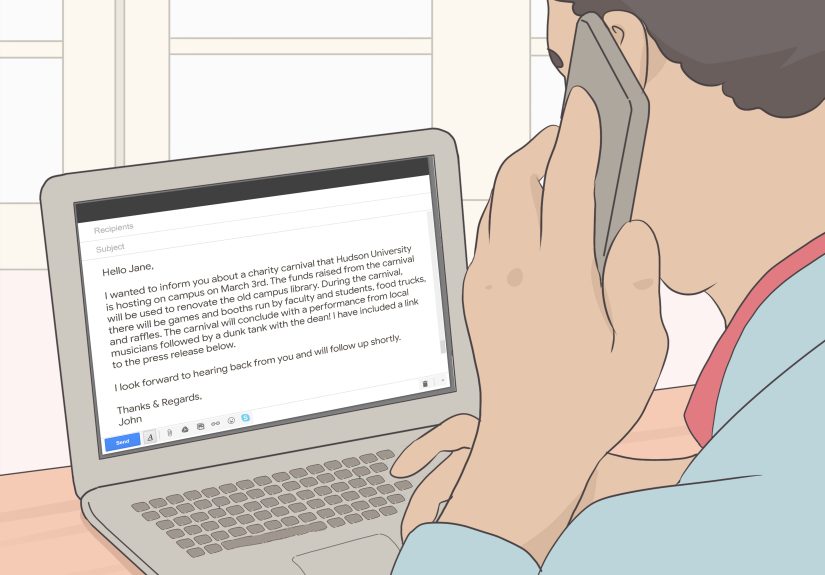
Step 6: Write a pitch email that sounds like a human wrote it
Your pitch is not a brochure. It’s a short message that answers: “Why should your audience care, and why should you cover it now?”
Pitch structure that works (without being robotic)
- Subject line: specific, not cute
- First sentence: the hook (impact + timeliness)
- Two to four bullets: key details and what’s unique
- Offer: interviews, visuals, access
- Close: easy yes/no question, plus contact info
Subject line examples
- “Media invite: 500-student robotics showcase (Sat., downtown)”
- “Interview available: Local nurse leads free heart-health screenings”
- “Photo/video opportunity: Giant shoreline cleanup with 1,000 volunteers”
Pitch email example (copy/paste friendly)
Subject: Media invite: Free job fair connecting 40 employers + veterans
Hi [Name] I’m reaching out because [City] is hosting a veterans-focused job fair this Friday that aims to connect
local employers with job-seeking veterans and military families.
- What’s new: 40 employers committed to onsite interviews + resume reviews
- Local impact: partners estimate 300+ attendees; focus on skilled trades and healthcare
- Strong visuals: interview stations, resume clinics, employer booths
- Interviews available: organizers + veterans comfortable sharing their job search story
Would you be interested in sending a reporter or listing it in your community calendar? If helpful, I can send a one-page media advisory.
Thanks,
[Your Name]
[Cell] | [Email]
Step 7: Time your outreach like a pro (without being annoying)
Timing matters because newsrooms run on deadlines, staffing, and planning meetings. A smart cadence increases your odds
without turning you into “that email address.”
A simple outreach timeline
- 7–14 days out: pitch longer-lead outlets (magazines, weekly papers, niche sites)
- 3–7 days out: send your media advisory to local news + assignment desks
- 24–48 hours out: short reminder + confirm interview windows
- Day-of: quick confirmation + any updates (parking changes, weather plan, visual schedule)
If you’re reaching out to TV, include a clear “best time to arrive” window and a predictable moment for visuals
(like a ribbon-cutting at 10:30 a.m. or a big volunteer group photo at 11:00 a.m.).
Step 8: Make a tiny media kit that removes friction
Your media kit doesn’t need to be fancy. It needs to be useful. Remember: reporters are juggling multiple assignments.
Your job is to hand them clean ingredients for a storyfacts, names, and visualswithout drama.
Include these basics
- One-paragraph event summary (plain language)
- Quick facts (numbers, dates, location, mission)
- Short speaker/organizer bios (2–3 sentences each)
- Two pre-approved quotes (one organizer, one participant if relevant)
- High-resolution photos/logo (with usage permission)
- Directions, parking, and contact info
Bonus: prepare a “what to film/photograph” mini shot list. It sounds extrauntil you realize it’s basically a cheat code
for getting better coverage.
Step 9: Be ridiculously clear about access, logistics, and rules
Journalists hate surprises. If there’s a check-in process, restricted areas, security, a photo release situation,
or a tight schedule, say so upfront.
Logistics that help media say yes
- Parking: where to go, what to type into GPS, and what to do if the lot is full
- Check-in: who to ask for and where
- Interview windows: times that won’t ruin your own program
- Wi-Fi/cell reception: if relevant (yes, this matters)
- Weather plan: especially for outdoor events
If your event is sensitive (health, minors, shelters, legal issues), note privacy boundaries and offer alternatives:
an anonymized interview, a spokesperson, or a participant who has opted in.
Step 10: Follow up politely, once or twice, then move on like an adult
The follow-up is where good outreach becomes great outreachbecause inboxes are chaos and emails get buried.
But there’s a fine line between “helpful reminder” and “please block this person.”
Follow-up rules that keep you likable
- One follow-up is usually enough for most reporters.
- Reply to your original email so they have the context.
- Add new value: a confirmed VIP, updated visual moment, new local stat, or a better interview option.
- Make it easy to decline: “No worries if it’s not a fit.”
Follow-up example
Hi [Name] quick follow-up in case this got buried. We’ve confirmed a 10:45 a.m. photo moment (group packing line starts),
and we can offer two short interviews right after. Want me to reserve a media spot, or should I take you off this one?
Step 11: If they don’t come, create “coverage-ready” assets anyway
Sometimes media can’t attend. That’s not a failure. It’s just Tuesday. You can still generate coverage by packaging the event results
in a way that makes a post-event story easy.
Post-event content that journalists (and your audience) can use
- 2–3 strong photos (with captions and names spelled correctly)
- A 30–60 second highlight video clip
- Results: funds raised, volunteers, meals packed, supplies donated, attendees served
- One great quote that feels human (not corporate)
- A short post-event press release or recap email
Send a brief recap within 24 hours. Don’t write “sorry you missed it.” Write: “Here’s what happened, here’s why it mattered,
and here’s what’s next.” That tone keeps doors open for the next pitch.
Common mistakes that quietly kill coverage
- Burying the details: make date/time/location unmissable.
- Over-hype: “world-class,” “unprecedented,” and “life-changing” are not your friends.
- Spray-and-pray emailing: irrelevant pitches get ignored fast.
- No visuals: if it can’t be shown, it’s harder to cover.
- No access plan: reporters need easy parking, quick interviews, and clear timing.
Conclusion
Requesting media coverage is less about “getting lucky” and more about removing obstacles: pick a real story angle, contact the right
people, send a clean advisory, and offer visuals and interviews that fit newsroom reality. If you do those things consistently,
you’ll build something even better than a one-time hit: a reputation as someone who makes journalists’ lives easier.
And when you make a journalist’s life easier, you become the rare email they don’t dread opening. Which, in the modern era,
is basically the PR version of winning an Olympic medal.
Additional : Real-World Experiences and Lessons Learned
I’ve seen “requesting media coverage” go spectacularly rightand hilariously wrongoften because of tiny details nobody thinks about
until it’s too late. Here are a few experience-based lessons that can save your event from becoming the best story nobody covered.
Experience #1: The “We sent a press release” trap
A small nonprofit once told me, proudly, “We emailed a press release to 120 reporters!” Then they waited. And waited. And got… silence.
When we reviewed what they sent, the first paragraph spent more time describing how “thrilled” they were than explaining what the event was.
The date and location were buried halfway down the page like a spoiler nobody asked for.
The fix was almost comically simple: we rewrote the outreach as a short pitch plus a one-page media advisory. Subject line became
“Media invite: Saturday free school-supply giveaway (1,000 backpacks).” The first sentence stated the public benefit. The second sentence
offered a clear visual moment (tables of supplies, families arriving, volunteers assembling packs). Two outlets still couldn’t attend,
but one listed it in a weekend roundup and a local photographer showed up because the “photo moment” was spelled out.
Lesson: sending a document is not the same as making a story easy. Your email body is the pitch; the attachment is backup.
Experience #2: Assignment desks love schedules, not surprises
For a citywide cleanup event, organizers assumed the visuals were “obvious.” To them, it was obvious that 800 volunteers with trash bags
would look great on camera. To a newsroom, it was not obvious when and where the best footage would happen.
The first year, the event ran smoothlyand the media didn’t come. The second year, the advisory included a mini run-of-show:
“9:00 a.m. volunteer check-in, 9:20 kickoff remarks, 9:30 teams fan out, 10:15 big haul photo moment at the waterfront staging area,
10:30 interview window with organizers and volunteers.” That one addition gave producers something they could plan around.
A local TV crew arrived for the “big haul” moment, shot clean footage, grabbed two interviews, and left in under 25 minutes.
Lesson: you’re not asking them to attend your eventyou’re offering them a tight, predictable segment they can produce quickly.
Experience #3: The best follow-up adds value, not guilt
A startup hosting a product demo kept following up with “Did you see my email?” (which is the inbox equivalent of tapping someone’s
shoulder every 30 seconds). Coverage didn’t happen. When we changed the follow-up to include a new anglelocal customer impact plus a
real data point from early usersthe conversation shifted. The reporter still didn’t cover the event, but asked for an interview later
for a broader trend piece.
Lesson: follow-ups work when they offer new information, clearer access, or a better hooknot when they demand attention.
Experience #4: Post-event recaps can create “late coverage”
One community fundraiser had zero press attendance. Instead of giving up, the team sent a post-event recap within 18 hours:
three strong photos with captions, the amount raised, a short quote from a beneficiary, and a “what’s next” line.
Two local outlets used the photos and numbers for a short online write-up because the content was already packaged in a publishable form.
Lesson: even if no one shows up, you can still earn coverageespecially onlineby delivering clean assets quickly.
The overarching pattern? When media coverage happens, it’s rarely because you begged harder. It’s because you did the quiet work:
a clear hook, a right-sized list, a skimmable advisory, an easy visual plan, and a respectful follow-up. Do that consistently,
and you’ll stop “requesting coverage” and start building media relationships that pay off for every event after this one.