Table of Contents >> Show >> Hide
- What Makes a Movie Poster Truly Great?
- The 15 Best Movie Posters Of All Time
- 1. Jaws (1975)
- 2. Vertigo (1958)
- 3. The Godfather (1972)
- 4. Alien (1979)
- 5. Star Wars (1977)
- 6. Pulp Fiction (1994)
- 7. Metropolis (1927)
- 8. Anatomy of a Murder (1959)
- 9. Casablanca (1942)
- 10. E.T. the Extra-Terrestrial (1982)
- 11. Back to the Future (1985)
- 12. The Silence of the Lambs (1991)
- 13. Jurassic Park (1993)
- 14. Raiders of the Lost Ark (1981)
- 15. The Exorcist (1973)
- Why These Iconic Film Posters Still Matter
- Experience Notes: What Watching Great Movie Posters Teaches You
- Conclusion
Movie posters are tiny miracles of persuasion. In one image, they must whisper, shout, seduce, warn, summarize, tease, and still leave enough mystery for a ticket buyer to say, “Fine, take my money.” The best movie posters of all time do not merely decorate theater walls; they become cultural shorthand. You see a shark rising from the deep, a spiral pulling two figures into danger, or a black background with puppet strings, and your brain instantly opens a tiny cinema.
Great film poster design is not about cramming every actor’s face into the frame like a family reunion photo taken by an anxious studio executive. It is about choosing the one visual idea that makes the movie impossible to ignore. Some posters are minimalist. Some are painted epics. Some are pure typography. Some look so simple that a tired intern might say, “I could do that,” which is usually the moment a real designer quietly hides the coffee.
This list ranks 15 iconic movie posters based on visual originality, cultural impact, storytelling power, design influence, and long-term memorability. It includes classic Hollywood artwork, modern pop-culture staples, horror masterpieces, science-fiction icons, and posters that changed the way studios thought about selling movies.
What Makes a Movie Poster Truly Great?
A great movie poster does three things at once. First, it communicates genre: horror, romance, adventure, crime, science fiction, comedy, or something deliciously weird in between. Second, it creates an emotional reaction before the viewer knows the plot. Third, it sticks in the mind long after the marketing campaign is over.
The best movie posters use strong composition, memorable typography, controlled color, and a single dominant idea. A poster does not need to explain the movie. In fact, the smartest ones usually avoid explaining too much. They give you a door, not the whole house tour.
The 15 Best Movie Posters Of All Time
1. Jaws (1975)
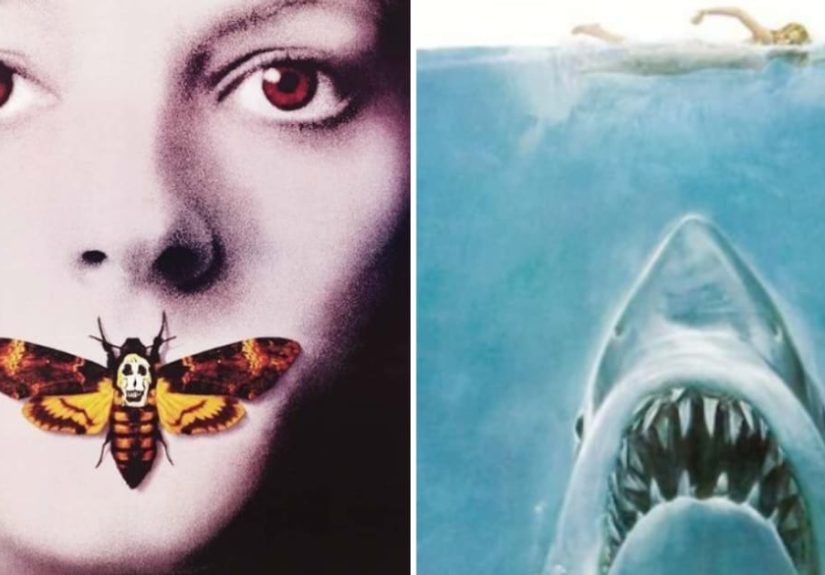
The poster for Jaws may be the most effective warning label ever disguised as entertainment. Roger Kastel’s image of a massive shark rising toward an unsuspecting swimmer is direct, primal, and almost unfairly good. You do not need to know the characters, the plot, or even the title. Your nervous system understands the message in half a second: water is canceled.
Its brilliance lies in the composition. The vertical distance between the swimmer and the shark turns empty water into suspense. The shark is not merely an animal; it is a visual countdown. The blue background looks clean and inviting, which makes the threat even worse. The poster sells terror without gore, panic without clutter, and danger without needing a paragraph of explanation.
As an example of movie poster design, Jaws is almost perfect because it transforms a simple idea into universal fear. It also helped define the blockbuster era. Long before trailers could be replayed endlessly online, this poster did the heavy lifting. It made the beach feel like a bad investment.
2. Vertigo (1958)
Saul Bass’s poster for Alfred Hitchcock’s Vertigo is a masterclass in psychological design. Instead of using a glamorous portrait of James Stewart or Kim Novak, Bass uses a dizzying spiral, jagged figures, and a hot orange background that practically hums with anxiety.
The poster does not show a scene; it shows a state of mind. That is why it remains one of the most iconic film posters in history. The spiral becomes obsession, fear, falling, desire, and confusion all at once. The human figures look trapped inside the design rather than placed on top of it. Even the typography feels slightly unstable, as if the letters themselves are trying not to lose balance.
Vertigo proves that the best movie posters can work like visual poetry. They do not summarize; they interpret. Bass turned a thriller into a graphic symbol so strong that it still influences designers decades later.
3. The Godfather (1972)
The poster for The Godfather is a lesson in restraint. A black background. A white title. Puppet strings. That is basically it, and somehow it carries more authority than a room full of shouting mobsters.
The genius is in the metaphor. The puppet strings immediately suggest power, control, manipulation, family loyalty, and invisible influence. It does not need to show violence. It does not need to show a mansion, a gun, or a table full of pasta. The design tells us that this is a story about who pulls the stringsand who gets pulled.
Its stark visual identity helped make The Godfather one of the most recognizable movie brands ever created. The poster is elegant, ominous, and instantly memorable. It is also proof that minimalism can feel enormous when the idea is strong enough.
4. Alien (1979)
The Alien poster is one of the greatest examples of sci-fi horror marketing because it refuses to show the monster. Instead, it gives us darkness, an egg, a strange green glow, and the unforgettable tagline: “In space no one can hear you scream.” That line does so much work it should have its own parking space.
The poster’s power comes from what it withholds. There are no heroic astronauts. No spaceship battle. No detailed creature reveal. The image creates dread through negative space and mystery. The cracked egg suggests birth, invasion, infection, and something ancient waking up where it absolutely should not.
As iconic movie posters go, Alien understands suspense better than most thrillers understand suspense. It sells the atmosphere rather than the plot. That is why the design still feels modern: black space, one impossible object, and a promise that whatever is inside will ruin everyone’s day.
5. Star Wars (1977)
The original theatrical poster for Star Wars, commonly associated with Tom Jung’s dramatic artwork, helped introduce audiences to a universe that had not yet become the universe. That matters. Today, lightsabers, Darth Vader, droids, and starships are cultural furniture. In 1977, the poster had to sell something new, strange, and wildly ambitious.
The artwork presents Luke Skywalker as a mythic hero, Princess Leia as regal and central, and Darth Vader as a looming cosmic threat. It does not aim for realistic scale; it aims for legend. The composition feels like a pulp adventure cover, a fantasy painting, and a space opera announcement all rolled into one bright, heroic package.
The result is one of the best movie posters of all time because it captures the emotional promise of Star Wars: adventure, danger, romance, destiny, and a galaxy that seems far away but somehow immediately familiar.
6. Pulp Fiction (1994)
The Pulp Fiction poster did not just sell a movie; it decorated an entire generation of dorm rooms, apartments, video stores, and bedrooms belonging to people who wanted visitors to know they had opinions about dialogue. The image of Uma Thurman as Mia Wallace, lying with a cigarette, a paperback, and a dangerous calm, became a pop-culture landmark.
The poster cleverly mimics the look of vintage pulp magazines and cheap crime paperbacks. Its distressed texture, bold yellow title, red price tag, and cover-style layout make the film feel like forbidden reading material found under a mattress in 1962. It is stylish, ironic, cool, and just sleazy enough to fit Quentin Tarantino’s world.
What makes it great is not complexity but attitude. The poster says, “This movie has a rhythm, a smirk, and probably a gun in the drawer.” It sells tone better than almost any poster of the 1990s.
7. Metropolis (1927)
The poster for Fritz Lang’s Metropolis, designed by Heinz Schulz-Neudamm, is a towering achievement of Art Deco movie advertising. It looks less like a film poster and more like the front gate to the future. The robot figure, the geometric architecture, and the vertical intensity all make the city feel both magnificent and terrifying.
This poster is historically important because it helped define how science fiction could look before most of cinema had even learned the language of the genre. Its sharp lines and monumental scale suggest machinery, class division, urban power, and human fragility. It feels futuristic even now, which is a ridiculous accomplishment for artwork created nearly a century ago.
Metropolis belongs on any serious list of the best movie posters because it is not only beautiful; it is foundational. You can see its DNA in later cyberpunk, dystopian cinema, and retro-futurist design.
8. Anatomy of a Murder (1959)
Another Saul Bass triumph, the poster for Anatomy of a Murder turns a courtroom drama into one of the most famous graphic images in film history. A fragmented black body shape lies against a bold background, instantly suggesting crime, evidence, violence, and legal dissection.
The design is clever because it visualizes the title literally while also working metaphorically. The body is not detailed or sensationalized. It is reduced to a symbol, almost like a piece of evidence pinned to a board. The rough edges create tension, while the clean layout gives the image legal precision.
This poster remains a favorite among designers because it shows how abstraction can be more powerful than realism. No courtroom, no judge, no dramatic witness pointing across the roomjust a broken silhouette and an idea sharp enough to cut paper.
9. Casablanca (1942)
Casablanca has the kind of classic Hollywood poster that feels like a time capsule with excellent lighting. Associated with legendary designer Bill Gold’s early studio work, the poster uses star power, romance, danger, and wartime atmosphere to sell a film that would become one of the most beloved dramas ever made.
Unlike minimalist posters, Casablanca embraces the old-school studio style. Faces matter. Mood matters. Humphrey Bogart’s guarded expression and Ingrid Bergman’s luminous presence tell us everything about longing, regret, and impossible choices. The design is busy by modern standards, but it is busy with purpose.
Its greatness comes from emotional clarity. The poster promises romance under pressure, glamour under threat, and moral drama in a world on fire. It is classic because it understands exactly what kind of movie it is selling.
10. E.T. the Extra-Terrestrial (1982)
The poster for E.T. the Extra-Terrestrial, with its glowing fingertip connection, is one of the most tender images in blockbuster history. John Alvin’s famous design borrows a sense of wonder from classical art while keeping the story simple: two beings from different worlds reach toward each other.
The image works because it avoids spectacle. It does not show the spaceship, the chase, or the full creature. It focuses on contact. The dark background makes the glowing fingers feel sacred, secret, and childlike. It suggests friendship, curiosity, and awe without turning sentimental cheese into fondue.
For family films, fantasy films, and science-fiction posters, E.T. remains a gold standard. It sells emotion first. The adventure follows naturally.
11. Back to the Future (1985)
Drew Struzan’s poster for Back to the Future captures a movie’s entire energy in one pose. Marty McFly stands beside the DeLorean, checks his watch, and looks startled, as if time travel is both thrilling and deeply inconvenient. Which, to be fair, it is.
The design is a perfect blend of character, concept, and comedy. The flaming tire tracks suggest speed and science-fiction danger. Marty’s expression keeps the tone light. The DeLorean becomes instantly iconic, not merely as a car but as a doorway to chaos.
Struzan’s painted style gives the poster warmth and adventure. It feels handmade, cinematic, and alive. Many modern posters try to imitate this kind of nostalgic magic, but few have matched its balance of wonder and wit.
12. The Silence of the Lambs (1991)
The poster for The Silence of the Lambs is quiet, disturbing, and impossible to forget. Jodie Foster’s face appears pale and still, her mouth covered by a death’s-head moth. The image is elegant enough for a gallery wall and creepy enough to make you check the locks.
Its strength is psychological tension. The covered mouth suggests silence, fear, secrets, and captivity. The moth adds transformation, decay, and a strange beauty. The poster does not show Hannibal Lecter, which is a bold choice considering he became one of cinema’s most famous villains. Instead, it centers vulnerability and dread.
This is one of the best movie posters because it trusts symbolism. It knows that the scariest image is not always the loudest one.
13. Jurassic Park (1993)
The Jurassic Park poster is branding at its cleanest: a black background, a red-and-yellow circle, and a skeletal T. rex logo adapted from the visual identity created around Michael Crichton’s novel and the film campaign. No actors. No screaming kids. No jungle chase. Just the mark.
That confidence is astonishing. The poster treats the movie like an event, not a normal release. The dinosaur skeleton feels scientific, dangerous, and instantly readable from a distance. The color palette gives it warning-sign energy, as if the poster itself should be behind an electric fence.
Its long-term impact is undeniable. The Jurassic Park logo became one of the most recognizable movie symbols in history. Sometimes the best film poster is not a scene but an emblem.
14. Raiders of the Lost Ark (1981)
The poster art for Raiders of the Lost Ark channels the spirit of old adventure serials with heroic illustration, dramatic lighting, and pure Saturday-matinee momentum. Indiana Jones, whip in hand, looks like the kind of man who has never met a collapsing temple he could not make worse.
The poster works because it sells adventure as texture. You can almost feel dust, leather, sweat, ancient stone, and danger hiding just outside the frame. Unlike minimalist designs, this poster embraces pulp spectacle. It gives the audience faces, artifacts, romance, villains, and movement while still keeping Indiana Jones as the central icon.
It is one of the greatest adventure movie posters because it does exactly what the film does: it revives old-fashioned thrills with craftsmanship, humor, and style.
15. The Exorcist (1973)
The poster for The Exorcist is terrifying because it is so calm. A priest stands under a streetlamp outside a house, surrounded by darkness and fog. That is it. No demon face. No shocking image. No chaos. Just a man arriving at the worst appointment of his life.
Bill Gold’s design understands anticipation. The poster turns the house into a source of evil and the priest into a small figure facing something enormous. The light from the window and streetlamp creates a religious, almost ritualistic mood. It feels like the last peaceful second before everything goes wrong.
As horror poster design, it is nearly unbeatable. It proves that dread often lives in the moment before the door opens.
Why These Iconic Film Posters Still Matter
The best movie posters of all time survive because they are more than advertisements. They are visual memories. They condense entire films into symbols: the shark, the spiral, the egg, the puppet strings, the glowing fingers, the moth, the dinosaur logo. These images are easy to remember because they are built around one clear idea.
Modern movie marketing often leans on crowded ensemble posters, polished faces, and blue-orange explosions that look like someone spilled a superhero smoothie. There is nothing wrong with spectacle, but the greatest posters remind us that clarity wins. A strong concept can travel across decades, languages, formats, and generations.
For designers, writers, marketers, and film lovers, these posters offer a simple lesson: do not say everything. Say the right thing so well that people cannot forget it.
Experience Notes: What Watching Great Movie Posters Teaches You
Spending time with great movie posters changes the way you look at movies, marketing, and even everyday design. At first, a poster seems like a decorative object. You like it or you do not. Maybe it looks cool on a wall. Maybe it reminds you of a film you love. But once you start paying attention, you realize that the best posters are doing a surprising amount of work with very few pieces.
The first experience many movie fans have with poster art is emotional rather than analytical. You walk past a poster and feel something before you understand why. The Jaws poster makes you tense. E.T. makes you soften a little. Alien makes you curious and uncomfortable. Back to the Future makes adventure feel fun before you even know the rules of the story. That immediate reaction is not accidental. It is the result of composition, contrast, color, space, and timing.
One of the most useful lessons is that great design usually has confidence. The Jurassic Park poster does not beg for attention by showing every exciting scene. It simply places the logo in front of you and trusts that the image is strong enough. The Godfather poster does the same with puppet strings. The Alien poster trusts darkness. The Exorcist poster trusts a single quiet moment. That kind of confidence is rare, especially in a world where everyone wants to add one more detail “just in case.”
Another experience is noticing how posters affect memory. Some people remember a movie poster before they remember the film’s plot. The image becomes the front door to the story. A great poster can make a movie feel larger, stranger, scarier, or more romantic than a normal advertisement ever could. This is why collectors, designers, and film fans treat posters like cultural artifacts. They are not just selling tools; they are part of the movie’s identity.
For content creators and marketers, the practical takeaway is huge. Whether you are designing a website banner, writing a headline, creating a product page, or planning a campaign, the same rule applies: one powerful idea beats ten weak ones. The best movie posters do not win because they are noisy. They win because they are precise. They know the emotional button they want to press, and then they press it with style.
Finally, great movie posters make watching films more enjoyable. They invite you to think about how a story announces itself to the world. Before the opening scene, before the first line of dialogue, before the soundtrack swells, the poster has already started the conversation. And when that poster is truly great, the conversation keeps going for decades.
Conclusion
The 15 best movie posters of all time prove that unforgettable design does not need to explain everything. It needs to create a feeling, spark curiosity, and give the audience one image they can carry forever. From the deadly simplicity of Jaws to the elegant dread of The Exorcist, from Saul Bass’s graphic genius to Drew Struzan’s painted adventure, these posters show how cinema can begin before the movie even starts.
Great posters are not just promotional material. They are promises. Some promise fear. Some promise wonder. Some promise danger, romance, mystery, or pure popcorn joy. The finest ones keep that promise with a single unforgettable image.
Note: This article was written in original American English for web publishing and synthesized from real film-history, museum, archive, and design-industry information without copying source text.