Table of Contents >> Show >> Hide
- Why Resistance Bands Belong in Your Gym Routine
- How to Use Resistance Bands at the Gym Without Looking Lost
- The Best Resistance Band Exercises to Do at the Gym
- 1. Banded Lateral Walk
- 2. Banded Glute Bridge
- 3. Resistance Band Squat
- 4. Banded Romanian Deadlift
- 5. Seated or Standing Band Row
- 6. Resistance Band Chest Press
- 7. Overhead Band Press
- 8. Band Pull-Apart or Reverse Fly
- 9. Resistance Band Face Pull
- 10. Lat Pull-Down with a Band
- 11. Pallof Press
- 12. Banded Dead Bug
- How to Build a Full-Body Resistance Band Gym Workout
- Common Mistakes to Avoid
- Experience: What Resistance Band Training at the Gym Actually Feels Like
- Conclusion
Resistance bands are the gym equipment equivalent of hot sauce: small, underrated, and weirdly capable of making almost everything better. While barbells, dumbbells, and machines usually get the spotlight, resistance bands deserve a permanent place in your training plan. They are portable, joint-friendly, easy to scale, and perfect for warm-ups, accessory work, finishers, and even full workouts when the gym is packed and every machine is somehow occupied by a person scrolling between sets.
If you want a smarter, more efficient strength session, the best resistance band exercises to do at the gym can help you train your upper body, lower body, and core without turning your workout into a circus act. Bands create tension throughout the movement, challenge stability, and make simple exercises feel more athletic. They also play nicely with a standard gym setup, since you can anchor them to racks, benches, or sturdy posts and combine them with bodyweight or free-weight work.
In this guide, you’ll find the top resistance band exercises for gym training, how to use them, what muscles they target, and how to program them so your workout feels purposeful instead of random. In other words, less “I guess I’ll stretch this thing and hope for the best,” and more real results.
Why Resistance Bands Belong in Your Gym Routine
The biggest advantage of resistance bands is versatility. You can use them to activate sleepy muscles before a lift, add extra tension during strength work, or finish a session with high-rep burnout sets that leave your muscles politely asking for a break. Because bands provide increasing tension as they stretch, they feel different from dumbbells and machines. That difference matters. It can make familiar exercises more challenging, improve control, and teach you to stay honest with your form.
Resistance band training also works well for people who want efficient workouts. A single band can help you train your glutes, back, chest, shoulders, arms, and core in one session. At the gym, that means less waiting for equipment and more moving. It also means you can squeeze productive work into busy days, which is useful when your schedule is packed and your gym seems to be hosting a social event near the cable station.
Another reason bands are so useful is that they fit almost every training goal. They can support mobility, build muscular endurance, improve posture, add stability demands, and help reinforce movement patterns such as hinging, squatting, rowing, pressing, and resisting rotation.
How to Use Resistance Bands at the Gym Without Looking Lost
Before jumping into the best exercises, a few practical rules will make your gym band workout smoother. First, choose the right band tension. If the band is so light that you can breeze through 25 reps while thinking about lunch, it is probably too easy. If it yanks you into terrible form by rep three, it is too much. Second, anchor bands only to sturdy, fixed equipment such as a squat rack, heavy post, or approved anchor point. A shaky bench is not a personality trait; it is a bad anchor.
Third, control both phases of the movement. Don’t just snap the band and call it strength training. Pull, press, or step with intent, then return slowly. Finally, use bands strategically. They are excellent as a warm-up, accessory block, or finisher, and they can also build an entire full-body session when used well.
The Best Resistance Band Exercises to Do at the Gym
1. Banded Lateral Walk
Targets: Glutes, hips, hip stabilizers
Place a loop band just above your knees or around your ankles, depending on your strength level. Bend slightly at the hips and knees, brace your core, and take controlled side steps in one direction, then return. This is one of the best resistance band exercises for waking up the glutes before squats, deadlifts, lunges, or treadmill work.
Why it works: It trains lateral hip stability, which supports better lower-body mechanics and helps you avoid knees collapsing inward during bigger lifts. It may look simple, but after ten clean steps each way, your glutes usually get the message.
2. Banded Glute Bridge
Targets: Glutes, hamstrings, core
Lie on your back with your knees bent and feet flat. Place a loop band above your knees. Drive through your heels, lift your hips, and gently press your knees outward against the band at the top. Lower with control. At the gym, this works beautifully as part of a lower-body activation series before squats or hip-dominant training.
Why it works: It teaches glute engagement without loading the spine and helps lifters who tend to let their quads do all the work.
3. Resistance Band Squat
Targets: Quads, glutes, core
Stand on the band with your feet about shoulder-width apart and hold the ends at shoulder height, or use a loop band above the knees during bodyweight squats. Sit back and down, keep your chest proud, and stand up with control. This is a great option when you want a squat pattern without rushing to claim a rack like it’s concert seating.
Why it works: Band squats reinforce knee tracking, glute tension, and squat mechanics. They’re excellent for beginners, de-load days, and high-rep finishers.
4. Banded Romanian Deadlift
Targets: Hamstrings, glutes, posterior chain
Stand on the band and grip the handles or ends. Soften your knees, hinge at the hips, keep your back flat, and lower until you feel a stretch in your hamstrings. Drive through your feet and return to standing by squeezing your glutes. At the gym, this is a smart accessory after deadlifts or leg day compound work.
Why it works: It grooves the hip hinge pattern and adds tension without the same fatigue cost as heavy barbell work. If you want more posterior-chain love without frying your nervous system, this is a winner.
5. Seated or Standing Band Row
Targets: Upper back, lats, rear shoulders, biceps
Anchor the band to a sturdy post at about chest height. Step back until there is tension, hold the handles or ends, and pull your elbows back while squeezing your shoulder blades together. Avoid shrugging. Think “chest tall, ribs down, row with purpose.”
Why it works: Rows are among the best resistance band exercises for posture and upper-back strength. They balance out all the pressing and all the hunched-over screen time that modern life generously provides.
6. Resistance Band Chest Press
Targets: Chest, shoulders, triceps
Anchor the band behind you at chest level. Stand in a split stance, brace your midsection, and press the handles forward until your arms are extended. Return slowly. This movement feels a bit like a cable press but is easier to set up when the cable machine is being guarded like treasure.
Why it works: It trains pressing strength while forcing the core to stabilize. It is also easier on some shoulders than heavy barbell pressing, especially when performed with a controlled range and neutral hand position.
7. Overhead Band Press
Targets: Shoulders, triceps, upper back, core
Stand on the band and hold it at shoulder height with elbows under your hands. Press overhead without arching your lower back. Lower slowly to the starting position. This is an excellent accessory lift on upper-body day or a shoulder-friendly option when you want pressing volume without loading a bar overhead.
Why it works: It trains shoulder strength and core control at the same time. If your rib cage flares and your lower back takes over, the band will immediately expose the issue. Bands are honest like that.
8. Band Pull-Apart or Reverse Fly
Targets: Rear delts, upper back, posture muscles
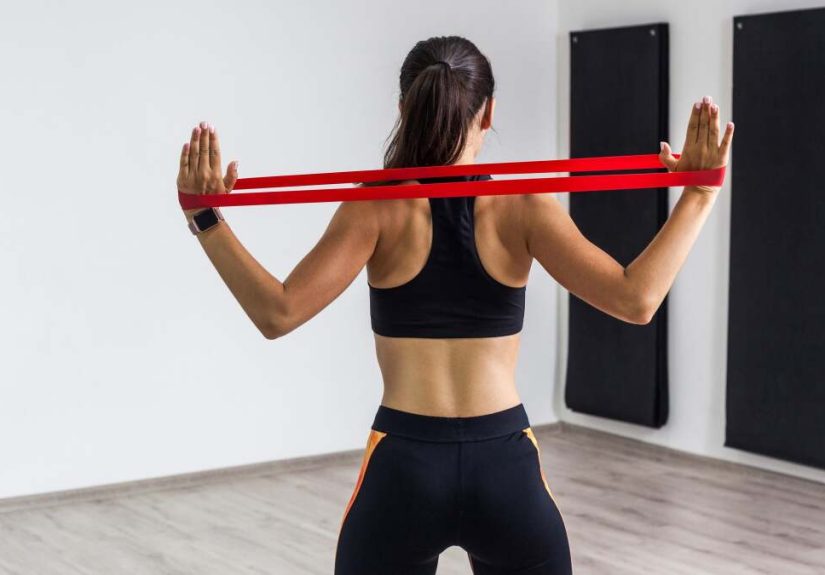
Hold a light band with straight but not locked arms at chest height. Pull the band apart until your arms open wide and your shoulder blades squeeze together. Return slowly. You can also do a reverse fly variation from a slight hinge position.
Why it works: This is one of the best resistance band exercises for countering rounded shoulders and building the upper-back endurance that supports better lifting form. It also fits beautifully into warm-ups between bench or shoulder sets.
9. Resistance Band Face Pull
Targets: Rear shoulders, upper back, rotator cuff support
Anchor the band around face height. Pull toward your forehead with elbows high and hands separating as you finish the movement. Pause briefly, then return under control. Keep the movement smooth instead of turning it into a dramatic tug-of-war.
Why it works: Face pulls are gym gold for shoulder health, posture, and balanced upper-body training. If pressing is the flashy headliner, face pulls are the reliable stage crew that make the whole show work.
10. Lat Pull-Down with a Band
Targets: Lats, upper back, biceps
Hold the band overhead with your arms extended, or anchor it above you to mimic a true pull-down. Pull down until your elbows come near your sides, then return slowly. This move is especially useful if you are building pull-up strength or want extra vertical pulling work without fighting for a machine.
Why it works: It helps train the lats through a controlled path and reinforces shoulder positioning. It is simple, effective, and far more challenging than it looks when done correctly.
11. Pallof Press
Targets: Core, obliques, anti-rotation stability
Anchor the band to your side at chest height. Stand sideways to the anchor, hold the band at your sternum, and press it straight out in front of you without letting your torso twist. Bring it back in slowly. This is a smart gym-core exercise for people who want functional trunk strength instead of endless crunches.
Why it works: The Pallof press trains your core to resist motion, which is exactly what your trunk often needs to do during squats, presses, carries, and real life.
12. Banded Dead Bug
Targets: Deep core, trunk stability, shoulder control
Anchor a band overhead and hold it while lying on your back in a dead bug position, or have a partner provide tension. Press the band down while slowly extending the opposite arm and leg pattern. Keep your lower back gently connected to the floor.
Why it works: It teaches bracing, improves coordination, and makes core training feel athletic instead of repetitive.
How to Build a Full-Body Resistance Band Gym Workout
If you want to turn these moves into a practical session, here is a simple format that works well:
Warm-Up and Activation
Banded lateral walk: 2 sets of 10 steps each way
Band pull-apart: 2 sets of 12 to 15
Pallof press: 2 sets of 8 to 10 per side
Main Strength and Accessory Block
Resistance band squat: 3 sets of 10 to 15
Banded Romanian deadlift: 3 sets of 10 to 12
Band row: 3 sets of 10 to 15
Band chest press: 3 sets of 10 to 15
Overhead band press: 2 to 3 sets of 8 to 12
Finisher
Face pull: 2 sets of 15
Glute bridge: 2 sets of 15
Lat pull-down with band: 2 sets of 12 to 15
This structure works as a stand-alone workout or as a lighter gym day between heavier lifting sessions. You can also use bands for supersets with dumbbells or machines. For example, pair dumbbell bench presses with band pull-aparts, or pair leg presses with lateral walks. That combo gives you both strength and control, which is a lot more useful than chasing random soreness.
Common Mistakes to Avoid
The first mistake is using momentum instead of muscle. Fast reps with sloppy posture turn good exercises into interpretive dance. The second is choosing the wrong resistance. Too light and you are wasting time. Too heavy and your joints, shoulders, or low back start improvising. The third is ignoring setup. If the anchor is unstable, the range is awkward, or the band rubs against something sharp, fix it before you start.
Another common issue is forgetting progression. Resistance band training should still challenge you over time. Step farther from the anchor, choose a heavier band, add a pause, increase the rep count, or slow the lowering phase. Bands are not just for beginners. They are for anyone smart enough to value tension, control, and efficiency.
Experience: What Resistance Band Training at the Gym Actually Feels Like
One of the funniest things about using resistance bands at the gym is that they look humble right up until they light up every weak link you forgot you had. Plenty of people walk in expecting the barbell area to deliver the “real” workout and the bands to be a side dish. Then they do a clean set of lateral walks, Pallof presses, and face pulls and suddenly their glutes, core, and upper back are introducing themselves with surprising enthusiasm.
That is part of the appeal. Resistance bands make you pay attention. You cannot coast through a row while shrugging your shoulders and pretending your back is doing the work. You cannot fake a chest press if your stance is unstable and your ribs are flaring. The band tells on you immediately. In a strange way, that instant feedback becomes one of the best parts of training with them. They make workouts feel more connected, more precise, and often more athletic.
At the gym, bands also solve a lot of real-world problems. Maybe the cable station is occupied. Maybe you want to warm up your shoulders before pressing but do not want to waste energy. Maybe you are in that awkward middle zone where heavy lifting feels too aggressive for the day, but you still want a productive session. Bands fit that gap beautifully. They let you build a workout around what your body needs instead of what equipment happens to be free.
There is also a mental benefit that people do not talk about enough. Resistance band exercises can make training feel approachable on days when motivation is low. Walking into the gym and committing to a giant, complicated workout can feel overwhelming. Walking in and saying, “I’m going to do band rows, glute bridges, squats, presses, and core work for 30 solid minutes,” feels doable. And once you start moving, that usually turns into a much better session than expected.
Over time, many gym-goers notice that bands improve the quality of their bigger lifts. Squats feel more stable. Pressing feels smoother. Rows feel more targeted. Posture improves. Warm-ups become more than random arm circles and hope. That is because bands train the supporting pieces that heavy lifts often expose but do not always fix on their own.
Perhaps the best experience-related lesson is this: bands reward consistency. You do not need a heroic one-day effort. You need repeated, well-controlled sets done with good form. Add them to your routine a few times each week, use them with intention, and they stop being “extra equipment” and start becoming one of the smartest tools in your entire gym bag.
Conclusion
The best resistance band exercises to do at the gym are the ones that make your training more effective, more efficient, and more balanced. That usually means choosing movements that cover the basics: squat, hinge, row, press, pull, and brace. From lateral walks and glute bridges to rows, chest presses, face pulls, and Pallof presses, resistance bands can help you build strength, improve stability, support posture, and make every workout feel a little more intentional.
If your current routine feels repetitive, crowded, or harder to stick with than it should, resistance bands are an easy fix with serious upside. They do not replace every machine or barbell, but they absolutely earn their place beside them. Pack a band in your gym bag, use it with purpose, and enjoy the satisfying moment when a stretchy loop of rubber humbles your ego in the most productive way possible.
Note: This article is for general educational purposes and works best when you match the band tension, range of motion, and exercise selection to your fitness level and gym setup.