Table of Contents >> Show >> Hide
- Why $10m ARR Changes the Job
- 1. Net Revenue Retention Is the Real Main Character
- 2. Efficient, Repeatable Go-to-Market Beats Growth Theater
- 3. A Management System Matters More Than Founder Heroics
- 4. Pricing, Packaging, and Product Depth Quietly Control Everything
- What Matters Less Than People Think
- The Only 4 Things That Really Matter After $10m ARR, in Plain English
- Experience From the Post-$10m ARR Stage
- Conclusion
There is a funny thing about crossing $10 million ARR: from the outside, it looks like you have made it. From the inside, it feels more like someone quietly replaced your bicycle with a commercial airliner and then asked, “Cool, so who’s flying this thing?”
Before $10 million ARR, a SaaS company can get away with a lot of founder heroics. A great product, a few smart bets, some hustle, a little duct tape, and one gloriously overcommitted team can carry a surprising amount of weight. After $10 million ARR, that stops being a strategy and starts being a hazard.
At this stage, the game changes. The question is no longer whether customers will buy. They already have. The real question is whether the business can scale in a way that is repeatable, efficient, and durable. In other words: can you build a company that compounds instead of one that just sprints?
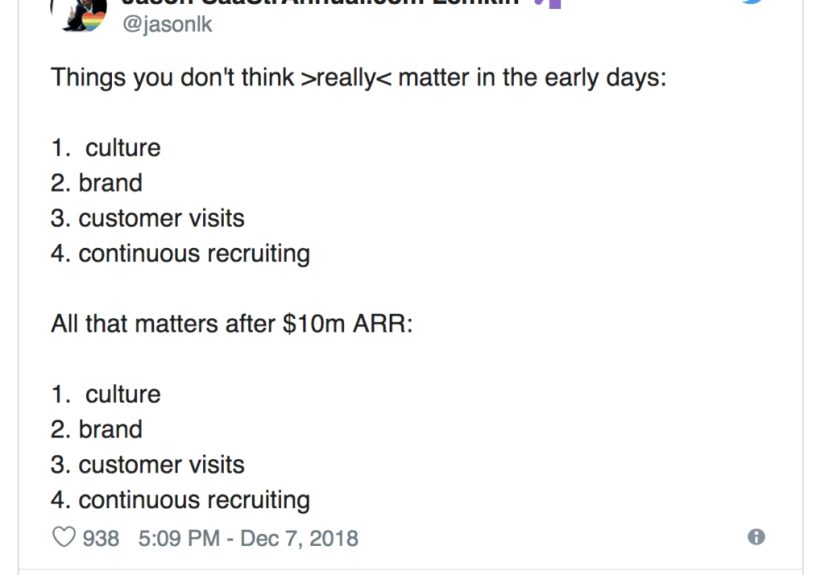
That is why, after $10 million ARR, only four things really matter. Not fifty. Not your latest buzzword deck. Not your “AI narrative” if it does not actually improve the business. Just four big ideas that separate companies with momentum from companies with a nice logo and a very stressed finance team.
Why $10m ARR Changes the Job
At $1 million ARR, survival is the headline. At $10 million ARR, discipline becomes the headline. You now have enough customers, enough revenue, and enough complexity for patterns to show up everywhere. Your churn is not random anymore. Your sales efficiency is not an accident anymore. Your hiring mistakes are no longer “learning experiences”; they are expensive recurring events with calendar invites.
That is why the post-$10 million ARR stage rewards operators who can separate signal from noise. And the signal is remarkably consistent.
1. Net Revenue Retention Is the Real Main Character
If you remember only one sentence from this article, make it this one: after $10 million ARR, existing customers matter more than your vanity pipeline slide.
New logos are exciting. They are also photogenic. They show up nicely in board decks and company all-hands presentations. But once you are past $10 million ARR, the healthiest growth usually comes from keeping customers, helping them succeed, and expanding them over time. That means renewals, upsells, cross-sells, seat growth, usage growth, and deeper product adoption.
Why is this so important? Because retained revenue is cheaper, cleaner, and more predictive than constantly replacing leaky buckets with fresh leads. A company with strong net revenue retention has a built-in growth engine. A company with weak retention has a treadmill. The treadmill is louder, more dramatic, and somehow still goes nowhere.
What smart teams focus on
Post-$10 million ARR teams stop looking at customer success as a polite post-sales support function. They treat it as a revenue function. They care about time to value, onboarding quality, product adoption, renewal readiness, and account health long before the renewal date appears on anyone’s calendar like a jump scare.
They also get more specific. Instead of asking, “How is churn?” they ask:
- Which customer segments retain best?
- Which onboarding paths create sticky accounts?
- Which features correlate with expansion?
- Which cohorts flatten, and which quietly sink into the swamp?
This is where a lot of companies grow up. They stop managing averages and start managing cohorts. The average customer is often a statistical hallucination. Cohorts tell the truth.
What usually breaks retention
Poor retention after $10 million ARR rarely comes from one dramatic catastrophe. It usually comes from a thousand tiny paper cuts: messy implementation, weak handoffs from sales to success, vague value messaging, overpromising, undertrained managers, and product complexity disguised as “enterprise capability.”
If customers do not understand the value quickly, they do not expand. If they do not expand, growth gets expensive. If growth gets expensive, everyone suddenly becomes very interested in “efficiency” and starts using phrases like “capital allocation framework” with the energy of someone trying not to panic.
2. Efficient, Repeatable Go-to-Market Beats Growth Theater
The second thing that matters after $10 million ARR is not growth at any cost. That era has been mugged by reality. What matters now is efficient, repeatable go-to-market execution.
That means your acquisition engine should not depend on luck, one magical salesperson, or a founder who still closes every meaningful deal because “customers just like hearing the vision.” Customers do like hearing the vision. They also like competent reps, clear pricing, realistic implementation plans, and follow-up emails that do not read like they were written in a moving car.
Focus on channels and segments that actually work
Companies that scale well after $10 million ARR usually double down on proven segments and proven motions. They do not wake up one Tuesday and decide to chase enterprise, SMB, mid-market, government, Europe, healthcare, and “the creator economy” all at once because the TAM slide looked lonely.
Instead, they ask a more useful set of questions:
- Which customer segment has the best retention and expansion?
- Which channel produces the healthiest payback?
- Which sales motion is most repeatable?
- Where does marketing create demand versus just generate activity?
That is what efficient growth looks like. It is not always flashy. It is often a little boring. Good. Boring is underrated. Boring pays salaries.
Do not confuse pipeline volume with business quality
After $10 million ARR, you should be very suspicious of big top-of-funnel numbers that do not turn into healthy cohorts. A lead is not “good” because it filled out a form. A lead is good when it becomes a customer who stays, expands, and does not require three emergency discount approvals and a prayer circle to close.
Efficient growth means the unit economics work, the payback is sane, the messaging is clear, and the sales motion can be taught to other people. If the business only works when the founder parachutes in, it does not really work yet.
3. A Management System Matters More Than Founder Heroics
Here is the least glamorous truth in SaaS scaling: after $10 million ARR, management quality becomes product strategy.
You cannot run a growing company on vibes, Slack messages, and a heroic CEO memory palace. Once the organization gets bigger, the absence of a management system becomes visible everywhere: forecasting misses, random priorities, conflicting dashboards, slow hiring, confused ownership, and recurring meetings where everyone says “alignment” while clearly meaning “help.”
Build operating cadence, not corporate theater
A real operating cadence is not bureaucracy for the sake of bureaucracy. It is simply the rhythm that keeps a company honest. The best teams know what success looks like annually, quarterly, and weekly. They define the metrics that matter, review them consistently, and connect leading indicators to outcomes.
That means weekly inspection of the inputs that drive renewals, adoption, productivity, sales execution, and product delivery. It also means resisting the urge to chase every shiny emergency that bounces across the company chat like a caffeinated pinball.
A company without cadence feels busy. A company with cadence gets somewhere.
Upgrade the leadership bench
At this stage, leaders need to manage managers, not just talented individuals. That sounds obvious until you watch a fast-growing startup promote its best doers into management and then act surprised when the org becomes a maze of good intentions and bad delegation.
After $10 million ARR, leadership quality shows up in whether teams can execute without drama. Great leaders make priorities clearer, forecasts better, hiring smarter, and handoffs cleaner. Weak leaders create noise, dependency, and meetings that should have been documents.
You usually need a blend here: internal leaders who understand the company’s DNA and experienced external hires who have seen the movie before and know where the monster jumps out. Too many insiders and the company can get provincial. Too many outsiders and the company forgets what made it special in the first place.
4. Pricing, Packaging, and Product Depth Quietly Control Everything
The fourth thing that really matters after $10 million ARR is whether your product and pricing model create natural expansion.
Lots of founders still treat pricing like a dentist appointment: important, uncomfortable, and easy to postpone for way too long. That is a mistake. Pricing and packaging are not just finance decisions. They shape acquisition, conversion, expansion, retention, and the overall quality of your revenue.
Make the upgrade path obvious
Healthy post-$10 million ARR companies build a business where customers can grow inside the product. That can happen through seats, usage, additional modules, premium controls, enterprise governance features, new teams adopting the product, or adjacent workflows that feel like a natural next step.
If customers get more value as they grow, your pricing should capture that value without becoming confusing or punitive. A clean value metric is powerful. A pricing page that requires an archaeological team is not.
Packaging matters too. Tiers should map to real customer types, real needs, and real moments when a buyer says, “Okay, we have outgrown this plan.” If your tiers exist mainly because somebody wanted three boxes on a pricing page, the market will notice.
Protect product focus
This is also the stage where product teams can get lost in a swamp of custom requests, roadmap guilt, and “strategic opportunities” that are really just expensive distractions wearing dress shoes.
The product still needs to evolve, of course. But after $10 million ARR, the winning move is usually depth, not chaos. Close the gaps that block adoption. Improve reliability. Strengthen workflows. Build the enterprise features that make expansion easier. Create better telemetry so the team knows where value is actually being delivered.
In short: do not confuse more product with more value. The best products at scale often feel clearer, not busier.
What Matters Less Than People Think
Once you are beyond $10 million ARR, several things become less important than founders often assume:
- Random market expansion before the core motion is truly repeatable.
- Huge top-of-funnel vanity metrics without downstream quality.
- Feature volume as a substitute for customer value.
- Brand storytelling that outruns product reality.
- Founder availability as a permanent operating system.
Yes, these things can help at the margin. But none of them can save a company with weak retention, sloppy execution, shallow pricing strategy, or a leadership structure made of wishful thinking.
The Only 4 Things That Really Matter After $10m ARR, in Plain English
If you want the entire article in one tight summary, here it is:
- Keep and grow the customers you already have.
- Scale acquisition efficiently, not theatrically.
- Build a management system that works without heroics.
- Create pricing and product depth that make expansion feel natural.
That is the job. Everything else is supporting cast.
Experience From the Post-$10m ARR Stage
If you talk to operators who have lived through this stretch, they will tell you that life after $10 million ARR is not harder in a dramatic movie-scene way. It is harder in a subtler, more adult way. The company does not usually explode. It just becomes impossible to hide what is not working.
One common experience is realizing that growth has momentum now, but not all momentum is healthy. A team can hit the number while silently damaging future retention through bad-fit deals, messy onboarding, aggressive discounting, or product promises that engineering never actually approved. For a while, everyone celebrates. Six months later, finance is squinting at renewal risk, customer success is overworked, and sales is insisting that “these accounts just need more love.” That is a polite way of saying the company rented revenue instead of building it.
Another common lesson is that forecasting becomes emotional if the operating system is weak. At smaller stages, a miss can be explained away with startup logic: the market shifted, a deal slipped, hiring took longer, life happened. After $10 million ARR, repeated misses usually point to something structural. Maybe pipeline quality is poor. Maybe sales stages are fiction. Maybe managers are coaching too late. Maybe the product is sticky for one segment and slippery for another. This is the stage where leaders learn that a forecast is not just a number. It is an x-ray.
There is also a very human experience that operators rarely mention in public: the founder has to become less magical. That sounds sad, but it is actually healthy. The company cannot need the founder in every sales call, every product debate, every candidate close, every renewal scare, and every strategy memo. If that continues, the founder becomes the system, and systems built from one person do not scale well. They break, usually at inconvenient times, usually during travel.
Teams also discover that hiring “experienced leaders” is not enough by itself. Plenty of companies bring in fancy resumes and still struggle. Experience helps, but only when the company knows what outcomes those leaders own, how decisions get made, and what the operating cadence actually is. Otherwise you do not get leverage. You just get expensive confusion with LinkedIn polish.
And then there is pricing, the wonderfully awkward topic everyone postpones until it becomes urgent. Companies often discover they were underpriced, overcomplicated, or packaged in ways that made expansion harder than it should be. A better pricing structure does not just lift revenue. It clarifies the product. It forces the team to answer a useful question: what exactly are customers paying more for as they grow?
In my experience, the companies that navigate this stage best are not the loudest. They are the ones that get more honest. Honest about which customers fit. Honest about where churn starts. Honest about whether the product truly delivers value fast enough. Honest about whether the org runs on process or personality. That honesty is not glamorous, but it is incredibly profitable.
So yes, after $10 million ARR, the work changes. It becomes less about proving the company deserves to exist and more about proving it deserves to scale. That is a tougher test. It is also the one that matters.
Conclusion
Crossing $10 million ARR is a milestone, but it is not the finish line. It is the moment when the company stops being a promising story and starts becoming a real machine. And real machines need the right parts working together: strong retention, efficient go-to-market, disciplined management, and pricing plus product depth that support expansion.
If those four things are strong, a SaaS company can grow with confidence. If even two of them are weak, growth gets expensive, noisy, and weirdly exhausting. So if you are wondering what really matters after $10 million ARR, the answer is refreshingly simple: keep customers, acquire efficiently, run the company like a company, and make it easy for customers to grow with you.
Everything else is mostly just a very fancy screensaver.