Table of Contents >> Show >> Hide
- Why an off-grid office shed feels so good
- Start with the shell, not the solar panels
- Build the power system around your real workday
- Air quality and comfort are non-negotiable
- Internet, ergonomics, and sound make the office usable
- How to make the shed peaceful in daily life
- Common mistakes that ruin the dream
- A longer look at the experience of working in peace with an off-grid office shed
- Final thoughts
There is a special kind of joy in walking ten steps across your yard, opening a small door, and entering a workspace that belongs entirely to your brain. No sink full of dishes. No television muttering like it pays rent. No mysterious household meeting that begins with, “Since you’re home anyway…” An off-grid office shed is not just a backyard structure. It is a boundary with walls, a peace treaty with distraction, and, when planned well, a surprisingly practical way to work.
But the phrase off-grid office shed can fool people into thinking the whole idea is just rustic charm plus a laptop. In reality, a successful solar-powered shed office depends on something much less glamorous: careful choices. The quiet, cozy, self-sufficient workspace in your imagination only becomes real when the structure is weather-tight, the energy load is realistic, the ventilation is healthy, and the internet is dependable enough that your video call does not freeze with your face making a haunted expression.
This guide breaks down what it really takes to build and enjoy a peaceful backyard office shed that can operate independently, stay comfortable through changing seasons, and support real work rather than fantasy camping.
Why an off-grid office shed feels so good
Most people do not crave an office because they love desks. They crave an office because they want control. A detached home office changes how work feels because it creates a psychological transition. You leave the house, arrive somewhere intentional, and your brain gets the message: now we focus.
That matters even more in an off-grid shed office. When the space makes its own power, handles its own lighting, and runs on a deliberate system, you tend to become more selective about what you bring into it. The result is often a cleaner, quieter, less cluttered workday. You stop filling the room with gadgets you do not need. You notice the sound of a fan, the heat from the afternoon sun, the comfort of good daylight, and the relief of not sharing your workspace with laundry baskets.
In other words, off-grid living strips things down. For a workspace, that can be a gift.
Start with the shell, not the solar panels
The biggest beginner mistake is obsessing over batteries before the shed itself is ready. A shed with poor insulation, air leaks, and bad window placement will always feel cranky, no matter how shiny the electrical system looks on paper.
Choose the site with sunlight and sanity in mind
Pick a location that gets healthy daylight but does not roast in the worst afternoon heat. If your climate benefits from passive solar gain, thoughtful window placement can help warm the space in cooler months. In hot climates, shading matters more. Trees, overhangs, exterior shading, and blinds can make the difference between a calm office and a wooden toaster.
Also think about practical peace. Place the shed far enough from street noise, barking fences, pool pumps, and busy doors. The right spot is not just about where the shed fits. It is about where your concentration has a chance to survive.
Insulate like your focus depends on it, because it does
Good insulation is not an energy nerd luxury. It is the reason your coffee does not get cold in twenty minutes and your brain does not melt by noon. An insulated floor, insulated walls, and a properly treated roof or ceiling dramatically improve comfort. Air sealing matters just as much. Tiny gaps around doors, windows, and utility penetrations turn a shed into a draft machine.
Weatherstripping, a quality door sweep, careful caulking, and a solid air barrier all do quiet heroic work. They lower heating and cooling demand, reduce dust, and help the room feel more stable through the day. A stable room is easier to work in. Human beings are surprisingly poor at deep thought when one ankle is freezing and the other is sweating.
Windows should serve work, not sabotage it
Natural light is wonderful until it hits your monitor like a laser pointer from the sun itself. Choose windows for balanced daylight, cross-breeze potential, and views that calm rather than distract. A backyard office shed with one carefully placed window often works better than a glass box that turns every Zoom meeting into a silhouette documentary.
Use shades, blinds, or light-filtering window coverings so you can control glare. This matters for comfort, but it also matters for energy use. The less solar heat blasting into the room, the less power your cooling system must burn through later.
Build the power system around your real workday
Here is the off-grid truth nobody puts on the cute Pinterest photos: your energy budget decides everything. Not your mood. Not your dreams. Not the dramatic little Edison bulb sign that says “Rise and Grind.”
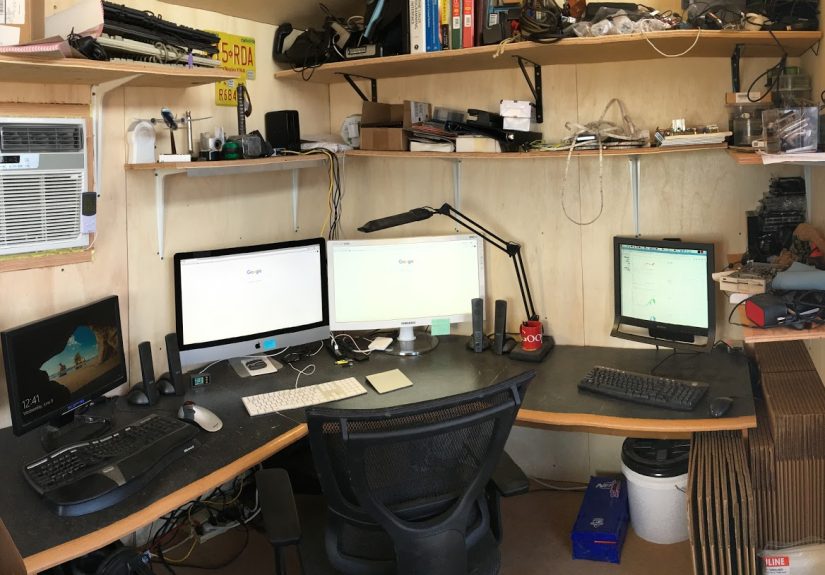
Start by listing what you truly need during a normal workday. For many people, that list is simple: laptop, monitor, modem or router, task lighting, phone charger, and maybe a small fan or efficient heating and cooling system. Once you know your essential loads, you can think clearly about solar panels, battery storage, charge control, and inverter size.
Keep the electrical appetite small
The happiest solar-powered office sheds are usually the ones that avoid waste. Use efficient devices. Choose LED lighting. Let equipment sleep when it is idle. A laptop often makes more sense than a power-hungry desktop. An efficient monitor beats a giant glowing billboard unless your work truly requires the extra screen space.
This is where many off-grid plans either become elegant or ridiculous. If your shed is meant for writing, calls, design work, accounting, research, or remote management, you may not need a massive system. But if you plan to run resistance heaters, a mini fridge, a kettle, a microwave, a desktop tower, decorative lights, and “just one small printer,” your battery bank will begin filing complaints.
Heating and cooling are the real bosses
In most climates, space conditioning is the largest challenge. That is why the shed envelope matters so much. If you reduce the heating and cooling load first, the electrical system becomes more reasonable.
For many detached workspaces, a ductless mini-split is an excellent fit because it offers efficient heating and cooling without bulky ductwork. In a small office studio, that simplicity matters. Paired with insulation, air sealing, and sensible shading, a mini-split can turn a fragile seasonal shed into a genuine year-round workspace.
What should you avoid? Using a random space heater as your entire winter strategy and then plugging it into the same strip as your monitor, chargers, and speakers. That is not an energy plan. That is a suspense film.
Battery storage buys calm
True off-grid comfort comes from consistency. Solar production changes with season, weather, shade, and daylight hours. Batteries smooth that out. They let the shed keep working when a cloudbank rolls in, when you start early, or when the afternoon drags on longer than expected.
A reliable setup usually feels boring in the best possible way. The lights turn on. The internet stays up. Your devices stay charged. You stop thinking about the system every ten minutes. That is the goal. A peaceful workspace should not require daily emotional negotiations with the weather.
Air quality and comfort are non-negotiable
A backyard shed office is small, which means bad air shows up fast. Stale air, excess humidity, heat buildup, and sneaky moisture problems can turn a charming workspace into an exhausting one.
Ventilation matters more than people expect
If the shed is tightly sealed, you need a plan for fresh air. Operable windows can help in mild weather, but they are not a complete solution in every season or every climate. The point is not to create a dramatic wind tunnel. The point is to avoid a stale, stuffy room that leaves you sleepy by midafternoon.
Humidity control is equally important. In damp climates, moisture can lead to odors, mold risk, and that “why does this room smell like a wet cardboard memoir?” feeling. A compact dehumidifier or a well-sized mini-split with moisture control can protect both comfort and materials. Keep an eye on condensation, especially around windows, corners, and the floor assembly.
Never get casual about combustion
If your off-grid office shed uses any backup generator, it belongs outdoors and well away from the structure. It should never be used inside the shed, under it, or just outside an open door in the name of “ventilation.” Carbon monoxide is not interested in your shortcuts.
The same common-sense caution applies to fuel storage, heaters, and improvised electrical work. Peace comes from safety, not from pretending that fumes are a personality trait.
Internet, ergonomics, and sound make the office usable
Power is only half the story. A workspace is still a workspace. It needs internet that can handle your actual job, a setup that does not punish your neck, and enough acoustic sanity that every call does not sound like you are broadcasting from inside a drum.
Plan for primary and backup internet
Depending on your property, your options may include wired broadband from the house, fixed wireless, satellite, or a mobile hotspot backup. For many people, the smart move is to use the best primary connection available and keep a secondary option for emergencies. Nothing tests your devotion to “simple living” like losing a client meeting because your only connection decided today was a spiritual retreat.
Even if the shed is off-grid electrically, it does not need to be off-reality. Strong Wi-Fi or a stable direct connection can make the difference between a hobby shed and a serious remote work studio.
Set up your body for long days
A peaceful office should not leave you shaped like a question mark. Use a desk and chair that support a neutral posture. Put the monitor at a comfortable height, keep the keyboard and mouse positioned so your shoulders stay relaxed, and leave enough space to work without folding yourself into laptop shrimp mode. Add a footrest if needed. Add task lighting if your eyes are straining. Tiny spaces magnify bad ergonomics because there is less room to compensate.
Silence is designed, not accidental
If you want real quiet, use rugs, soft finishes, insulated walls, solid doors, weatherstripping, and thoughtful layout. Put the noisy inverter, backup equipment, or outdoor condenser where they will not dominate the soundscape. A calm office shed is one where the loudest thing in the room is your own typing and maybe the occasional crow offering uninvited feedback.
How to make the shed peaceful in daily life
Once the technical pieces are handled, the emotional magic is mostly about routine. Open the windows in the morning if the weather allows. Turn on one lamp instead of all of them. Keep only your essential tools inside. Sweep the floor often. End the day with a simple reset.
That is one overlooked advantage of a detached home office. Because it is separate, you naturally become more intentional. You carry in what matters. You carry out what does not. The shed teaches you to stop treating your workspace like a storage bin with a login screen.
Many people find that their best off-grid office habit is not technical at all. It is walking to it. That short commute creates a mental threshold. You arrive with purpose. You leave with permission to stop. The house becomes home again instead of a place where work leaks into every room like spilled glitter.
Common mistakes that ruin the dream
- Oversizing the fantasy, undersizing the power plan. If the load list is unrealistic, the whole system becomes expensive and frustrating.
- Skipping insulation. This forces you to spend more on heating, cooling, and battery storage later.
- Ignoring humidity and ventilation. A small room can feel stale, damp, or oppressive quickly.
- Using dangerous heating shortcuts. High-draw heaters, sloppy cords, and overloaded strips are not worth the risk.
- Treating internet as an afterthought. Off-grid power means little if the connection is unreliable.
- Filling the shed with junk. Peace is easier to maintain in a space that has a job description.
A longer look at the experience of working in peace with an off-grid office shed
The most interesting part of an off-grid office shed is not the equipment. It is the way the space changes your behavior over time. At first, the experience often feels charming in a visible, almost theatrical way. You notice the cedar smell, the light on the desk, the click of the door latch, the small thrill of powering your workday from your own system. It feels new. It feels clever. You may even feel a little smug, which is human and therefore forgivable.
Then the deeper experience begins. The novelty wears off, and the shed starts teaching you what kind of worker you actually are. You learn whether you need silence or soft background noise. You learn whether one window improves your mood or distracts you into staring at squirrels like they are project managers. You learn how much gear you really need and how much you only kept around because wall outlets in the house were enabling your bad habits.
Morning becomes one of the best parts. There is something grounding about stepping outside before the day gets noisy, unlocking the door, and entering a room that is already simpler than the rest of life. In a good setup, the air feels clean, the desk is reset, and the first light in the shed comes on with purpose instead of chaos. The room does not ask for much. It asks you to work.
There are lessons in bad weather too. A cloudy week teaches humility fast. If your electrical planning was lazy, the shed will let you know. If it was thoughtful, the room still works, just with a little more awareness. You become more attentive to the rhythm of energy, heat, airflow, and daylight. That is not a burden. For many people, it is part of the appeal. The workspace feels less disposable. You feel connected to how comfort is made rather than assuming it appears by magic when you flip a switch.
There is also a surprising emotional benefit in the limits. An off-grid office shed gently discourages nonsense. You are less likely to collect pointless gadgets, run unnecessary appliances, or leave every device on forever. The room nudges you toward restraint, and restraint often creates clarity. Instead of building a miniature version of the house with all the same distractions, you build a place for concentration.
By the time you have spent months working in a self-sufficient backyard office, the best part is usually not that it is off-grid. The best part is that it is calm. It becomes the one place where your tools are where they belong, your boundaries are easier to keep, and your attention is treated like something valuable. That is what people are really chasing when they dream about a tiny office studio behind the house. Not rustic aesthetics. Not bragging rights. Just a room that lets them think in peace.
Final thoughts
A peaceful off-grid office shed is absolutely possible, but it works best when romance and reality cooperate. Build a tight shell. Keep the energy load honest. Choose efficient equipment. Respect ventilation, humidity, and safety. Protect your internet. Keep the space simple. Do that, and your detached office becomes more than a pretty backyard idea. It becomes a reliable place to think, create, call, write, design, plan, and finish things without the rest of the house knocking on your attention every seven minutes.
And that, frankly, is a beautiful use of a shed.
Note: This article is intentionally publication-ready and excludes inline source clutter.