Table of Contents >> Show >> Hide
- What Counts as the World’s Smallest Implantable Chip?
- Meet the Tiny Implant That Changed the Conversation
- How Does a Chip This Small Even Work?
- Why Making Implants Smaller Actually Matters
- From Tiny Sensor to Real Medical Uses
- Smallest Does Not Mean Simplest
- The Field Is Moving Fast Beyond One Tiny Chip
- The Real Endgame: Invisible, Precise, and Intelligent Care
- Experiences Related to the World’s Smallest Implantable Chip
- Conclusion
Imagine a medical device so tiny it can sit on the tip of a needle and still do real work inside the body. Not “real work” in the flashy-concept-video sense, either. We are talking about sensing, signaling, and potentially helping doctors monitor disease with far less hardware than traditional implants require. It sounds a little like science fiction, a little like a spy movie, and a lot like modern bioelectronics.
The phrase world’s smallest implantable chip has become a headline magnet for good reason. Engineers are shrinking medical electronics to a scale that would have looked ridiculous a decade ago. One of the strongest contenders for that title comes from Columbia Engineering: a sub-0.1-cubic-millimeter wireless implantable “mote” that can be injected with minimally invasive techniques and used for real-time temperature sensing. That sentence is packed with jargon, but the idea is wonderfully simple: a tiny chip goes into the body, measures something important, and talks back wirelessly.
And yet, as with most breakthrough technologies, the size is only the opening act. The real story is what miniaturization changes. Smaller implants may reduce tissue damage, simplify procedures, open the door to distributed sensing, and create medical devices that feel less like hard machinery and more like invisible assistants. At the same time, ultra-small implants raise big questions about durability, power, safety, privacy, and whether a device that wins the size contest can also win the reliability contest. In medicine, cute and tiny are not enough. The chip has to earn its keep.
What Counts as the World’s Smallest Implantable Chip?
Before crowning any champion, it helps to define the category. In medical technology, “smallest implantable chip” can mean several different things. It might refer to the smallest single-chip complete system. It might mean the smallest clinically used implant. It might mean the smallest temporary implantable device. Those are not the same race, and they do not share the same finish line.
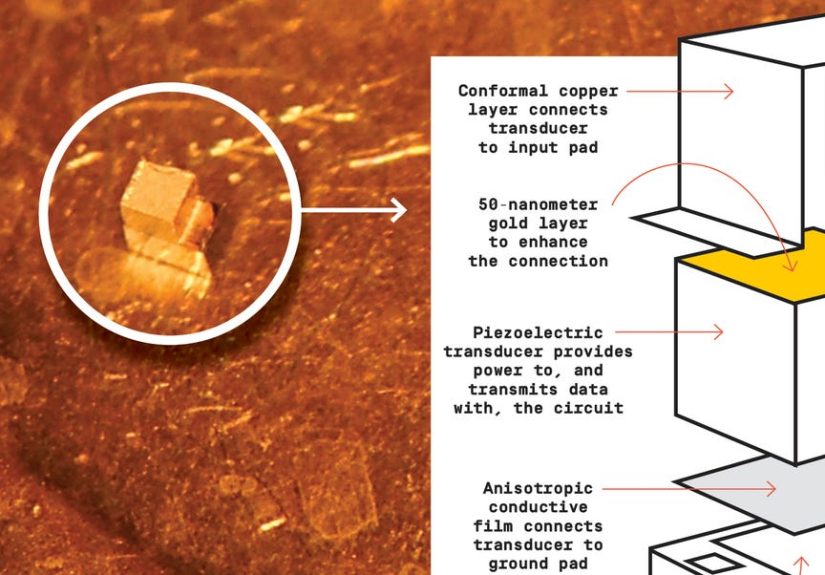
The Columbia device is especially notable because it is not just a tiny component. It is a highly integrated system. The mote was reported as smaller than 0.1 mm3, with dimensions on the order of a few hundred micrometers, and it was designed to perform real-time wireless temperature sensing. That matters because miniaturization in medical electronics is not only about shaving off size. It is about integrating sensing, communication, and power into one extremely small footprint.
That is why this device stands out in conversations about the world’s smallest implantable chip. It is not simply a sliver of silicon looking impressive under a microscope. It is a functioning implantable sensor platform. In other words, it is tiny with a job description.
Meet the Tiny Implant That Changed the Conversation
The Columbia mote represents the kind of leap that forces the medical device industry to sit up straight. Researchers described it as a complete functioning single-chip system with a total volume of less than 0.1 cubic millimeters. In plain English, it is roughly dust-mite-sized, visible only under a microscope, and small enough to point toward injection through a hypodermic needle rather than traditional surgical placement.
Its first demonstrated job was temperature sensing. That may sound modest until you remember how clinically useful temperature can be. Temperature changes can reveal inflammation, tissue response, energy delivery during ultrasound-based therapies, and local physiological conditions that are hard to capture from outside the body. A tiny implant that measures those changes in real time could become a quiet little informant living exactly where the action is.
Even better, the chip did not need a bulky battery strapped to its back like a hiker heading into the mountains. Instead, the system used ultrasound for both wireless power and data communication. That design choice is a major part of what made aggressive miniaturization possible. When engineers stop dragging around oversized power hardware, the whole device can go on a serious diet.
How Does a Chip This Small Even Work?
This is where the engineering gets delightfully nerdy. Most people assume tiny wireless devices should use radio waves, because that is how phones, routers, and many consumer electronics communicate. But for implants this small, traditional radio-frequency approaches run into trouble. The wavelength is simply too large relative to the device, and the power requirements can become awkward fast.
The Columbia team used ultrasound instead. Ultrasound is already familiar in medicine, which is a nice bonus. In this system, acoustic energy powers the chip and also serves as the communication link. A microscale piezoelectric transducer sits on top of the chip, converting acoustic energy into electrical energy. The sensor then measures temperature and modulates a returning signal so the outside system can read the data. Tiny device, big hustle.
That architecture hints at why implantable bioelectronics are evolving so quickly. As chips get more efficient and materials get smarter, engineers can start building devices that no longer need the old formula of battery plus wires plus bulky packaging. Instead, the implant becomes more like a microscopic node in a medical network. That idea is exciting because it shifts the whole concept of monitoring from “place one large device and hope for the best” to “place very small devices exactly where information matters most.”
Why Making Implants Smaller Actually Matters
Smaller implants are not just engineering trophies. They can change the patient experience in meaningful ways. A smaller device generally means less invasive placement, less disruption to tissue, and potentially faster recovery. If a device can be injected or inserted through a very small incision, it may reduce procedural complexity and lower the psychological barrier that some patients feel around surgery.
Miniaturization also matters biologically. Implantable sensors live in a body that is not always thrilled about hosting uninvited electronics. The larger and stiffer the implant, the greater the chance of tissue irritation, inflammation, and fibrotic encapsulation that can degrade performance over time. In many cases, shrinking the device can improve compatibility with surrounding tissue, even if it does not magically erase all foreign-body responses.
Then there is the power of distribution. Instead of relying on one large implant to tell the whole story, future systems may use multiple small implants to track local temperature, pressure, glucose, neural activity, or drug response in different places at once. That opens up a more detailed picture of what is happening inside the body. Think less “single snapshot” and more “live map.”
From Tiny Sensor to Real Medical Uses
The world’s smallest implantable chip is not useful because it is tiny. It is useful because tiny makes new medical strategies possible. Temperature sensing is only the starting point. Researchers and federal bioengineering programs have highlighted a broad future for implantable bioelectronic stimulators and sensors, microdevices for therapeutic delivery, and systems that monitor physiology in real time.
Possible applications include tracking localized heat during ultrasound therapy, monitoring pressure in tissues or vessels, sensing glucose, recording neural signals, watching post-surgical recovery, and supporting closed-loop treatment systems that both detect and respond. In that last category, the implant is not just a passive witness. It becomes part of the treatment loop.
That broader trend is already visible in neighboring technologies. The FDA approved the first continuous glucose monitoring system with a fully implantable glucose sensor in adults in 2018. The sensor was far larger than Columbia’s mote, but it proved an important commercial point: implanted sensors can move beyond the lab and into regulated patient care. Likewise, implantable loop recorders used for heart rhythm monitoring are placed under the skin and can remain in place for years. These are not the smallest chips in the world, but they are proof that implantable electronics can become routine tools rather than exotic experiments.
Smallest Does Not Mean Simplest
Here is the part the hype machine usually skips: shrinking the hardware does not shrink the challenges. In fact, sometimes it does the opposite. When an implant becomes microscopic, every design choice gets harder. Power budgets become brutally tight. Wireless communication becomes more fragile. Packaging gets more complicated because a tiny device still needs protection from bodily fluids while staying compatible with tissue.
Biocompatibility is a major hurdle. Once an implant enters the body, proteins coat its surface, inflammatory responses can begin, and fibrotic tissue may gradually wall it off. That can interfere with sensing accuracy, chemical diffusion, and electrical performance. Engineers can reduce those problems with softer materials, coatings, clever placement, and smaller size, but biology does not hand out automatic forgiveness just because the device is adorable.
There is also the awkward truth that smaller devices often have less room for the very things that make implants robust: shielding, power storage, redundant circuitry, and durable packaging. Medicine loves miniaturization right up until the moment a device needs to survive a messy real-world body for months or years. At that point, engineering becomes a balancing act between invisibility and dependability.
The Field Is Moving Fast Beyond One Tiny Chip
The Columbia mote is not alone. It belongs to a rapidly growing family of implantable bioelectronics that are becoming smaller, softer, and smarter. Reviews of injectable wireless microdevices note that some devices are already approaching “dust” scale, enabling injection with minimal insertion damage. That is a remarkable shift from the older generation of implants that relied on visible wires, larger housings, or surgical hardware that clearly announced its presence.
Northwestern University added another dramatic example with its 2025 report of what it called the world’s smallest pacemaker. That device is smaller than a grain of rice, can fit inside the tip of a syringe, works with a soft wearable controller, and is designed to dissolve after temporary pacing is no longer needed. That is not the same thing as Columbia’s mote, but it points in the same direction: implants that are easier to place, less burdensome to the body, and more specialized for short-term therapeutic needs.
Other researchers are pushing on adjacent fronts. Harvard has reported soft implantable neural probes designed for longer-term recording with better mechanical compatibility. Stanford has continued work on chip-based visual prosthetics and high-density neural interfaces. MIT has explored implantable drug-delivery systems that can be triggered wirelessly in emergencies. The common thread is obvious: the future of implantable electronics is not just smaller devices. It is smaller devices doing more meaningful things.
The Real Endgame: Invisible, Precise, and Intelligent Care
If ultra-small implantable chips reach maturity, they could help move healthcare toward a model that is more precise and less reactive. Instead of waiting for symptoms to become obvious, clinicians may one day gather continuous local data from inside the body. Instead of blasting whole systems with treatment, therapies could become more targeted. Instead of bulky implants that require major procedures, some devices may be placed with far lighter interventions and, in some cases, dissolve when their job is done.
This is especially important for patients who need temporary monitoring or short-term support. Children recovering from surgery, adults undergoing localized therapies, people with unpredictable glucose events, and patients with intermittent cardiac or neurological issues could all benefit from implants that are easier to place and easier to live with.
Still, the future depends on something less glamorous than headlines: clinical translation. The hardest questions are no longer “Can we build it?” but “Can it survive?”, “Can it stay accurate?”, “Can it stay safe?”, “Can patients trust it?”, and “Can regulators approve it?” The chip may be microscopic, but the paperwork, testing, and ethical responsibility are very much full-sized.
Experiences Related to the World’s Smallest Implantable Chip
When people hear about the world’s smallest implantable chip, the first reaction is usually wonder. The second is often, “Okay, but what would that actually feel like in real life?” That question matters because the experience of an implant is never just technical. It is physical, emotional, and practical all at once.
For patients, one of the biggest experience shifts is the possibility of a lighter procedure. Existing implantable devices such as loop recorders and fully implantable glucose sensors already show how smaller systems can make treatment feel less dramatic than traditional surgery. A device placed under the skin in a short outpatient visit creates a very different emotional landscape from one that requires major incisions, visible wires, or a long recovery. The medical goal may be data collection or therapy, but the patient’s lived experience often starts with a simpler thought: “This feels manageable.” That is not a minor advantage. In medicine, reducing fear and friction can be almost as important as improving raw performance.
There is also the day-to-day experience of living with a device you cannot see but know is there. Some people find that reassuring. They like the idea that their body is being quietly monitored while they sleep, work, or exercise. Others find it odd at first, almost like having a tiny secret roommate made of circuits. Over time, though, invisible technology tends to fade into the background if it is reliable. That is one reason the next generation of tiny implants is so promising: the best medical device is often the one that does its job without demanding attention every five minutes like an overenthusiastic smartwatch.
For clinicians, the experience changes too. Smaller implants can mean less tissue disruption, fewer mechanical complications, and more flexibility in where the device can go. But they also demand new workflows. Doctors may need better imaging guidance, new insertion tools, and more confidence in wireless communication systems. A tiny implant is not automatically easier to use just because it looks elegant in a lab photo. Clinical experience depends on repeatability, training, and whether the device behaves well in messy real bodies rather than perfect diagrams.
Families may feel the impact most strongly in temporary-use cases. Northwestern’s dissolvable pacemaker concept is a good example. For parents of newborns or children who need short-term pacing after surgery, the idea of a miniature device that can do its work and then disappear naturally is powerful. It suggests a future with fewer wires, less removal-related risk, and one less thing for frightened families to worry about. That kind of experience is hard to measure on a spec sheet, but it matters deeply.
For engineers and researchers, the experience is almost the opposite: the smaller the device, the larger the headache. Every micrometer becomes a negotiation between power, signal strength, materials, packaging, and safety. Still, that struggle is exactly what makes the field exciting. The world’s smallest implantable chip is not only a clever object. It is a preview of healthcare becoming more intimate, more precise, and less physically imposing. If the technology keeps maturing, the experience of having an implant may someday feel less like receiving hardware and more like gaining a quiet layer of protection built right into the body.
Conclusion
The world’s smallest implantable chip is not just a marvel of miniaturization. It is a glimpse of how medicine may evolve when sensors, power systems, and wireless communication get compact enough to disappear into the body without acting like intruders. Columbia’s tiny mote helped define the frontier by showing that a complete implantable single-chip system could measure temperature and communicate wirelessly at an astonishingly small scale. Since then, neighboring advances in pacemakers, neural probes, retinal devices, glucose sensors, and implantable drug systems have made the broader direction impossible to ignore.
The smartest way to think about this technology is not as a one-off gadget, but as a platform shift. Today’s smallest implantable chips are still early compared with established medical devices, and the road to routine clinical use will depend on solving power, biocompatibility, durability, privacy, and regulatory challenges. But the long-term value is huge. In the best-case future, implantable chips become smaller, safer, more temporary when needed, and more precise in what they measure or control.
So yes, the phrase world’s smallest implantable chip sounds like a bragging right. And it is. But in this case, the brag is not about size alone. It is about the possibility that medicine’s next major leap may arrive not with bigger machines, but with devices so small they can do extraordinary work almost invisibly.