Table of Contents >> Show >> Hide
- Why Rare Lucille Ball Photos Still Stop People Mid-Scroll
- Before “I Love Lucy”: The Young Performer Behind the Glamour
- The Desi Arnaz Years: Love, Work, and Television History
- Pregnancy, Family, and the Photos That Changed TV Motherhood
- The Face of Comedy: Why Her Expressions Still Work
- Style in Rare Photos: Red Hair, Blue Eyes, and Smart Costumes
- Lucille Ball the Executive: The Power Behind the Pictures
- Where Fans Find Rare Lucille Ball Photos Today
- How to Look at Rare Photos Like a Storyteller
- The Experience of Seeing Rare Lucille Ball Photos
- Conclusion: Rare Photos Reveal the Real Scale of Lucille Ball
Some stars are remembered by a single image. Lucille Ball is remembered by an entire facial-expression library: the wide-eyed panic, the raised eyebrow, the “I definitely did not just create a national emergency with a chocolate conveyor belt” grin. But rare photos of Lucille Ball tell a larger story than the familiar sitcom moments. They reveal a determined young performer, a glamorous Hollywood contract player, a working mother in the public eye, a sharp television producer, and a comedy legend who knew that looking ridiculous on purpose required serious intelligence.
Born in Jamestown, New York, in 1911, Ball grew up far from the polished studio portraits that later made her instantly recognizable. Her early path included drama training in New York, modeling work, Hollywood film roles, radio success, and then the television breakthrough that made “Lucy” feel like a member of America’s extended family. Rare photographs matter because they slow the legend down. Instead of seeing only the icon, we see the climb.
Why Rare Lucille Ball Photos Still Stop People Mid-Scroll
Rare vintage photos of Lucille Ball are fascinating because they show contrast. In one image she may look like a poised 1940s film star, all curls and controlled lighting. In another, she is caught in a candid family moment, less “queen of television comedy” and more “mom trying to keep everyone looking at the camera for half a second.” That mix is exactly why fans keep searching for Lucille Ball rare photos, old Hollywood portraits, and behind-the-scenes Lucy images.
Photo archives from LIFE, Getty Images, and magazine retrospectives have helped modern audiences revisit Ball beyond the standard publicity still. LIFE’s rare-photo feature, for example, highlights images that did not originally run in the magazine, including portraits from the period when Ball was still working her way through Hollywood before her biggest break. Getty’s editorial archive contains thousands of images connected to Ball’s public life, studio portraits, family appearances, and entertainment career, showing how carefully her public image evolved across decades.
Before “I Love Lucy”: The Young Performer Behind the Glamour
Many rare Lucille Ball photos from the 1930s and 1940s surprise casual fans because they do not look like “Lucy Ricardo” at all. They show a stylish, ambitious, camera-ready performer still searching for the role that would finally fit her unusual combination of beauty, timing, toughness, and total fearlessness. Ball worked as a model and appeared in numerous films before television made her a household name. The National Women’s Hall of Fame notes that she became known as the “Queen of the B’s” because of her many B-movie roles before her television breakthrough.
That nickname sounds like a backhanded compliment, but it also explains why her rare early portraits are so interesting. She was not an overnight success. She was a professional who learned camera angles, lighting, costume, pacing, and how to survive in a business where “next big thing” could become “whatever happened to her?” before lunch. In those early images, you can see a performer who had not yet become America’s favorite redhead but was already studying every inch of the frame.
The Desi Arnaz Years: Love, Work, and Television History
Photos of Lucille Ball and Desi Arnaz remain some of the most searched and emotionally powerful images connected to her life. They show glamour, partnership, tension, affection, and the birth of a new kind of television production. “I Love Lucy” premiered in 1951 and became one of the defining sitcoms in American entertainment history. The Library of Congress exhibition on the show explores its history through family scrapbooks, photographs, scripts, music, and documents, which is exactly the kind of material that makes rare images feel like time machines.
The photographs from this period are more than celebrity nostalgia. They capture a marriage that became a production engine. Ball and Arnaz pushed for a television format that looked better, preserved episodes more effectively, and helped shape sitcom production. The Lucy-Desi Museum’s history of the show notes that “I Love Lucy” premiered on October 15, 1951, and ran through 1957, with later hour-long specials continuing the cast’s run.
Pregnancy, Family, and the Photos That Changed TV Motherhood
Some of the most meaningful Lucille Ball photos are the ones connected to motherhood. In the early 1950s, Ball’s real pregnancy and Lucy Ricardo’s fictional pregnancy became a major cultural moment. The subject had to be handled carefully on network television, but the result helped bring a new kind of domestic realism to American sitcoms. TIME has examined how “I Love Lucy” changed the way America saw motherhood, while AP’s historical account notes the famous timing of the January 1953 episode in which Lucy Ricardo gave birth as Ball gave birth to Desi Arnaz Jr. in real life.
That is why rare family photos of Ball with Lucie Arnaz and Desi Arnaz Jr. remain so compelling. They are not merely sweet snapshots; they are images of a family living inside a media storm before modern celebrity culture had a full instruction manual. Recent retrospectives continue to revisit photos of Ball and Arnaz’s children through the years because the family story is inseparable from the show’s cultural impact.
The Face of Comedy: Why Her Expressions Still Work
Lucille Ball’s face was one of the most precise instruments in comedy. Rare photos often freeze what television lets pass in motion: the half-second before disaster, the split-second after a bad idea becomes irreversible, the dignified pose that somehow hints she is about to fall into grapes. Her genius was not just making funny faces. It was making the face tell the truth before the dialogue did.
PBS’s “American Masters” biography describes Ball as a performer who could turn ordinary chores into spectacular fiascoes. That observation explains why still images of her remain so alive. Even without movement, a good Lucille Ball photograph suggests momentum. You can almost hear the audience laugh because her posture and expression carry the setup, the joke, and the aftermath at the same time.
Style in Rare Photos: Red Hair, Blue Eyes, and Smart Costumes
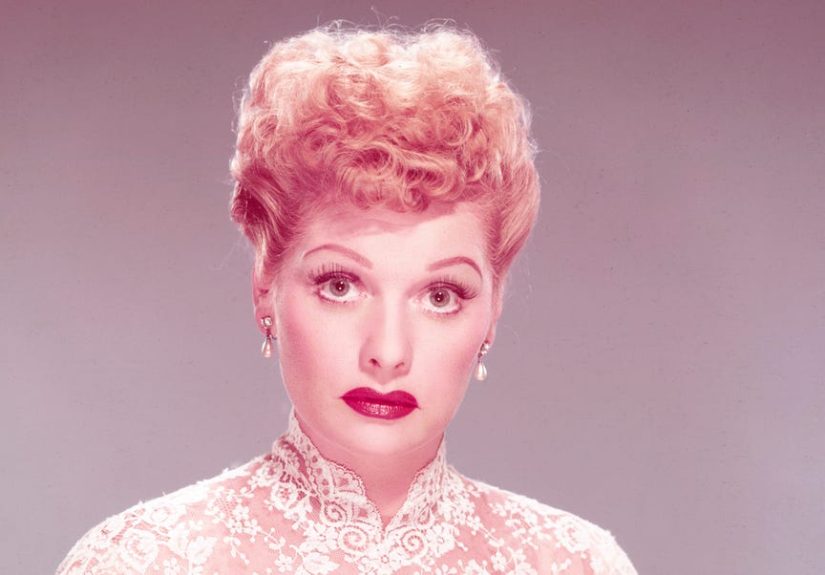
Lucille Ball’s style is another reason rare photos continue to circulate. Her famous red hair became a signature, but her image was never just about color. Publicity portraits from the 1940s and 1950s show controlled glamour: sculpted curls, strong lipstick, crisp tailoring, and expressive eyes that could shift from elegant to chaotic in one beat. These images are catnip for vintage fashion fans, old Hollywood collectors, and anyone who has ever considered buying a dramatic robe and calling it “research.”
Good Housekeeping’s rare vintage photo collection traces Ball’s life from childhood and early entertainment work to her family years, later sitcoms, public appearances, and honors. House Beautiful has also highlighted rare photos connected to Ball’s homes, offering a more domestic view of a star often remembered through studio lights and soundstages. Together, those images create a fuller picture: Lucy the performer, Lucille the professional, and Ball the private person who still had to live somewhere after the applause ended.
Lucille Ball the Executive: The Power Behind the Pictures
Rare photos from Ball’s later career often show a different kind of authority. She is not merely posing as a star; she is standing as a business figure. After her divorce from Desi Arnaz, Ball took greater control of Desilu Productions. Multiple histories of her career note her importance as a television executive, with Desilu connected to major series such as “Star Trek” and “Mission: Impossible.”
This is where rare Lucille Ball images become especially valuable. A publicity shot can sell a show, but a behind-the-scenes or later-career photograph can reveal power. Ball helped prove that a woman in entertainment could be the product, the producer, and the person making hard business decisions. The Television Academy records her major awards recognition, including Emmy nominations and wins, Hall of Fame induction, and lifetime honors.
Where Fans Find Rare Lucille Ball Photos Today
The best places to discover rare Lucille Ball photos are not random social media reposts with captions like “probably 1950ish???” Fans should look to reputable archives, museum collections, established publishers, and licensed image libraries. The Library of Congress, the Lucy-Desi Museum, LIFE/TIME archives, Getty Images, PBS, the Television Academy, and long-running magazines with photo research teams are stronger starting points than unsourced image dumps.
That matters because old photographs travel badly online. Dates get mixed up. Captions become folklore. A studio portrait becomes a “candid.” A film still becomes a “family photo.” And suddenly someone’s aunt on Facebook is confidently declaring that Lucille Ball invented color television while wearing a hat from 1962 in a photo taken in 1955. The internet is magical, but it also needs adult supervision and, occasionally, a historian with coffee.
How to Look at Rare Photos Like a Storyteller
When viewing rare photos of Lucille Ball, do not just ask, “Is this pretty?” Ask better questions. What stage of her career does this image show? Is she being presented as a glamorous actress, a comic performer, a wife, a mother, a producer, or a national treasure? What does the costume suggest? Is the photo carefully lit, or does it feel spontaneous? Who else is in the frame, and what does their presence say about her professional world?
This approach turns a simple photo gallery into a miniature biography. A young studio portrait tells us about Hollywood’s beauty standards. A shot with Desi tells us about romance and production partnership. A family photo tells us about fame crossing into private life. A later awards image tells us about survival, recognition, and legacy. Rare photos do not replace written history, but they make history easier to feel.
The Experience of Seeing Rare Lucille Ball Photos
Seeing rare Lucille Ball photos can feel strangely personal, even for viewers born decades after “I Love Lucy” first aired. That is the magic of a performer whose comedy still feels fresh. You may begin by clicking through a gallery for nostalgia and end up noticing how much work lived behind the laughter. The first experience is usually surprise: “Wait, she looked like that before Lucy Ricardo?” The second is admiration: “How did she manage to look glamorous and completely unafraid of humiliation?” The third is the sneaky one: respect.
A good viewing experience starts slowly. Instead of racing through 40 images in two minutes, pause on each photo and mentally place it on a timeline. In an early Hollywood portrait, look for the actress trying to fit the studio system. In a Desi-and-Lucy image, look for the dual identity of couple and company. In a family photo, notice how fame changes the ordinary rituals of childhood, travel, birthdays, and public appearances. In later images, look at posture. Ball often appears composed, direct, and professional, as if she has already heard every bad pitch in Hollywood and survived them all.
There is also a fun emotional rhythm to these photos. Some images make you laugh because you can almost imagine a missing punchline. Others feel elegant and quiet. A few feel bittersweet because they remind us that Lucille Ball’s public cheerfulness came from discipline, not ease. She lived through career disappointments, intense work schedules, a very public marriage, divorce, reinvention, and the pressure of being beloved. Rare photos make that complexity visible without turning it into a lecture.
For fans, the best experience is comparing the familiar Lucy with the less familiar Lucille. Watch a classic episode, then browse a reputable archive or museum collection. Suddenly, the comedy looks different. The timing is still hilarious, but the performer seems even sharper. You begin to notice the body control, the confidence, the willingness to look foolish, and the producer’s brain behind the actor’s face. That is when rare photos become more than decoration. They become evidence.
Collectors, bloggers, and editors should also experience these images responsibly. A beautiful old photo is not automatically free to publish. Before using any Lucille Ball image online, check licensing, credit requirements, and archive permissions. This is not the glamorous part of nostalgia, but it prevents headaches, takedown notices, and the deeply unfun activity of explaining copyright law to your future self at midnight.
Conclusion: Rare Photos Reveal the Real Scale of Lucille Ball
Rare photos of Lucille Ball remind us that icons are built one frame at a time. She was not only Lucy Ricardo, not only the red-haired queen of slapstick, and not only the face of one of television’s most beloved sitcoms. She was a young hopeful, a film worker, a radio performer, a wife, a mother, a producer, a studio executive, and a woman whose comic instincts helped reshape American entertainment.
That is why these photos still matter. They show the glamour, but also the grind. They show the laughter, but also the intelligence required to create it. Most of all, they show a performer who understood something timeless: if you are brave enough to look silly in public, you just might become unforgettable.
Note: This article is original, web-ready content based on researched public biographical, archival, and entertainment-history sources. Before publishing any actual photographs, verify image rights, licensing terms, and required credits.