Table of Contents >> Show >> Hide
- What Do Economists Mean by “Animal Spirits”?
- Election Season: The Perfect Storm for Animal Spirits
- Why We Can’t Resist Trading the Election
- Lessons from Recent Election Cycles
- The A Wealth of Common Sense Take on Election Trading
- Practical Guidelines for Investors During Election Season
- Animal Spirits in Real Life: How Election Trading Feels
- Extended Reflections: Experiences with “Trading the Election”
- Conclusion: Vote with Your Ballot, Not Your Brokerage Account
Every four years (or sometimes sooner, thanks to surprise snap elections and plot twists),
investors in the United States collectively lose their minds. Cable news flashes red banners,
social media turns into a 24/7 prediction market, and suddenly everyone’s uncle is both a
constitutional scholar and a macro strategist. In the middle of that chaos, one idea quietly
explains a lot of what we see in markets: animal spirits.
The phrase comes from John Maynard Keynes, but you don’t have to be an economist to see it in
action. Animal spirits are simply the emotions, instincts, and stories that drive people to buy,
sell, panic, or pile into risk. Election season just pours rocket fuel on top of all that.
In this article, we’ll unpack what animal spirits really are, how they show up when investors
try to “trade the election,” what history actually says about markets and politics, and how a
wealth of common sense can keep you from turning your portfolio into a political
scoreboard.
What Do Economists Mean by “Animal Spirits”?
Keynes coined the term “animal spirits” to describe how instincts and emotions shape economic
decisions. In theory, investors calmly weigh data, probabilities, and long-term outlooks. In
reality, human beings are a glorious mashup of:
- Hope: “My candidate will win and stocks will soar.”
- Fear: “If the other side wins, it’s game over for the economy.”
- FOMO: “Everyone’s buying; if I don’t, I’ll be left behind.”
- Herd behavior: “I don’t know what’s happening, but I’m going with the crowd.”
Modern behavioral finance translated Keynes’s animal spirits into a long list of well-studied
biases: overconfidence, loss aversion, confirmation bias, and more. The key takeaway is
simple: even sophisticated investors are not robots. They are humans whose beliefs, narratives,
and political identities can push them to trade for emotional reasons rather than financial ones.
Election Season: The Perfect Storm for Animal Spirits
Elections crank uncertainty up to maximum volume. Headlines speculate on tax policy, regulation,
trade, healthcare, defense spending, and everything in between. Polls move. Odds change. Markets
react in real time to every speech, debate, and leaked memo.
Volatility, Not Certainty
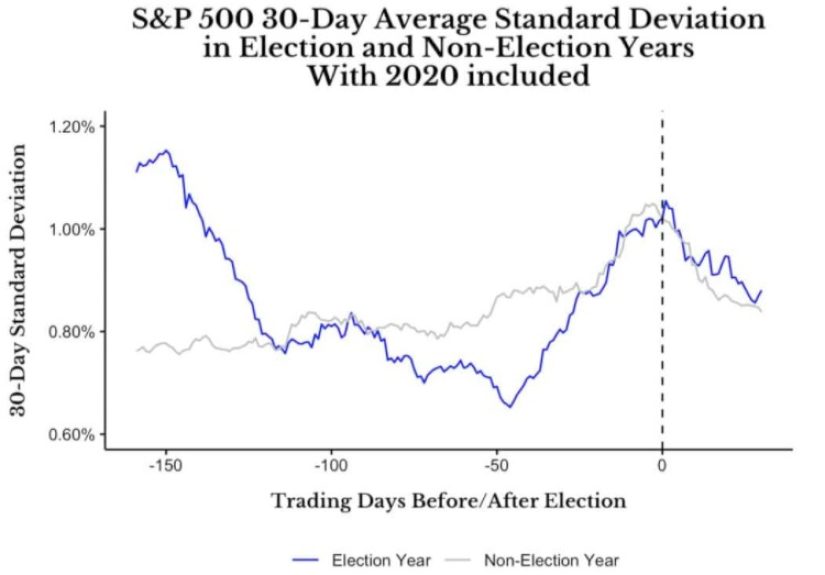
Historical studies of U.S. presidential elections show a consistent pattern:
volatility tends to rise around elections, but long-term returns do not clearly
favor one party. Some research finds that implied volatility increases when the outcome looks
more uncertain, especially when markets perceive a bigger potential policy shift.
Asset managers who have combed through decades of election data generally reach the same
conclusion: markets can be choppy before and shortly after Election Day, but over multi-year
horizons, fundamentals like earnings growth, inflation, interest rates, and innovation matter
far more than who held the Oval Office for four or eight years.
The Election Cycle Myth
There’s a popular story called the “election cycle” theory that claims returns are always weak
before elections and strong afterward. Look close enough and you find something more nuanced:
some cycles fit the story, others don’t at all. When you average everything, the pattern becomes
weaker than the myth suggests.
In other words, if your trading strategy is “buy in November every four years because I saw a
chart once,” you’re not harnessing profound market wisdomyou’re just doing numerology with
extra steps.
Why We Can’t Resist Trading the Election
If the data says election trading isn’t a magic shortcut to riches, why do people keep doing it?
That’s where animal spirits really show up.
Politics as Identity, Portfolios as Protest Signs
For many people, politics is tied to identity and values. That makes elections emotional,
not just analytical. When an investor strongly believes a candidate is good or bad for the
country, it’s tempting to express that belief through their portfolioselling stocks when
“the wrong person” is leading in polls or going all-in when “their side” gains momentum.
The problem? Markets don’t care about our feelings. They care about expected cash flows,
risk, and liquidity. A candidate you dislike can coincide with strong stock returns.
A candidate you love can preside over a rough market. Political satisfaction and portfolio
performance are not neatly correlated.
Media Noise and the Adrenaline Hit
Election coverage is optimized for attention, not portfolio stability. Every twist is the
“most important in decades.” Every poll is a “bombshell.” For traders, this is like sitting
in a casino where the dealer is also a hype person shouting, “Huge move coming!” every five
minutes.
That environment encourages:
- Short-termism: Overreacting to each poll, tweet, or scandal.
- Overtrading: Constantly tinkering with positions based on the latest headline.
- Story-driven bets: “If X wins, then Y sector has to explode higher.”
Sometimes those stories workfor a while. Other times the market has already priced in
the obvious trade, and latecomers just become liquidity for those exiting.
Lessons from Recent Election Cycles
Recent U.S. elections offer plenty of examples of animal spirits at work. Markets have often
seen sharp moves immediately after resultssometimes relief rallies, sometimes selloffsonly
to reverse direction weeks or months later as real policy details emerge.
One pattern shows up often: investors build big narratives about what a particular candidate
“means” for stocks, then discover that the economy, global events, and central banks have
their own ideas. Hype-driven “X trades” (named after whichever candidate just won) can look
brilliant for a short window, then fade once expectations collide with reality.
Hedge funds and macro traders sometimes profit handsomely from this volatility when they get the
narrative and timing right. But for everyday investors trying to manage retirement savings, the
lesson is less glamorous and more practical: don’t let short-term political excitement derail a
long-term plan.
The A Wealth of Common Sense Take on Election Trading
The title of this article tips its hat to the
Animal Spirits podcast and the
A Wealth of Common Sense blog, where the consistent message through multiple election
cycles has basically been:
- You shouldn’t build a portfolio around your political predictions.
- Market history doesn’t support all-or-nothing election bets.
- Most investors are better off focusing on simple, boring, long-term rules.
That “common sense” approach recognizes that animal spirits are real, but it doesn’t let them
drive the car. Instead of trying to guess which party boosts stocks more, it asks:
- Are you diversified?
- Are you saving enough?
- Is your risk level appropriate for your time horizon?
- Do you have a rules-based process you can stick with when headlines get loud?
In other words, you can have strong opinions about elections and still avoid turning your
portfolio into a political mood ring.
Practical Guidelines for Investors During Election Season
Here’s how to navigate election years without letting animal spirits wreck your plans.
1. Treat Elections as One Risk Factor, Not The Risk Factor
Elections matterbut they’re not the only thing that matters. Inflation, interest rates, global
growth, productivity, demographics, and technological change often have a bigger impact on
long-term returns than a single election result.
When you frame the election as one variable in a much bigger equation, your trading decisions
automatically become less extreme.
2. Avoid All-or-Nothing Political Bets
The classic election mistake is going to 100% cash or 100% risk based on who you think will win.
Historically, investors who stay invested tend to do better than those who sit on the sidelines
waiting for political clarity. Missing just a few strong days around periods of volatility
can meaningfully dent long-term returns.
If you absolutely can’t resist expressing an election view, limit it to a small, clearly defined
percentage of your portfoliothink “fun money,” not “my entire retirement.”
3. Separate Political Views from Market Views
It’s possible to think a candidate is bad for the country and still recognize that stocks might
do fine (or better than fine) under their administration. Markets respond to a wide set of
incentives, policies, and global conditions. They are not a real-time approval rating.
A simple litmus test: if you’re only willing to buy stocks when your preferred party is in power,
you’re probably letting politics control your finances more than data.
4. Use Rules to Tame Your Animal Spirits
Instead of relying on vibes, put guardrails in place:
- Rebalancing rules: Rebalance once or twice a year on a fixed schedule, regardless of politics.
- Allocation ranges: Decide in advance how much stock/bond mix you can tolerate and stick to it.
- Cooling-off period: Wait 24–72 hours before making big election-related changes.
The point isn’t to eliminate emotionthat’s impossible. It’s to make sure emotion doesn’t get
to hit the “Sell All” button at 2 a.m. after a particularly fiery debate.
Animal Spirits in Real Life: How Election Trading Feels
So far, this all sounds nicely rational. But anyone who has actually lived through a contentious
election while managing real money knows it doesn’t feel rational in the moment.
Imagine a typical election-year week for an investor:
- Monday: A poll shows a surprising swing. Futures drop overnight.
- Tuesday: A candidate hints at a new policy. Banks rally, healthcare slumps.
- Wednesday: Markets bounce as another poll says, “Never mind, it’s close again.”
- Thursday: Social media declares the end of capitalism or democracy, depending on who you follow.
- Friday: A jobs report arrives and reminds everyone that the economy still exists.
If you check your portfolio every hour during this madness, animal spirits will have plenty of
opportunities to talk you into expensive mistakes. That’s why many experienced investors make
a surprisingly boring choice near election time: they zoom out, review their plan, and do
almost nothing.
Extended Reflections: Experiences with “Trading the Election”
To really understand how animal spirits collide with election trading, it helps to look at
how people actually behave when the stakes feel high and the headlines are screaming.
The Investor Who Always Sits Out Election Years
Many advisors can tell you about a client who repeatedly insists on “waiting for the election
to be over” before investing new cash. The logic sounds reasonable: “There’s too much
uncertainty. I’ll invest when things calm down.”
The problem is that markets often move during the uncertainty. By the time the outcome
is known and things feel calmer, a lot of the big moves may already have happened. Over several
election cycles, that pattern can add up to years of missed compounding.
The Trader Who Goes All-In on the “Obvious” Trade
Another familiar character is the trader who believes they’ve found the perfect election play:
maybe it’s a basket of infrastructure stocks, a particular currency pair, or a defensive sector.
They build a big position because “it just makes sense” that this will benefit under the new
administration.
Sometimes they’re right on the direction but wrong on the timing. Sometimes the policy never
materializes. Sometimes the market priced in the story months earlier. In all those cases,
the “obvious” trade ends up being far less obvious in hindsight.
None of this means you can never trade around elections. It simply means that the bar for
conviction should be high, position sizes should be reasonable, and you should always
respect the possibility that the market knows more than your news feed.
The Advisor in the Crossfire
Financial advisors get a front-row seat to election-year animal spirits. Their inboxes fill with:
- “If this candidate wins, I want to sell everything.”
- “If that candidate wins, I want to double my stock exposure.”
- “Should we buy gold, canned beans, and a bunker ETF?”
A good advisor doesn’t answer those questions with a partisan pep talk. Instead, they bring the
conversation back to the client’s goals: college funding, retirement, financial independence,
legacy. Those goals remain remarkably similar regardless of which slogan is currently trending.
Election years test not just investors’ portfolios but also their ability to separate short-term
emotion from long-term purpose. Advisors who keep clients focused on process rather than
politics add real value during those stressful periods.
Personal Lessons from Watching Election Markets
Anyone who’s watched multiple election cycles up close eventually picks up a few recurring
lessons:
- The market often moves before the headlines catch up. By the time a narrative reaches the front page, institutions have usually been trading on it for a while.
- Extreme certainty ages poorly. The strongest pre-election hot takes (“If X wins, the market will crash!”) rarely look good in retrospect.
- Staying invested is usually underrated. The boring strategy of sticking with a diversified portfolio through multiple political regimes tends to beat the dramatic strategy of jumping in and out.
Over time, these experiences push thoughtful investors toward humility. They still care about
elections. They still vote their values. But they no longer assume that their political beliefs
give them a reliable edge in timing markets.
Conclusion: Vote with Your Ballot, Not Your Brokerage Account
Animal spirits will always be part of marketsespecially during elections. We are human, and
humans feel things. But the goal of smart investing is not to suppress those feelings; it’s to
keep them from hijacking your long-term plan.
Election-year trading can feel exciting, righteous, and intellectually satisfying. Unfortunately,
it is often hazardous to your wealth. History suggests that discipline, diversification, and
time in the market beat political market timing over and over again.
So as the next election cycle ramps up, by all means follow the news, argue with your friends,
and show up to vote. Just remember that your portfolio doesn’t need to take sides. Let your
ballot reflect your politicsand let your investment strategy reflect something rarer and more
valuable: a true wealth of common sense.