Table of Contents >> Show >> Hide
- What the FDA expansion actually means (in plain English)
- Repatha 101: what it is and how it works
- Who is “at increased risk” now?
- The science behind the expansion: why the evidence matters
- How Repatha is taken: dosing, devices, and what injection day looks like
- Safety and side effects: what patients should know
- Where Repatha fits in modern cholesterol care
- Repatha vs. other advanced LDL-lowering options
- Access, insurance, and the “prior authorization treadmill”
- Questions to ask your clinician about the expanded approval
- Why this FDA decision is a big deal
- Experiences from the real world: when “expanded approval” meets real life (extra perspective)
If cholesterol had a personality, LDL would be that houseguest who shows up uninvited, rearranges your furniture,
and then acts shocked when you ask them to leave. For years, doctors have relied on lifestyle changes and statins
(plus a few add-ons) to show LDL the door. But some peopleespecially those with inherited high cholesterol or
very high cardiovascular riskneed more than a strongly worded eviction notice.
That’s where Repatha (evolocumab) comes in. And now, in a meaningful shift, the FDA expanded
Repatha’s approval to cover a broader group of adults: not only those with diagnosed cardiovascular disease,
but also adults at increased risk for major cardiovascular events. The label also clarifies Repatha’s role
in managing high cholesterol alongside diet and exercise and updates how the drug can be used across certain high-cholesterol
conditions.
Translation: the “who qualifies?” conversation just got biggerand a lot more interesting.
What the FDA expansion actually means (in plain English)
The updated indication allows Repatha to be used to help reduce the risk of major adverse cardiovascular (CV) events
in adults at increased risk. In the label’s language, those events include CV death, heart attack (myocardial infarction),
stroke, unstable angina requiring hospitalization, or coronary revascularization (procedures like stents or bypass surgery).
The headline change is the shift from “only people with established cardiovascular disease” to a broader “increased risk” category.
Practically, that opens the door for more high-risk primary-prevention patientspeople who haven’t had a heart attack or stroke
but whose risk profile looks like a storm cloud with excellent Wi-Fi and a calendar invite.
The updated label also emphasizes that Repatha is used alongside diet and exercise to reduce LDL cholesterol in adults with
hypercholesterolemia and in adults and children (age 10+) with heterozygous familial hypercholesterolemia (HeFH) or
homozygous familial hypercholesterolemia (HoFH).
Repatha 101: what it is and how it works
Repatha is a PCSK9 inhibitora monoclonal antibody that targets the PCSK9 protein. PCSK9’s job (unhelpfully) is to mark LDL receptors
in your liver for destruction. Fewer receptors means less LDL is pulled out of the blood.
Repatha blocks PCSK9, which helps preserve LDL receptorsso your liver can remove more LDL cholesterol from circulation.
Think of it like turning your liver into a more efficient cleanup crew with better trash bins and fewer bin fires.
Who is “at increased risk” now?
The label language is intentionally broadbecause cardiovascular risk is messy. It’s not just one number; it’s a profile.
In real life, clinicians use a mix of LDL levels, medical history, imaging, and risk factors to decide when a stronger LDL-lowering
strategy is worth it.
Real-world profiles that often trigger the conversation
- Diabetes (especially long-standing or with complications) plus LDL that remains high despite therapy
- Evidence of atherosclerosis (plaque) on imaging or vascular diseaseeven without a prior heart attack or stroke
- Very high LDL that’s persistent and not responding enough to lifestyle and oral medications
- Familial hypercholesterolemia (HeFH or HoFH), where genetics essentially put LDL on “autopilot”
- Multiple risk factors (high blood pressure, smoking history, kidney disease, strong family history, etc.) plus elevated LDL
The point isn’t that “everyone with high cholesterol” suddenly needs an injectable medication. The point is that the FDA’s label now aligns more
closely with a long-standing clinical reality: some people are high risk before the first event, and waiting for a heart attack is a terrible
membership program.
The science behind the expansion: why the evidence matters
Big FDA label changes don’t happen because a drug “feels promising.” They happen because outcomes data show that lowering LDL translates into fewer
cardiovascular events in the real world.
FOURIER: proving fewer events in established cardiovascular disease
Repatha first built its reputation by powerfully lowering LDL. But the turning point for cardiovascular outcomes was the FOURIER trial,
which enrolled tens of thousands of patients with established cardiovascular disease on statin therapy. The study evaluated whether adding evolocumab
reduced cardiovascular eventsnot just lab numbers.
In FOURIER, evolocumab reduced major cardiovascular events compared with placebo, and the trial’s composite endpoints included heart attack, stroke,
hospitalization for unstable angina, revascularization, and cardiovascular death. This helped establish that more intensive LDL lowering with a PCSK9 inhibitor
can reduce events in secondary prevention (people who already have cardiovascular disease).
VESALIUS-CV: shifting into primary prevention for high-risk adults
The newer storyand the one that fits the “expanded approval” headlinecomes from VESALIUS-CV, a large randomized trial in adults
at high cardiovascular risk who had not had a prior heart attack or stroke. Participants had elevated LDL cholesterol (at least 90 mg/dL)
and were randomized to evolocumab or placebo.
Over a median follow-up of several years, evolocumab lowered LDL substantially (a little over 50% in reported follow-up data), and the trial showed a
statistically meaningful reduction in first major cardiovascular events in this high-risk population. That’s the clinical bridge from “lower LDL” to “prevent
the first big event” in the kinds of patients doctors worry about most.
In other words: the label expansion isn’t a victory lap for a single cholesterol number. It’s the FDA acknowledging outcomes data in high-risk people who
haven’t yet had their “first” heart attack or stroke.
How Repatha is taken: dosing, devices, and what injection day looks like
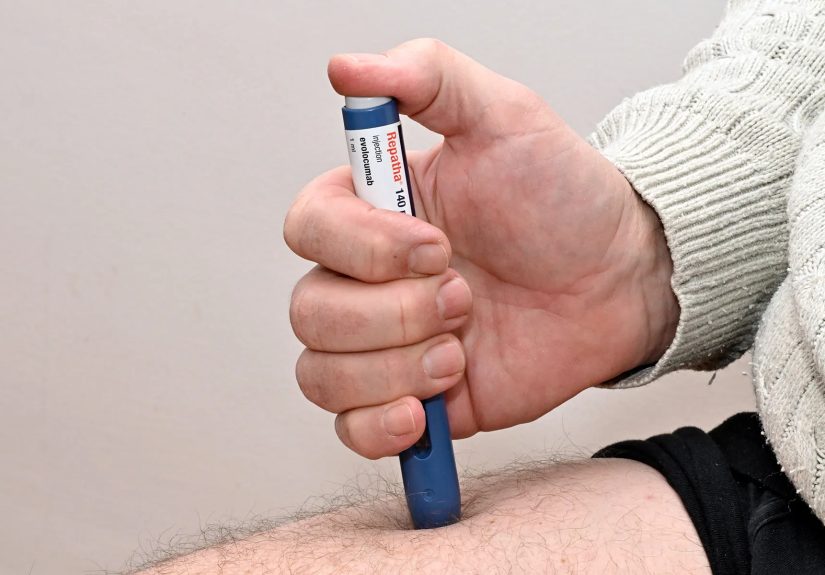
Repatha is given as a subcutaneous injection (under the skin). The most common dosing schedules are:
- 140 mg every 2 weeks, or
- 420 mg once monthly
For people with HoFH, dosing typically starts at 420 mg monthly, and may be increased to 420 mg every 2 weeks if response is not adequate
after a period of treatmentbecause HoFH is an especially stubborn form of high cholesterol.
Devices and practical tips
- Injection sites commonly include the abdomen, thigh, or upper arm; rotating sites helps reduce irritation.
- Some presentations may include components relevant for people with latex sensitivity, so it’s worth mentioning allergies to your clinician.
- LDL lowering can be assessed within weeks; clinicians often recheck labs after the medication has had time to work.
The “injection experience” varies. Some people barely notice it; others feel mild stinging or soreness. Either way, this is one of those moments where
good technique is underrated and YouTube confidence should be replaced by actual training.
Safety and side effects: what patients should know
No medication is a free lunchthough if any drug promised one, it would probably be the one that costs more than lunch.
The good news is that Repatha’s safety profile has been studied across large clinical trial programs.
Common side effects
- Nasopharyngitis (cold-like symptoms)
- Upper respiratory tract infections or flu-like illness
- Back pain
- Injection site reactions (redness, tenderness, swelling)
Less common but important considerations
- Hypersensitivity reactions can occur; serious allergic reactions are rare but require urgent medical attention.
- As with other biologic therapies, immunogenicity is monitored, though clinically significant issues are uncommon.
Bottom line: side effects are typically manageable, but any new medication should be started with a planespecially for people with multiple conditions,
complicated medication lists, or prior medication intolerance.
Where Repatha fits in modern cholesterol care
Repatha didn’t replace statins. Statins remain the first-line foundation for most patients because they’re effective, affordable, and backed by decades of outcomes data.
But for high-risk people whose LDL remains above goal despite maximally tolerated therapy, the usual escalation path often looks like:
- Lifestyle (diet quality, exercise, weight management, tobacco cessation)
- Statin therapy (as tolerated and appropriate)
- Add-on oral therapy (often ezetimibe; sometimes other agents depending on the case)
- Injectables like PCSK9 inhibitors when LDL is still not where it needs to beor when risk is especially high
The FDA expansion matters because it supports earlier, more aggressive LDL lowering in carefully selected high-risk adultseven before a first event occurs.
That doesn’t mean everyone jumps to injectables. It means the conversation can happen sooner for the patients most likely to benefit.
Repatha vs. other advanced LDL-lowering options
Patients often ask: “Is Repatha the only non-statin option?” Nope. It’s one of several tools, each with tradeoffs.
Common alternatives and complements
- Ezetimibe: oral, generally well tolerated, modest LDL lowering, often first add-on to statins.
- Bempedoic acid: oral option for certain patients; LDL lowering is meaningful but generally less than PCSK9 inhibitors.
- Inclisiran: an injection that reduces PCSK9 production using RNA interference; dosing is infrequent, but outcomes data are still developing compared with older therapies.
- Other FH therapies: in HoFH especially, combination therapy and specialized approaches may be needed.
Repatha’s standout feature is the combination of large LDL reductions and hard outcomes data in multiple settings.
The expanded indication adds another “where it fits” optionparticularly for high-risk adults without a prior heart attack or stroke who still have uncontrolled LDL.
Access, insurance, and the “prior authorization treadmill”
If you’ve ever tried to get a PCSK9 inhibitor approved, you know the process can feel like applying for a loan to buy your own arteries back.
Historically, prior authorization has been a major barrier, even when patients clearly met clinical criteria.
Over time, prices have shifted and access pathways have evolved. Amgen previously announced a major list price reduction, and more recently,
the company launched a direct-to-patient option that offers a lower monthly price for cash-paying patients. These moves may reduce friction for
some people, though insurance coverage rules, formularies, and patient cost-sharing still vary widely.
Practical tips that can help (without turning you into an amateur billing specialist)
- Bring recent lab results (LDL, non-HDL, ApoB if available) to appointments.
- Document prior therapies tried (statins, doses, side effects, ezetimibe, etc.).
- If you have FH, get it clearly stated in the chartdiagnosis codes matter.
- Ask the clinic whether they have a dedicated prior authorization team or pharmacist support.
- If cost is the main barrier, ask about manufacturer programs and cash-pay pathways.
Questions to ask your clinician about the expanded approval
- Based on my risk profile, do I qualify under the updated “increased risk” indication?
- What LDL target (or threshold) are we aiming for, and why?
- Should we try oral add-ons first, or is an injectable reasonable now?
- Which dosing schedule fits my life bestevery 2 weeks or monthly?
- How soon should we recheck my cholesterol labs after starting?
- What side effects should I watch for, and what’s the plan if they happen?
- How will we handle insurance approval, and what are my cost options if it’s denied?
Why this FDA decision is a big deal
Cardiovascular prevention has always had an awkward timing problem: the moment you feel fine is often the moment you’re most likely to ignore risk.
The FDA’s expanded approval signals a shift toward taking high-risk primary prevention more seriouslyespecially in patients with
persistently elevated LDL.
It also reinforces a core lesson from modern lipid science: for many people, LDL isn’t just a “bad number.” It’s a modifiable driver of future events.
And when lifestyle plus standard medications aren’t enough, having more optionssupported by outcomes datamatters.
Medical note: This article is for educational purposes and does not replace medical advice. Decisions about cholesterol therapy should be made
with a licensed clinician who can evaluate your full risk profile.
Experiences from the real world: when “expanded approval” meets real life (extra perspective)
An FDA label expansion sounds tidy on paper: a few lines of indication text change, andboommore people can benefit. In real clinics, it’s less “boom”
and more “okay, but can we get it approved, and will the patient actually take it?”
Experience #1: The primary-prevention patient who didn’t look sick.
A common scenario is the patient with diabetes who feels fine, works, travels, and only visits a clinic because their annual labs were “a little off.”
Their LDL is still high despite diet changes and an optimized statin plan, and their family history reads like a cardiology textbook. Before the expanded approval,
the conversation sometimes ended with, “Let’s keep trying oral options,” even when risk was clearly elevated. Now, clinicians can point to the updated indication
and newer trial evidence and say, “We’re not waiting for something bad to happen to justify prevention.”
Experience #2: The prior authorization relay race.
The biggest emotional whiplash often happens after the prescription is written. Patients get hopeful, then the pharmacy calls with the dreaded words:
“Your insurance needs additional information.” Clinics that handle this well usually have a workflow: recent labs, documentation of prior therapies, diagnosis codes
(especially familial hypercholesterolemia), and a clear rationale tied to risk. Clinics that handle it poorly create what patients describe as “being stuck in voicemail
purgatory.” The expansion can help, but only if the paperwork keeps up.
Experience #3: Injection day is mostly… anticlimactic.
People imagine injections as dramatic. In reality, most patients report the first dose is more about nerves than pain. The best experiences usually involve a quick teaching
sessionhow to let the medication warm up, where to inject, how to rotate sites, and what mild reactions are normal. Once patients realize it’s a small routinelike taking
out the trash, but less smellyadherence improves. The worst experiences tend to happen when patients feel rushed, undertrained, or unsure whether a reaction is normal.
Experience #4: Familial hypercholesterolemia families feel seen.
For parents of kids with HeFH, cholesterol is not a “someday” problemit’s a “since birth” problem. Families often talk about the frustration of doing everything right
(healthy meals, sports, good sleep) and still watching LDL stay stubbornly high because genetics wrote the script. Having approved options for children (age 10 and up)
changes the tone from helpless to proactive. It also changes the family conversation: prevention becomes a shared plan rather than a scary unknown.
If there’s a theme across these experiences, it’s this: expanded approval is not just about accessit’s about timing. The best cardiovascular event is the one that never happens,
and prevention works best when it’s easier to start than to postpone.