Table of Contents >> Show >> Hide
- 2025 AC Capacitor Replacement Cost: The Real-World Price Range
- What Is an AC Capacitor (and Why Does It Affect Cost)?
- Cost by Capacitor Type: Run vs. Dual Run vs. Start
- Key Factors That Change AC Capacitor Replacement Cost
- Three Price Examples (So You Can Mentally Prepare)
- DIY vs. Hiring a Pro: What’s “Worth It” in 2025?
- How to Avoid Overpaying for AC Capacitor Replacement
- Warning Signs Your AC Capacitor Is Failing
- How Long Do AC Capacitors Last?
- Can Maintenance Prevent Capacitor Failure?
- FAQ: AC Capacitor Replacement Cost in 2025
- Homeowner Experiences: What People Learn After Paying for a Capacitor Replacement (500+ Words)
If your air conditioner suddenly stops working on the hottest day of the year (because of course it does), there’s a decent chance the culprit is a small part with a big ego: the AC capacitor. The good news? Capacitor replacement is usually one of the more affordable HVAC repairs. The bad news? It can still feel pricey when you’re sweating indoors and Googling “is it normal to hear my ceiling fan judging me?”
This guide breaks down AC capacitor replacement cost in 2025, what you’re actually paying for, why quotes vary so much, and how to avoid paying “emergency weekend pricing” when your system could’ve been saved with earlier warning signs.
2025 AC Capacitor Replacement Cost: The Real-World Price Range
In 2025, most homeowners can expect to pay about $150 to $400 for a professional air conditioner capacitor replacement, with many typical invoices clustering around the $175 to $250 range. In some markets (or during peak heat waves), you may see totals push closer to $450+, especially when after-hours service or additional diagnostics are involved.
Why the spread? Because your bill usually includes more than the capacitor itself. Think of it like ordering fries and realizing you also paid for delivery, a service fee, and the privilege of using a phone.
Typical cost breakdown (what’s on the invoice)
- The capacitor part: Often $8–$45 for common run/dual-run capacitors (some premium or less common options cost more).
- Service call / diagnostic fee: Commonly $100–$250, depending on region and company policies.
- Labor: Often billed as a flat repair price or an hourly rate (many markets land around $75–$150/hour for HVAC labor).
- Possible add-ons: taxes, truck fees, after-hours charges, or bundled repairs if another part is failing too.
What Is an AC Capacitor (and Why Does It Affect Cost)?
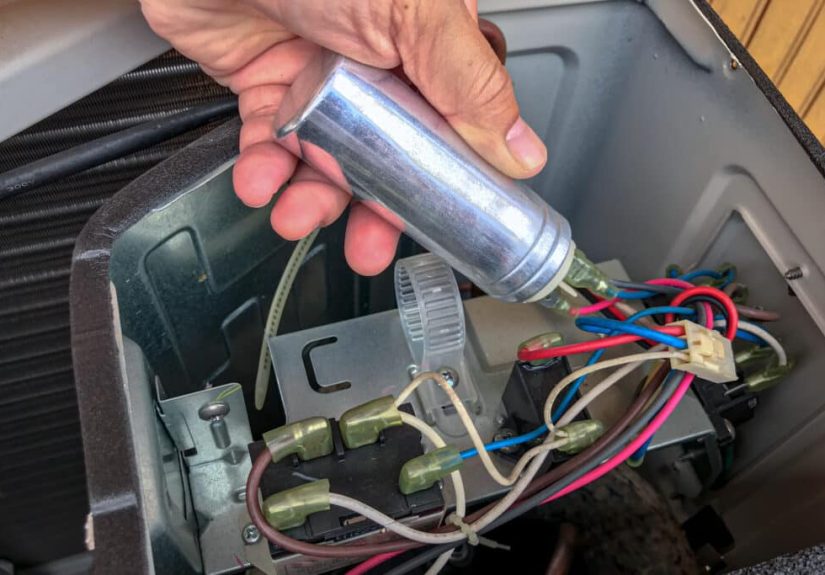
An AC capacitor stores and releases energy to help start and run the motors in your systemlike the compressor and the condenser fan motor. When the capacitor weakens or fails, your AC may struggle to start, run inefficiently, or refuse to turn on at all.
Capacitors are small, but they deal with high voltage. That’s why many HVAC companies strongly recommend professional replacement. The job itself may be quick for a trained technician, but it’s still electrical work, and the price reflects the risk, the skill, and the fact that your HVAC tech owns more tools than most hardware stores.
Cost by Capacitor Type: Run vs. Dual Run vs. Start
One of the biggest pricing factors is what type of capacitor your system uses.
Run capacitor cost (2025)
A standard run capacitor helps keep a motor running smoothly once it’s started. These are common in many systems and usually fall on the lower end of part pricing. With professional service, total replacement often lands in the mid-range of typical quotes.
Dual run capacitor cost (2025)
A dual run capacitor does two jobs in one part (commonly supporting both the compressor and the fan motor). These are extremely common in central AC units. The part may cost slightly more than a basic run capacitor, but the overall installed price usually stays within the same broad national rangeunless access is difficult or service is urgent.
Start capacitor cost (2025)
A start capacitor provides a bigger burst of energy to help a motor start. Not every system uses one. Costs can vary widely depending on the system and whether additional components (like a start kit) are involved.
Key Factors That Change AC Capacitor Replacement Cost
If you’ve ever wondered why your neighbor paid $180 while your quote is $390, here are the usual suspects.
1) Service call and diagnostic pricing
Many HVAC companies charge a diagnostic fee to send a technician out, evaluate the issue, and confirm what failed. Sometimes that fee is rolled into the repair if you approve the work; sometimes it’s separate. This alone can swing your total by $100+.
2) Your location and local labor rates
Like most home services, pricing varies by region. Metro areas and high-cost-of-living markets tend to have higher labor rates. Rural areas can be lowerbut availability can also affect pricing during peak season.
3) Time of year (aka: “summer tax”)
Capacitors love failing during heat waves. Demand spikes, schedules fill up, and emergency appointments become expensive. If you need same-day or weekend service, your final bill may climb.
4) Access and unit setup
If the technician can reach your condenser easily, the repair is simpler. If the unit is fenced in tightly, mounted in a tough spot, or has corrosion and wiring issues, the visit can take longerand cost more.
5) System condition and “while we’re in there” repairs
Sometimes a failed capacitor is the only issue. Other times it fails because something else is stressing the systemlike a failing fan motor, damaged contactor, or electrical problems. If your tech finds additional issues, your total repair cost can rise quickly (and yes, you should ask for itemized options before approving extras).
6) Warranty coverage
If your system is under a parts warranty, you might pay mostly labor and service fees. If you have a labor warranty (less common unless you purchased an extended plan), the out-of-pocket cost can drop dramatically.
Three Price Examples (So You Can Mentally Prepare)
Example 1: Standard weekday replacement (most common)
Scenario: Central AC won’t start. Technician diagnoses a failed dual run capacitor.
Likely total: $175–$275 depending on service fee structure and local rates.
Example 2: Peak-season urgent visit
Scenario: It’s Saturday afternoon in July. Your home feels like a crockpot set to “regret.” You need same-day service.
Likely total: $300–$450+ (after-hours premiums and high-demand scheduling can push prices up).
Example 3: Warranty helps, but labor still applies
Scenario: The capacitor is covered under manufacturer parts warranty, but labor isn’t.
Likely total: $120–$250 depending on labor minimums and service fees.
DIY vs. Hiring a Pro: What’s “Worth It” in 2025?
Let’s be direct: a capacitor is relatively inexpensive as a part, which is why people are tempted to DIY. But capacitors can hold a dangerous charge, and HVAC systems involve high voltage and components that can be damaged by mistakes. For most homeownersespecially if you’re not experienced with electrical repairsprofessional replacement is the safer, smarter route.
Also, many HVAC companies won’t install customer-supplied parts, and DIY work can complicate warranty claims if something goes wrong. If your goal is to save money, your best bet is usually comparing quotes and avoiding emergency pricingnot taking on high-risk electrical work.
How to Avoid Overpaying for AC Capacitor Replacement
You don’t need to become an HVAC expert overnight. You just need a short checklist and the confidence to ask normal questions like a normal adult who is definitely not sweating through their shirt.
Ask these questions before approving the repair
- Is the diagnostic fee applied to the repair if I proceed?
- Is this a flat-rate repair or hourly labor? (Either can be fairclarity is the key.)
- What capacitor type and rating are you replacing? (Run vs dual run; correct microfarads and voltage matter.)
- Is there any sign the capacitor failed because of another problem? (Like a failing motor.)
- Is the part under warranty? (If you know your install date/model, ask.)
- Can you provide an itemized quote? (Part, labor, fees, and any add-ons.)
Smart timing saves money
If your system is showing early symptoms (see the next section), booking service before a total breakdown can help you avoid emergency fees and give you more options for scheduling.
Warning Signs Your AC Capacitor Is Failing
A failing capacitor can look like several common AC problems. Watch for:
- AC won’t start or struggles to start (repeated clicking or delayed startup)
- Warm air or reduced cooling performance despite running
- Outdoor unit hums but fan doesn’t spin (or spins inconsistently)
- System shuts off unexpectedly or cycles oddly
- Higher energy bills with no other explanation
If your unit is acting up, the safest move is to turn it off and call a licensed HVAC technician. Continuing to run a system with electrical issues can stress other components and turn a small repair into a bigger one.
How Long Do AC Capacitors Last?
Capacitor lifespan varies based on heat, usage, power quality, and overall system condition. Many sources cite a broad rangeoften several years to well over a decadethough real-world performance depends heavily on climate and maintenance. If your area has frequent power surges or your unit runs nonstop for months, the capacitor may wear out sooner.
Can Maintenance Prevent Capacitor Failure?
Maintenance can’t make a capacitor immortal, but it can reduce stress on your system. Routine AC maintenancelike keeping coils clean, replacing filters on schedule, and ensuring airflow isn’t restrictedsupports efficient operation and can help reduce the strain that contributes to electrical wear.
If your home has frequent electrical storms or power fluctuations, ask an HVAC pro whether surge protection makes sense for your setup. It won’t stop all failures, but it can help protect sensitive components.
FAQ: AC Capacitor Replacement Cost in 2025
Is a capacitor replacement a “big” AC repair?
Usually, no. Compared with major repairs like compressor replacement, capacitor replacement is typically one of the more affordable fixesassuming it’s caught early and no other parts were damaged.
Why did one company quote $200 and another $450?
Common reasons include different service call policies, flat-rate pricing vs. hourly labor, after-hours charges, and differences in what’s included (warranty, membership discounts, or bundled inspections). Always ask for itemization.
Should I replace the capacitor proactively?
Most homeowners replace capacitors when symptoms appear or failure is confirmed. If your system is older and you’ve had repeated electrical issues, your HVAC technician may recommend proactive replacement based on testing and system condition.
Homeowner Experiences: What People Learn After Paying for a Capacitor Replacement (500+ Words)
When homeowners talk about AC capacitor replacement, the story rarely starts with, “I scheduled preventative maintenance and everything went according to plan.” Nomost stories begin with a house that won’t cool and a growing suspicion that the sun has moved closer to Earth out of spite.
Experience #1: The surprise fee that wasn’t really a surprise. A common lesson is that the capacitor itself isn’t what drains your walletit’s the visit. Many people expect to pay “for the part,” then feel blindsided by a service call/diagnostic fee. After the fact, homeowners often say they wish they’d asked, “Is the diagnostic included if I approve the repair?” right away. The same repair can look very different when one company rolls fees into a flat rate and another lists them separately.
Experience #2: Timing is everything. Homeowners who call on a weekday morning often report far lower totals than those who need after-hours help. Plenty of people learn this the hard way: the AC limps along for a week, then fails dramatically on a weekend. The technician’s availability becomes the premium product, and the capacitor replacement cost jumps. The takeaway is simple: if your AC is acting strangehesitating to start, shutting off unexpectedly, or cooling inconsistentlydon’t “wait and see” during peak season. Waiting can turn a manageable appointment into an emergency call.
Experience #3: One small part can be a warning sign. Many homeowners feel relieved after the capacitor replacement… until the tech points out what may have caused it. Sometimes capacitors fail from normal wear. Other times, they fail because the system is under stress: a fan motor pulling too much amperage, corrosion and moisture inside the electrical compartment, or power issues that beat up components over time. Homeowners often say the most valuable part of the visit was not the repair itself, but the explanation of what to watch next. That’s why it’s worth asking, “Did the capacitor fail on its own, or does something else look off?”
Experience #4: The best “discount” is a paper trail. People who kept their installation paperwork (or at least the model/serial info) tend to have smoother warranty conversations. Homeowners often report they didn’t realize parts could be covered until they asked. Even when labor isn’t covered, getting the part covered can reduce the total. The lesson: if your AC is less than a decade old (or you bought the home recently), it’s worth checking warranty terms before you pay full price for everything.
Experience #5: Clear communication beats HVAC anxiety. The best outcomes usually happen when homeowners ask for an itemized quote, confirm whether they’re paying a flat rate, and make sure the repair matches the diagnosis. You don’t have to challenge the technicianyou just want clarity. People often say they felt more confident (and less “sold to”) when they requested simple specifics: capacitor type, rating, and what fees are included. In the end, the experience tends to be less stressful when you treat it like any other professional service: understand the scope, understand the price, and don’t be afraid to compare options if the situation isn’t urgent.
In other words, capacitor replacement is rarely the “big scary” repair. The real pain usually comes from surprise fees, bad timing, or ignoring early warning signs. The more you treat your AC like a system that deserves basic attentionrather than a magical cold-air geniethe less likely you are to overpay when a small part finally taps out.