Table of Contents >> Show >> Hide
- What You Need Before You Start
- Choose the Right Hearthfire Plot
- Step-by-Step: How to Build a House with Hearthfire in Skyrim
- Where to Get Building Materials Fast
- Best Room Combinations for Different Play Styles
- Common Mistakes to Avoid
- Why Hearthfire House Building Still Feels So Good
- Player Experience: What Building a Hearthfire House Actually Feels Like
- Final Thoughts
If you have ever stomped out of a draugr crypt, pockets full of loot, only to realize your “home” is basically a chest with walls, Hearthfire is your moment. This add-on lets you build a real house in Skyrim from the ground up, which means you get to stop pretending Breezehome is spacious and start living like the Dragonborn version of a frontier architect. It is part role-playing, part resource management, and part “why do I suddenly care so much about goat horns?”
Learning how to build a house with Hearthfire in Skyrim is not difficult, but it does have a few steps that can confuse first-time players. You need the right plot of land, the right quests completed, a decent stack of materials, and a little patience while your dream manor slowly stops looking like an ambitious lumber accident. Once you understand the order of operations, though, the whole system clicks into place.
This guide walks through the entire process, from buying land and choosing the best homestead to gathering building materials, selecting the smartest room upgrades, and avoiding the mistakes that make players mutter at the drafting table like it personally insulted their bloodline. By the end, you will know exactly how to build a Hearthfire house that matches your play style, whether you want a cozy family home, a mage compound, or a warrior museum full of axes and questionable interior design choices.
What You Need Before You Start
Before you can begin building, you need access to Hearthfire. If you are playing older versions of Skyrim, that means owning the add-on. If you are on Skyrim Special Edition or Anniversary Edition, Hearthfire is already included, which is excellent news for your future real-estate empire and terrible news for your free time.
Once that is sorted, your real checklist is simple:
- Have enough gold to buy land. Each Hearthfire plot costs 5,000 gold.
- Complete the local requirements that unlock the land sale.
- Travel to the plot and use the Drafting Table and Carpenter’s Workbench.
- Collect materials such as sawn logs, quarried stone, clay, iron ingots, and hardware pieces like nails, hinges, and locks.
The build flow in Hearthfire is always the same. You buy a plot, read the setup around the site, draft a small house, build it in stages, then expand it into a main hall with up to three wings and an optional cellar. In other words, Skyrim does not let you free-build like a sandbox survival game. Hearthfire is more like a very polite fantasy construction system with a strict blueprint and a dragon problem outside.
Choose the Right Hearthfire Plot
There are three plots of land in Hearthfire, and each one has the same basic house structure but a different environment, unlock path, and unique outdoor feature. That means the “best” house is not just about scenery. It is also about convenience, resources, and what kind of character you are playing.
| Homestead | Hold | How to Unlock | Unique Outdoor Feature | Best For |
|---|---|---|---|---|
| Lakeview Manor | Falkreath | Usually unlocked after the Falkreath Jarl’s bandit-related favor and land offer | Apiary | Players who want the prettiest location and a classic family-home vibe |
| Windstad Manor | Hjaalmarch | Unlocked through the Morthal area quest line tied to Laid to Rest | Fish Hatchery | Alchemy fans, ingredient farmers, and players who like practical utility |
| Heljarchen Hall | The Pale | Unlocked after Waking Nightmare and Kill the Giant | Grain Mill | Players who want central-ish access and open tundra views |
Lakeview Manor is the fan favorite for a reason. It is scenic, easy to love, and feels like the Hearthfire home people picture when they think, “I should settle down after murdering my 400th bandit.” The forested setting makes it feel warm and lived-in, even when wolves are trying to ruin your evening.
Windstad Manor is the most practical pick if you care about ingredients and crafting efficiency. The fish hatchery is a standout feature, especially for players who lean into alchemy. It is not as pretty as Lakeview, unless your dream lifestyle is “wet marsh wizard,” but it is incredibly useful.
Heljarchen Hall sits in the Pale and has a colder, more rugged atmosphere. It is a great choice for players who like open terrain, cleaner sightlines, and a slightly less cozy, more “Nordic estate run by someone who definitely owns several warhammers” aesthetic.
Step-by-Step: How to Build a House with Hearthfire in Skyrim
1. Buy the land
Talk to the Jarl or steward associated with the hold once you meet the requirements. Pay 5,000 gold, receive the deed, and your map will point you to the plot. Congratulations: you are now a homeowner in a province where giants can casually punt you into low orbit.
2. Visit your plot and check the starter setup
When you arrive, you will find a drafting table, a carpenter’s workbench, a chest with starter supplies, and nearby deposits for clay and quarried stone. This is your construction hub. Do not ignore the chest. Skyrim is trying to help for once, which is unusual enough to celebrate.
3. Use the Drafting Table to select the Small House Layout
Your first blueprint is the small house. This is the mandatory beginning of every Hearthfire home. You cannot skip straight to a grand hall with a library and trophy displays. Even the Dragonborn has to start with the equivalent of a respectable shed.
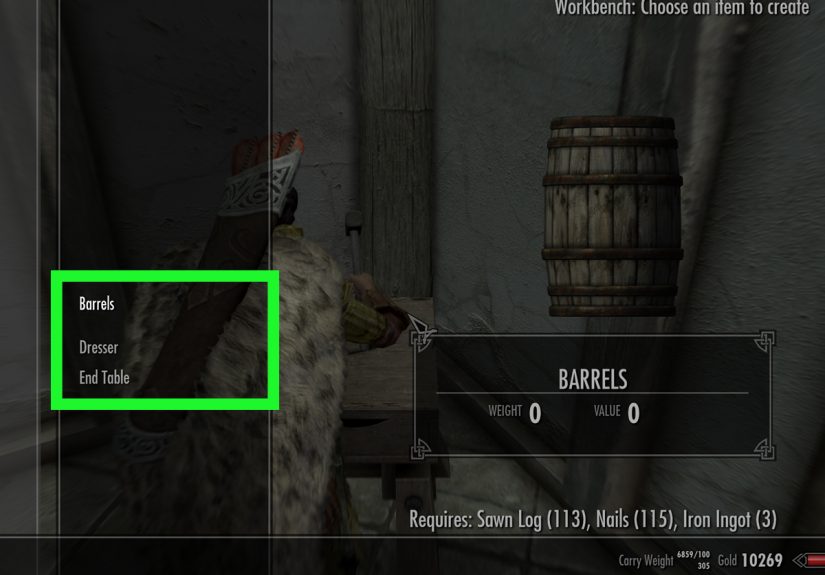
4. Build the Small House at the Carpenter’s Workbench
Once the layout is chosen, move to the workbench and build each stage of the structure. The small house is assembled piece by piece, including the foundation, wall framing, walls, floor, roof framing, roof, and door. This stage mostly uses sawn logs, quarried stone, clay, and a little hardware.
After it is complete, you technically have a usable home. You can furnish it and stop there for a while if you want. This is actually a good move early in the game if you need storage, a bed, and a safe drop-off point before investing in the full mansion build.
5. Build the Main Hall
The main hall is where your house stops looking temporary and starts looking important. Go back to the drafting table, choose the main hall, and then return to the carpenter’s workbench to build each section. This stage takes more materials, more time, and more trips to get iron, glass, straw, leather strips, and all the fussy little pieces that somehow turn a building site into a home.
Once the main hall is finished, the game also lets you remodel the small house into an entryway. Do this. It is the natural next step, and it makes the layout feel complete instead of like your manor has a starter cabin awkwardly glued to the front.
6. Add your wings
After the main hall is complete, you can choose one wing for each side of the house. This is the biggest customization decision in Hearthfire, because once you start a wing choice, that decision is permanent for that house.
North Wing options: Storage Room, Trophy Room, or Alchemy Laboratory
West Wing options: Greenhouse, Bedroom, or Enchanter’s Tower
East Wing options: Kitchen, Library, or Armory
This means one house can have three wings total, but not every room type. If you want every possible wing in the game, you need to build all three homesteads across Skyrim. Hearthfire is basically telling you that one house is not enough, which is how fantasy real-estate obsession begins.
7. Add the cellar and exterior improvements
The cellar is optional, but it is worth building if you want more storage and a fuller estate. Outside, you can also add practical upgrades such as a stable, smelter, garden, animal pen, and other utility pieces. Each plot also gets its own unique outdoor addition, which is one of the best reasons to pick one location over another.
8. Furnish the interior
You can furnish rooms manually at the workbenches inside the house, or you can appoint a steward later and pay them to furnish parts of the home over time. Manual furnishing gives you control and lets you prioritize what matters first. Steward furnishing saves effort, though it costs more gold and a little patience.
Where to Get Building Materials Fast
If you are wondering why building a house with Hearthfire in Skyrim sometimes feels like a part-time job, the answer is simple: materials. You are not just building walls. You are also building shelves, containers, light fixtures, display cases, and enough iron hardware to make a blacksmith smile in a deeply unsettling way.
Essential materials
- Sawn Logs: Buy them from sawmills or through a steward. They are delivered to your plot.
- Quarried Stone: Mine it near the homestead or buy it through a steward.
- Clay: Mine deposits near the site or purchase it through a steward.
- Iron Ingots: Needed for nails, hinges, and iron fittings.
- Corundum Ingots: Needed for locks.
- Glass, Goat Horns, and Straw: Commonly purchased from general goods merchants.
- Leather Strips: Needed for some furnishings and decorative pieces.
The fastest route is usually this: mine the free clay and stone at the plot, buy logs in bulk, and hoard iron every chance you get. If you appoint a steward after getting the main hall built, life becomes much easier because they can purchase materials directly for you. That alone can save a lot of running around, especially once you realize your “simple decorating session” actually needs more hinges than a medieval castle door convention.
Best Room Combinations for Different Play Styles
Because each wing choice is permanent, you should build with intention. The best Hearthfire house is not the one that looks good in theory. It is the one that fits the way you actually play.
Best setup for a family home
Go with Bedroom + Kitchen + Storage Room or Bedroom + Kitchen + Greenhouse. This combination feels warm, practical, and homey. It gives you sleeping space, cooking support, and either extra storage or ingredient growth. If your goal is to settle down, adopt children, and give your spouse a place that feels like more than “a fortified loot bin,” this is the move.
Best setup for a mage
Choose Alchemy Laboratory + Enchanter’s Tower + Library or swap the library for a greenhouse if you are ingredient-focused. This setup turns your house into an arcane headquarters. It is perfect for players who live on potions, enchantments, soul gems, and the quiet satisfaction of organizing shelves no one else in Skyrim will appreciate.
Best setup for a warrior or collector
Pick Armory + Trophy Room + Kitchen or Armory + Trophy Room + Bedroom. The armory is excellent for weapon and armor displays, while the trophy room leans hard into the “yes, I did personally ruin that sabre cat’s day” energy. Add a kitchen if you want utility, or the bedroom if you want the house to feel less like a museum curated by a warlord.
Best setup for pure practicality
Storage Room + Greenhouse + Kitchen is criminally underrated. It may not scream drama, but it makes everyday play smoother. You get storage, ingredients, and better support for survival-style or crafting-heavy runs. Not every build needs a dramatic tower. Sometimes efficiency is the real luxury.
Common Mistakes to Avoid
Do not rush your wing choices. Once you begin building a wing, you are committed. If you accidentally build a library when you wanted an armory, Skyrim will not offer you a polite renovation refund.
Do not underestimate iron. Players focus on logs, clay, and stone, then suddenly discover they are short on nails, fittings, hinges, and locks. Iron disappears fast.
Do not ignore the steward system. Appointing a steward after your main hall is built makes furnishing and material buying far less annoying.
Do not assume every house is equally useful. Lakeview looks amazing, Windstad offers the fish hatchery, and Heljarchen has the grain mill. A beautiful view is wonderful, but utility matters too.
Do not try to force one house to do everything. Hearthfire works best when you accept its design. One house cannot hold every possible wing. If you want all nine wing types, build all three homes and give each one a purpose.
Why Hearthfire House Building Still Feels So Good
What makes Hearthfire memorable is not just the construction system. It is the feeling that your house becomes a record of your playthrough. City homes in Skyrim are useful, but they are bought fully formed. A Hearthfire home grows with you. First it is a rough plot of land. Then it is a tiny shelter. Then it becomes a real estate project you weirdly care about more than half the civil war.
That emotional arc matters. When you build your house manually, every room feels earned. The armory is not just a room. It is the place where your favorite weapons finally stop rattling around in random chests. The greenhouse is not just a side wing. It is the moment you realize your alchemy habit now has infrastructure. Even the entryway, which is not exactly glamorous, feels satisfying because it proves your home has become something larger and more permanent.
There is also a role-playing magic to it. A stealth archer’s house feels different from a battlemage’s estate. A family-focused run leads to different choices than a collector run. The game never makes you write a backstory for the house, but Hearthfire quietly encourages you to do it anyway. That is part of the charm. The structure is fixed enough to be manageable, yet flexible enough to reflect your version of the Dragonborn.
Player Experience: What Building a Hearthfire House Actually Feels Like
The experience of building a Hearthfire house in Skyrim is a funny mix of ambition, routine, and accidental obsession. At first, it feels simple. You buy a plot of land, walk up to the workbench, and think, “Great, I’ll throw together a little cabin and be done in ten minutes.” That is the exact moment Hearthfire smiles politely and hands you a second career in procurement.
You start with optimism. The site looks manageable. There is a chest, some tools, and a nice scenic view. Then the material lists begin. You need logs. Then more logs. Then iron for nails. Then more iron because apparently every shelf in Skyrim requires the hardware budget of a drawbridge. You make a few supply runs, come back, add a wall, build a roof, and suddenly you are emotionally invested in a half-finished building in the woods.
That investment is the magic. Hearthfire creates a rhythm that feels surprisingly satisfying. Adventure for a while, gather materials, return home, build one more piece, then head back out again. The loop works because it gives your wandering in Skyrim a domestic payoff. A dungeon crawl is no longer just about gold and loot. It might also mean enough iron ingots to finish wall sconces or enough coin to buy extra furnishings. Somehow, goat horns become exciting. This is not rational, but it is absolutely real.
There is also a strong sense of ownership that normal player homes do not quite match. When you buy a city house, it is nice, but it is still a package deal. With Hearthfire, you remember the build process. You remember when it was just a foundation and some framing. You remember the first time the main hall came together and the place finally looked important. You remember standing in the entryway, turning the camera, and thinking, “Oh no. I care about this house more than some actual questlines.”
The room choices add another layer of personality. A player building an armory and trophy room is telling a different story from someone who chooses a greenhouse and bedroom. One house says, “I am a conqueror with a display problem.” The other says, “I would like a nice dinner, a warm bed, and maybe fewer vampires near the property line.” Even if the game’s customization is structured rather than freeform, the choices still feel expressive.
Then there is the mood of each location. Lakeview feels like the fantasy postcard version of Skyrim housing. Windstad feels practical and slightly haunted by swamp weather. Heljarchen feels stern, wide open, and gloriously Nordic. The same house system lands differently in each place, which helps the experience stay fresh across multiple builds.
And yes, there is frustration. You will run out of one small item at the worst possible time. You will forget to buy enough glass. You will discover that the room you want is permanently tied to the wrong wing direction. You may briefly consider shouting at your drafting table. But even those annoyances become part of the memory. Hearthfire works because the house is not handed to you. It becomes a project, and projects are messy.
By the time the house is fully finished, it feels less like a reward screen and more like a base of operations with a story behind it. You stocked it. You shaped it. You paid for it. You probably hauled half the province into it one ingot at a time. That is why building a house with Hearthfire in Skyrim still stands out so many years later. It turns a wandering hero into someone with an address, a front door, and a suspiciously strong opinion about interior storage.
Final Thoughts
If you want to know how to build a house with Hearthfire in Skyrim, the short answer is this: buy the right plot, build the small house first, expand into the main hall, choose your wings carefully, and gather more materials than you think you will need. The long answer is that Hearthfire is one of the most charming systems in the game because it makes your home feel earned.
Whether you settle at Lakeview Manor for the scenery, Windstad Manor for the fish hatchery, or Heljarchen Hall for the tundra estate energy, the best approach is to build with purpose. Match the house to your character. Build for utility, style, or family life. Just do not pretend you only need a “few supplies.” Hearthfire hears that kind of confidence and immediately demands seventeen more nails.