Table of Contents >> Show >> Hide
- What Are Hungary’s Panel Buildings, Exactly?
- A Quick Visual Glossary: Words You’ll Hear (and Should Pretend You Already Know)
- Why Photograph Them? Because They’re Honest (and Weirdly Cinematic)
- The 37 Frames
- Beyond the Aesthetic: What Panel Buildings Tell Us About Hungary
- From Grey to “Actually Pretty”: Renovation, Retrofits, and the Next Chapter
- How to Shoot Your Own “37 Frames” Without Being a Nuisance
- Extra: of “Experience” A Walk Through the Panels (Without Pretending You’re in a Spy Movie)
- Conclusion
If you’ve ever landed in Budapest, taken one wrong tram, and suddenly found yourself surrounded by
perfectly repeated balconies like a copy machine got emotionally attached to concretecongrats.
You’ve met Hungary’s panel buildings. Locals call them panelház (panel house), and they’re the
most misunderstood cast of characters in the country’s built environment: part necessity, part ideology,
part engineering shortcut, part everyday homeand, yes, part accidental photography playground.
This article is a guided photo-essay in words: 37 frames you can “shoot” with your eyes (or your camera)
to understand what Hungary’s prefabricated apartment blocks really are. We’ll go from why these buildings
exist, to what they look like up close, to how they’re being upgraded todayplus a long, practical “experience”
section at the end for anyone who wants to wander the estates without feeling like they accidentally joined a
concrete cult.
What Are Hungary’s Panel Buildings, Exactly?
“Panel building” sounds like something you buy at a hardware store next to the garden hoses, but it’s
actually a construction method: large concrete panels manufactured in standardized shapes and assembled
on site like a very serious set of life-size building blocks. The goal wasn’t poetry. The goal was speed:
build lots of apartments quickly, predictably, and at a cost governments could swallow without choking.
Across Central and Eastern Europe, this approach became the mass-housing workhorse of the postwar decades.
Hungary’s version grew into entire neighborhoods of long “slab” blocks, point towers, and courtyard clusters.
If your mental image is “grey rectangles,” you’re not wrongbut you’re also missing the human layer: families,
kitchens, school runs, friendships, quiet routines, and the strangely comforting geometry of a place that
always looks like it knows where it’s going.
Why They Became So Common
Hungary (like much of Europe) faced acute housing pressure in the second half of the 20th century: urban migration,
industrial expansion, and the basic math of “more people than apartments.” Panel construction solved the urgent problem
the way a fire extinguisher solves a kitchen fire: not elegantly, but effectivelyfast.
Over time, panel housing became normalized. Then the political system changed, economies shifted, and the buildings
stayedbecause concrete is stubborn like that. Today, panel buildings remain a major part of the housing stock,
especially around Budapest and large regional cities. They’re not “ruins.” They’re homes that have simply lived
through multiple chapters of history without changing outfits.
A Quick Visual Glossary: Words You’ll Hear (and Should Pretend You Already Know)
- Panelház: a panel building (prefab concrete apartment block).
- Housing estate: the larger planned neighborhood of multiple blocks + schools + shops + green space.
- Slab block: long, horizontal apartment blockexcellent for sunsets and existentialism.
- Point block / tower: taller “punctuation mark” buildings that break up the skyline.
- Stairwell core: the vertical “spine” with stairs, elevators, mailboxes, and gossip logistics.
- Retrofit: modernization workinsulation, windows, facades, heating upgrades, and “please stop leaking.”
Why Photograph Them? Because They’re Honest (and Weirdly Cinematic)
Panel buildings are great photo subjects for the same reason diners, neon signs, and old motels are:
they’re ordinary in a way that becomes extraordinary when you slow down. Their repetition turns into rhythm.
Their wear-and-tear turns into texture. And their scale (human lives inside huge forms) gives you instant story.
Also: they refuse to pose. You don’t photograph a panel building; you negotiate with it. The building says,
“Here are 240 identical windows. Show me you deserve them.”
The 37 Frames
Think of each “frame” below as a photo you could takeplus what that photo would reveal. You can do this
in Budapest or in any Hungarian city with panel estates. The magic isn’t in finding the “prettiest” building.
The magic is noticing what these places are built to do: hold everyday life at industrial scale.
-
Frame 1: The approach shot.
One block on the horizon. It looks like a ship. You realize it’s an entire neighborhood. -
Frame 2: The repeating balconies.
A grid of small personal decisions: plants, laundry racks, satellite dishes, and the occasional fearless chair. -
Frame 3: The “color surprise” facade.
A renovated block with bold paint. Same structure, new moodlike a poker-faced friend wearing a bright scarf. -
Frame 4: The stairwell entrance.
The portal: intercom, chipped steps, and that one notice board that’s half official and half neighborhood diary. -
Frame 5: Mailboxes close-up.
Names, stickers, taped repairs. A census of belonging in metal rectangles. -
Frame 6: The elevator button panel.
Decades of fingerprints, scratches, and the faint sense that this elevator has seen things. -
Frame 7: The courtyard geometry.
Planned green space between blocks. Not “park” exactlymore like shared breathing room. -
Frame 8: The playground.
Concrete near concrete. The swings are a reminder that these estates were built for families, not just statistics. -
Frame 9: The corner shop.
A small store tucked under a block. Panel estates always grow their own street-level micro-economy. -
Frame 10: The bus stop scene.
People waiting, blocks behind them. The real portrait isn’t the buildingit’s the relationship between building and transit. -
Frame 11: The long “slab” perspective.
Stand at one end. The building becomes a vanishing point. Your camera starts to whisper, “W I D E A N G L E.” -
Frame 12: The tower as landmark.
A taller block used like a compass. Residents don’t say “north”; they say “by the tall one.” -
Frame 13: Window curtains at dusk.
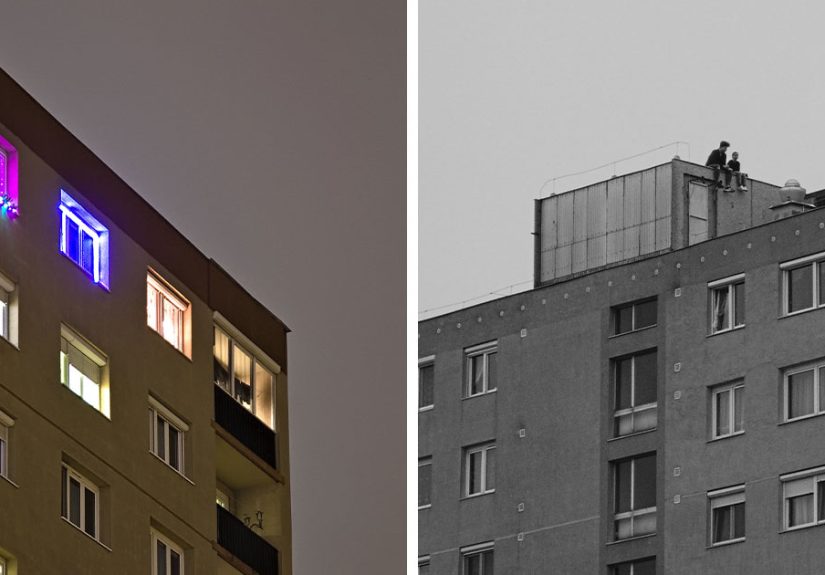
The grid lights up with different lives: warm squares, cold squares, the occasional TV glow like a tiny lighthouse. -
Frame 14: The facade texture.
Up close, “grey block” becomes aggregate, seams, patches, and repairsarchitecture with a scar timeline. -
Frame 15: The panel joints.
Those lines aren’t decoration; they’re the building’s assembly instructions still visible decades later. -
Frame 16: The stairwell window.
Brutal outside, surprisingly soft light inside. The best “accidental cathedral” in the neighborhood. -
Frame 17: The corridor view.
A hallway that feels endless, then suddenly ends in a door mat that says “Welcome.” The human scale returns. -
Frame 18: The “extra insulation” layer.
Cladding, new windows, tighter envelopes: evidence that the panel era is being edited, not erased. -
Frame 19: The rooftop silhouette.
Antennas, vents, and small structures that look like they were added by necessity, not architects. -
Frame 20: The view outward.
From higher floors: green patches, older neighborhoods, new glass towers. You see Budapest’s timelines stacked. -
Frame 21: The ground-floor “edge.”
Some blocks have shops, some have blank walls. Photograph where the building meets the street to see the urban logic. -
Frame 22: The graffiti and the cleanup.
Competing layers: tags, paint, municipal “corrections.” It’s a dialogue in aerosol. -
Frame 23: The stairwell mural.
Some entrances hide mosaics or painted artsmall cultural gifts tucked into functional spaces. -
Frame 24: The “neighboring block” composition.
One block is never just one block. Photograph two or three together to capture the estate as a system. -
Frame 25: The winter shot.
Snow makes the geometry cleaner. The buildings look quieter, like they’re holding their breath. -
Frame 26: The summer shot.
Laundry, open windows, plants on balconies. The concrete feels less severe when life spills outward. -
Frame 27: The rain shot.
Wet surfaces deepen contrast. Reflections turn parking lots into temporary mirrors. -
Frame 28: The “close-up of normal.”
Door mats, shoes, prams, bicyclesobjects that turn a mass-produced shell into a specific home. -
Frame 29: The parking reality.
Estates were planned for a different car era. The modern vehicle count tells you how the city evolved faster than the blueprint. -
Frame 30: The tree line.
Mature trees soften the strictness. Many estates are greener than outsiders expect, which changes the emotional temperature. -
Frame 31: The renovation seam.
Half the building updated, half not. It’s the architectural equivalent of “before and after” in one frame. -
Frame 32: The window replacement pattern.
Not every unit upgrades at once. Mixed window styles become a patchwork of individual budgets and priorities. -
Frame 33: The “energy upgrade” clue.
New exterior layers and tightened details hint at the huge, unglamorous mission: making old buildings comfortable and efficient. -
Frame 34: The quiet bench.
A single bench, someone reading, blocks behind them. This is where “mass housing” becomes “daily life.” -
Frame 35: The skyline contrast.
Frame panel blocks with new developments in the distance. It’s not a battle; it’s a conversation between eras. -
Frame 36: The night train/tram view.
Moving past lit windows creates a flipbook of domestic scenes. The city becomes cinema. -
Frame 37: The “one detail that makes you laugh.”
A balcony decorated like a beach bar. A giant plush toy in a window. Proof that people always outsmart uniformity.
Beyond the Aesthetic: What Panel Buildings Tell Us About Hungary
They’re a Record of Big Promises and Small Lives
Panel estates were designed with a particular kind of confidence: the belief that standardized construction and
planned neighborhoods could deliver dignity at scale. Even when the ideology around them is debated, the physical
result is undeniable: a huge number of Hungarians have lived, loved, argued, studied, and grown old inside these
walls. The buildings didn’t just house peoplethey organized a way of life around schools, transit, and daily errands.
They Also Reveal Modern Inequality in Very Concrete Ways
After political and economic transitions, panel housing took on new reputationssometimes unfairly.
Some blocks became highly desirable because they’re well-connected, upgraded, and close to parks or metro lines.
Others struggled with aging infrastructure and uneven investment. In many cities, the same building type can symbolize
either stable affordability or stubborn neglect, depending on how it’s maintained.
From Grey to “Actually Pretty”: Renovation, Retrofits, and the Next Chapter
The most important story in panel housing today isn’t nostalgia or mockeryit’s modernization. Across Europe (and
increasingly as an idea in the United States), the big question is: how do you upgrade millions of existing apartments
without displacing residents, blowing budgets, or turning cities into permanent construction zones?
One promising approach is prefabricated retrofit “skins”: off-site manufactured facade panels that add insulation,
improve airtightness, and refresh the building’s exterior. Think of it as giving the building a warm jacket that also
happens to look nicer. In some programs, these upgrades can be installed quickly, reducing disruption and making large-scale
energy improvement more realistic.
What Upgrades Usually Matter Most (and Why Residents Care)
- Insulation + airtightness: warmer winters, cooler summers, lower energy bills, fewer drafts that feel like the building is personally offended by you.
- Window replacement: comfort, noise reduction, and “why does my living room sound like the entire boulevard?” relief.
- Heating and hot water systems: reliability, cost control, and fewer surprise “cold shower character-building exercises.”
- Stairwell and elevator renewals: safety, accessibility, and less daily friction for older residents and families.
- Facade updates: not just vanitynew cladding can protect the structure and help manage moisture and durability.
How to Shoot Your Own “37 Frames” Without Being a Nuisance
A quick etiquette guide, because “I’m doing street photography” is not a magic spell that makes people stop being people.
Panel buildings are homes. Treat them like neighborhoods, not backdrops.
Practical tips
- Photograph buildings, not private lives. Wide shots and details beat zooming into someone’s dinner table.
- Go early or go golden. Morning light reveals texture; sunset turns repetition into drama.
- Use repetition intentionally. Let the grid fill the frame, then break it with one human detail.
- Look for contrasts. Old concrete + new insulation, grey blocks + green trees, uniform facades + personal balconies.
- Let the estate tell a story. Transit stops, courtyards, shops, pathsphotograph the system, not just the shell.
Extra: of “Experience” A Walk Through the Panels (Without Pretending You’re in a Spy Movie)
Start your day like a local would: not with a grand architectural manifesto, but with a practical destination.
Pick a panel estate that’s easy to reach by public transit, then step off the tram or metro and pause.
The first sensation is usually scale. In the center of Budapest, buildings compete for attention with ornament,
riverside views, and historic drama. In a panel district, the buildings don’t compete; they repeat.
And that repetition changes how you move. You stop hunting for “the landmark” and start noticing patterns:
identical stairwell windows, identical balcony rails, identical shadows. It’s oddly calminglike walking inside
graph paper, except the graph paper contains grocery stores and toddlers.
Follow the footpaths through the green space between blocks. Many estates have more trees than visitors expect,
and the landscapingwhether intentional or just the result of decades of growthsoftens the hard lines.
You’ll see routines: dog walkers doing the same loop, older residents taking the same bench, kids treating a
patch of pavement like it’s the world’s most important race track. Photographing here isn’t about “finding the perfect building.”
It’s about catching the relationship between built form and daily behavior. A bench placed at the edge of a courtyard tells you
where people actually want to be. A shortcut worn into the grass tells you where the planners guessed wrong.
Drift toward the ground-floor edges where the estate meets the street. This is where you’ll feel the neighborhood’s
“current” most clearly: small shops, convenience stores, maybe a bakery smell that makes you forgive the concrete for a moment.
Look up at the balconies. They’re the most honest part of the facade: a personal archive of how residents adapt standard units.
Plants are everywhere, because greenery is the easiest rebellion. So are improvised sunshades, laundry racks,
and the occasional “this balcony is now my second living room” setup. If you’re lucky, you’ll see the same building wearing different decades:
newer windows on some units, older ones on others, fresh cladding on one section, original texture on the next.
It’s not uniformity anymoreit’s a patchwork of personal upgrades.
Later, return at dusk. Panel buildings are at their most human when the lights come on. The grid becomes a constellation of
tiny scenes: cooking, studying, watching TV, talking, resting. You don’t need to zoom in to feel itjust stand back and watch
how the estate shifts from “architecture” to “neighborhood.” That’s the point of the whole 37-frame exercise:
to see panelház not as a meme about ugliness, but as a living system that has carried Hungarian urban life for generations.
The buildings may be standardized, but the lives inside them never are.
Conclusion
Hungary’s panel buildings are not just “leftovers” from a past erathey’re a massive, ongoing housing reality and a visual language
you can learn to read. In 37 frames, you can see how prefab concrete became neighborhood, how repetition became rhythm, and how
modern retrofits are quietly rewriting the panel story from “grey necessity” to “practical future.”