Table of Contents >> Show >> Hide
- The Short Answer
- Why Mold Is Sometimes Harmless and Sometimes Risky
- When Moldy Food Is Sometimes Safe to Save
- When Mold Means Throw the Whole Thing Away
- Why Scraping Off Mold Usually Does Not Work
- What Happens If You Accidentally Eat Moldy Food?
- Who Should Be Extra Careful?
- How to Reduce Mold Without Wasting More Food
- Common Moldy Food Scenarios, Solved
- There is mold on one slice of bread. Can I keep the rest?
- There is a small mold patch on block cheddar. Is it salvageable?
- My strawberries have one fuzzy berry in the container. What now?
- My jam has mold on top. Can I spoon it off?
- Blue cheese has mold. Isn’t that the point?
- My dry-cured salami has a white coating. Is that bad?
- The Bottom Line
- Everyday Experiences With Moldy Food: The Kitchen Reality Check
You know the moment. You open the fridge, reach for the strawberries, and there it is: a fuzzy little science project staring back at you like it pays rent. Your first instinct might be to throw everything away, disinfect the shelf, and reconsider all your life choices. But here is the twist: moldy food is not always dangerous. Sometimes it is completely unsafe. Sometimes it is merely gross. And sometimes, surprisingly, it is still salvageable.
That is why the real question is not “Is mold bad?” but “What kind of food are we talking about?” Mold behaves very differently on a block of cheddar than it does on bread, yogurt, or a carton of berries. Moisture, texture, density, and how deeply mold can spread all matter. So before you go into full kitchen panic mode, let’s sort out when mold means “trash it immediately” and when it means “trim carefully and carry on.”
The Short Answer
Yes, moldy food can be dangerous, but not always. Some molds are intentionally used to make foods like blue cheese, Brie, Camembert, and certain dry-cured meats. Those molds are part of the product and are considered safe for most healthy people. Accidental mold on everyday food is a different story. In many cases, the safest move is to throw the food away because mold can spread below the surface, bring along bacteria, or produce toxins you cannot see, smell, or scrape off with wishful thinking.
Still, there are exceptions. Dense, low-moisture foods such as hard cheese, hard salami, and some firm vegetables can sometimes be saved if you cut a generous margin around the moldy spot. So no, mold is not always a one-way ticket to the trash can. But it is also not something to negotiate with like a stubborn roommate.
Why Mold Is Sometimes Harmless and Sometimes Risky
Some molds are useful
Human beings have been eating certain molds on purpose for a very long time. Blue cheese gets its signature veins and sharp flavor from safe mold cultures used during production. Some soft-ripened cheeses rely on mold to form their rind and texture. Certain dry-cured salamis also develop a harmless white mold coating on the outside as part of the aging process.
In other words, not all mold is a villain. Sometimes it is basically a tiny food stylist.
Other molds are a problem
Accidental mold growth is different because you usually do not know which mold is present or what else came with it. Some molds can trigger allergic reactions or respiratory symptoms. Some can produce mycotoxins, which are toxic compounds associated with health problems. And some foods with mold may also contain invisible bacterial growth alongside the mold. That is why “it’s just a little fuzzy spot” is not always the comforting statement people think it is.
Another important point: the mold you see is often only the visible part. Beneath the surface, root-like threads can spread farther than your eyes can detect. In soft or porous foods, those threads can travel well beyond the obvious green, white, or blue patch. That is exactly why some foods are salvageable and others are not.
When Moldy Food Is Sometimes Safe to Save
Here is the part that surprises people: a few moldy foods can often be saved safely if the mold is limited and the food is dense enough.
1. Hard cheese
If you find mold on hard or semi-hard cheese like cheddar, Swiss, Parmesan, or Colby, you can often cut away the moldy part and keep the rest. The rule of thumb is to cut off at least 1 inch around and below the moldy spot. Keep the knife away from the mold itself so you do not drag spores through the good part.
What does not count? Shredded cheese, crumbled cheese, sliced cheese, and soft cheese. Those belong in the “do not save” category.
2. Firm fruits and vegetables
Firm produce with low moisture, such as carrots, bell peppers, cabbage, and similar vegetables, can sometimes be salvaged. Again, the key is to cut away at least 1 inch around and below the mold. Dense produce gives mold a harder time spreading quickly through the entire item.
That said, if the food feels soft, slimy, collapsed, or smells off, the safe answer changes fast. At that point, it is less “trim and save” and more “nice try, goodbye.”
3. Hard salami and dry-cured country ham
Surface mold can be normal on some hard salamis and dry-cured country hams. In those cases, the mold can often be scrubbed or removed from the surface. This is one of the rare times mold on meat does not automatically mean disaster. But this rule applies to specific cured products, not deli turkey from the back of your fridge pretending it is fine.
When Mold Means Throw the Whole Thing Away
For many foods, visible mold is a full-stop moment. These foods are either soft, porous, moist, or more likely to support hidden spread and bacterial growth.
1. Bread and baked goods
Bread is porous, which means mold can spread through the loaf long before you see it on every slice. Muffins, pastries, rolls, cakes without a protective hard texture, and similar baked goods should also be tossed if mold appears. Removing one moldy corner is not a clever hack. It is an edible gamble.
2. Soft fruits and vegetables
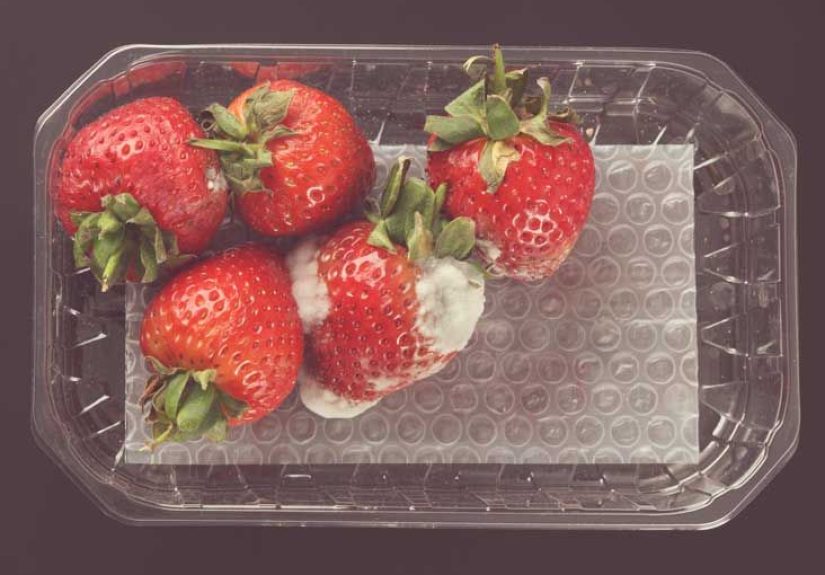
Strawberries, tomatoes, peaches, cucumbers, leafy greens, and other soft produce should be discarded if mold shows up. High moisture gives mold an easy path below the surface. If one berry in a container is moldy, check the others carefully. In many cases, the safest option is to discard the whole container, especially if the berries are touching and several are soft or damp.
3. Soft cheese and dairy
Cottage cheese, cream cheese, ricotta, goat cheese, yogurt, sour cream, and similar dairy products should be thrown out if mold appears. The same goes for shredded or sliced cheese. Soft dairy gives mold and bacteria too much room to spread in ways you cannot see.
4. Jams and jellies
This one catches a lot of people off guard. No, you should not scoop mold off the top of jam and keep eating the rest. Jams and jellies can support mold growth and may carry toxin concerns. That “I’ll just remove the top layer” move belongs in the kitchen hall of fame for bad ideas.
5. Nuts, peanuts, and nut butters
Moldy nuts and peanut butter should be discarded. Some molds associated with nuts and grains can produce mycotoxins, including aflatoxins, which are among the better-known food safety concerns.
6. Leftovers, cooked grains, cooked pasta, deli meats, bacon, and hot dogs
Cooked leftovers and ready-to-eat refrigerated foods should be tossed if mold appears. That includes casseroles, pasta, rice dishes, lunch meats, and similar items. These foods often have enough moisture for mold and bacteria to spread quickly, even while chilling in the refrigerator.
Why Scraping Off Mold Usually Does Not Work
People love a shortcut, but scraping mold off food is mostly a psychological comfort move. The fuzzy patch on the surface is often just the part that announced itself. Beneath it, microscopic growth may have already traveled into the food. On high-moisture or porous foods, that hidden spread can be significant.
There is also the problem of contamination around the mold. Even if the mold itself seems localized, nearby food may contain spores, bacterial growth, or toxins. So if your plan is to remove the suspicious green bit from a tub of yogurt and proceed like nothing happened, the yogurt would like a word.
What Happens If You Accidentally Eat Moldy Food?
Usually, a healthy adult who accidentally eats a small amount of moldy food will be okay. That is the good news. The less-good news is that it depends on the food, the mold, and the person eating it.
Possible symptoms can include nausea, vomiting, diarrhea, abdominal cramps, fever, or an allergic reaction. In some cases, people may notice no symptoms at all. If someone develops severe symptoms, signs of dehydration, bloody diarrhea, repeated vomiting, or a high fever, medical advice is a smart move. That is especially true for young children, older adults, pregnant people, and anyone with a weakened immune system.
The important thing is not to panic over one accidental bite. One wrong berry does not automatically mean catastrophe. But repeated exposure to obviously spoiled food is not a strategy, either.
Who Should Be Extra Careful?
Some people should be much more cautious around moldy food and foodborne illness in general:
- Pregnant people
- Infants and young children
- Older adults
- People with weakened immune systems
- People going through chemotherapy or taking immune-suppressing medications
For these groups, even foods that might be low-risk for others can be a bad bet. Mold itself is not the only issue. Hidden bacteria and foodborne pathogens are part of the concern too.
How to Reduce Mold Without Wasting More Food
Food safety and food waste do not have to be enemies. You can lower your chances of seeing surprise fuzz in the first place without turning your kitchen into a laboratory.
Keep the refrigerator cold
Your refrigerator should stay at 40°F or below, and your freezer should stay at 0°F. Cold temperatures slow the growth of mold and bacteria, though they do not stop everything forever.
Use leftovers promptly
Cooked leftovers are generally best used within 3 to 4 days. After that, the risk goes up. If you will not eat them in time, freeze them sooner rather than later.
Store food covered
Mold spreads by airborne spores. Covering food in the refrigerator helps reduce cross-contamination and keeps moisture levels more stable.
Clean the fridge regularly
Spills, sticky jars, and forgotten produce drawers create a mold-friendly environment. Clean the refrigerator every so often, wipe spills quickly, and do not let the back shelf become an archaeological dig.
Buy realistic amounts
If a family of two keeps buying warehouse-sized berry boxes with the confidence of a smoothie startup, mold may be the predictable ending. Buying smaller amounts more often can reduce both waste and frustration.
Common Moldy Food Scenarios, Solved
There is mold on one slice of bread. Can I keep the rest?
No. Toss the loaf. Bread is porous, and the mold likely spread farther than you can see.
There is a small mold patch on block cheddar. Is it salvageable?
Yes, often. Cut off at least 1 inch around and below the spot, and keep the knife away from the mold.
My strawberries have one fuzzy berry in the container. What now?
Inspect the whole container carefully. If several berries are soft, leaking, or moldy, discard the lot. Soft fruits do not give you much margin for error.
My jam has mold on top. Can I spoon it off?
No. Throw it away. This is not the place to practice optimism.
Blue cheese has mold. Isn’t that the point?
Yes, but only the mold that is part of the product. If blue cheese grows additional mold that does not belong there, or if it smells or looks wrong, it may no longer be safe.
My dry-cured salami has a white coating. Is that bad?
Not necessarily. Some dry-cured salamis naturally develop a safe white surface mold. But if the salami is slimy, smells off, or shows unusual mold growth, do not assume it is fine.
The Bottom Line
Moldy food is not always dangerous, but it is also not something you should judge by vibes alone. Hard cheese, firm vegetables, and certain cured meats can sometimes be saved with proper trimming or surface cleaning. Soft, moist, porous, or prepared foods usually cannot. Bread, berries, yogurt, lunch meat, leftovers, and jam are not worth the risk.
So yes, the headline is true: moldy food is not always dangerous. But the safe exceptions are limited, and the rules matter. When the food is soft, wet, or mysterious, trust caution over courage. Your stomach does not hand out medals for bravery.
Everyday Experiences With Moldy Food: The Kitchen Reality Check
Most people do not learn mold rules from a food safety chart. They learn them the hard way, usually while standing in front of the refrigerator in pajamas, holding a container that felt like a good purchase three days ago.
Take berries, for example. You buy them with excellent intentions. They are for breakfasts, maybe snacks, possibly a healthy dessert if the week goes especially well. Then real life happens. Suddenly it is Thursday, one strawberry is wearing a tiny white sweater, and the rest of the carton is one deep sigh away from collapse. This is where many people begin bargaining: “What if I throw out just the fuzzy one?” Unfortunately, berries are sneaky. Their moisture makes them mold magnets, and the mold often spreads before you can spot it. It is one of those annoying moments when frugality and food safety stop being best friends.
Then there is the bread situation, which has humbled almost everyone at least once. You reach for a slice and notice one green dot near the heel of the loaf. It looks tiny. Innocent, even. But bread is basically a sponge with ambition. Mold can move through it quietly, which means the slice that looks fine may not actually be fine. It is a tragic ending, especially when the loaf was expensive and “artisanal,” but no sandwich is worth a mystery fungus experiment.
Cheese, on the other hand, is where life gets weirdly hopeful. A block of cheddar with one moldy corner feels like bad news, until you learn that hard cheese can often be saved by cutting generously around the spot. This is the rare kitchen moment when science throws you a bone. The same person who had to trash a whole loaf of bread can rescue most of a nice chunk of Parmesan and feel oddly triumphant about it.
Leftovers create a different emotional drama. You open a container of pasta from earlier in the week and realize you are no longer sure whether it is dinner or evidence. Maybe it smells okay. Maybe it does not. Maybe there is no visible mold, but the date is fuzzy and your confidence is fading fast. This is where the “when in doubt, throw it out” rule earns its paycheck. Leftovers are convenient, but they are not immortal.
And of course, there is the jam debate. Few kitchen myths are as persistent as the old “just scrape the top off” idea. Maybe someone learned it from a relative who survived many questionable pantry decisions and became family folklore because of it. But mold on jam is not a charming old-school shortcut. It is a reminder that food traditions and food safety do not always agree.
In the end, moldy food decisions are really about learning which moments reward caution and which ones allow a little practical rescue. Once you know the difference, the fridge becomes less of a daily gamble and more of a place where you make smart calls, save what is truly safe, and toss what is trying way too hard to become a biology lesson.
Note: Source links were intentionally omitted for clean web publishing, and unnecessary citation artifacts were removed.