Table of Contents >> Show >> Hide
- The Burning Man Sculpture That Says More Than a Thousand Therapy Sessions
- Why Burning Man Was the Perfect Place for This Message
- The Adults Are Armored. The Children Are Honest.
- What “Inner Child” Really Means in Modern Life
- Why This Burning Man Art Still Feels Urgently Relevant
- Conflict, Reconciliation, and the Courage to Soften
- Experiences This Sculpture Unlocks in the Viewer
- Final Thoughts
- SEO Tags
Some art politely hangs on a wall and waits to be admired. Other art marches straight into your chest, sits down on your feelings, and refuses to leave until you’ve reexamined your life choices. Alexander Milov’s Love, the unforgettable sculpture that appeared at Burning Man, belongs firmly in the second category.
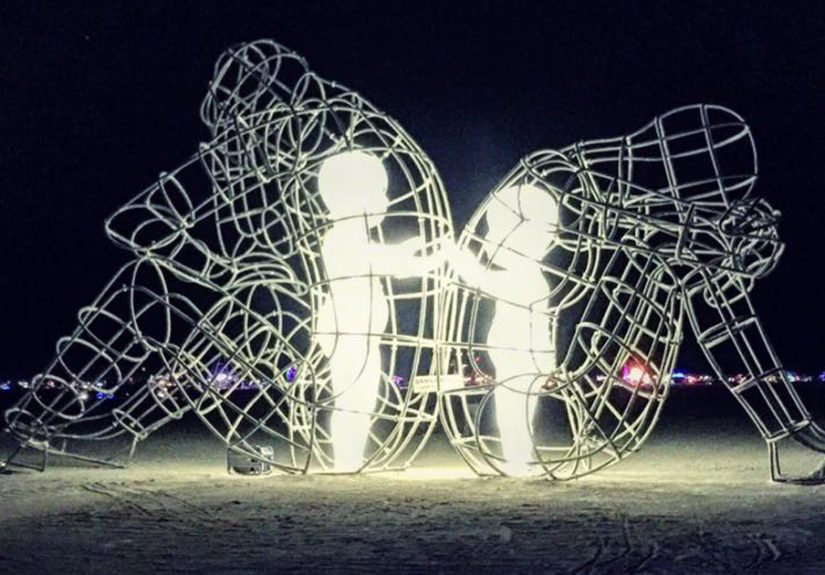
At first glance, the piece looks simple enough: two giant wire-frame adults sit back to back, clearly not having a great day. Maybe they argued. Maybe somebody said, “I’m fine,” in the most not-fine way possible. But inside those hulking adult forms are two illuminated children reaching toward one another. Suddenly, the sculpture is no longer just a cool desert installation. It becomes a visual gut punch about conflict, vulnerability, and the tiny soft part of us that still wants connection even when the adult version is busy sulking.
That is exactly why this Burning Man sculpture continues to resonate years after it first appeared on the playa. It captures a truth that most people know but rarely say out loud: grown-ups are often just children with email accounts, deadlines, and slightly better shoes. Underneath our pride, defensiveness, and emotional armor, many of us are still carrying younger versions of ourselves who want safety, tenderness, recognition, and love.
In a culture that rewards performance, detachment, and looking unbothered, Love dares to suggest something radically uncool and deeply human. The part of us that wants to be understood did not disappear. It just got stuck behind the metal frame.
The Burning Man Sculpture That Says More Than a Thousand Therapy Sessions
Milov’s sculpture works because it tells a complete story without needing a single spoken word. The adult figures are large, rigid, and turned away from each other. Their posture suggests distance, tension, maybe even heartbreak. These aren’t cartoon villains or dramatic heroes. They are simply people who have shut down. That restraint is part of what makes the piece so powerful. It does not scream. It aches.
Then there are the children inside.
Unlike the adults, the inner child figures are luminous, open, and active. They are the emotional opposite of the outer bodies. While the adults are locked in silence, the children are still trying to connect. One reaches toward the other through the metal framework, creating a poignant contrast between what we show and what we feel.
The visual symbolism is almost unfairly effective. The adults appear trapped by ego, hurt, or habit. The children represent sincerity, innocence, and the stubborn desire to love anyway. If the grown-up part of the sculpture says, “Don’t talk to me,” the child inside says, “Please don’t leave.”
That contrast is what makes Love more than just another Burning Man art installation. It transforms a private emotional experience into public art. People do not merely look at it; they recognize themselves in it. And once that happens, the sculpture stops being about two figures in the desert and starts becoming about every strained conversation, every emotional retreat, and every moment when tenderness got stuck behind pride.
Why Burning Man Was the Perfect Place for This Message
Burning Man has never been just a festival where people wear goggles and make dust look fashionable. At its best, it functions like an experimental city devoted to art, participation, and radical self-expression. The environment encourages installations that do not simply decorate space but transform it. Art there is supposed to provoke, involve, and unsettle. In other words, subtle emotional earthquakes are welcome.
That context matters. A sculpture like Love would be moving almost anywhere, but in the Black Rock Desert it gains extra power. Burning Man invites people to step outside ordinary routines and encounter themselves differently. Strip away the office, the schedule, the social script, and suddenly a massive sculpture about emotional disconnection feels less like an object and more like a mirror with better lighting.
Even the festival’s culture supports that reading. Burning Man celebrates communal effort, immediacy, and radical self-expression. Milov’s sculpture fits naturally into that world because it is not passive art. It asks viewers to participate emotionally. You don’t need to climb it, push a button, or wave your arms around like a maniac to engage with it. Your participation happens internally. The artwork prompts recognition, memory, and reflection.
And honestly, what better setting could there be for a giant metaphor about wounded adulthood than a temporary city in the desert where people are already halfway to existential revelation by sunset?
The Adults Are Armored. The Children Are Honest.
The genius of this sculpture lies in how clearly it understands adulthood. The outer figures are not monstrous. They are familiar. Many people learn, over time, to protect themselves with emotional distance. We become careful. We become strategic. We become experts in saying, “No worries,” while internally resembling a raccoon trapped in a filing cabinet.
Adult life teaches us to mask pain in sophisticated ways. We intellectualize. We joke. We withdraw. We pick fights about dishes when the real issue is fear. We act indifferent when what we actually want is reassurance. The older we get, the better we often become at appearing composed while feeling disconnected.
That is why the children inside the sculpture matter so much. They are not there as decoration. They are the emotional truth of the piece. They suggest that beneath our most polished defenses, there remains a younger self that still longs for closeness. The “inner child” may sound like a phrase that belongs on a scented candle, but the underlying idea is serious: early experiences shape how we respond to love, conflict, rejection, and safety.
In practical terms, that means adult arguments are often not just adult arguments. They can stir up much older feelings. A partner’s silence may trigger abandonment. Criticism may awaken shame. Distance may feel bigger than the present moment because it is touching something older underneath. The sculpture translates that emotional reality into a scene anyone can understand in seconds.
The adults are defensive because they are hurt. The children are reaching because they still believe connection is possible. That duality is the whole human mess, elegantly welded into steel.
What “Inner Child” Really Means in Modern Life
The phrase “inner child” gets tossed around so often that it can start sounding like wellness confetti. But in psychological terms, it points to something meaningful: the younger emotional patterns, memories, needs, and beliefs that continue living inside adult behavior.
That does not mean there is literally a tiny kid inside every stressed adult, filing complaints and demanding dinosaur-shaped chicken nuggets. It means our childhood experiences do not vanish simply because we get older. They become part of how we interpret the world. If we learned early that affection was inconsistent, criticism was dangerous, or our feelings were inconvenient, those lessons may still shape our reactions decades later.
This is one reason the sculpture feels so haunting. It visualizes the tension between external maturity and internal vulnerability. On the outside, the figures are fully grown. On the inside, the most emotionally alive parts are still young.
That idea helps explain why certain situations hit people so hard. A delayed text becomes a crisis. A disagreement becomes a threat. A loved one’s bad mood feels like proof of rejection. These reactions are not signs of weakness or failure. Often, they are clues. They suggest that some part of the self learned long ago to brace for pain.
But the sculpture is not hopeless. Quite the opposite. The children inside are not cowering. They are reaching. That matters. The image suggests that beneath all the learned defenses, the desire for closeness survives. The emotional core is not destroyed. It is waiting for a chance to be seen, soothed, and believed.
Why This Burning Man Art Still Feels Urgently Relevant
Love continues to circulate online and in conversation because the modern world gives people endless tools for connection while making real vulnerability feel terrifying. We can send messages instantly, react publicly, and perform intimacy at scale. Yet many people struggle to say simple, honest things face to face: “I’m hurt.” “I miss you.” “I’m scared.” “Please stay kind with me.”
The sculpture exposes that contradiction beautifully. The adults are close in physical structure but far apart emotionally. The children, meanwhile, reach directly toward each other. In that sense, the artwork is not just about romantic relationships. It is about all kinds of human connection. Friends, family members, communities, and even strangers carry private emotional histories into public life.
It also speaks to burnout culture. Plenty of adults have become so focused on productivity, image, or survival that they barely remember what openness feels like. The inner child becomes less of a poetic idea and more of a neglected tenant. Still present. Still paying rent in emotional consequences. Still wondering when someone will finally turn on the lights.
Milov’s sculpture reminds viewers that emotional healing is not about becoming childish. It is about becoming honest enough to care for the parts of ourselves that still ache. That distinction is important. Maturity is not the absence of tenderness. It is the ability to protect tenderness without burying it alive.
Conflict, Reconciliation, and the Courage to Soften
One of the most compelling things about Love is that it captures the exact moment when reconciliation still feels possible. The adult figures have not turned back yet. The distance remains. The fracture is visible. And yet the children are reaching.
That in-between moment is where much of life happens. Most relationships are not destroyed by one dramatic catastrophe. They erode through misunderstandings, unspoken fears, accumulated disappointments, and the slow cementing of defensive habits. One person shuts down. The other pushes harder. Somebody grows sarcastic. Somebody becomes avoidant. Before long, both people are acting from protection rather than sincerity.
The sculpture suggests that healing begins beneath the argument. It starts with recognizing the softer need hidden inside the harder behavior. Anger may hide hurt. Silence may hide fear. Control may hide panic. Distance may hide longing. Once you see that, a fight is no longer just a fight. It becomes a clue about what has not yet been comforted.
This is what makes the inner child image so enduring. It gives language to a common experience many adults have felt but struggled to name. Sometimes the most mature thing we can do is not win the argument, maintain the mask, or pretend not to care. Sometimes the most mature thing is to admit that something inside us is scared and still reaching for connection.
Experiences This Sculpture Unlocks in the Viewer
Standing before a piece like this, even in photos, can be strangely disarming. People often arrive thinking they are going to admire craftsmanship, scale, or visual drama. Then the emotional recognition sneaks up on them. One second it is a striking sculpture in the desert. The next second it is your parents’ marriage, your last breakup, your own habit of shutting down when someone gets too close, or that old childhood ache you thought had been packed away neatly in the attic of your psyche.
That is the first major experience the sculpture creates: recognition. Not the shallow kind, either. It is the uncomfortable kind that makes you go still. Many viewers see the adult figures and instantly understand the physical language of conflict. The turned backs, the slumped postures, the refusal to face one another all feel painfully familiar. Then the glowing children inside change the entire experience. Suddenly, the sculpture is not about hostility alone. It is about the innocence buried under hostility. It is about the part of us that still wants to be met gently, even after we have made ourselves difficult to reach.
Another experience the sculpture stirs up is grief. Not necessarily dramatic grief with violins playing in the distance, but a quieter kind. It can awaken sadness for the version of yourself that learned to harden too early. It can remind people of the emotional needs they minimized, the tenderness they were taught to hide, or the softness they traded away in exchange for competence. Plenty of adults have mastered functioning while quietly starving for emotional safety. This sculpture has a way of exposing that bargain.
It also invites empathy, which may be its most radical move. Once you see the children inside the adults, it becomes harder to flatten people into villains. That does not excuse bad behavior, of course. A glowing art installation is not a legal defense. But it does complicate the story in a humane way. It suggests that many cold, defensive, or hurtful behaviors come from people whose own unresolved pain still lives close to the surface. That insight can shift how viewers think about family tension, romantic conflict, friendship breakdowns, and even their own mistakes.
Then there is the experience of hope. This is not a despairing work. If it were only about distance, it would be bleak. But the reaching children change everything. They imply that sincerity survives. They imply that our kindest, bravest, most open self may still exist beneath habit and fear. In a world that often rewards numbness, that is a surprisingly powerful message.
For many people, the sculpture creates one final experience: permission. Permission to stop pretending that adulthood means emotional invincibility. Permission to acknowledge that old wounds still echo. Permission to seek healing, speak honestly, and soften without feeling foolish. In that sense, Love is not just something to look at. It is something to feel through. It asks viewers to consider whether the child inside them is still reaching, and whether the adult on the outside is finally ready to listen.
Final Thoughts
Alexander Milov’s Burning Man sculpture endures because it does what great art rarely manages so cleanly: it makes a complex emotional truth instantly visible. Two adults sit in conflict. Two children reach in hope. That is the whole story, and somehow it is also half the story of being human.
Love shows that emotional distance is often a surface condition, not the deepest truth. Beneath resentment, fear, pride, and silence, there may still be a younger self asking for warmth, honesty, and repair. That idea is both heartbreaking and comforting. It explains why conflict hurts so much, and why healing remains possible.
Burning Man has long been known for art that shocks, delights, and challenges people to participate more fully in life. This sculpture does all three, but its real achievement is quieter. It reminds us that the most hidden parts of ourselves are not always dark. Sometimes they are glowing.
And sometimes, against all odds, they are still reaching out.