Table of Contents >> Show >> Hide
- Why Simple Flower Painted Rocks Are the Perfect Beginner Craft
- Supplies You’ll Need (Simple, Budget-Friendly, No Drama)
- Step 1: Pick the Right Rocks (Yes, It Matters)
- Step 2: Clean and Prep Like a Pro (So Your Paint Doesn’t Quit)
- Step 3: Choose Easy Flower Designs (Beginner-Friendly and Cute)
- Color Tips That Make Simple Flowers Look Stunning
- Step 4: Add Backgrounds (Optional, But Very Cute)
- Step 5: Seal Painted Rocks (So Your Art Survives Real Life)
- Kid-Friendly Rock Painting Tips (Because Small Humans Love Paint)
- Outdoor Display Ideas That Don’t Turn Into “Where Did My Rock Go?”
- Troubleshooting: Fix Common Painted Rock Problems
- Simple Flower Painted Rocks: Easy DIY Ideas You Can Try Today
- of “Real Life” Rock Painting Experiences (The Stuff Tutorials Don’t Always Tell You)
- Conclusion
If you’ve ever looked at a plain rock and thought, “You could use a personality,” congratulationsyou’re exactly the kind of human who will love simple flower painted rocks.
This easy DIY turns ordinary stones into tiny, cheerful blooms you can use as garden decor, gifts, paperweights, kindness rocks (where allowed), or the cutest little “I made this” moment on your desk.
The best part? You don’t need fancy art school skills, a professional studio, or a mysterious paintbrush named “Sir Bristlesworth.”
You just need a few basic supplies, a couple of simple flower shapes, and the willingness to paint a petal that might look like a jellybean the first time. That’s not a mistakeit’s your style.
Why Simple Flower Painted Rocks Are the Perfect Beginner Craft
Flower designs are forgiving: petals can be round, pointed, chunky, skinny, symmetrical, or delightfully chaotic.
Even “oops” marks can become leaves, dots, highlights, or texture. In other words: flowers are basically the comedy improv of rock painting.
What you’ll learn in this guide
- How to pick and prep rocks so paint actually sticks
- Easy flower designs (5-petal blooms, daisies, tulips, wildflower clusters)
- Color tricks that make simple designs look “wow”
- How to seal painted rocks (and when you can skip it)
- Outdoor display ideasand how to keep it eco-friendly
Supplies You’ll Need (Simple, Budget-Friendly, No Drama)
Rock painting basics
- Rocks: smooth-ish stones, 2–4 inches wide (flat-ish tops are easier)
- Soap + water (for cleaning)
- Old toothbrush (gets dirt out of tiny rock craters)
- Acrylic craft paint (small bottles are perfect)
- Paint pens (optional): great for outlines, dots, and tiny details
- Brushes: one flat brush (base coat), one small round brush (petals), one tiny detail brush (lines)
- Palette: paper plate, plastic lid, or anything you don’t mind getting paint on
- Paper towels + a cup of water (classic paint station essentials)
Helpful extras (not required, but nice)
- White acrylic paint or primer: makes colors pop
- Fine-grit sandpaper: for smoothing rough spots
- Pencil: for light sketching (works better on a base-coated rock)
- Clear sealer: spray acrylic sealer or brush-on varnish for protection
Step 1: Pick the Right Rocks (Yes, It Matters)
For easy flower painted rocks, choose stones with a flatter painting surface. River rocks are popular because they’re smoother, but any rock can work if you prep it well.
Avoid rocks that crumble, flake, or shed gritthose are basically trying to ghost your paint job.
Rock sourcing tips (eco-friendly and low-stress)
- Buy craft rocks if you want consistent, smooth surfaces.
- Use stones from your own yard (free + convenient + you don’t have to explain why you brought home 37 rocks).
- Avoid removing rocks from protected natural areas. Many parks follow “Leave what you find” guidance to protect ecosystems and the visitor experience.
Step 2: Clean and Prep Like a Pro (So Your Paint Doesn’t Quit)
Dirt is the #1 enemy of paint adhesion. Even rocks that look clean can have dust and oils that make paint peel laterespecially if you plan to seal or display outdoors.
Quick prep checklist
- Wash rocks with soap and water.
- Scrub with a toothbrush to remove grime.
- Rinse thoroughly.
- Dry completely (give them timemoisture trapped in cracks can mess with paint and sealer).
- Sand any sharp edges or gritty spots (optional but helpful).
Should you base-coat the rock?
If you want bright, clean colors, base-coat with white acrylic paint. White acts like a primer and makes flower colors look more vibrant (especially yellows, pinks, and light blues).
If you like a natural stone background, skip the full base coat and paint flowers directly onto the rock for a rustic look.
Step 3: Choose Easy Flower Designs (Beginner-Friendly and Cute)
Here are simple flower painted rock ideas that look great even if you’re new. Pick one style, paint a few rocks, and suddenly you’ll have a whole “collection.”
(Not a rock hoard. A collection. Very classy.)
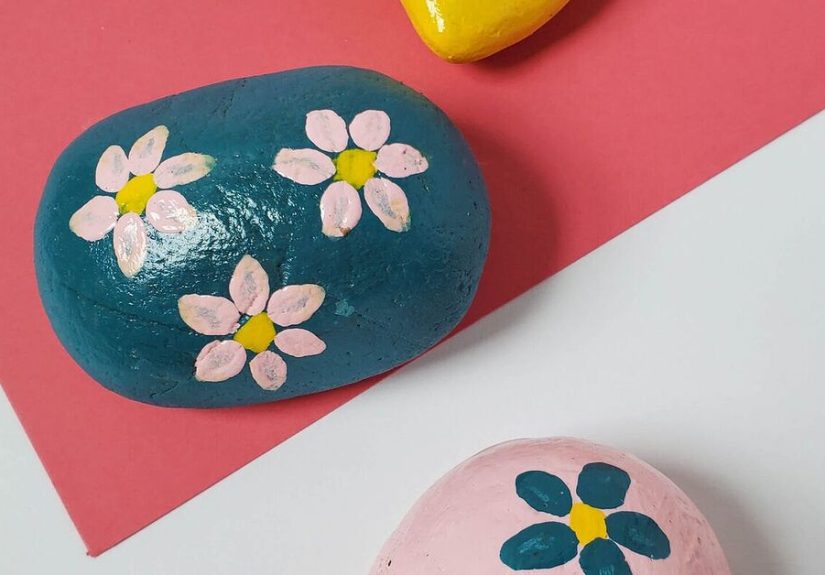
Design #1: The Classic 5-Petal Flower
This is the easiest place to start. Think: cartoon flower, happy little bloom, instantly recognizable.
- Paint a small circle for the flower center (yellow, white, pinkanything goes).
- Add five rounded petals around the center, like a pinwheel of jellybeans.
- Let dry, then add a tiny dot highlight on each petal (lighter shade or white).
- Paint 1–2 leaves below (simple teardrop shapes).
Design #2: Easy Daisy
Daisies look detailed, but they’re secretly just repeated brush strokes. The trick is thin petals and a bold center.
- Paint a medium center circle (golden yellow works beautifully).
- Use a small brush to pull thin white strokes outward for petals (8–16 strokes).
- Add a tiny shadow line where petals meet the center (light gray or pale blue).
- Dot the center with a slightly darker yellow for texture.
Design #3: Simple Tulip (Minimal and Modern)
Tulips are perfect if you like clean shapes.
- Paint a rounded “cup” shapelike a U with slightly pointed tips.
- Add one center petal line (a curved line from top to bottom).
- Paint a stem (thin green line) and two long leaves (curved blades).
- Add a highlight stroke on one side of the tulip cup.
Design #4: Wildflower Cluster (Looks Fancy, Still Easy)
If you want a “wow” rock without extra stress, clusters are your best friend. Small flowers hide small imperfections.
- Paint three small 5-petal flowers close together (vary the colors).
- Add tiny dot flowers in between (use a paint pen or the end of a brush handle).
- Add leafy sprigs (small angled strokes) around the cluster edges.
- Finish with white dots as “sparkle” fillers.
Color Tips That Make Simple Flowers Look Stunning
Use a “2-shade petal” trick
Paint petals in a medium shade, then add a lighter stroke on one side. Instantly more depth, zero complicated shading.
Keep a tight palette
Choose 2–3 main colors and 1 accent. Too many colors can look busy; a limited palette looks intentional (like you planned it… even if you didn’t).
Outline (only if you want to)
A thin outline with a paint pen can make flowers popespecially on speckled rocks. But outlines are optional.
Soft, outline-free flowers look more painterly and calm.
Step 4: Add Backgrounds (Optional, But Very Cute)
Backgrounds can be as simple as a single color wash or a quick gradient. If you’re going for “easy DIY,” keep it simple:
- Solid color: sky blue, mint green, pale lavender
- Half-dipped: paint the bottom half one color, add flowers above
- Speckle effect: flick watered-down paint for tiny dots (protect your table unless you enjoy chaos)
Step 5: Seal Painted Rocks (So Your Art Survives Real Life)
Sealing matters most if your rock will live outdoors, get handled a lot, or might meet moisture.
If your painted rock is purely decorative and will sit inside, sealing is optionalbut it can still add shine and protect against scratches.
Common sealer options (and what they’re best for)
- Spray acrylic sealer: fast, even finish, great for outdoor durability. Best applied in thin coats in a well-ventilated area.
- Brush-on varnish (polyurethane craft varnish): easy indoor use, less smell, good control. Apply thin coats to avoid brush marks.
- Craft “glue-sealer” formulas: can work for decorative projects, but some are intended for sheltered outdoor use and may not be fully waterproof.
How to seal your flower painted rocks (spray method)
- Let paint dry fully (give it extra time if you used thick layers).
- Place rocks on cardboard outdoors or in a very well-ventilated space.
- Spray a light coat from the recommended distance.
- Let dry, then apply 1–2 more light coats (thin layers hold up better than one heavy coat).
- Allow to cure fully before putting outdoors or stacking rocks together.
How to seal your flower painted rocks (brush-on method)
- Use a clean, soft brush (wide and flat works well).
- Apply a thin, even coatavoid over-brushing once it starts to set.
- Let dry fully, then apply another thin coat.
- For extra smoothness, you can lightly sand between coats (optional).
Sealing safety note
Spray sealers can be strong-smelling and should be used with ventilation and care. Always follow the product label instructions for temperature, humidity, and drying conditions.
Kid-Friendly Rock Painting Tips (Because Small Humans Love Paint)
- Choose non-toxic, labeled art materials when kids are involved.
- Use aprons or old shirtspaint is basically a magnet for sleeves.
- Try dot flowers using the end of a brush handle (super easy, super fun).
- Skip spray sealers around kidsuse brush-on varnish with adult supervision, or keep rocks indoors.
Outdoor Display Ideas That Don’t Turn Into “Where Did My Rock Go?”
Painted rocks look adorable outside, but weather and lawn equipment are not known for their emotional sensitivity.
Here are smart ways to display your flower rocks:
- Planter toppers: place around the base of potted plants
- Garden edging accents: cluster near a walkway (not where the mower lives)
- Indoor-outdoor trays: keep them together so they don’t wander off
- Gift tags: write a name on the back and tie to a present
A quick kindness rock reality check
If you love the idea of hiding painted rocks for others to find, keep it local and mindful: community spaces where it’s welcomed are great,
but protected natural areas and many parks follow “leave what you find” ethics and may treat placed objects (including painted rocks) as litter or impact.
When in doubt, don’t placegift instead.
Troubleshooting: Fix Common Painted Rock Problems
“My paint looks streaky.”
Add a white base coat first, or apply two thinner layers of color instead of one thick one.
Some pigments (yellow, red, light blue) naturally need extra coats to look solid.
“My paint peeled off.”
Usually this is a prep issue: the rock wasn’t fully cleaned/dried, or it was dusty.
Wash again, dry thoroughly, and try a base coat to help adhesion.
“My sealer made it cloudy or sticky.”
Humidity and thick coats can cause cloudiness or tackiness. Use thin coats, let each coat dry longer than you think,
and follow the product’s recommended conditions. If it stays tacky, a compatible topcoat sealer can sometimes helptest first on a practice rock.
“My marker lines bled.”
Some inks react to certain spray sealers. If you’re using markers for outlines, test your exact marker + sealer combo on a sample rock first.
Paint pens designed for multi-surface crafts often hold up better than standard permanent markers.
Simple Flower Painted Rocks: Easy DIY Ideas You Can Try Today
- Monochrome flowers: all blue petals with a navy center + white dots
- Sunflower mini: yellow petals, brown center, tiny green leaf
- Cherry blossoms: five pale pink petals + dark pink center dots on a gray rock
- Rainbow garden set: paint 6 rocks, each with one flower color, display as a cluster
- Negative space: leave the rock natural and paint only the flowers
of “Real Life” Rock Painting Experiences (The Stuff Tutorials Don’t Always Tell You)
Here’s the honest truth about simple flower painted rocks: the first one is rarely perfect, the second one is surprisingly better,
and by the third, you’re making up names for your rocks like they’re houseplants (“This is Petunia. She’s thriving.”).
What makes this DIY so addictive isn’t perfectionit’s the way tiny improvements show up fast.
One common “aha” moment people have is realizing how much the rock affects the final look. A super porous stone can drink paint like it’s auditioning for a sponge role,
while a smooth river rock makes brush strokes glide. That’s why beginners often feel like their first flower looks dull or patchythen they try a white base coat,
and suddenly the same paint color looks bright and clean. It feels like cheating, but it’s actually just smart.
Another classic experience: thinking you need 47 brushes and a mysterious artisan palette, then discovering your favorite tools are a $2 small round brush
and the end of a paintbrush handle for dots. Dots are magic. Dots turn empty space into “design.” Dots hide wobbly edges. Dots also multiply when you’re not paying attention
and suddenly your flower rock looks like it’s wearing glitter without the glitter. (A win.)
People also tend to learnsometimes the hard waythat drying time is not a suggestion. It’s a lifestyle.
If you paint petals too soon over a damp base layer, the colors can muddy. If you seal before paint fully cures, the finish can look weird.
The best “experience-based” hack is to work in batches: paint three rocks, rotate, come back to rock one when it’s actually dry.
It keeps your momentum going without smearing your masterpiece with a thumbprint you’ll stare at forever.
And then there’s the outdoor reality check. A rock that looks fantastic on your table might look different after a week of sun, dew, and “surprise sprinkler.”
That’s why many crafters develop a personal system: indoor rocks get a simple protective coat (or none), while outdoor garden rocks get multiple thin coats of a durable sealer,
applied under decent weather conditions. Once you’ve watched a beautiful flower fade faster than your motivation to fold laundry, you start sealing like you mean it.
Finally, the most unexpectedly sweet experience: people notice these little rocks. A small painted daisy on a windowsill can make a room feel warmer.
A handful of flower stones in a planter can make a porch feel “finished.” And gifting oneespecially with someone’s favorite colorslands like a tiny, handmade compliment.
It’s a simple DIY, but it carries a big message: you took something ordinary and made it joyful. That’s pretty much the whole point.
Conclusion
Simple flower painted rocks are the kind of easy DIY that fits into real life: quick setup, low cost, and satisfying results.
Start with clean, dry rocks, paint a few basic blooms, and decide whether you need a protective sealer based on how (and where) you’ll use them.
Keep your designs simple, your coats thin, and your expectations playful. Your first rock doesn’t have to be perfectit just has to make you smile.
And if it turns out a little quirky? Congratulations. You made art.