Table of Contents >> Show >> Hide
- Why stretching can help (and when it won’t)
- How to stretch safely (so it helps, not hurts)
- The best neck stretches for headaches
- Shoulder stretches that can ease “headache tension”
- Back stretches that support the neck (yes, really)
- A simple routine: what to do when a headache is brewing
- Prevention: make headaches less likely tomorrow
- FAQ: Common questions people ask (usually while rubbing their temples)
- Real-world experiences: what people notice when they try these stretches (about )
- Conclusion
You know the feeling: your head starts whispering “hello,” your shoulders answer with a shrug, and your neck sends a strongly worded memo in all caps. Before you blame the weather, your coworker’s perfume, or that one overhead light that flickers like it’s auditioning for a horror moviecheck your posture.
A big chunk of everyday headaches are tied to muscle tension, stress, and the “modern human stance” (a.k.a. leaning into screens like we’re trying to read tiny print on a grain of rice). If your headache feels like a tight band around your head, or you notice neck/shoulder stiffness tagging along, gentle stretching can be a surprisingly effective first step. Not a cure-all for every headache typebut a low-risk, body-friendly tool you can try fast.
Quick note: This article is for general education, not a diagnosis. If you have sudden severe headache, “worst headache of your life,” fever with stiff neck, fainting, confusion, weakness/numbness, vision changes, or a headache after a head injuryskip the stretches and get medical care ASAP.
Why stretching can help (and when it won’t)
The tension headache connection
Tension-type headaches are commonly linked to tight muscles in the scalp, neck, and shoulders. When those muscles stay “on” for hoursstress, poor ergonomics, jaw clenching, driving, scrollingthe irritation can radiate upward and feel like head pain. Stretching helps by easing muscle tension, improving blood flow, and reminding your nervous system that you are not, in fact, a statue.
What about migraines?
Migraine is a neurological condition and can include neck pain and stiffness. But neck pain is often a symptom of migraine rather than the root cause. Translation: stretching might reduce the “tight neck” side of the experience, but it may not stop a true migraine attack on its own. Still, many people use gentle movement, breath, and posture resets as part of their migraine toolkit.
When stretching is a great idea
- Your headache comes with neck/shoulder tightness (especially after desk work or phone use).
- You notice forward head posture (“tech neck”) or hunched shoulders.
- Your headache eases with heat, massage, or movement.
- You have a history of tension-type headaches or cervicogenic headaches (headaches that originate from the neck).
When to be cautious
- Sharp, shooting pain; numbness/tingling down the arm; dizziness that’s new or intense.
- Recent injury, whiplash, surgery, osteoporosis, or known spinal instability.
- Stretching makes symptoms worse every time (that’s your body saying “nope”).
How to stretch safely (so it helps, not hurts)
- Gentle beats intense. Stretch to a feeling of mild tension, not pain.
- Hold 15–30 seconds and breathe slowly (no bouncing).
- Repeat 2–3 rounds per side.
- Keep shoulders relaxed. If your shoulders creep up toward your ears, reset.
- Pair with heat (warm shower, heating pad) if your muscles feel “stuck.”
The best neck stretches for headaches
These target the usual suspects: upper trapezius, levator scapulae, suboccipitals, and the deep neck flexors (the muscles that help your head stop living two inches in front of your body).
1) Chin-to-chest stretch (gentle neck flexion)
- Sit tall. Imagine a string lifting the crown of your head.
- Slowly lower your chin toward your chest until you feel a stretch in the back of your neck.
- Hold 15–30 seconds. Breathe.
- Return to neutral slowly.
Why it helps: It eases the back-of-neck tension that loves to contribute to a “helmet” headache sensation.
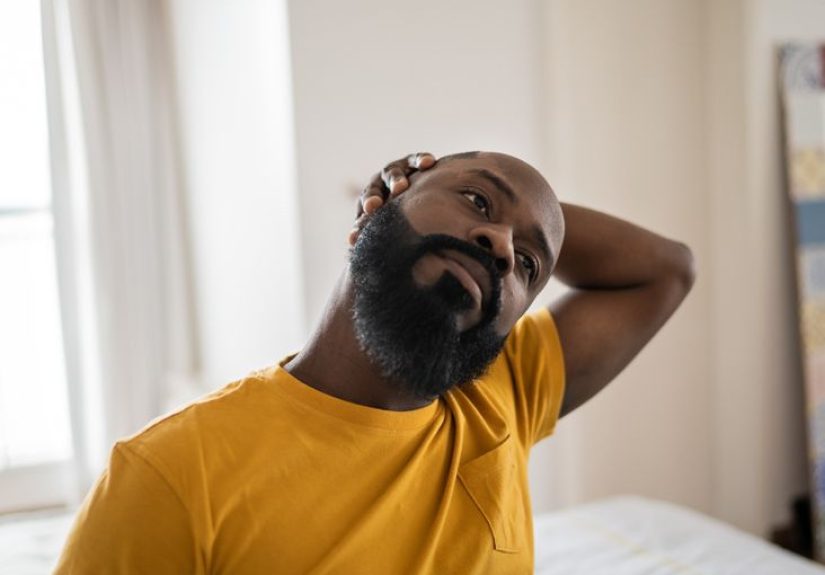
2) Side neck tilt (upper trapezius stretch)
- Sit or stand tall.
- Keep your shoulders down. Gently tilt your right ear toward your right shoulder (don’t lift the shoulder).
- To deepen slightly, place your right hand on the left side of your head and apply light pressure.
- Hold 15–30 seconds. Switch sides.
Pro tip: Keep your nose pointing forward; if you rotate, you’ll shift the stretch elsewhere.
3) Levator scapulae stretch (the “look into your pocket” move)
- Sit tall and relax your shoulders.
- Turn your head about 45° to the right.
- Tuck your chin down as if you’re looking into your right front pocket.
- Use your right hand to add gentle pressure to the back of your head.
- Hold 20–30 seconds. Switch sides.
Why it helps: The levator scapulae often gets cranky from laptop posture and can refer discomfort up toward the head.
4) Slow head turns (controlled rotation)
- Start with your head centered over your shoulders.
- Slowly rotate your head to the right until you feel mild tension.
- Hold 15–30 seconds, then return to center.
- Repeat left.
Make it better: Exhale as you rotate; inhale as you return. Your nervous system loves a good rhythm.
5) Chin tucks (posture reset + deep neck flexor activation)
- Sit tall with your eyes level.
- Glide your head straight back (like making a “double chin,” glamorous but effective).
- Hold 3–5 seconds. Repeat 8–12 times.
Why it helps: This counters forward head posture, one of the biggest drivers of neck fatigue during screen time.
Shoulder stretches that can ease “headache tension”
When shoulders stay elevated and rounded, neck muscles work overtime. These stretches open the front of the body and reduce upper-back overload.
6) Shoulder rolls (quick relief, zero equipment)
- Roll shoulders up, back, and down in a smooth circle 10 times.
- Reverse direction 10 times.
Mini-upgrade: Pair with slow nasal breathing to downshift stress.
7) Scapular squeezes (shoulder blade retraction)
- Sit or stand tall.
- Squeeze shoulder blades gently together (think: “put them in your back pockets”).
- Hold 2–3 seconds; repeat 10 times.
Why it helps: This wakes up upper-back support muscles so your neck doesn’t do everyone’s job.
8) Doorway chest stretch (opens tight pecs)
- Stand in a doorway with forearms on the doorframe, elbows around shoulder height.
- Step one foot forward and gently lean until you feel a stretch across your chest and front shoulders.
- Hold 20–30 seconds. Repeat 2–3 times.
Why it helps: Tight chest muscles pull shoulders forward, which can increase neck strain.
9) Upper trap “anchor” stretch (desk-worker favorite)
- Sit tall. Place your right hand under your right thigh (or behind your back) to “anchor” the shoulder down.
- Tilt your head to the left for a gentle stretch along the right side of your neck/shoulder.
- Hold 20–30 seconds. Switch sides.
Back stretches that support the neck (yes, really)
The neck doesn’t exist in isolation. Stiff upper back (thoracic spine) often forces the neck to over-move, which can contribute to headachesespecially cervicogenic patterns.
10) Cat-Cow (spine mobility reset)
- On hands and knees, inhale as you arch your back and lift your chest (Cow).
- Exhale as you round your spine and gently tuck your chin (Cat).
- Repeat slowly for 6–10 cycles.
Why it helps: Improves spinal mobility and reduces the “locked” feeling from prolonged sitting.
11) Thread-the-needle (upper back + shoulder release)
- On hands and knees, slide your right arm under your left arm, palm up.
- Lower your right shoulder and temple toward the floor.
- Hold 20–30 seconds, breathing into your ribs.
- Switch sides.
12) Child’s pose with side reach (lat + upper back stretch)
- From kneeling, sit hips back toward heels and reach arms forward (Child’s pose).
- Walk both hands to the right to stretch the left side body; hold 20 seconds.
- Walk hands left; hold 20 seconds.
13) Seated thoracic extension (the “undo hunching” move)
- Sit tall with hands interlaced behind your head.
- Gently lift your chest and look slightly up (avoid cranking the neck).
- Hold 5 seconds; repeat 6–8 times.
Think of it as: giving your upper back permission to do what your neck has been forced to do.
A simple routine: what to do when a headache is brewing
If you feel that “here we go” pressure building, try this 6–8 minute flow:
- Shoulder rolls – 10 each direction
- Chin tucks – 10 reps
- Upper trap stretch – 20 seconds each side
- Levator scap stretch – 20 seconds each side
- Doorway chest stretch – 30 seconds
- Cat-Cow – 6 slow cycles
Then drink water and do one small posture upgrade (raise your screen, relax your jaw, or unclench your shoulders). Tiny changes add up.
Prevention: make headaches less likely tomorrow
Ergonomics that don’t require a home office makeover
- Screen height: top third of your monitor near eye level.
- Keyboard distance: elbows close to your body, shoulders relaxed.
- Phone use: bring the phone to your face, not your face to the phone.
- Micro-breaks: 30–60 seconds every 30–60 minutes: shoulder rolls + chin tuck.
Heat, hydration, and stress downshifts
Heat can relax tense neck/shoulder muscles; gentle self-massage can also help. Add hydration and a few slow exhales, and you’ve got a solid “non-drug” starter pack for tension headaches. If headaches are frequent, consider professional evaluationphysical therapy can focus on posture retraining, manual techniques, and a tailored exercise plan.
FAQ: Common questions people ask (usually while rubbing their temples)
How long should I hold each stretch?
Most people do well with 15–30 seconds per stretch, repeated 2–3 times. For chin tucks, think repetitions (8–12) instead of long holds.
Should I stretch during a migraine?
If movement worsens symptoms (light sensitivity, nausea), keep it gentle: a supported position, slow breathing, and mild neck mobility. Save deeper stretches for after the peak passes.
Can stretching replace medication?
Sometimes it reduces the need; sometimes it doesn’t. For tension-type headaches, stretching + posture + stress reduction can be very helpful. For migraine, stretching is usually a “supportive player,” not the whole team.
When should I see a professional?
If headaches are new, changing, frequent, or disablingor if you suspect cervicogenic headachetalk to a clinician. A physical therapist can assess posture, neck mobility, trigger points, and strength imbalances and give you a plan that fits your body and schedule.
Real-world experiences: what people notice when they try these stretches (about )
In the real world, people rarely say, “Ah yes, I performed a perfect levator scapulae stretch and achieved enlightenment.” What they usually say is something like: “I didn’t realize my shoulders were basically earrings.”
The desk-worker story: A common pattern is the 3 p.m. headache that shows up right after your posture has quietly collapsed for six straight hours. People who start doing micro-breaks (60 seconds of shoulder rolls + chin tucks every hour) often report that headaches either arrive later, feel less intense, or stop popping up daily. The biggest “aha” moment is learning that you don’t need a full yoga session to get benefitsyou need consistency. The win is small, boring, and oddly powerful: a one-minute reset you actually do.
The “jaw clencher” surprise: Many folks notice their headache relief improves when they combine neck stretches with a jaw check-in. They’ll stretch their upper traps and levator scapulae, then realize their teeth are pressed together like they’re holding a secret. Adding a simple cuelips together, teeth apartplus slow exhales often makes the stretch feel more effective. It’s not magic; it’s your nervous system stepping off the gas pedal.
The gym-goer learning curve: Some people with “neck tension headaches” discover they’re doing a lot of pulling movements (rows, deadlifts, carries) with their shoulders shrugged up. When they add doorway chest stretches and scapular squeezesand focus on keeping shoulders down during liftsthey often report fewer post-workout headaches. The common theme: it’s not “exercise causes headaches,” it’s “certain mechanics overload the neck.”
The pillow plot twist: People also talk about the sleep connection. If you wake up with a stiff neck and a dull headache, a new pillow height or different sleep position can matter as much as stretching. Many find that a brief morning routine (chin-to-chest stretch, gentle rotation, and one round of shoulder rolls) takes the edge off faster than scrolling through doom news and hoping the headache gets bored and leaves.
The realistic expectation: The most consistent reports are not “my headaches vanished forever,” but “I feel more in control.” The stretches become a signal: “I’m noticing tension early.” That early noticing is huge. Instead of waiting until your head is pounding, you intervene when symptoms are still a whisper. People who treat stretching like brushing teethsmall, daily, non-dramatictend to get better results than those who only stretch when the pain is already throwing a party.
Bottom line: if your headaches are related to muscle tension and posture, these stretches can be a practical, low-cost experiment. Try them for two weeks, track what changes (frequency, intensity, triggers), and use that information to refine your routineor bring it to a clinician for a more personalized plan.
Conclusion
Headaches can be complicated, but your first step doesn’t have to be. If your neck, shoulders, and upper back feel tightespecially after screens, stress, or sleepgentle stretching can help dial down muscle tension, improve posture mechanics, and reduce the “tension headache” cycle. Keep it easy, keep it consistent, and treat your shoulders like they belong in their actual job description: supporting your arms, not auditioning to be earmuffs.