Table of Contents >> Show >> Hide
- The Comment That Lit the Match
- Why So Many Harry Potter Fans Were Angry
- What Felton Was Probably Trying to Say
- Why the Timing Made Everything Worse
- The Nostalgia Problem No One in Hollywood Can Escape
- Did Tom Felton Actually “Enrage” Fans?
- What This Means for Tom Felton Going Forward
- The Fan Experience: When the Magic Gets Complicated
- Final Thoughts
- SEO Tags
Leave it to a red carpet to turn one tidy soundbite into a full-scale fandom eruption. Tom Felton, forever known to millions as Draco Malfoy, stepped onto the Tony Awards carpet looking polished, nostalgic, and ready to talk about returning to the Wizarding World on Broadway. Then came the J.K. Rowling question. And just like that, the internet did what the internet does best: dropped the invisibility cloak, grabbed a megaphone, and started arguing at top volume.
The controversy was not really about whether Felton likes the Harry Potter franchise. Of course he does. It made him famous, gave him a beloved character, and now, years later, handed him a rare chance to play an older Draco Malfoy in Harry Potter and the Cursed Child on Broadway. The uproar came from how he addressed Rowling, whose statements about transgender issues have triggered years of backlash, public criticism, and painful division inside the fandom itself. For many fans, especially trans fans and their allies, this is not old gossip. It is a live issue with real emotional and political weight.
That is why Felton’s red carpet answer landed with the force of a rogue Bludger. What he may have intended as a grateful, career-focused response was heard by many as distant, dismissive, and weirdly casual about a debate that has reshaped the public meaning of the Harry Potter brand. And when you are speaking inside a franchise built on loyalty, identity, and childhood attachment, casual can sound a lot like callous.
The Comment That Lit the Match
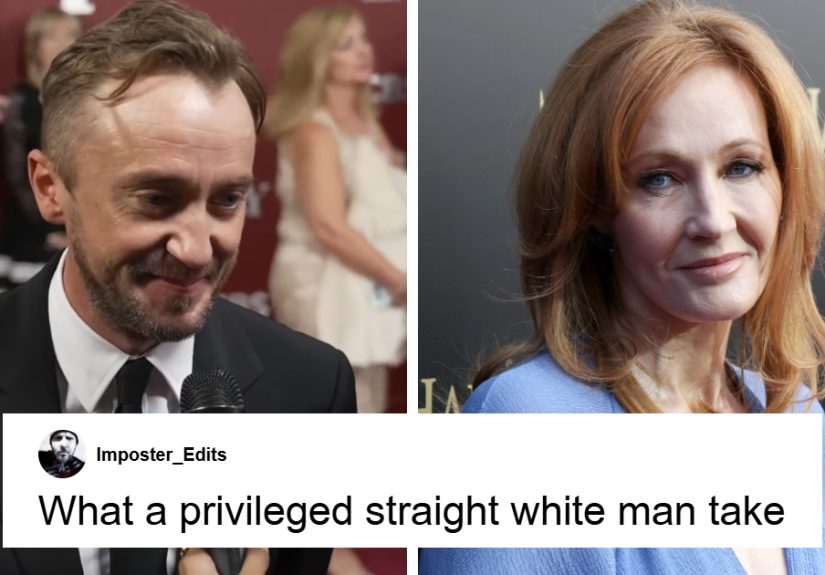
At the 2025 Tony Awards, Felton was asked whether the controversy around Rowling had any impact on his decision to step back into Draco’s designer-black shoes for Broadway. His answer was essentially no. He said the controversy did not affect his choice, that he was not especially tuned in to it, and that he remains grateful to Rowling because Harry Potter brought people together all over the world.
Now, from a strictly public-relations perspective, you can see the outline of what he was trying to do. He was centering gratitude. He was talking about the work. He was leaning into the unifying power of the franchise. On paper, that sounds harmless enough. In practice, though, his response hit an already tender nerve. Fans who have followed Rowling’s increasingly contentious role in debates over trans rights did not hear a harmless celebration of storytelling. They heard a shrug.
And shrugs, in moments like this, travel badly.
Why So Many Harry Potter Fans Were Angry
Context mattered more than tone
Felton’s remarks did not arrive in a vacuum. Rowling’s public comments on gender, sex, and trans identity have been debated for years, criticized by LGBTQ+ advocates, and repeatedly brought back into the spotlight by her own social media activity and political interventions. To fans who view the issue as serious and ongoing, saying you are not really paying attention does not read as neutral. It reads as opting out of empathy.
That is where the backlash found its fuel. Plenty of people were not asking Felton to deliver a graduate seminar on gender politics between camera flashes and velvet lapels. But they did expect a little more awareness, especially from someone stepping back into a franchise where the creator’s politics are now inseparable from the brand conversation. In other words, fans were not mad that he failed to give a perfect answer. Many were mad because he seemed to act as though there was barely a question to answer.
His answer clashed with the franchise’s public history
Another reason the reaction was so strong is that Felton’s stance landed against a very visible backdrop: other major Harry Potter figures have already spoken. Daniel Radcliffe has said Rowling’s rhetoric made him deeply sad and confirmed they were no longer in contact. Emma Watson publicly voiced support for trans people and later said it was painful that a real conversation with Rowling never became possible. Rupert Grint took a softer route, comparing Rowling to an aunt while also making clear that he did not agree with her views. That means the franchise has not been silent. It has been split.
So when Felton took the “I’m grateful, I’m not that attuned” lane, fans compared him not to some imaginary neutral celebrity but to former co-stars who already chose to speak more directly. Fair or unfair, that comparison was inevitable. Once a franchise family has publicly fractured, every new answer becomes part of the record.
The red carpet is a terrible place for nuance
There is also a practical truth here: red carpets are where nuance goes to die in formalwear. A question that probably deserved a careful, thoughtful answer got squeezed into a few seconds of bright lights and quick-turn video clips. Felton’s phrasing may have been more clumsy than malicious. But social media does not award points for almost-nuance. It reacts to what the clip sounds like, not what the speaker might have meant after two cups of tea and a calmer setting.
That helps explain the speed of the reaction, though it does not erase it. In fact, it may have intensified it. A short answer can harden into a symbol faster than a long one. Within hours, Felton’s comment became less about one actor’s personal view and more about a larger question: what do fans hear when beloved stars respond to harmful controversy with detachment?
What Felton Was Probably Trying to Say
To be fair, Felton’s answer did not sound like a full-throated political endorsement of Rowling’s every public position. It sounded more like an actor trying to honor the work that changed his life while sidestepping a culture-war battlefield he either did not want to enter or did not feel equipped to enter. That distinction matters.
But it only matters up to a point. In a franchise as emotionally loaded as Harry Potter, sidestepping is still a move. Fans notice when someone refuses to engage, especially when the silence sounds wrapped in gratitude toward the very person they believe has caused harm. Many critics of Felton’s comment were not accusing him of writing Rowling’s tweets or sharing all her views. They were reacting to what felt like indifference to the people hurt by them.
This is the trap many celebrities fall into when trying to remain “above the fray.” They think they are choosing neutrality. Their audience hears hierarchy. When an actor emphasizes gratitude to the creator while seeming vague about the people affected by that creator’s conduct, fans understandably conclude that one side got emotional clarity and the other got a polite fog machine.
Why the Timing Made Everything Worse
The timing could not have been more combustible. Felton’s comments came just as he was announcing a major Harry Potter return: a Broadway run in Harry Potter and the Cursed Child, beginning in November 2025 at the Lyric Theatre. That alone guaranteed attention. He was not just reminiscing about the old days. He was actively re-entering the commercial and cultural machinery of the franchise.
And that machinery is still humming. Rowling remains tied to the wider Wizarding World ecosystem, including newer screen projects. HBO executives have defended her involvement in the upcoming television adaptation while insisting the show is not being shaped by her politics. Critics are not persuaded so easily. To them, the money, platform, and legitimacy attached to new projects are part of the story. That means any actor joining, rejoining, defending, or gently dodging the topic gets pulled into a bigger argument than they may want.
Felton, then, was not simply answering as Tom Felton the actor. He was answering as Tom Felton the returning face of a franchise that is still commercially potent and morally contested. That is why even a brief answer felt so loaded.
The Nostalgia Problem No One in Hollywood Can Escape
Nostalgia is a powerful drug. Hollywood knows it. Broadway knows it. Studios know it so well they would bottle it and sell it in collector’s-edition packaging if they could. Felton’s return as Draco Malfoy was always going to trigger warm memories for fans who grew up watching him sneer through Hogwarts hallways like a platinum-haired menace. But nostalgia has limits. It can soften criticism, not erase it.
That is the real lesson of this controversy. The old “remember how much joy this brought people” defense is not as bulletproof as it used to be. Yes, Harry Potter shaped a generation. Yes, it created friendships, midnight release parties, fan art, conventions, and enough house-sorting discourse to power the internet for years. But for many people, joy in the past does not cancel harm in the present. In fact, it can make the disappointment sting more.
That is why fan anger often looks so personal. It is personal. People are not reacting to a random intellectual property. They are reacting to something that lived in their bedrooms, their backpacks, their school libraries, their first online communities, and their sense of belonging. When a star from that universe seems glib about a pain point, the response is rarely mild. People do not merely disagree. They feel let down.
Did Tom Felton Actually “Enrage” Fans?
The short answer is yes, many of them. But it is also true that the fandom is not one giant opinion blob wearing a Hogwarts scarf. Some people defended Felton. Some argued that he was asked a loaded question on a carpet, answered honestly, and should not be forced into political messaging every time he mentions Draco. Others said it is possible to honor the art without endorsing every view of its creator. That perspective absolutely exists, and pretending otherwise would be lazy.
Still, the dominant reaction in many online spaces was frustration. The reason is simple: fans expected more care. Not necessarily a perfect statement, not necessarily a scorched-earth condemnation, but at least an answer that acknowledged the controversy as something bigger than background static. Instead, Felton gave an answer that many read as emotionally unplugged.
That is why the clip spread so fast. It touched the rawest nerve in modern fandom: the gap between what a public figure means to say and what a long-disappointed audience is prepared to hear.
What This Means for Tom Felton Going Forward
This probably is not career-ending, and anyone predicting the collapse of Western civilization over a Draco Malfoy interview should maybe go outside for ten minutes. But it does matter. Felton has long benefited from a relatively warm public image, especially compared with the smug little wizard he played on-screen. This moment reminded everyone that goodwill is not armor. Nostalgia cannot protect a celebrity forever when the conversation shifts from character love to moral clarity.
If Felton speaks on the issue again, fans will listen more carefully. That is the rule once the first answer goes badly. He may decide to clarify, deepen, or reframe what he meant. Or he may continue trying to keep the focus on performance and gratitude. Either way, the fantasy that he could stroll back into the franchise untouched by its politics has clearly vanished into thin air.
And that may be the biggest takeaway of all: in 2025 and beyond, no one gets to be “just” a Harry Potter star. Not really. Not when the fandom, the creator, the studios, and the stars are all still arguing over what this universe means now.
The Fan Experience: When the Magic Gets Complicated
One reason this kind of story explodes so quickly is that it taps into a very specific fan experience, the kind that is hard to explain unless you lived through peak Harry Potter culture. For a lot of readers and moviegoers, this was not merely entertainment. It was a ritual. It was waiting for midnight releases, arguing over houses in school cafeterias, quoting favorite lines at sleepovers, pretending a broomstick from the backyard was absolutely a Nimbus 2000, thank you very much. It was a social language. It was a comfort object. It was a home address for the imagination.
That is why the collision between fandom and controversy feels uniquely messy. When the creator of something beloved becomes a source of pain or division, fans are forced into a weird emotional obstacle course. Some keep the books and let go of the author. Some leave the franchise completely. Some stay but change how they engage with it, choosing secondhand purchases, fan-created spaces, or community interpretations that center inclusion instead of celebrity worship. Some are simply tired. Deeply, magnificently tired.
For queer and trans fans in particular, the experience can be especially sharp. Many connected to Harry Potter because it offered themes of chosen family, outsider identity, courage, and resistance to cruelty. So when the franchise becomes tangled up in rhetoric they see as harmful, it can feel less like a normal celebrity scandal and more like being pushed out of a place that once felt welcoming. That sense of betrayal is difficult to measure and very easy to dismiss if you only look at the story as “people mad online.” But for many fans, it is not trivial. It is intimate.
Felton’s comment touched that emotional history. To some listeners, his detachment sounded like the familiar script celebrities use when they want the benefits of a beloved franchise without the discomfort of its real-world baggage. And that is where the frustration deepens. Fans are often told they are overinvested, too emotional, too dramatic. But fandom has always been emotional. That is the whole point. You cannot spend decades encouraging people to build identity around a story and then act surprised when they respond strongly to the people who represent it.
There is also the social-media experience to consider. A ten-second clip now functions like a sorting hat for public opinion. It asks: where do you stand? Are you defending the actor, condemning the answer, separating art from artist, or refusing to buy another ticket? The clip becomes a loyalty test, and everyone is suddenly writing miniature manifestos in the comments section. That environment does not create calm reflection. It creates speed, certainty, and emotional compression.
And yet, despite all that chaos, there is something revealing in the intensity of the reaction. Fans still care. Not always in a warm, fuzzy, Butterbeer-at-Universal way, but care nonetheless. They are still fighting over what this franchise means because it still means something. The innocence may be gone. The simplicity is definitely gone. But the emotional investment remains very much alive. That is why comments like Felton’s do not just float by. They hit history, memory, identity, and disappointment all at once. In fandom terms, that is not a minor spell. That is a full magical blast radius.
Final Thoughts
Tom Felton’s red carpet remarks became a lightning rod because they exposed the central tension of modern Harry Potter: millions still feel affection for the world, but that affection now lives beside conflict, grief, politics, and distrust. Felton tried to emphasize gratitude and unity. Many fans heard disengagement and privilege. Both reactions tell us something important about the franchise in 2025: the magic is still commercially powerful, but morally contested in a way no cast member can casually wave away.
That is the new reality of Wizarding World fame. You are not only inheriting a wand. You are inheriting the argument attached to it.