Table of Contents >> Show >> Hide
- What Is QUICKSINK?
- The 2022 Gulf of Mexico Demonstration
- Why a GPS-Enabled Bomb Matters at Sea
- Not Just a Bomb: A Cost and Inventory Story
- From F-15E to B-2: Expanding the Concept
- The 500-Pound Variant and Why Size Matters
- Why the Navy Cares About an Air Force Bomb
- What the Video Showsand What It Does Not
- Strategic Message: Deterrence by Demonstration
- How QUICKSINK Fits Into Modern Maritime Defense
- Public Fascination: Why Everyone Watched
- Experience-Based Reflections: Watching the Test as a Defense-Tech Observer
- Conclusion
- SEO Tags
There are military demonstrations that look technical, and then there are military demonstrations that make the internet collectively lean forward and say, “Well, that ship had a very bad afternoon.” The U.S. Air Force’s QUICKSINK test belongs firmly in the second category. In publicly released footage, a GPS-enabled precision bomb strikes a surface vessel and sends it beneath the waves with startling speed. No Hollywood soundtrack required. The ocean provided the dramatic pause.
Behind the eye-catching video is a serious shift in modern maritime defense. The weapon involved is based on the Joint Direct Attack Munition, better known as JDAM, a guidance kit that turns a conventional free-fall bomb into an all-weather precision weapon. QUICKSINK takes that familiar idea and adapts it for maritime targets, giving aircraft a relatively low-cost way to help defeat surface vessels. In plain English: the Air Force is exploring how to make an old tool do a very new job at sea.
What Is QUICKSINK?
QUICKSINK is an Air Force Research Laboratory program designed to create a low-cost, air-delivered capability against surface vessels. Rather than starting from a blank sheet of engineering paper, the program builds on existing bomb bodies and JDAM guidance technology. That matters because military innovation is not always about inventing the flashiest new gadget. Sometimes it is about taking something already in the toolbox and teaching it a new trickpreferably one that does not require a budget meeting the size of a small novel.
The core idea is simple at a high level: aircraft can carry modified precision-guided bombs and use them against ships in a way that produces effects traditionally associated with torpedoes. The Air Force has described the concept as a method for achieving torpedo-like results from the air, giving commanders more options across wide maritime areas. That does not mean QUICKSINK replaces every anti-ship missile or submarine-launched torpedo. It means the U.S. military is expanding the menu.
The 2022 Gulf of Mexico Demonstration
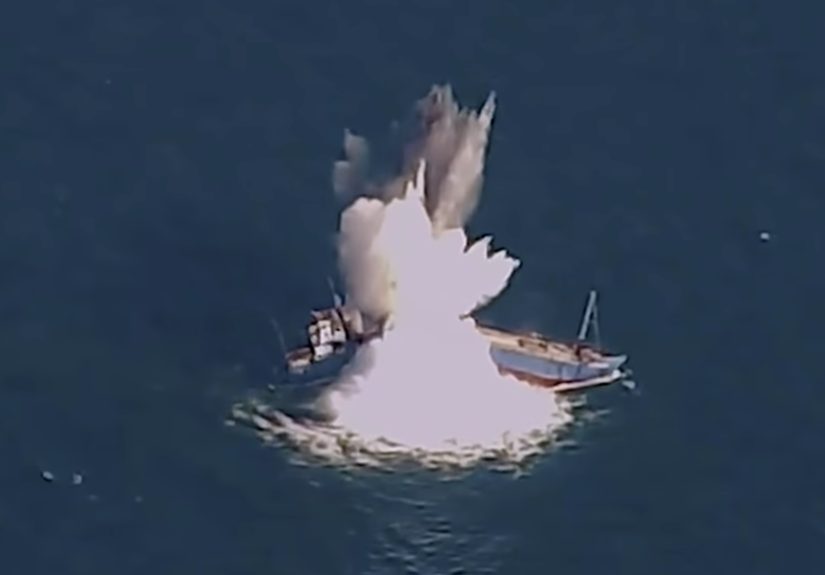
The test that made QUICKSINK famous occurred in April 2022 at the Eglin Gulf Test and Training Range in the Gulf of Mexico. An F-15E Strike Eagle released a modified GBU-31 JDAM against a full-scale surface vessel. The result was dramatic: the target ship was destroyed and sank quickly. For viewers, the footage looked almost unreal, as if someone had pressed fast-forward on naval warfare.
For engineers and defense planners, the demonstration was more than a viral clip. It showed that a modified air-delivered munition could deliver a powerful effect against a maritime target. The test involved AFRL, Eglin’s Integrated Test Team, the 780th Test Squadron, and other Air Force organizations. It also reflected cooperation with the Navy, because sea control is never a one-service hobby. Ships, aircraft, sensors, targeting networks, and joint planning all have to work togetherideally better than a group project in high school.
Why a GPS-Enabled Bomb Matters at Sea
JDAM itself is not new. The U.S. Air Force describes it as a guidance tail kit that converts unguided bombs into precision, all-weather smart munitions using inertial navigation and GPS. That history is important because JDAM became popular precisely because it made existing bomb stocks more accurate without requiring a completely new weapon family.
Ships, however, are not buildings. They move, maneuver, and operate in a complicated environment where weather, distance, and timing matter. QUICKSINK addresses that challenge by combining the JDAM concept with additional guidance elements intended for maritime targeting. The public descriptions focus on the broad concept: a modified munition that can be used against stationary or moving surface vessels. The technical recipe is not the point hereand for obvious reasons, the Air Force does not publish a “ship-sinking cookbook.”
Not Just a Bomb: A Cost and Inventory Story
The most interesting part of QUICKSINK may not be the splash. It may be the economics. Advanced anti-ship missiles are powerful, but they can be expensive, limited in inventory, and reserved for high-priority missions. A JDAM-based maritime weapon offers a different approach: use a widely understood guidance-kit family and adapt it for naval targets. That gives planners another way to think about magazine depth, which is the military term for “how many useful things you still have left after the first bad day.”
In a major conflict, especially across the vast Pacific, having only a small number of exquisite weapons may not be enough. The U.S. military has been exploring ways to combine advanced weapons with more affordable precision options. QUICKSINK fits that conversation because it suggests that ordinary aircraft carrying modified precision bombs could contribute to maritime strike missions without relying solely on rare or costly systems.
From F-15E to B-2: Expanding the Concept
The 2022 test used an F-15E Strike Eagle, a fighter-bomber known for hauling serious ordnance and making it look routine. Later demonstrations expanded the story. During RIMPAC 2024, the large multinational maritime exercise in the Pacific, U.S. forces used QUICKSINK in a sinking exercise involving the former USS Tarawa. Reporting from defense outlets and official Navy statements connected the demonstration with the Air Force’s B-2 Spirit stealth bomber, showing that the concept was no longer limited to one aircraft type.
That is strategically important. A stealth bomber paired with relatively lower-cost precision maritime weapons changes the planning equation. It suggests the Air Force could use long-range aircraft to threaten ships across broad ocean areas. Again, this is not magic. It still depends on intelligence, surveillance, communications, targeting, training, and command decisions. But the public demonstration made one thing clear: the Air Force wants a bigger role in maritime strike.
The 500-Pound Variant and Why Size Matters
In 2025, the Air Force publicly discussed a smaller, 500-pound QUICKSINK variant based on a GBU-38 JDAM. That may sound less dramatic than a 2,000-pound weapon, but smaller can be very useful. Lighter weapons can allow aircraft to carry more munitions, match effects to different target types, and give mission planners more flexibility. In defense technology, bigger is not always better. Sometimes better is betterand occasionally smaller is the sneaky genius in the room.
The 500-pound demonstration also shows that QUICKSINK is not a one-off science fair project with a very loud volcano. It is an evolving program. The Air Force and AFRL appear to be testing how the concept scales, how different aircraft can carry it, and how commanders might use it in future maritime operations. That development path is typical for military technology: prove the idea, expand the conditions, refine the design, and see where it fits into the broader force.
Why the Navy Cares About an Air Force Bomb
At first glance, an Air Force GPS-enabled bomb sinking a ship sounds like a Navy story being told by someone wearing the wrong uniform. But modern warfare is joint by design. The Navy brings ships, submarines, carrier air wings, maritime patrol aircraft, and sea-control expertise. The Air Force brings long-range bombers, fighters, tankers, sensor networks, and a deep bench of precision-strike experience. QUICKSINK sits at the intersection.
The Navy has long relied on torpedoes and missiles to defeat ships. The Air Force’s contribution is different: air-delivered weapons launched from aircraft that may be able to cover large distances and respond quickly. If the services can share targeting information and coordinate operations, a maritime opponent has to worry not only about submarines and ships, but also aircraft carrying adapted precision munitions.
What the Video Showsand What It Does Not
The footage of QUICKSINK is visually impressive. A vessel is struck, water erupts, and the ship rapidly loses its future as a floating object. But videos can make complex systems look simpler than they are. The clip does not show the planning, range safety, test instrumentation, target preparation, environmental checks, or post-test analysis. It does not show the sensor networks or command decisions that would matter in a real operation. It shows the final moment, not the entire process.
That distinction matters. A successful test is evidence of capability, not proof that every real-world scenario is easy. Ships may have defenses, electronic warfare systems, escorts, decoys, and the annoying habit of not wanting to be sunk. Weather, distance, communications, and rules of engagement all complicate the picture. QUICKSINK is impressive, but no single weapon is a golden ticket. Defense planners know this. Comment sections sometimes forget.
Strategic Message: Deterrence by Demonstration
Public military tests are rarely just about engineering. They also send messages. QUICKSINK tells allies that the United States is investing in maritime defense and long-range strike options. It tells potential adversaries that surface ships may face threats from more directions than before. It tells taxpayers that the military is looking for lower-cost ways to expand capability. And it tells defense analysts they can safely cancel their weekend plans because there is a new acronym to study.
In the Indo-Pacific, where distances are enormous and naval forces matter deeply, the ability to threaten surface ships from the air is strategically relevant. A conflict in such a theater would place heavy demands on munitions, logistics, and aircraft availability. Systems like QUICKSINK could contribute to a layered approach that includes submarines, anti-ship missiles, mines, aircraft, and surface ships.
How QUICKSINK Fits Into Modern Maritime Defense
Maritime defense is becoming more distributed. Instead of relying on one perfect weapon or one perfect platform, modern militaries are building networks of sensors, shooters, and command systems. A ship might be detected by one platform, tracked by another, and engaged by a third. QUICKSINK is useful in that type of world because it potentially gives more aircraft a role in the anti-surface mission.
This approach also reflects a broader trend: adapting existing munitions for new missions. The U.S. military has repeatedly tried to make weapons modular, upgradeable, and compatible with multiple aircraft. That is not glamorous, but it is practical. A weapon that can be produced, stored, carried, and integrated across many platforms may be more valuable in a long crisis than a spectacular system available only in small numbers.
Public Fascination: Why Everyone Watched
Part of the public fascination with QUICKSINK is the sheer clarity of the demonstration. Many defense technologies are hard to visualize. Cyber tools? Invisible. Electronic warfare? Mostly antennas and serious people staring at screens. Logistics? Extremely important, but not exactly popcorn material. QUICKSINK, by contrast, offers a simple visual story: aircraft releases weapon, weapon hits ship, ship has a very short meeting with gravity.
That simplicity makes the video memorable, but the deeper story is about engineering discipline and military adaptation. The Air Force did not merely drop a bomb into the ocean and hope for a dramatic splash. The demonstration came from years of work on precision guidance, test ranges, joint experimentation, aircraft integration, and maritime targeting. The final footage is the visible tip of a very technical iceberg.
Experience-Based Reflections: Watching the Test as a Defense-Tech Observer
Watching the Air Force sink a ship with a GPS-enabled bomb is a strange experience because the human brain tries to process it in two modes at once. The first mode is pure spectacle. The ship is large, the ocean is calm, and then suddenly the scene turns into a physics lesson with a water plume. It is the kind of footage that makes even non-defense readers understand the phrase “precision effect” without needing a glossary.
The second mode is analytical. Once the splash fades, questions arrive. Why use a bomb instead of a missile? How does this change aircraft roles? What does it mean for naval strategy? Why are cost and quantity becoming such dominant themes in defense planning? The more you think about QUICKSINK, the less it feels like a single weapon test and the more it feels like a window into how the U.S. military is preparing for contested oceans.
One lesson from the footage is that innovation often looks obvious only after someone proves it works. Of course aircraft should be able to help sink ships. Of course existing bombs should be adapted for new missions. Of course low-cost precision matters when oceans are vast and inventories are finite. But “of course” is easy after the test. Before the test, engineers had to solve real problems, planners had to justify the experiment, crews had to execute safely, and range teams had to collect useful data.
Another takeaway is the importance of restraint in interpreting military videos. The clip is impressive, but it should not be treated like a cheat code. Real combat is not a controlled test range. Targets may move unpredictably, defenses may interfere, and the fog of war is not just a poetic phraseit is a recurring guest star. QUICKSINK adds an important option, but options must be integrated with doctrine, logistics, training, and command judgment.
The most practical experience for readers is to view the test as a case study in adaptation. A technology originally associated with land attack is being pushed into the maritime world. A familiar aircraft weapon is becoming part of a broader sea-control conversation. A visually simple strike reveals a complex network of research labs, test squadrons, Navy cooperation, bomber integration, and strategic signaling. In other words, the ship sinks quickly, but the story behind it moves slowly, carefully, and through many layers of defense planning.
There is also a communication lesson. Public demonstrations like QUICKSINK help ordinary readers understand why military research matters. Not everyone wants to read a technical program brief. Many people do, however, understand a clear before-and-after image: ship floating, ship not floating. That visual clarity can make complex defense topics more accessible, as long as writers avoid turning the subject into cartoonish hype. The goal is not to cheer destruction. The goal is to understand capability, deterrence, and the changing character of maritime security.
Finally, QUICKSINK is a reminder that the future of warfare may be shaped as much by affordability and integration as by raw performance. The most powerful weapon is not always the most useful one. Sometimes the decisive advantage comes from having enough accurate, adaptable tools in the right place at the right time. That is why a GPS-enabled bomb sinking a ship is more than a dramatic video. It is a sign that the Air Force is thinking seriously about how to project power across oceans without relying only on the most expensive arrows in the quiver.
Conclusion
The Air Force’s QUICKSINK demonstration is memorable because it looks simple: a GPS-enabled bomb meets a ship, and the ship loses. But the real story is deeper. It is about adapting JDAM technology for maritime defense, giving aircraft new anti-ship options, strengthening joint Air Force-Navy cooperation, and exploring lower-cost ways to deter threats at sea.
Whether launched from an F-15E in a Gulf of Mexico test or demonstrated in broader exercises involving strategic bombers, QUICKSINK represents a practical idea with major implications. It does not make other anti-ship weapons obsolete, and it does not eliminate the hard parts of maritime warfare. But it does add another layer to the U.S. military’s toolkit. In an era when ships, sensors, aircraft, and precision weapons are increasingly connected, that extra layer may matter a great deal.