Table of Contents >> Show >> Hide
- Who Is Australia’s Most Tattooed Woman?
- Why the Before-and-After Photos Hit So Hard
- From Blonde Bombshell to Blue-Eyed Icon
- The $218k Price Tag: Why People Can’t Stop Talking About It
- What Amber Luke’s Story Says About Tattoo Culture Today
- The Safety Conversation the Internet Shouldn’t Skip
- Public Reaction: Admiration, Judgment, and the Internet’s Favorite Hobby
- What the Photos Really Show
- Experiences Related to This Story: Why So Many People Connect With It
- Final Thoughts
There are before-and-after photos, and then there are the kind that make the internet collectively drop its coffee mug. The latest example comes from Amber Luke, widely known as Australia’s most tattooed woman, whose dramatic transformation has turned a simple side-by-side post into a full-blown conversation about identity, self-expression, beauty standards, and the very human urge to say, “Wow, that is… a lot of ink.”
Luke’s striking images do more than show a physical makeover. They tell the story of a woman who has spent the equivalent of roughly $218,000 on tattoos and body modification, transforming herself from a fairly conventional young blonde woman into one of the most instantly recognizable tattoo personalities on social media. The photos are shocking, yes, but they are also oddly fascinating. Not just because of the tattoos, but because they force people to confront a bigger question: when someone radically changes their appearance, are we reacting to the art, the cost, the confidence, or our own discomfort?
That tension is exactly why this story keeps spreading. On the surface, it is a viral transformation post. Underneath, it is a story about reinvention, public judgment, and the strange modern sport of pretending we are not obsessed with other people’s choices while clicking on every single picture anyway.
Who Is Australia’s Most Tattooed Woman?
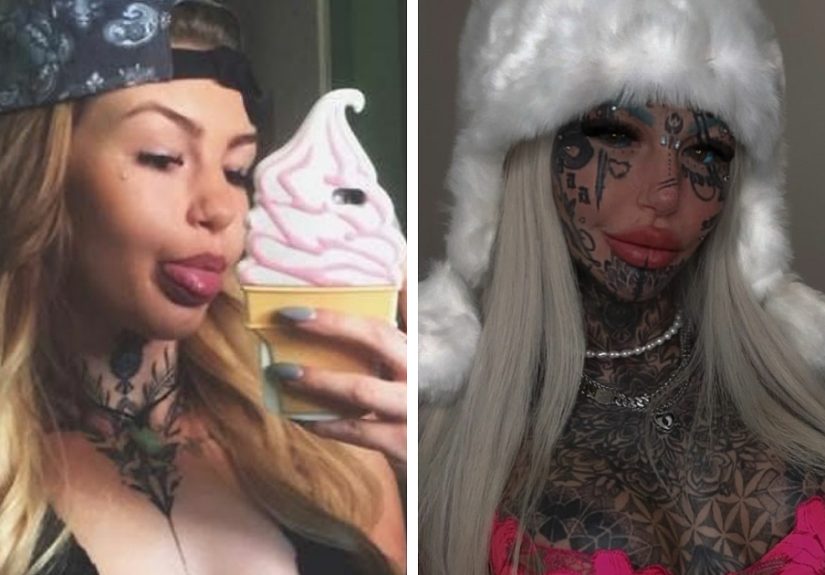
Amber Luke has become famous for pushing body art far beyond what most people think of as a “tattoo phase.” Reports about her transformation describe her body as being almost completely covered in ink, with extensive facial tattoos, body modifications, and the now-iconic blue eyes created through an extremely risky eyeball tattoo procedure. Her before-and-after photos are especially attention-grabbing because the contrast is so dramatic. In older images, she appears polished, glamorous, and almost unrecognizable next to the heavily tattooed, fiercely stylized version of herself that fans know today.
That contrast is what powers the headline. But the real story is not simply that she looked different years ago. Of course she did. Most people look different after nearly a decade. The bigger point is that Luke’s transformation was deliberate, expensive, highly public, and impossible to ignore. She did not just get a few tattoos and call it a day. She built a visual identity so bold that it now functions almost like a personal brand.
And that is where the article gets interesting. Because once a person makes their body part biography, part billboard, and part rebellion, the public stops seeing mere aesthetics. They start assigning meaning. They ask whether it is empowering, extreme, reckless, inspiring, sad, artistic, or all of the above before lunch.
Why the Before-and-After Photos Hit So Hard
Transformation content has always had a magnetic pull. Makeover shows thrived on it. Weight-loss stories live on it. Celebrity glow-ups depend on it. But tattoo transformations have their own special electricity because they challenge a deeply rooted social assumption: that a “before” photo is somehow more acceptable, more employable, more wholesome, or more real than the “after.”
Luke’s side-by-side images tap directly into that bias. One version fits more neatly into mainstream beauty culture. The other refuses to ask permission. That makes viewers react fast and, often, emotionally. Some admire the commitment. Some mourn the old image as if they have personally lost a cousin they never met. Others rush to declare that the “before” was better, which says less about Amber Luke and more about how tightly many people still cling to conventional ideas of femininity and attractiveness.
In other words, the photos go viral because they are not just visual. They are cultural bait. They invite admiration, judgment, projection, and debate in equal measure.
From Blonde Bombshell to Blue-Eyed Icon
The most arresting part of Luke’s story is not that she changed her style. Plenty of people do that every few years after a breakup, a birthday, or one unfortunate shopping phase. What makes her story so memorable is the scale. Her transformation was total. She did not sprinkle tattoos around the edges of an otherwise familiar image. She redefined the whole picture.
That kind of change makes people uneasy because it is so intentional. We are used to accidental aging, soft career pivots, and subtle cosmetic upgrades. We are less comfortable when someone says, in effect, “I know exactly how I want to look, and I do not care whether that fits your idea of acceptable.”
Luke’s appearance has been described in headlines with words like dragon, extreme, and unrecognizable, which are clicky words, sure, but they also reflect a deeper truth. Her look is not designed to blend in. It is meant to stand out. In a world where millions of people edit themselves toward sameness, that kind of radical distinctiveness is always going to attract attention.
The $218k Price Tag: Why People Can’t Stop Talking About It
Let’s be honest: the dollar figure does a lot of heavy lifting in this headline. If the story were simply about a woman with many tattoos, it would still attract curiosity. Add a six-figure price tag, though, and suddenly the story enters a whole new category of public fascination.
Money turns personal choice into spectacle. Readers do quick mental math. They imagine houses, cars, college tuition, retirement funds, and approximately 900 extremely decent burritos. Then they compare all of that to tattoos and body modifications. That comparison is the engine of the outrage-and-awe cycle.
But focusing only on the cost misses a key point. People spend huge sums on appearance all the time. Cosmetic surgery, luxury fashion, hair treatments, injectables, designer skincare, and dental work can add up fast. Those choices are often normalized because they move someone closer to mainstream beauty ideals. Tattoos, especially visible and extreme ones, are judged differently because they move away from those ideals. Same body, same money, wildly different public reaction.
That does not mean everyone has to love the result. It does mean we should be honest about why a tattoo budget feels more shocking than other appearance-related spending. The answer is not always logic. Sometimes it is just bias in expensive shoes.
What Amber Luke’s Story Says About Tattoo Culture Today
Tattoos are mainstream now
Tattoo culture is no longer fringe in the way it once was. In the United States, tattoos have become common across age groups, professions, and social circles. Plenty of people now see body art as a normal form of self-expression, a memorial, a style choice, or all three rolled into one session under bright studio lights.
That cultural shift matters because stories like Luke’s land differently in 2026 than they would have in 1996. Back then, visible tattoos were more likely to be read as deviant or dangerous. Today, many readers may not blink at sleeves, neck tattoos, or hand ink. But Luke’s transformation still pushes beyond the comfort zone of mainstream acceptance, reminding us that while tattoo culture has grown, its outer edges still provoke strong reactions.
Acceptance has limits
Even as society grows more accepting of tattoos, visible body art can still carry consequences. Workplace experts and research continue to note that bias has not fully disappeared, especially when tattoos are hard to conceal or when employers operate in more conservative industries. That means someone can post a photo captioned “be yourself” and still face real-world judgment from hiring managers, strangers, or relatives who treat a neck tattoo like a personal attack on family values.
Luke’s story highlights this contradiction beautifully. We live in an era that celebrates individuality, but often only in carefully measured doses. A small meaningful tattoo? Empowering. A face full of ink and a look that rejects beauty norms entirely? Suddenly everybody becomes an amateur sociologist.
The Safety Conversation the Internet Shouldn’t Skip
There is another side to this story that deserves more than a shocked emoji: safety. Standard tattoos are common, but they still come with real health considerations. U.S. health agencies have repeatedly warned about contaminated tattoo inks, allergic reactions, and infections. Even sealed ink can carry microorganisms, which is not exactly the sort of bonus feature anyone wants from a fresh design.
That matters because viral tattoo stories often get flattened into aesthetics only. People discuss whether the person looked better before or after, but they ignore the medical side. And in Luke’s case, that medical side is impossible to separate from the story because her eyeball tattooing reportedly left her temporarily blind for weeks.
Cosmetic eyeball tattooing is not just a more dramatic version of ordinary tattooing. Eye specialists have warned that it can carry severe risks, including inflammation, infection, retinal damage, and vision loss. So while it may be tempting to frame Amber Luke’s look as fearless or hardcore or “next-level,” it is more responsible to say this: some body modification choices move far beyond typical tattoo risk and into territory medical professionals view as genuinely dangerous.
That nuance matters. Admiring someone’s confidence should never require pretending that every procedure is equally safe. It is possible to respect autonomy and still recognize a bad idea wearing very stylish eyeliner.
Public Reaction: Admiration, Judgment, and the Internet’s Favorite Hobby
The comment sections around Luke’s photos reveal a familiar split. One group cheers her confidence and praises her for living authentically. Another insists she looked “better before,” often with the kind of certainty usually reserved for weather forecasts and overconfident uncles. A third group just wants to stare in fascinated disbelief, which is the digital-age version of rubbernecking with Wi-Fi.
These reactions are predictable because body transformation stories always become public Rorschach tests. People do not only respond to the person in the photo; they respond to what that person represents. For some, Luke represents freedom from conformity. For others, she symbolizes excess. For others still, she is a reminder that self-expression is celebrated until it becomes too visible, too expensive, too female, or too impossible to categorize.
That is why the “before-and-after” frame can be misleading. It implies a neat value judgment, with one version standing as an unspoken benchmark against the other. But real life is messier. The “before” is not inherently more valid than the “after.” It is simply earlier.
What the Photos Really Show
At a glance, Amber Luke’s viral images look like a story about tattoos. Look again and they reveal something broader: the social drama around who gets to define beauty, how far self-expression can go before it becomes controversial, and why we still treat visible difference like a public referendum.
Her transformation is not everyone’s taste. It is not supposed to be. Personal style is not a group project. But the photos do succeed at one thing many viral images fail to do: they make people talk about something real. Not just ink, but identity. Not just body modification, but autonomy. Not just aesthetics, but the cost, judgment, and risk that come with choosing to become unmistakably yourself in public.
And perhaps that is the real reason these before-and-after images feel so powerful. They are not simply about what Amber Luke did to her body. They are about what the rest of us do with our opinions when we see it.
Experiences Related to This Story: Why So Many People Connect With It
What makes Amber Luke’s story resonate is that, at its core, it mirrors experiences many people understand even if they have never set foot in a tattoo studio. Most people know what it feels like to outgrow an old version of themselves. Maybe it was the high school version, the office version, the people-pleasing version, or the version that kept dressing for approval instead of comfort. That is why before-and-after images hit such a nerve. They compress years of private change into one public frame.
For some readers, the connection is about appearance. They know the strange experience of looking at an old photo and thinking, “That person was me, but not really me.” Hair changes, clothing shifts, weight changes, aging, fitness transformations, and personal style evolutions all carry that same emotional jolt. A dramatic tattoo transformation just turns the volume way up.
For others, the connection is about judgment. Almost everyone has had a moment when they changed something about themselves and the world immediately had an opinion. Cut your hair short, people gasp. Dye it bright red, suddenly your aunt becomes a branding consultant. Get a tattoo, and somebody who still prints coupons at home starts lecturing you about professionalism. Luke’s story amplifies that universal experience of being watched, assessed, and discussed as if your body were a committee meeting.
There is also the experience of spending money on something that feels wildly worth it to you and wildly irrational to everyone else. One person buys luxury watches. Another collects sneakers. Someone else spends a fortune restoring a vintage car, traveling the world, or building the kitchen of their dreams. Luke spent heavily on body art. The category changes, but the human instinct is the same: people invest in what makes them feel more like themselves.
Then there is the experience of misunderstanding. Many people who make unconventional choices get reduced to a headline. They become “the tattooed woman,” “the guy with all the piercings,” “the one who changed too much,” or “the one who used to look so pretty.” Those labels flatten complex lives into one talking point. Anyone who has ever felt pigeonholed by a single trait can recognize that frustration instantly.
Finally, this story connects because reinvention is one of the internet’s favorite themes. People love proof that human beings are not fixed. They love comeback arcs, makeover reveals, personal evolution, and dramatic visual evidence that identity is not always static. Amber Luke’s before-and-after photos deliver all of that in one image. That is why people click. That is why they argue. And that is why the story lingers. Under all the ink, headlines, and outrage, it taps into something deeply familiar: the desire to be seen as the person you chose to become, not just the person you used to be.
Final Thoughts
Amber Luke’s stunning before-and-after photos are more than viral eye candy. They are a crash course in modern image culture, where self-expression can be celebrated, monetized, criticized, and medically questioned all at the same time. Her transformation is visually dramatic, financially jaw-dropping, and socially divisive, which is exactly why it keeps circulating.
Whether readers see her story as empowering, excessive, artistic, risky, or all of the above, one thing is clear: these photos are unforgettable because they force a conversation most viral beauty stories avoid. What happens when someone does not just refresh their image, but completely rewrites it?
Amber Luke answered that question in permanent ink. The internet, naturally, is still trying to catch up.